5 Warning Signs Your Dorm Roommate Resents You
You walk into your dorm room after a long day of classes. Your roommate is lying on their bed, headphones on, face turned toward the wall. You say hi. Nothing. You ask about their day. A one-word answer, maybe a shrug. You've noticed this chill in the air for weeks now, but you can't pinpoint when it started or what you did.
Resentment leaks out sideways — in slammed drawers, clipped texts, and a slowly thickening silence that makes your shared space feel like a cold war zone. The difference is that resentment caught early can almost always be repaired. Below are five warning signs to watch for and what you can actually do about it.

1. The Silent Treatment Has Replaced Normal Conversation
What It Looks Like
Your roommate used to chat with you when you were both getting ready in the morning. Now they time their routine so you barely overlap. When you do share the room, they stay plugged into headphones or scroll their phone with a focus that feels deliberate. Questions get answered in monosyllables: "Fine." "Sure." "Whatever."
This isn't the same as an introvert needing alone time. If your roommate was always quiet, that's their baseline. But if warmth has been slowly replaced by frost, that's a signal.
Why It Happens
Withdrawing is one of the most common ways people manage anger they don't feel safe expressing. Your roommate may believe that bringing up their frustration will make things worse, or they may not even fully understand what's bothering them yet.
What You Can Do
Resist the urge to match their energy or pretend everything's fine. Instead, name the pattern without accusation:
- Try: "Hey, I've noticed things have been quieter between us lately. I want to make sure we're good — is there anything on your mind?"
- Avoid: "Why are you ignoring me?" or "What's your problem?"
Ask once, genuinely. If they deflect, give them a day or two before circling back.
2. Passive-Aggressive Notes and Gestures Are Piling Up
What It Looks Like
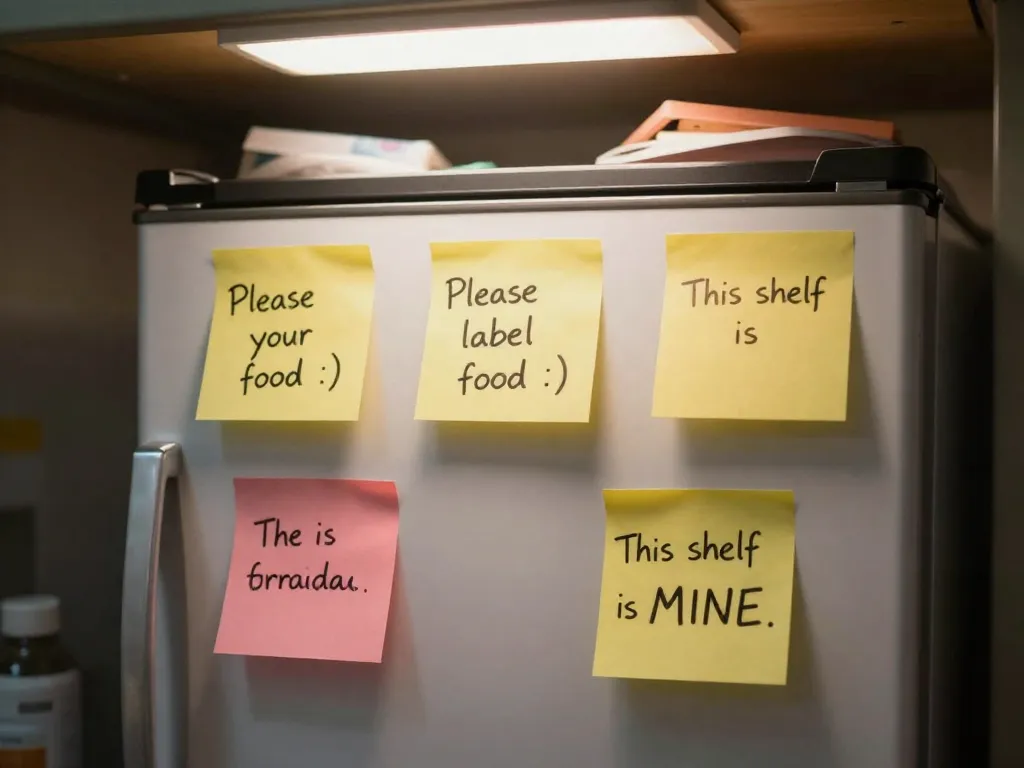
You find a sticky note on the microwave that says "Please clean up after yourself :)" even though you wiped down the counter that morning. Your roommate starts aggressively organizing "their" side of the room, or they move your belongings to a neat pile on your desk without saying a word. Maybe they post a pointed meme in a group chat you're both in.
Passive aggression is resentment wearing a polite mask. It communicates displeasure while giving the person plausible deniability.
Why It Happens
People resort to passive aggression when they feel that direct confrontation is too risky or too uncomfortable. In a dorm setting, the stakes feel uniquely high — you can't just go home after an argument. You have to keep living together.
What You Can Do
Don't respond to the passive move itself. Respond to the emotion underneath it:
- Try: "I saw the note about the microwave. I want to be a good roommate — can we talk about what a clean kitchen looks like for both of us?"
- Avoid: Leaving a counter-note, or sarcastically over-cleaning to make a point.
The goal is to make direct conversation feel safer than the indirect route.
3. They've Stopped Including You — or Started Excluding You
What It Looks Like
Your roommate used to invite you to grab dinner or mention when friends were coming over. Now plans happen without you. Worse, you overhear them making plans with your mutual friends and pointedly not extending the invite. Their social life feels like a door that used to be open and has quietly been shut.
A subtler version: they invite other people to hang out in your shared room without giving you a heads-up, treating the space as entirely theirs.
Why It Happens
Social exclusion often means the resentment has moved beyond a single incident and has started to color how they see the relationship overall. They may be venting to friends about you, which can create an echo chamber that deepens the divide.
What You Can Do
This one requires both self-reflection and a direct conversation:
- Reflect honestly. Has something specific changed between you? Did you cancel on plans repeatedly, say something hurtful, or violate an unspoken boundary?
- Name what you've noticed. "I've felt some distance between us socially, and I miss hanging out. If I did something that bothered you, I'd genuinely like to know so I can make it right."
- Respect their answer. They may not be ready to talk about it. That's okay. The act of asking signals that you care.
4. Small Irritations Are Getting Disproportionate Reactions
What It Looks Like
You accidentally leave a cup on the shared desk, and your roommate sighs loudly and stares at the ceiling. You come home at 10:30 p.m. on a weeknight and they snap, "Some of us are trying to sleep." Your alarm goes off once and they text you a paragraph about respecting boundaries.
The reaction doesn't match the offense. That mismatch is the clue.
Why It Happens
When someone has been swallowing frustration for weeks or months, every minor annoyance becomes the last straw. A cup on the desk isn't about the cup. It's about the twenty other things they never said anything about — the time you had friends over until 2 a.m., the week you forgot to take out the trash, the music they quietly hate but never mentioned. Resentment is cumulative, and it distorts the scale of problems.
What You Can Do
When someone overreacts, resist getting defensive. Instead:
- Acknowledge the frustration first: "You seem really frustrated, and I don't think it's just about the cup. What's actually going on?"
- Be willing to hear a list. If they open up, you might hear a backlog of complaints. Listen, take it in, and respond thoughtfully.
- Propose a reset. This is a perfect time to suggest creating some shared ground rules together — not as punishment, but as a way to make expectations visible so resentment doesn't keep building in silence.
Consider formalizing your agreements with a tool like Servanda before conflicts escalate — having clear, written expectations around noise, guests, cleaning, and shared items can prevent the kind of quiet buildup that leads to disproportionate blowups.

5. They've Started "Keeping Score"
What It Looks Like
Your roommate starts tracking who cleaned the bathroom last, who bought the paper towels, or how many nights you had a guest over versus how many they did. They might bring up favors they've done as leverage: "I've been the one taking out the trash for the last three weeks, so I think it's only fair that..."
Scorekeeping turns a shared living arrangement into a transaction ledger. It replaces goodwill with accounting.
Why It Happens
People keep score when they feel the relationship is fundamentally unfair. They believe they're contributing more, sacrificing more, or accommodating more — and they want proof.
What You Can Do
- Don't argue the numbers. Whether or not their count is accurate isn't the point. The point is that they feel the balance is off.
- Validate the underlying feeling: "It sounds like you've been feeling like things aren't fair between us. I don't want you to feel that way — let's figure this out."
- Build a system together. A simple chore chart, a shared grocery spreadsheet, or a rotation schedule can remove the need for mental scorekeeping entirely. The structure isn't about distrust — it's about removing ambiguity so both of you can relax.
Here's a sample framework:
| Area |
Roommate A's Week |
Roommate B's Week |
| Trash |
Weeks 1 & 3 |
Weeks 2 & 4 |
| Bathroom |
Weeks 2 & 4 |
Weeks 1 & 3 |
| Vacuuming |
Weeks 1 & 3 |
Weeks 2 & 4 |
| Shared supplies purchase |
Even months |
Odd months |
What to Do When You Spot These Signs
Recognizing that your dorm roommate resents you is only the first step.
Step 1: Check Yourself First
Before approaching your roommate, spend ten minutes honestly asking yourself:
- Have I been inconsiderate in ways I haven't noticed?
- Am I respecting the boundaries we've discussed (or the ones we should have discussed)?
- Am I projecting — could I be misreading introversion or stress as resentment?
You don't need to have all the answers. You just need to walk into the conversation with genuine openness rather than defensiveness.
Step 2: Initiate a Low-Pressure Conversation
Don't stage an intervention. Instead, find a natural moment — walking back from the dining hall, both hanging out on a lazy Sunday afternoon — and bring it up gently.
Phrases that lower the temperature:
- "I've been feeling like something's off between us, and I wanted to check in."
- "I want to make sure living together is working for both of us."
- "Is there anything I can do differently?"
Step 3: Listen More Than You Speak
If they open up, your only job is to listen. Don't rebut, don't explain, don't justify. Just hear them. You can respond thoughtfully once they've finished. People who feel heard are far less likely to stay resentful.
Step 4: Make Agreements Concrete
Whatever you agree on — quiet hours, guest policies, cleaning routines — write it down. Not because you don't trust each other, but because human memory is unreliable and assumptions are the root of most roommate resentment.
Step 5: Know When to Involve a Third Party
If you've tried talking, tried adjusting, and the resentment persists or escalates, bring in your RA or a campus mediation service. This isn't a failure — it's a recognition that some conflicts need a neutral perspective. RAs are trained for this.
Conclusion
Resentment between dorm roommates rarely shows up as a dramatic confrontation. It seeps in through silences, sticky notes, disproportionate reactions, and the slow erosion of a relationship that started with at least a little bit of hope. The five warning signs above — withdrawal, passive aggression, social exclusion, overreactions, and scorekeeping — are your early detection system.
The fact that you're reading this article says something good about you: you noticed something was off, and you cared enough to look into it. The other half is acting on it — with honesty, with humility, and with a genuine willingness to make your shared space work for both of you. Dorm life is temporary, but the skills you build navigating these moments will last far beyond graduation.
Frequently Asked Questions
How do you tell the difference between an introverted roommate and one who resents you?
The key indicator is change over time. If your roommate has always been quiet and independent, that's their personality — but if they used to be friendly and communicative and have gradually become cold and withdrawn, that shift is a sign of resentment rather than introversion.
What should you do if your roommate won't talk about what's bothering them?
Ask once with genuine care, then give them a day or two of space before gently circling back. Pressuring someone who has shut down usually pushes them further into silence, but showing that you're consistently open to listening can eventually make them feel safe enough to share.
How do you bring up roommate problems without starting a fight?
Choose a relaxed, natural moment rather than staging a formal sit-down, and use language that focuses on your observations and feelings — like "I've been feeling like something's off between us" — instead of blame-oriented statements. Keeping your tone curious rather than accusatory makes it far more likely your roommate will open up honestly.
Is it normal for college roommates to resent each other?
It's extremely common, especially because most college students are living closely with a near-stranger for the first time and haven't yet developed strong conflict-resolution skills. The resentment itself isn't the problem — it's what happens when it goes unaddressed for weeks or months that causes lasting damage to the relationship.
When should you involve your RA in a roommate conflict?
Bring in your RA or a campus mediation service when you've made genuine attempts to communicate and adjust but the resentment continues to persist or escalate. RAs are trained to mediate these situations, and involving a neutral third party can break through communication barriers that two frustrated roommates can't resolve alone.