
When to Quit Your Own Startup Over Co-Founder Conflict
You built this thing from nothing. You pitched the idea over beers, split the equity on a napkin, pulled all-nighters before the seed round, and convinced investors that your team was the reason to bet. Now you dread every Slack notification from your co-founder. Board meetings feel like custody hearings. And every morning, a quiet question grows louder: Should I leave my own company?
This is one of the most emotionally brutal decisions a founder can face — and one of the least discussed. Startup culture celebrates perseverance and "grinding through" adversity, but nobody writes a Medium post about the day they handed in their resignation letter to a company with their name on the cap table. If you're a technical or non-technical founder stuck in a dysfunctional co-founder relationship and you've already taken VC money, this article is for you. Not to push you toward the exit — but to help you think clearly when everything feels impossible.
Key Takeaways
- Not every co-founder conflict means you should leave. Some conflicts are structural and fixable; others are rooted in broken trust or incompatible values that won't change.
- Taking VC money raises the stakes but doesn't eliminate your options. You have more leverage — and more exit pathways — than you probably think.
- The "would I hire this person today?" test is clarifying. If the honest answer is no, you need to act on that information.
- Walking away is not failure. Staying in a destructive partnership that tanks the company — that's the real failure scenario.
- Formalize everything before emotions peak. Written agreements about roles, decision-making authority, and exit terms prevent the worst outcomes.

Why Co-Founder Conflict Feels Different After Raising Money
Before you raise a round, co-founder conflict is painful but relatively contained. You can split up, divide whatever modest assets exist, and move on. After you've raised venture capital, everything changes.
You now have a fiduciary duty to shareholders. There's a board watching. Employees depend on you. And your equity is locked in a vesting schedule that punishes early departure. The psychological weight is enormous: leaving feels like abandoning your crew mid-voyage.
But here's what founders in this situation often fail to internalize — staying in a broken partnership is also a risk to the company. Investors know this. Good board members know this. The question isn't whether conflict exists. It's whether the conflict is the kind that can be resolved, or the kind that will slowly destroy everything you've built.
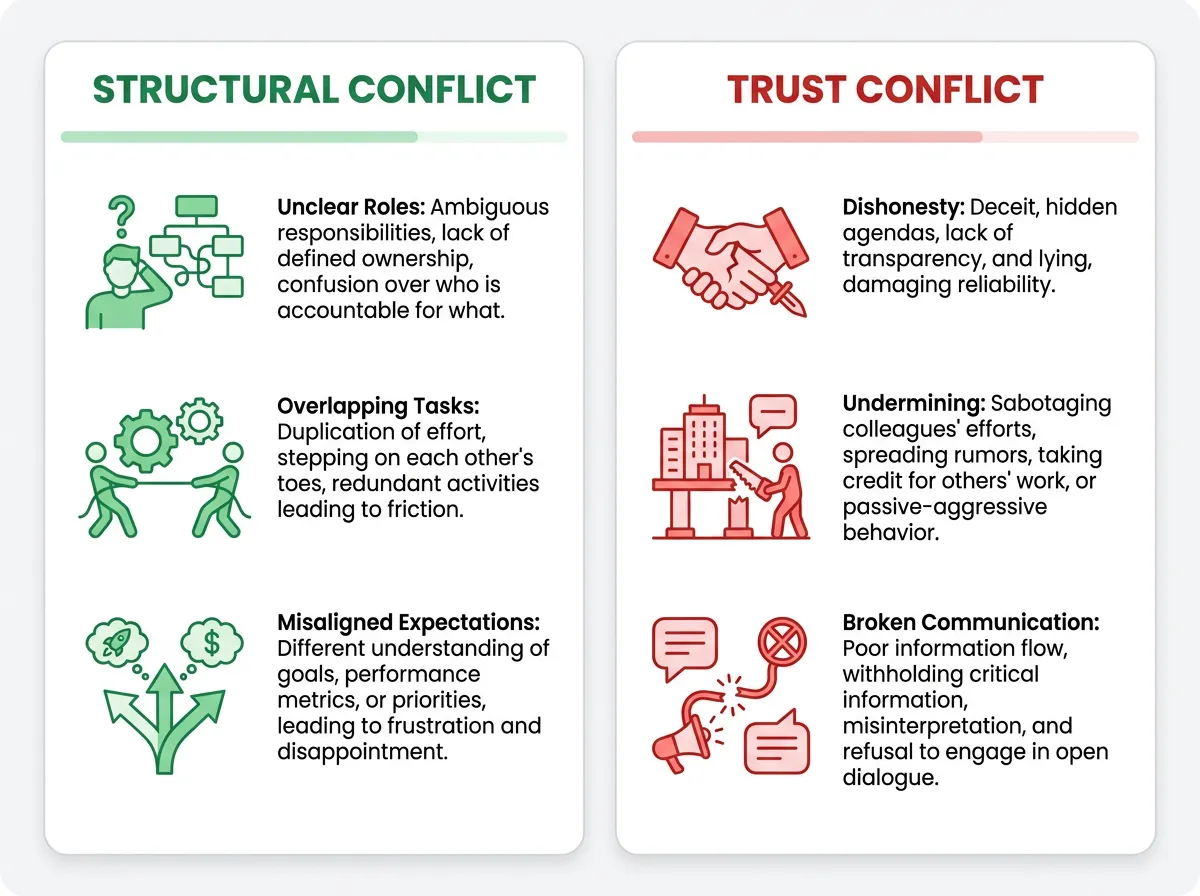
The Two Types of Co-Founder Conflict
Not all co-founder disputes are created equal. Before you make any decision, you need an honest diagnosis of what you're actually dealing with.
Structural Conflict (Often Fixable)
Structural conflict arises from unclear roles, overlapping responsibilities, poor decision-making frameworks, or misaligned expectations about workload and compensation. These disputes feel heated in the moment, but they usually respond to structure.
Signs you're dealing with structural conflict:
- Arguments tend to cluster around specific decisions (hiring, product direction, spending) rather than everything
- Both founders still respect each other's competence
- You disagree about how to win, not whether you're both committed
- Neither person feels personally attacked — just frustrated
If this sounds like your situation, you probably don't need to leave. You need better operating agreements, clearer swim lanes, and possibly a neutral third party to help you build a decision-making framework. AI-powered mediation platforms like Servanda can provide structure when emotions run high, helping co-founders formalize agreements around roles, equity, and decision authority before things escalate further.
Identity and Trust Conflict (Rarely Fixable)
This is the deeper, more dangerous category. Identity and trust conflicts emerge when founders have fundamentally different values, when one person feels the other is dishonest, or when the power dynamic has become so toxic that every interaction is a battlefield.
Signs you're dealing with identity and trust conflict:
- You've caught your co-founder lying to you, the board, or employees
- You feel personally unsafe — emotionally, financially, or professionally
- Your co-founder undermines you to the team or board behind your back
- Disagreements are no longer about the business; they're about control
- You've tried mediation, honest conversations, or restructured roles, and nothing has improved
- You experience physical stress symptoms (insomnia, weight change, anxiety) directly tied to the relationship
If more than two of these resonate, you're likely past the point of repair.
The Decision Framework: Should You Fight or Walk?
Once you've diagnosed the type of conflict, run through these five questions honestly. Write your answers down — it forces a clarity that rumination never provides.
1. "If I met this person today, would I choose them as my co-founder?"
This is the most clarifying question you can ask. Strip away sunk cost, shared history, and guilt. If you were starting fresh today with full knowledge of who this person is and how they operate, would you partner with them?
If the answer is a clear no, that tells you something important. It doesn't automatically mean you leave — but it means the status quo is not a viable long-term plan.
2. "Have I actually tried to fix this, or have I been avoiding the real conversation?"
Many co-founder breakups happen because both parties stewed in resentment for months (or years) without ever naming the core problem directly. Before you leave, make sure you've had the brutally honest conversation — not the polite, hedged version.
This means saying things like: - "I feel like I can't trust your judgment on hiring, and here's why." - "I believe you've been dishonest with me about [specific situation]." - "I don't think our working relationship is functional, and I want to discuss whether we should restructure or part ways."
If you've never said something this direct, you haven't fully tried yet.
3. "What does the board think?"
If you have a board, at least one member likely already senses the tension. Having a confidential, candid conversation with a trusted board member isn't disloyal — it's responsible governance.
Ask for their read on the situation. They may see dynamics you're too close to notice. They may also have experience navigating exactly this scenario at other portfolio companies. Many experienced VCs have helped manage co-founder transitions before.
4. "What does leaving actually look like financially and legally?"
This is where founders often get paralyzed by fear of the unknown. Talk to a startup attorney (not your company's attorney — your own) and understand:
- How much of your equity is vested
- Whether your shares are subject to clawback or repurchase provisions
- What your shareholder agreement says about departing founders
- Whether you have non-compete or IP assignment clauses that limit your next move
- What a "good leaver" vs. "bad leaver" scenario looks like under your current agreements
Knowledge eliminates the vague dread. The actual terms of your departure are usually more navigable than you fear.
5. "Is the company better off without me, or without my co-founder?"
This requires painful honesty. Sometimes you're the one the company can afford to lose. Your co-founder may have deeper customer relationships, better board rapport, or skills more critical to the current stage. That doesn't make you less valuable as a founder — it means the specific needs of the company at this moment may favor a different configuration.
Other times, it's your co-founder who should go, and the right move is to advocate for that outcome rather than quietly removing yourself. Don't default to martyrdom.
How to Leave Your Startup Without Burning Everything Down
If you've worked through the framework above and decided that leaving is the right move, here's how to do it with integrity and protect yourself.
Step 1: Secure Legal Counsel First
Before you tell your co-founder, your board, or anyone at the company, talk to your own attorney. Understand your rights, your equity position, and any contractual obligations. This is not adversarial — it's prudent.
Step 2: Negotiate Your Exit Terms Before Announcing
Work with the board (or a mediator, if the board is aligned with your co-founder) to agree on:
- Equity treatment: accelerated vesting, fair buyout, or continued vesting post-departure
- Transition timeline: typically 30-90 days
- Announcement messaging: how the departure will be communicated to team and investors
- Non-disparagement and confidentiality terms
- Advisory role or board observer seat, if appropriate
Step 3: Tell Your Team With Honesty and Grace
You don't need to air dirty laundry, but don't insult your team's intelligence with corporate platitudes either. Something like: "I've decided to move on from my operating role. This was a difficult personal decision. I'm incredibly proud of what we've built, and I'll be supporting the transition over the next [timeframe]."
Step 4: Grieve Without Shame
Leaving a startup you co-founded is a real loss. It's the death of a version of the future you planned on. Allow yourself to feel that. Talk to other founders who've been through it — you'll find there are more of them than you expect.

What Real Co-Founder Departures Look Like
Here are three anonymized scenarios composited from real founder experiences shared publicly on forums like Hacker News and in founder communities:
Scenario A: The Technical Founder Who Left After Series A A CTO co-founded a SaaS company and raised a $4M seed and $15M Series A. After the A round, the CEO began making unilateral product and hiring decisions, ignoring the technical roadmap entirely. The CTO tried restructuring responsibilities twice, brought in an executive coach, and escalated to the board. When the CEO told the board a fabricated version of their disagreements, the CTO knew trust was gone. She negotiated a departure with 18 months of accelerated vesting, an advisory agreement, and no non-compete. The company eventually pivoted, and she went on to found another successful startup.
Scenario B: The CEO Who Stayed Too Long A business-side founder ignored red flags for two years while his technical co-founder consistently shipped late, blamed the team, and refused any accountability. By the time the CEO finally addressed it, three senior engineers had quit and the board was losing confidence in both founders. The CEO ultimately pushed for his co-founder's removal, but the damage to team morale meant the company never fully recovered. His regret wasn't the conflict itself — it was waiting so long to act.
Scenario C: The Founders Who Split Cleanly Two founders realized 18 months in that they had fundamentally different visions for the company. One wanted to build a lifestyle business; the other wanted to pursue aggressive growth. Neither was wrong. They spent six weeks working with a mediator to structure a buyout. The departing founder sold her shares at a fair valuation, and they remain on good terms. Both describe it as one of the best decisions they've made.
Signs You Should Stay and Fight
This article isn't a case for leaving. It's a case for clear thinking. Sometimes the right move is to stay. Consider staying if:
- The conflict is about strategy, not character
- You haven't yet had the direct, uncomfortable conversation
- You still believe in the mission and feel energized by the work (even if the relationship is hard)
- A neutral third party — coach, mediator, board member — believes the relationship is salvageable
- Your co-founder is also willing to do the hard work of repairing things
Staying is an active choice, not a passive one. If you stay, commit to the repair process fully. Half-measures prolong the pain for everyone.
FAQ
Can I get fired from my own startup after taking VC money?
Yes. Once you've taken institutional investment and formed a board, you can be removed from your operating role. The board has fiduciary authority to make leadership changes. Your equity may be protected by your vesting schedule, but your title and role are not guaranteed. This is why understanding your shareholder agreement and employment terms matters.
How do I tell investors I'm leaving my startup?
Be direct, professional, and brief. Investors have seen co-founder splits before — they're more common than most people realize. Lead with the transition plan, not the drama. A message like "I've decided to transition out of my operating role; here's how we're ensuring continuity" goes much further than a lengthy explanation of interpersonal grievances.
What happens to my equity if I leave my own startup?
It depends entirely on your shareholder agreement, vesting schedule, and the terms you negotiate at departure. Typically, vested shares remain yours. Unvested shares are forfeited or repurchased. Some agreements include acceleration clauses triggered by certain events. Get independent legal advice before signing any separation agreement.
Is it worth trying co-founder therapy or mediation before leaving?
Absolutely, as long as both parties are genuinely willing to participate. A skilled startup mediator or executive coach can surface blind spots and build frameworks that prevent recurring disputes. The caveat: mediation only works when there's mutual good faith. If one founder is using the process to stall or manipulate, it will only delay the inevitable.
How common is it for co-founders to break up?
More common than the startup ecosystem acknowledges. Research from Harvard Business School professor Noam Wasserman found that 65% of startups fail due to co-founder conflict. Anecdotally, experienced VCs report that co-founder splits happen in a significant minority of their portfolio companies. You're not an outlier — you're just in a situation that nobody talks about publicly.
Moving Forward
The decision to leave a startup you co-founded will likely be one of the hardest of your professional life. There's no formula that makes it painless. But there is a difference between a decision made from fear, exhaustion, or avoidance — and one made from clarity, honest self-assessment, and a genuine understanding of your options.
If you're in a co-founder conflict right now, your most important next step isn't deciding whether to stay or go. It's getting honest — with yourself about what's actually broken, with your co-founder about what you need, and with a lawyer or advisor about what your real options look like.
The founders who navigate this well aren't the ones who avoid conflict. They're the ones who face it with clear eyes, make a decision, and then commit fully to whatever comes next.