
Why Avoiding Conflict Destroys Cofounder Relationships
You haven't had a real argument with your cofounder in months. You'd call that a good sign. But here's what's actually happening: you resent how they handled that investor meeting. They think you're micromanaging engineering. Neither of you has said a word about it. Instead, you've both started making decisions without consulting each other — small ones at first, then bigger ones. You tell yourself it's efficiency. It's not. It's the slow, silent drift that has ended more cofounder relationships than any screaming match ever has.
Post-mortems from failed startups reveal a counterintuitive truth: the cofounders who never fought often fared worse than those who fought frequently. Avoiding conflict in cofounder relationships doesn't preserve harmony — it manufactures a false peace that crumbles under the first real pressure. And by the time you realize the foundation has eroded, rebuilding it feels impossible.
This article breaks down why that silence is so dangerous, what it actually looks like in practice, and what you can do — starting today — to break the pattern before it breaks your company.
Key Takeaways
- Silence is not peace. The absence of arguments between cofounders is often a sign of avoidance, not alignment. Unspoken frustrations compound into resentment that becomes unrecoverable.
- The "slow drift" pattern kills more startups than blowups. Post-mortems consistently show that cofounder breakups result from months of accumulated, unaddressed tension — not single explosive events.
- Structured disagreement is a skill, not a personality trait. You can build specific habits — like scheduled check-ins and written operating agreements — that make hard conversations routine instead of terrifying.
- Early formalization prevents late-stage fractures. Documenting expectations around roles, equity, and decision-making rights while the relationship is still healthy creates a shared reference point when tension inevitably arises.
- Discomfort is the price of durability. The cofounders who last are the ones willing to tolerate short-term awkwardness for long-term trust.
The Myth of the Harmonious Cofounding Team
There's a pervasive belief in startup culture that the best cofounder relationships are frictionless. Founders read stories about legendary partnerships — Hewlett and Packard, Page and Brin — and assume these pairs simply "clicked." What gets left out of those narratives is the structured disagreement, the difficult negotiations, and the explicit agreements that made those partnerships durable.
The reality is that every meaningful cofounder relationship involves tension. You're two (or more) people with different skills, different risk tolerances, and different visions for what "success" looks like. Tension isn't the problem. Unprocessed tension is the problem.
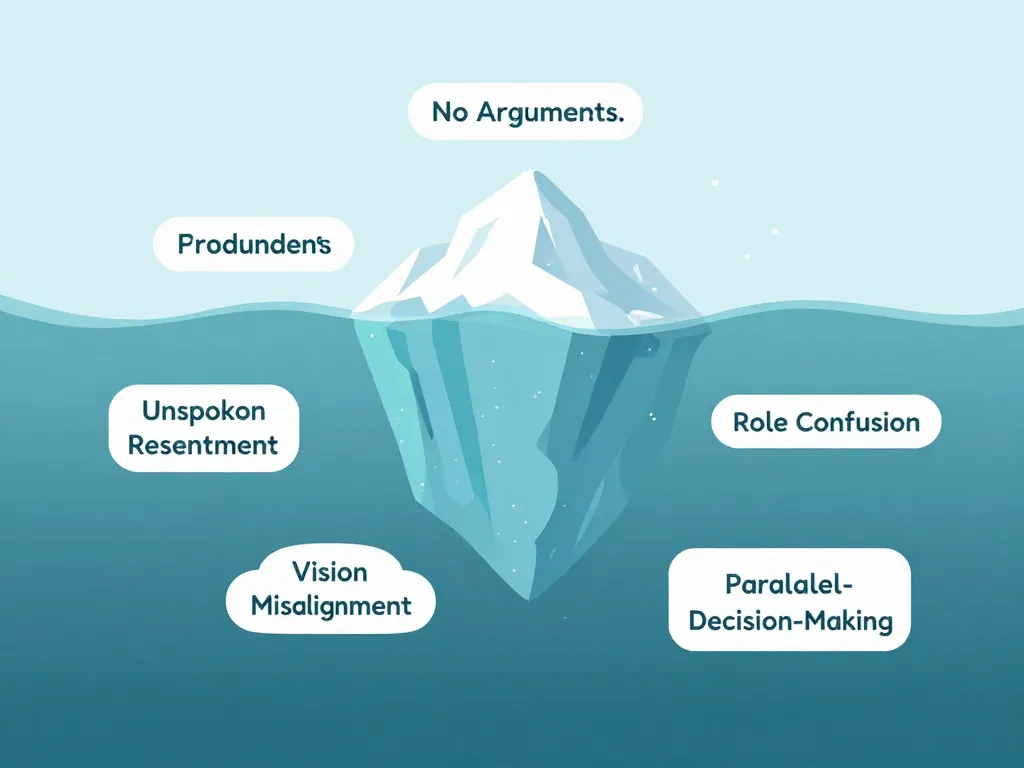
When you avoid conflict with your cofounder, you're not eliminating disagreement. You're driving it underground, where it metastasizes into something far more destructive:
- Assumptions replace conversations. You stop asking what your cofounder thinks and start assuming you already know.
- Parallel decision-making replaces collaboration. Each of you starts operating in your own silo, making choices the other learns about after the fact.
- Resentment replaces respect. Small frustrations, never voiced, accumulate until you can't look at your cofounder without a mental list of grievances.
This is the pattern that CB Insights, Noam Wasserman's research, and countless startup post-mortems point to as a leading cause of founder breakups. It's not the big fight. It's the fight that never happened.
What "Avoiding Conflict" Actually Looks Like Between Cofounders
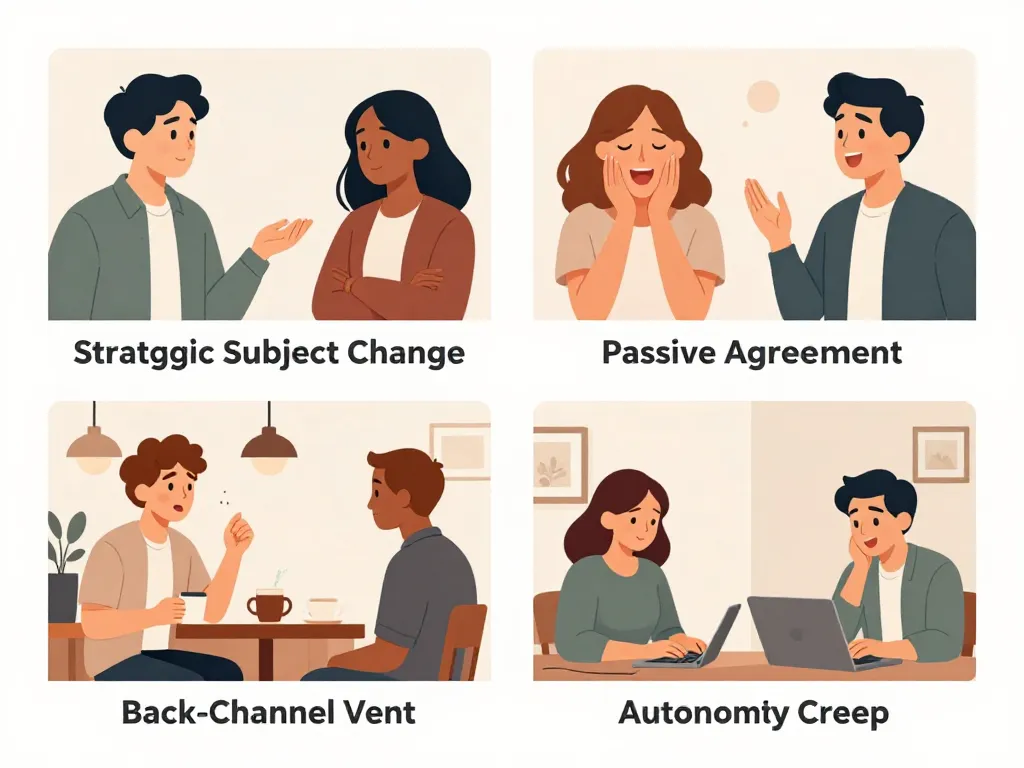
Conflict avoidance rarely announces itself. It doesn't feel like avoidance — it feels like being practical, being mature, or simply being busy. Here are the forms it most commonly takes:
1. The Strategic Subject Change
You start bringing up a concern — maybe about how equity should be restructured after a pivot, or about your cofounder's habit of making promises to clients you can't deliver on — and then you pivot to something easier. "Anyway, let's talk about the product roadmap." The hard topic gets deferred indefinitely.
2. The Passive Agreement
Your cofounder proposes a direction you fundamentally disagree with. Instead of voicing your concern, you say "sure, let's try it" — and then quietly undermine the decision by deprioritizing it, or you comply but carry a growing sense that your perspective doesn't matter.
3. The Back-Channel Vent
Instead of raising an issue directly with your cofounder, you discuss it with a mutual friend, an advisor, or a team member. The frustration gets aired, but not to the person who can actually address it. Worse, it erodes your cofounder's standing with people who now have a one-sided view of the situation.
4. The Slow Autonomy Creep
This is the most insidious form. Both cofounders gradually stop involving each other in decisions within their respective domains. It starts as healthy delegation and evolves into parallel companies operating under one roof. By the time someone notices, the cofounders have fundamentally different understandings of where the company is heading.
The Real-World Cost: Lessons from Cofounder Breakups
Consider these anonymized but representative scenarios drawn from startup post-mortems and founder interviews:
Scenario A: The Unspoken Equity Resentment
Two technical cofounders split equity 50/50 at incorporation. Within a year, one was working 70-hour weeks while the other had taken on a consulting gig on the side. The overworked founder noticed, seethed quietly, and compensated by making increasingly unilateral product decisions — reasoning that their disproportionate effort entitled them to disproportionate control. They never once raised the equity or workload imbalance directly. Eighteen months in, the part-time cofounder was blindsided when the other announced they wanted to dissolve the partnership. The relationship — both professional and personal — ended permanently.
Scenario B: The Vision Divergence No One Named
A CEO and CTO cofounded a B2B SaaS company. Over two years, the CEO gradually shifted toward enterprise sales while the CTO kept building for self-serve adoption. Neither explicitly discussed the strategic divergence because each assumed the other would eventually "come around." When a Series A investor asked about their go-to-market strategy, they gave contradictory answers in the same meeting. The round fell apart. So did the company.
Scenario C: The Role Confusion That Festered
Three cofounders launched together with loosely defined roles. As the company grew, two of them started overlapping in product management. Rather than having an uncomfortable conversation about who owned what, both quietly expanded their scope. The result was conflicting priorities communicated to the engineering team, a product that tried to go in two directions at once, and a CTO who eventually left, citing "strategic differences" — a euphemism for a conversation that should have happened on day one.
In every case, the pattern is the same: a hard conversation was available early on, it was avoided, and the cost of avoidance vastly exceeded the cost of the conversation itself.
Why Cofounders Avoid Conflict (Even When They Know Better)
Understanding the mechanics of avoidance helps you interrupt the pattern. Here's why smart, self-aware founders still fall into it:
- The stakes feel existential. Unlike a disagreement with a colleague, a cofounder conflict threatens the entire company. That makes the perceived risk of raising an issue feel enormous — even when the actual risk of silence is greater.
- Founder identity is wrapped up in the partnership. Admitting there's a problem can feel like admitting you chose the wrong cofounder, which feels like admitting a foundational judgment error.
- There's no built-in structure for it. Employees have performance reviews, managers have skip-levels, but cofounders rarely have any formal mechanism for surfacing tension. Without structure, hard conversations require you to manufacture courage from scratch every single time.
- Early-stage speed rewards decisiveness over deliberation. In the sprint of building a startup, pausing to work through interpersonal tension can feel like an indulgence you can't afford. (It's actually an investment you can't afford to skip.)
How to Break the Avoidance Pattern
If you recognize yourself in any of the patterns above, here's what you can do — not in theory, but this week.

Establish a Recurring Cofounder Check-In
Set a standing meeting — weekly or biweekly — with a fixed agenda that includes a section for "things that are bothering me that I haven't said yet." The structure does the heavy lifting. You don't need to summon the courage to bring up a hard topic spontaneously; you just need to honor the agenda.
A simple framework for each check-in:
- What's working well in how we're collaborating? (Start with genuine positives — this isn't a complaint session.)
- What's one thing I've been hesitant to bring up? (Each person answers. No rebuttals until both have spoken.)
- What decisions are coming up that we need to be aligned on? (Forward-looking alignment prevents future drift.)
Write Down Your Operating Agreement — Before You Need It
Many cofounder conflicts escalate because there's no shared document to reference. Expectations live in each founder's head, and those mental models inevitably diverge.
Document at minimum:
- Roles and decision-making authority: Who has final say on product? Hiring? Fundraising? What requires joint agreement?
- Equity and vesting terms: Including what happens if one person's contribution level changes.
- Exit and dispute resolution mechanisms: How will you handle it if one cofounder wants to leave? What if you fundamentally disagree on company direction?
Tools like Servanda can help cofounders create these written agreements in a structured way, ensuring you cover the topics most likely to cause friction later — while the relationship is still healthy enough to discuss them honestly.
Practice Disagreeing on Low-Stakes Issues
If you and your cofounder have fallen into a pattern of automatic agreement, you've lost the muscle for productive disagreement. Rebuild it intentionally.
Start with genuinely low-stakes decisions — which design option to go with for a landing page, where to hold your next offsite, whether to use one vendor or another. Practice stating a different preference, hearing the other person's reasoning, and reaching a resolution. This builds the habit of dissent so that when the stakes are high, the pattern is already in place.
Name the Pattern When You See It
One of the most powerful things you can say to a cofounder is: "I think we're avoiding something." This isn't an accusation — it's an observation that invites both of you to examine what's happening. It shifts the dynamic from two people pretending everything is fine to two people collaborating on the health of their partnership.
You can even make it about yourself: "I've noticed I've been holding back on saying what I really think about [topic]. Can we talk about it?"
Get Outside Perspective — But the Right Kind
Advisors, executive coaches, and in some cases mediators can provide enormous value — not by telling you what to do, but by creating a safe structure for conversations you've been avoiding. The key is choosing someone who won't simply validate one cofounder's perspective, but will hold space for both.
The Paradox of Cofounder Durability
The most enduring cofounder relationships aren't the smoothest ones. They're the ones where both people have developed a tolerance for productive discomfort. They've learned that a hard conversation at the right time is an act of investment in the relationship, not a threat to it.
This is counterintuitive because we're wired to associate conflict with danger. But in the context of a cofounding partnership, the real danger is the conversation you keep postponing. Every week it goes unspoken, the cost of having it increases — and the likelihood that you'll have it decreases.
The founders who make it are not the ones who never disagree. They're the ones who disagree early, disagree respectfully, and document their resolutions so the same fight doesn't happen twice.
Frequently Asked Questions
How do I bring up a problem with my cofounder without damaging the relationship?
Start by framing the conversation as something you want to work through together, not something you're accusing them of. Use language like "I've been thinking about how we handle X, and I'd love to get aligned" rather than "You always do Y." Choosing a calm, private setting — not in the middle of a crisis — also makes a significant difference.
What are the most common reasons cofounders break up?
Research consistently points to misaligned expectations around roles, equity, workload, and company vision. Notably, these are all issues that are detectable and addressable early. The breakup usually isn't caused by the disagreement itself, but by months or years of avoiding it until the rift becomes too wide to bridge.
Is it normal for cofounders to fight?
Yes — and in many cases, it's healthy. The absence of any disagreement between cofounders is often a warning sign that one or both people are suppressing their real opinions. What matters is not whether you disagree, but whether you have a constructive way to process those disagreements and reach resolution.
When should cofounders consider bringing in a mediator?
Consider outside help when you've attempted direct conversations multiple times without resolution, when the same issue keeps resurfacing, or when emotional charge has built to a level where productive dialogue feels impossible. A mediator isn't a sign of failure — it's a sign that you're taking the partnership seriously enough to invest in it.
How can cofounders prevent conflict from escalating?
The single most effective prevention mechanism is a written operating agreement that covers roles, decision rights, equity terms, and dispute resolution — created while the relationship is still strong. Pair that with a regular check-in habit, and you dramatically reduce the chance that small tensions compound into relationship-ending rifts.
Conclusion
The most dangerous phrase in a cofounder relationship is "everything's fine." Not because it's always a lie, but because it's often untrue in ways neither person has examined yet. The slow, silent drift — the unspoken resentments, the parallel decision-making, the strategic misalignment no one names — has ended more startups than any dramatic blowup.
The antidote isn't forced confrontation. It's building small, repeatable habits that make honesty routine: a standing check-in, a written operating agreement, a willingness to say "I think we're avoiding something." These practices cost minutes per week and save months — sometimes years — of compounding damage.
Your cofounder relationship is likely the single most consequential partnership in your professional life. Treat it with the same rigor you'd give your product, your fundraise, or your go-to-market strategy. The discomfort of one honest conversation today is always cheaper than the wreckage of the one you never had.