
Why Cofounder Breakups Start in Silence, Not Fights
You're sitting across from your cofounder at a coffee shop. Six months ago, you'd have been sketching product ideas on napkins, finishing each other's sentences. Today, you're both on your laptops. You haven't had a real conversation about the company's direction in weeks. Neither of you has said anything wrong. That's exactly the problem — neither of you is saying anything at all.
When most people imagine cofounder breakups, they picture a dramatic blowup: a shouting match over equity, a slammed door, a betrayal. But the data and the stories tell a different tale. The vast majority of cofounder splits don't begin with an explosion. They begin with a slow fade — a series of small frustrations swallowed, assumptions left unchecked, and conversations that never happen. By the time the fight finally arrives, the relationship is already over. The fight is just the funeral.
This article is about learning to hear the silence before it becomes permanent.
Key Takeaways
- Most cofounder breakups are caused by accumulated, unspoken resentment — not a single dramatic event. The absence of conflict is often more dangerous than the presence of it.
- There are specific, observable patterns that predict a silent drift — including avoiding hard topics, making decisions unilaterally, and retreating into separate domains.
- Formalizing expectations early (roles, equity, decision-making) removes the ambiguity that breeds quiet frustration. Written agreements aren't a sign of distrust — they're a sign of respect.
- Regular, structured check-ins between cofounders are the single most effective preventative measure. Not casual ones — intentional, sometimes uncomfortable ones.
- It's not too late to address silence directly, but it requires naming the pattern without blaming the person.
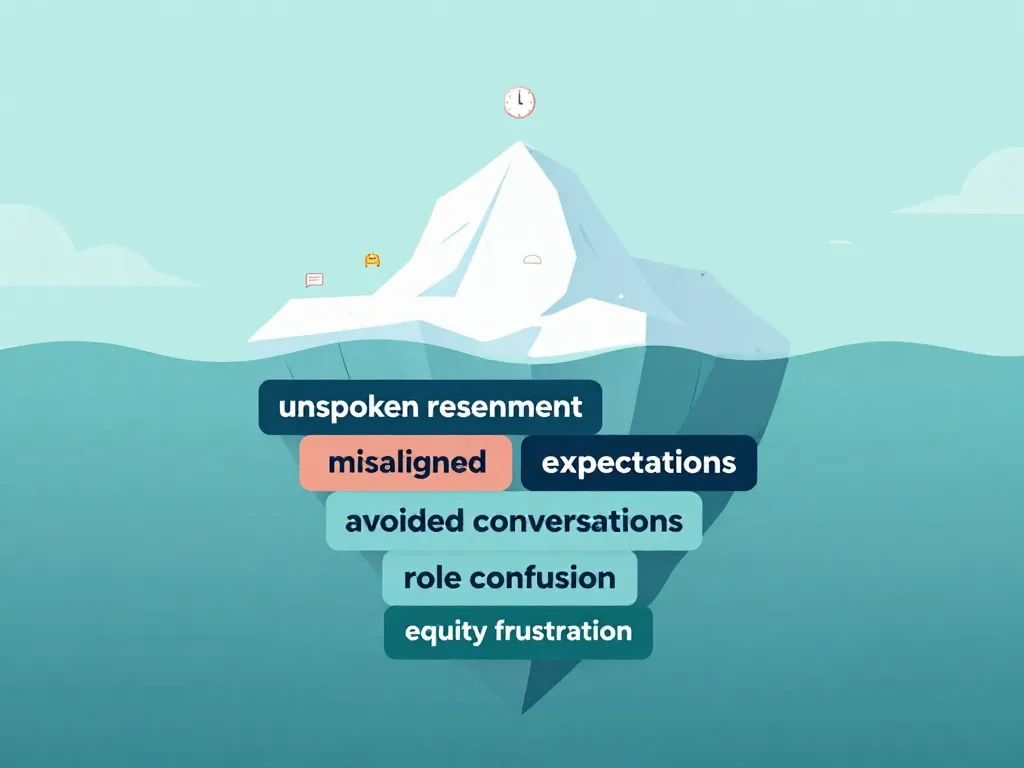
The Myth of the Big Blowup
Startup culture romanticizes conflict. We retell the stories of Steve Jobs screaming in boardrooms or cofounders throwing chairs. These stories make for good narratives, but they create a dangerous mental model: the idea that you'll know when your cofounder relationship is in trouble because it will be loud and obvious.
In reality, research from Harvard Business School professor Noam Wasserman — who studied over 10,000 founders — found that 65% of high-potential startups fail due to conflict among cofounders. And the most common pattern isn't a sudden rupture. It's a slow erosion of trust and alignment that goes unaddressed for months or even years.
The silence is dangerous precisely because it doesn't feel like a crisis. It feels like "being busy." It feels like "giving each other space." It feels like professionalism. And by the time one person finally breaks the silence, the other has already mentally checked out.
What Silent Cofounder Conflict Actually Looks Like
If you're waiting for a screaming match to tell you something's wrong, you'll miss the real warning signs. Here's what the early stages of a cofounder breakup actually look like:
1. The Disappearing Debate
Early in a startup, cofounders argue about everything — pricing, hiring, product features, the shade of blue on the landing page. This is healthy. It means both people are invested.
The warning sign isn't more arguing. It's less. When one cofounder stops pushing back, stops offering alternative ideas, or starts responding to proposals with a flat "sure, whatever you think" — something has shifted. They haven't become agreeable. They've become disengaged.
What this sounds like in practice: - "You decide, I trust you." (said without enthusiasm) - "I don't have strong feelings about it." (about something they used to care deeply about) - Silence in Slack threads that used to spark long discussions
2. The Unilateral Drift
One cofounder starts making decisions without consulting the other. Not out of malice — out of efficiency. "I didn't want to bother you with it." "It seemed straightforward." "I figured you were busy."
Each unilateral decision is small and justifiable on its own. But together, they create a pattern: two people building two slightly different companies under the same name.
3. The Proxy Complaints
Instead of saying "I'm frustrated that you missed the investor call," a cofounder might start complaining about tangentially related things: the state of the codebase, the office temperature, a minor expense report. The real grievance stays buried. The surface irritations multiply.
4. The Separate Orbits
Cofounders start building separate teams, separate relationships with investors, separate visions for the product. They stop eating lunch together. They schedule meetings that conveniently don't overlap. Their calendars become a physical manifestation of their emotional distance.

Why Cofounders Stay Silent (Even When They Know Something's Wrong)
Understanding why silence happens is just as important as recognizing it. Cofounders don't avoid hard conversations because they're cowards. They avoid them because the stakes feel impossibly high.
The Fear of Fragility
Many cofounders treat the relationship like a load-bearing wall — touch it wrong, and the whole building comes down. So they avoid stress-testing it entirely. The irony is that untested relationships are the ones most likely to collapse.
The Sunk Cost Trap
"We've been through so much together. I don't want to rock the boat." The longer a cofounder relationship has existed, the harder it becomes to raise issues — because raising issues implicitly questions the foundation everything has been built on.
The Identity Merger
In the early days, cofounders often merge identities. "We" becomes the default pronoun. This makes it psychologically difficult to express individual disagreement. Saying "I'm not happy with how things are going" can feel like a betrayal of the collective.
The Absence of Structure
Perhaps the most practical reason: most cofounder pairs never establish a framework for how to handle disagreement. There's no agreed-upon process for raising concerns, no regular check-in cadence, no written understanding of roles and decision rights. Without structure, difficult conversations have no natural entry point — so they simply don't happen.
A Story You Might Recognize
Consider two cofounders — let's call them Priya and Marcus. They met at a startup accelerator, clicked instantly, and launched a B2B SaaS product together. Priya handled product and engineering; Marcus handled sales and fundraising. For the first year, things hummed.
The cracks started small. Marcus promised a feature to a key prospect without consulting Priya. She was annoyed but didn't say anything — they needed the deal. Priya hired a senior engineer without looping Marcus in on the salary. He noticed but let it go — she knew the technical side better.
Over the next six months, they stopped having their weekly strategy calls. "Too busy." Marcus started telling investors about a product roadmap Priya didn't recognize. Priya started architecting systems that didn't align with Marcus's sales promises. Neither said a word to the other about the growing gap.
The "fight" — when it finally came — was about something trivial: who forgot to renew a software subscription. But it wasn't really about that. It was about twelve months of unspoken frustration, misaligned expectations, and the slow, quiet erosion of a partnership that once felt unbreakable.
Priya and Marcus eventually split. Both later said the same thing: "I wish we'd talked about it sooner. But I didn't know how to start."
How to Break the Silence Before It Breaks You
The good news: silence is a pattern, and patterns can be interrupted. Here's how — with specifics, not platitudes.

1. Institute a Cofounder "State of the Union"
Set a recurring meeting — biweekly or monthly — that is exclusively about the cofounder relationship. Not the product roadmap. Not the fundraise. The relationship itself.
Use a simple framework. Each person answers three questions: - What's working well between us? - What's one thing I've been hesitant to bring up? - What do I need from you in the next two weeks?
The first few of these will feel awkward. That's the point. Awkward conversations at a table are infinitely better than silent resentment in separate rooms.
2. Write Down What You've Been Assuming
Most cofounder conflicts stem from misaligned assumptions that were never made explicit. Who has final say on hiring? What happens if one person wants to pivot and the other doesn't? How do you handle a situation where one cofounder is working 70 hours a week and the other is working 40?
Formalizing these expectations into a written cofounder agreement isn't a sign that you don't trust each other — it's a sign that you take the relationship seriously enough to protect it. Tools like Servanda help cofounders create structured agreements that address these exact scenarios, turning vague assumptions into clear, shared expectations before resentment has a chance to build.
3. Name the Pattern, Not the Person
If you've noticed a drift, address it directly — but frame it as an observation about the dynamic, not an accusation about your cofounder's behavior.
- Instead of: "You've been making decisions without me."
- Try: "I've noticed we've been operating more independently lately. I want to make sure that's intentional and not something we're drifting into."
This small linguistic shift moves the conversation from blame to curiosity. It gives your cofounder room to engage rather than defend.
4. Create Low-Stakes Disagreement Opportunities
If you and your cofounder have stopped debating, deliberately reintroduce friction. Before your next product decision, ask: "What's the strongest argument against what we're about to do?" Before a hire: "Play devil's advocate with me."
The goal is to rebuild the muscle of productive disagreement so that when a high-stakes topic arises, you both already have the habit of speaking honestly.
5. Get an Outside Perspective — Before You Need One
Many cofounders only seek external help (a mediator, advisor, or coach) after the relationship is in crisis. By then, positions have hardened and resentment has calcified.
Consider bringing in a trusted advisor, executive coach, or even a mutual mentor for a periodic cofounder health check. The same way you'd get a physical before symptoms appear, a relationship check-in with an outside perspective can catch drift early.
The Conversation You're Avoiding Is the One You Most Need to Have
There is probably a conversation sitting in the back of your mind right now. Something you've been meaning to bring up with your cofounder but haven't found the right moment for. Maybe it's about equity. Maybe it's about effort. Maybe it's about the direction of the company. Maybe it's about something so small it feels silly to mention — except it keeps nagging at you.
That conversation is the one that matters most. Not because the topic itself is necessarily critical, but because every day you avoid it, the silence gets a little more comfortable — and a little more dangerous.
Cofounder breakups don't start with fights. They start with the things you didn't say on a random Tuesday. They grow in the margins of busy schedules and the gaps between Slack messages. They harden in the absence of honest conversation until one day, you realize you're not really building something together anymore — you're just two people sharing a cap table.
The antidote isn't dramatic. It's not a retreat or a therapy session (though those can help). It's simply this: say the thing. Say it early, say it gently, say it with curiosity instead of accusation. And build the structures — the agreements, the check-ins, the habits — that make saying the thing a normal part of how you work together.
Silence is not peace. Don't mistake the quiet for calm.
Frequently Asked Questions
How do I know if my cofounder and I are drifting apart?
Look for behavioral shifts rather than dramatic events. If you've stopped debating decisions, started making choices without consulting each other, or find yourselves having shorter and less substantive conversations than you used to, those are early signs of drift. The key indicator is the absence of engagement — not the presence of conflict.
What's the best way to bring up concerns with my cofounder without starting a fight?
Frame your concern as an observation about a pattern rather than a complaint about their behavior. Starting with "I've noticed that we..." instead of "You always..." keeps the conversation collaborative. Choose a time when you're both calm and not under deadline pressure, and express genuine curiosity about their perspective rather than arriving with a predetermined conclusion.
Should cofounders have a formal agreement even if they're close friends?
Especially if they're close friends. Friendship often leads cofounders to leave critical expectations unspoken because "we just get each other." A written agreement covering roles, decision-making authority, equity vesting, and exit scenarios protects the friendship by removing ambiguity. It's far easier to discuss hypothetical disagreements than real ones.
How often should cofounders check in about their relationship — not just the business?
At minimum, once a month — and more frequently during high-stress periods like fundraising or major pivots. These check-ins should be separate from operational meetings and should explicitly address how the working relationship feels, not just what tasks need to get done. Even a 30-minute structured conversation can surface issues that would otherwise go unspoken for months.
Can a cofounder relationship be saved after months of silence?
Often, yes — but it requires both people to acknowledge the pattern honestly and commit to rebuilding intentional communication habits. The longer the silence has lasted, the more structured the repair process needs to be. Starting with a candid conversation about what's gone unspoken, followed by implementing regular check-ins and clarifying expectations in writing, can create a path forward even after significant drift.