
Why Most Cofounder Breakups Start on Day One
You're at a coffee shop with someone brilliant. You've been riffing on an idea for three hours, finishing each other's sentences. The energy is electric. By the end of the night, you've agreed: Let's do this. Let's build it together.
Six months later, one of you is doing all the work. The other thinks they're doing all the work. Neither of you agreed on what "work" actually means. The equity split you shook hands on feels wildly unfair to at least one of you. And the vision you thought you shared? It turns out you were imagining two completely different companies.
This isn't a rare story. According to researcher Noam Wasserman, 65% of high-potential startups fail due to cofounder conflict. And in nearly every post-mortem, the seeds of that conflict were planted on day one — during the very moment that felt the most promising.
The problem isn't that cofounders choose the wrong people. It's that they skip the conversations that matter most when everything still feels easy.
Key Takeaways
- Most cofounder breakups aren't caused by a single blow-up — they trace back to unspoken assumptions made during the founding "honeymoon phase."
- Splitting equity 50/50 without discussing contribution expectations is one of the most common and most damaging early mistakes.
- Role ambiguity breeds resentment faster than almost any other founder dynamic.
- Vesting schedules and operating agreements aren't signs of distrust — they're signs of maturity.
- Having hard conversations before launch is dramatically easier than having them after money, users, or emotions are on the line.

The Honeymoon Phase Is Where Cofounder Breakups Begin
Every cofounder relationship starts with a honeymoon phase. You're aligned on the big vision. You admire each other's strengths. Talking about money, roles, or worst-case scenarios feels unnecessary — or worse, like it might kill the magic.
So you don't talk about it.
This is exactly the pattern that shows up in hundreds of startup post-mortems. The founders who write about what went wrong almost never point to a single catastrophic event. Instead, they describe a slow unraveling that started with things left unsaid.
Here's what makes the honeymoon phase so dangerous: it creates an illusion of alignment. You both say "let's build something great," but one of you means a venture-backed rocket ship and the other means a profitable lifestyle business. You both say "we'll figure out roles later," but one of you assumes they'll be CEO and the other assumes decisions will be made as equals.
These aren't small differences. They're tectonic — and they only surface under pressure.
The Five Conversations Founders Skip (and Pay for Later)
1. The Equity Conversation
The most common equity mistake isn't choosing the wrong number. It's choosing any number without discussing the assumptions behind it.
A 50/50 split feels fair in the moment. But "fair" depends on context that most cofounders never articulate:
- Who is working full-time versus part-time?
- Who brought the original idea, and how much does that matter six months from now?
- Who is contributing capital?
- What happens if one person's role becomes less critical as the company evolves?
Real pattern: Two cofounders split equity equally. One quits their job to work full-time; the other keeps consulting on the side and contributes 15 hours a week. Within four months, the full-time founder is furious. The part-time founder feels attacked — after all, they agreed on 50/50. Both are right based on their own assumptions. Neither discussed those assumptions out loud.
2. The Roles and Decision-Making Conversation
Who makes the final call on product decisions? On hiring? On how to spend the first $10,000?
When cofounders skip this conversation, they default to one of two patterns:
- Constant consensus-seeking, which slows everything down and creates frustration when you inevitably disagree.
- Unspoken hierarchy, where one founder starts making decisions and the other feels sidelined.
Neither pattern is sustainable. What works is explicit ownership: "You own product. I own sales. On company-wide strategy, we discuss and I have final call — but here's how we handle disagreements."
That conversation takes twenty minutes. Skipping it costs months.

3. The "What Does Success Look Like?" Conversation
This is the question that most founders think they've answered but haven't.
Consider these two visions, both of which sound like "let's build a great company":
- Founder A: "I want to raise a Series A within 18 months, grow aggressively, and aim for an exit in 5-7 years."
- Founder B: "I want to bootstrap to profitability, pay ourselves well, and build something we own for the long run."
These visions are incompatible. They lead to different decisions about hiring, pricing, fundraising, and risk tolerance. If you discover this gap after you've raised money or hired a team, the breakup gets exponentially more painful.
4. The Commitment and Sacrifice Conversation
Startups require sacrifice, but founders rarely agree on how much sacrifice or what kind.
Questions that feel awkward to ask but prevent blowups later:
- How many hours a week are you realistically committing?
- Are you willing to go without salary for six months? Twelve?
- What's your financial runway, and how does it affect your risk tolerance?
- Do you have life obligations (family, health, other commitments) that will shape your availability?
These aren't interrogation questions. They're alignment questions. Two founders with different capacities can absolutely build together — but only if they've named the difference and structured around it.
5. The "What If This Doesn't Work Out?" Conversation
No one wants to plan their divorce on their wedding day. But the analogy is imperfect — because unlike a marriage, a startup almost certainly will end. Over 90% of startups fail. Even among those that succeed, cofounder relationships often need to evolve or conclude.
The founders who survive these transitions are the ones who built off-ramps before they needed them:
- Vesting schedules so that equity is earned over time, not granted upfront.
- Buyout provisions so there's a clear process if one founder wants to leave.
- IP assignment agreements so there's no ambiguity about who owns what.
This isn't pessimism. It's the same logic behind wearing a seatbelt — you plan for impact because you want to keep going.
Patterns from Real Cofounder Breakups
Looking across startup post-mortems and founder accounts, several patterns emerge with striking consistency.
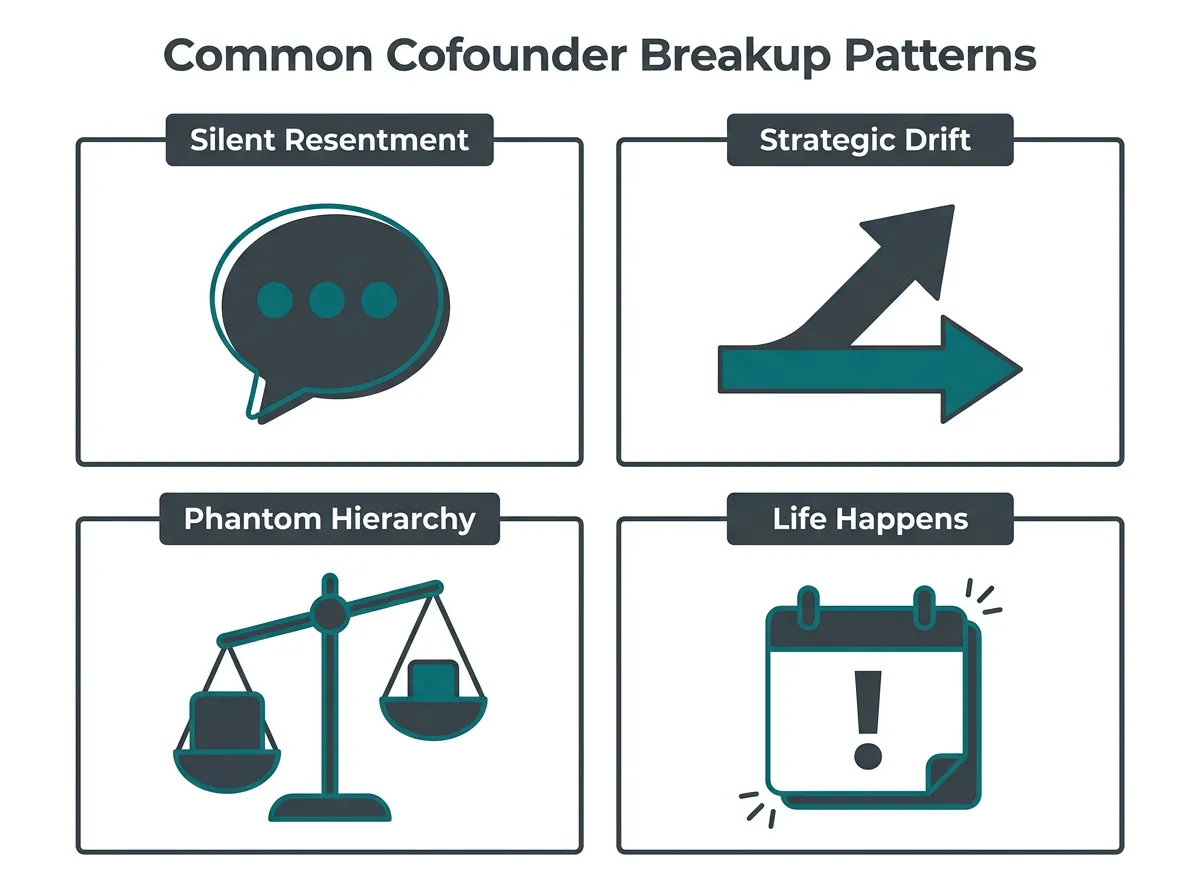
The "Silent Resentment" Pattern
One founder feels they're carrying more weight. Instead of addressing it, they absorb the frustration until it becomes contempt. By the time they raise it, the other founder is blindsided — and defensive. The conversation that should have happened at month two happens at month eight, with ten times the emotional charge.
The "Strategic Drift" Pattern
Cofounders start aligned but slowly drift in different directions. One becomes obsessed with product quality; the other focuses on growth at all costs. Without a shared framework for making strategic tradeoffs, every decision becomes a proxy battle for a larger, unnamed disagreement.
The "Phantom Hierarchy" Pattern
Cofounders who split everything 50/50 — equity, titles, decision rights — often discover that true equality is nearly impossible to maintain in practice. One person always ends up with more external credibility, more investor relationships, or more domain expertise. The "equal" structure prevents the honest acknowledgment of these dynamics, creating resentment on both sides.
The "Life Happens" Pattern
One founder's circumstances change. They have a child, face a health challenge, or receive a compelling job offer. Without predetermined agreements about what happens in these scenarios, the remaining founder faces an impossible choice: be understanding and absorb more work, or enforce expectations that were never written down.
How to Have These Conversations Without Making It Weird
The reason founders skip these conversations isn't laziness. It's social friction. Asking your new cofounder about vesting or exit scenarios can feel like you're signaling distrust.
So reframe it. These conversations aren't about distrust — they're about building a relationship that can survive pressure.
Here's a practical approach:
-
Set a dedicated "alignment session." Don't try to squeeze these topics into a casual hang. Block two hours specifically for founder alignment. Make it feel intentional, not confrontational.
-
Use a written framework. Work through a structured set of questions together — Y Combinator's cofounder questionnaire is a good starting point. Writing removes some of the awkwardness of raising tough topics verbally.
-
Separate the conversation from the decision. You don't need to resolve everything in one sitting. Start by surfacing your assumptions. Say: "Let's each write down what we think our roles are, compare notes, and then decide together next week."
-
Formalize what you agree on. Once you've had these conversations, put the outcomes in writing. This doesn't require a lawyer for every detail — tools like Servanda help cofounders create written agreements that prevent future conflicts by giving structure to the commitments you've already made verbally.
-
Schedule recurring check-ins. Alignment isn't a one-time event. Set a monthly or quarterly founder check-in where you revisit roles, satisfaction, and strategic direction. Make it routine so it doesn't feel like a crisis when someone raises a concern.
The Uncomfortable Truth About Cofounder Compatibility
Here's something that's rarely said in startup culture: not every great brainstorm partner is a great cofounder.
The skills that make someone exciting to ideate with — creativity, enthusiasm, big-picture thinking — are different from the skills that make someone a reliable co-operator: follow-through, conflict tolerance, willingness to do unglamorous work.
This doesn't mean you should only cofound with cautious, operational people. It means you should test the relationship under realistic conditions before making a long-term commitment.
Some founders do this by working on a small project together first. Others have a "trial period" with a clear evaluation point. The method matters less than the principle: treat the cofounder decision with at least as much rigor as you'd treat a senior hire.
FAQ
How do I bring up equity and roles with a cofounder without damaging the relationship?
Frame it as something every serious founding team does, because it's true. You might say: "I've been reading about how important founder alignment is early on — can we set aside a couple of hours this week to get on the same page about roles, equity, and expectations?" Making it about the company's health rather than personal distrust removes most of the awkwardness.
Is a 50/50 equity split always a bad idea?
Not always, but it's a bad idea when it's chosen by default to avoid a hard conversation. A 50/50 split works when both founders are contributing equally across time, skills, capital, and risk — and when you've discussed what happens if that balance changes. The split itself is less important than the conversation behind it.
When should cofounders get a formal operating agreement?
Before you spend money, write code, or talk to investors. The best time is during the first few weeks of working together, when the cost of misalignment is lowest. An operating agreement covers equity, vesting, roles, IP ownership, and exit terms — the exact issues that destroy partnerships when left unaddressed.
What are the early warning signs of cofounder conflict?
Watch for avoidance patterns: decisions getting delayed because neither founder wants to overrule the other, passive-aggressive communication, one founder consistently working more hours without acknowledgment, or recurring arguments about the same unresolved topic. These are symptoms of alignment gaps that need direct conversation, not more time.
Can cofounder relationships be repaired after a conflict?
Yes, but it requires both founders to want to repair it and a willingness to address root causes rather than just surface symptoms. Many cofounder conflicts stem from structural issues — unclear roles, mismatched expectations — that can be resolved by building the agreements that should have existed from the start. The longer you wait, the harder it gets.
Conclusion
Most cofounder breakups don't begin with betrayal or incompetence. They begin with silence — the conversations you didn't have when having them would have been easy.
The honeymoon phase of a founding relationship is precious. It's where energy and optimism are highest. But it's also where the most important agreements need to be made, precisely because everything still feels flexible and low-stakes.
If you're starting a company with someone, the single most valuable thing you can do this week isn't building a prototype or drafting a pitch deck. It's sitting down with your cofounder and talking honestly about equity, roles, vision, commitment, and what happens if things don't go as planned.
The founders who have those conversations aren't the pessimistic ones. They're the ones who are still building together a year from now.