
Why Success Masks Cofounder Conflict Until It's Too Late
Your startup just closed a Series A. Revenue is up 40% quarter over quarter. The team is growing, the press is favorable, and investors are returning your emails within the hour. From the outside, everything looks perfect.
But here's what no one sees: you haven't had an honest conversation with your cofounder in six months. There's a decision from last year — about equity, about a key hire, about strategic direction — that still sits in your chest like a stone. You tell yourself it doesn't matter. The numbers are good. Why rock the boat?
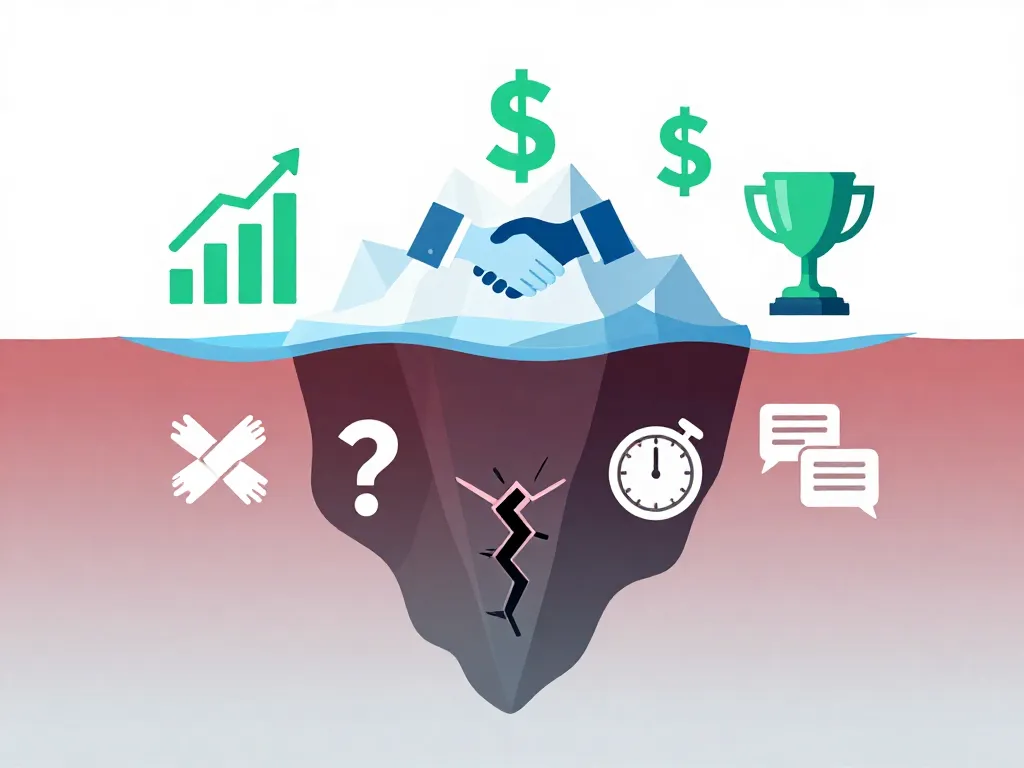
This is the trap. Cofounder conflict doesn't usually emerge in the hard times, when both founders are grinding together against a shared enemy. It festers during success — when there's finally enough oxygen in the room for unspoken resentments to catch fire. And by the time the conflict surfaces, it's often too late to resolve it cleanly.
This article explores why startup success is the most dangerous time for cofounder relationships, how to recognize the warning signs, and what you can do now — while things still look good — to protect your partnership.
Key Takeaways
- Success creates the illusion of alignment. When metrics are up, cofounders assume they agree on everything — but traction can hide deep disagreements about vision, roles, and values.
- The "don't rock the boat" instinct is a relationship killer. Avoiding hard conversations during good times doesn't preserve the partnership; it guarantees a bigger explosion later.
- Resentment compounds like interest. Small, unaddressed grievances from months ago become foundational cracks that can split a company in half.
- Structured check-ins are not optional. The best cofounder relationships aren't conflict-free — they have built-in systems for surfacing tension before it becomes toxic.
- Formalizing agreements during peacetime is the single highest-leverage move cofounders can make. Don't wait for a crisis to define roles, decision-making authority, and exit terms.
The Paradox: Why Good Times Breed Bad Breakups
Most people assume cofounder conflict peaks during adversity — when the startup is running out of money, when a product launch fails, when a key customer churns. And yes, those moments are stressful. But they also create a powerful bonding effect. When your backs are against the wall, there's a shared enemy. You're in survival mode together.
Success dissolves that glue.
Once the external pressure lifts, each founder starts to look inward. Questions that were easy to ignore during the scramble become impossible to avoid:
- Who actually deserves credit for this growth?
- Why does my cofounder get the same equity when I'm working twice as hard?
- We agreed on this strategy a year ago, but I've changed my mind — have they?
- When did we stop making decisions together?
Research from Noam Wasserman, author of The Founder's Dilemmas, found that 65% of high-potential startups fail due to conflict within the founding team — not market failure, not product failure. And the pattern is remarkably consistent: the conflict was present long before the blowup, often during periods of visible progress.
The "We're Winning" Bias
Psychologists call it outcome bias — the tendency to evaluate the quality of a decision based on its result rather than on the process that produced it. When revenue is growing, cofounders assume their relationship is healthy because the company is healthy. They conflate business traction with interpersonal alignment.
But these are two completely different things. Your startup can be succeeding despite your cofounder relationship, not because of it. And the longer you mistake one for the other, the more damage accumulates beneath the surface.
The Five Silent Signals That Success Is Hiding Conflict
Cofounder conflict rarely announces itself. It whispers. Here are the patterns to watch for — especially when everything else seems to be going well.
1. You've Stopped Debating
In the early days, you and your cofounder probably argued about everything — product direction, pricing, hiring priorities. Those arguments were healthy. They meant you both cared and felt safe enough to disagree.
When the debates stop, it's rarely because you've reached perfect alignment. More often, one or both founders have decided it's not worth the friction. They've started making decisions in their own domain without consultation. The partnership has quietly become two people running parallel companies under the same name.
2. You're Having Important Conversations with Everyone Except Your Cofounder
Pay attention to who you're venting to. If you find yourself discussing your cofounder's performance with your spouse, your mentor, your board member, or your head of product — but never with your cofounder directly — that's a significant warning sign.
This triangulation feels safer than direct confrontation, but it erodes trust from every direction. Eventually, your cofounder will hear the feedback secondhand, and it will feel like betrayal.
3. Equity and Compensation Have Become Unmentionable Topics
Nothing poisons a cofounder relationship faster than perceived unfairness around money — and nothing is harder to bring up when the company is doing well. If you feel like you're contributing more than your equity share reflects, or if you suspect your cofounder feels the same, the silence around that topic is actively corroding your partnership.

4. You Disagree About What Success Actually Means
One founder wants to build a billion-dollar company. The other would happily sell for $50 million and move on. One founder wants to stay technical. The other wants to become a full-time CEO. These aren't minor preferences — they're fundamental divergences in vision. And success makes them harder to surface because both founders can point to the current trajectory and say, "See? My approach is working."
5. Small Resentments Have Started to Accumulate
You remember the time your cofounder took sole credit in a press interview. You remember the hire they pushed through over your objection. You remember the board meeting where they presented your idea as theirs. Individually, none of these were worth a confrontation. Collectively, they've become a narrative: My cofounder doesn't respect me.
Resentment compounds. What started as a minor irritation six months ago is now a foundational belief about your cofounder's character. And foundational beliefs are extraordinarily difficult to dislodge.
Real-World Patterns: How This Plays Out
Consider a composite example drawn from common cofounder breakup stories.
The Case of the "Equal" Partners: Two cofounders — call them Alex and Jordan — launch a SaaS platform. They split equity 50/50 with no vesting, no role definitions, and a handshake operating agreement. In year one, they grind together and land their first 100 customers. In year two, the product takes off. Revenue hits $2M ARR. They raise a seed round.
But by year two, their contributions have diverged significantly. Alex has become the de facto CEO — fundraising, hiring, managing the board. Jordan has stayed focused on product but has also pulled back on hours, citing burnout. Alex notices but says nothing. We're growing. It's fine.
By year three, Alex resents doing "all the work" while Jordan holds the same equity. Jordan resents being sidelined from strategic decisions they were never formally excluded from — it just happened gradually. When a Series A term sheet arrives requiring a CEO designation and a vesting refresh, the conversation that should have happened two years earlier happens now — with lawyers, with board members, and with two years of compounded resentment in the room.
The fundraise stalls. The lead investor walks. It takes eight months and a near-total collapse of the relationship to restructure. The company survives, but the partnership doesn't.
This story, with minor variations, plays out across thousands of startups every year.
What to Do Now — While Things Are Still Good
If you're reading this during a period of relative success and stability, you're in the best possible position to act. Here's how.
Have the Conversation You've Been Avoiding
Pick the one topic — equity, roles, long-term vision, a specific past decision — that you've been dancing around. Schedule a dedicated conversation about it. Not over Slack. Not at the end of a two-hour strategy meeting. A separate, dedicated conversation with no other agenda.
Frame it honestly: "I want to talk about something that's been on my mind. I don't think it's a crisis, but I think it could become one if we don't address it. Can we set aside an hour this week?"
This kind of directness feels risky, but it's infinitely less risky than the alternative — which is waiting until the topic forces itself into the open during a high-stakes moment.
Formalize What You've Left Informal
Many cofounders operate on implicit agreements that were never written down. Who makes final decisions about hiring? What happens if one founder wants to leave? How do you resolve a deadlock?
The best time to answer these questions is when you're not fighting about them. Consider formalizing your agreements with a tool like Servanda, which helps cofounders create written, structured agreements while the relationship is still collaborative — not adversarial.

Build a Regular Cofounder Check-In
This isn't a status update about the business. It's a structured conversation about the relationship. Some frameworks that work well:
- Start/Stop/Continue: Each founder shares one thing they'd like the other to start doing, stop doing, and continue doing.
- Satisfaction scores: Each founder rates their satisfaction on a 1-10 scale across key dimensions — decision-making, workload balance, communication quality, strategic alignment — and discusses any score below a 7.
- Future visioning: Once a quarter, each founder independently writes down where they want the company — and their role in it — to be in two years. Then compare notes.
The specific format matters less than the consistency. Monthly is a good cadence. Put it on the calendar. Protect it like you'd protect a board meeting.
Define Decision-Making Authority Explicitly
One of the most common sources of cofounder conflict is ambiguity around who gets to make which decisions. As your company grows and the stakes increase, this ambiguity becomes increasingly dangerous.
Map out your key decision categories:
- Hiring and firing — Who has final say on senior hires? On firing decisions?
- Strategy and product direction — How do you resolve disagreements about roadmap?
- Spending and financial commitments — What's the threshold for unilateral spending decisions?
- Fundraising terms — Who leads negotiations? Who has veto power?
- Company culture and values — How do you handle disagreements about team norms?
For each category, agree on whether decisions are made jointly, by one designated founder, or through some other mechanism. Write it down.
Get an Outside Perspective Before You Need a Mediator
A startup coach, an executive coach for each founder, or even a trusted mutual advisor can help surface tensions before they calcify. The key is finding someone who isn't invested in telling you what you want to hear.
Some YC partners and experienced startup advisors specifically offer cofounder relationship coaching. It's not therapy — it's preventive maintenance for your most important business relationship.
The Cost of Waiting
Let's be direct about what's at stake. When cofounder conflict eventually erupts — and unaddressed conflict almost always does — the consequences cascade:
- Fundraising stalls or collapses. Investors can sense cofounder tension instantly, and it's one of the fastest deal-killers in venture capital.
- Key employees leave. Your best people will not stick around to watch a founders' divorce play out in real time.
- Decision-making paralyzes. When founders can't agree, the company can't move. Competitors don't wait.
- Legal costs escalate. What could have been a difficult conversation becomes a dispute requiring lawyers, mediators, and sometimes litigation.
- The company dies. The most common outcome of unresolved cofounder conflict isn't a graceful separation — it's the death of the company itself.
None of this is hypothetical. CB Insights consistently ranks cofounder and team dysfunction among the top reasons startups fail. The pattern is always the same: the conflict was visible in hindsight, but no one addressed it when it was still manageable.
FAQ
How do you know if your cofounder conflict is normal or serious?
All cofounder relationships involve friction — that's healthy. The line between normal and serious is whether the friction gets processed or stored. If you're having disagreements but resolving them through direct conversation, you're fine. If you're accumulating a mental list of grievances that you've never voiced, that's a warning sign worth acting on immediately.
When is the best time to bring up concerns with your cofounder?
The best time is always before you feel like you have to. If you're bringing up a concern for the first time in the middle of a crisis, you've waited too long. Aim to raise issues when the emotional charge is low — during a regular check-in, not after the board meeting where the issue just played out in front of everyone.
Can a cofounder relationship be repaired after a major blowup?
Sometimes, but it requires both founders to be genuinely willing to do the work — which usually means acknowledging their own contribution to the problem, not just cataloging the other person's faults. Structured mediation, clear new agreements, and a willingness to rebuild trust incrementally can work. But it's always harder and more expensive than prevention.
Should cofounders get a cofounder agreement even if they're friends?
Especially if they're friends. Friendship creates an additional layer of avoidance — neither person wants to "make it weird" by formalizing business terms. But a written agreement actually protects the friendship by giving both people a shared reference point when disagreements arise, rather than forcing each person to rely on their own (often conflicting) memory of what was agreed.
What should a cofounder agreement include at minimum?
At minimum: equity split and vesting schedule, role definitions and decision-making authority, what happens if one founder leaves or is asked to leave, IP assignment, and a process for resolving disputes. Think of it as a prenup — not a sign that you expect failure, but a sign that you take the partnership seriously enough to plan for difficult scenarios.
Conclusion
The most dangerous moment in a cofounder relationship isn't when things are falling apart — it's when things are going well enough that you convince yourself the hard conversations can wait. They can't. Success is not a substitute for alignment, and traction is not evidence that your partnership is healthy.
The founders who build enduring companies aren't the ones who avoid conflict. They're the ones who build systems for addressing it early, honestly, and repeatedly — especially when there's no immediate crisis forcing the conversation.
If your startup is succeeding right now, congratulations. That's genuinely hard to do. But take an honest look at the relationship powering that success. If there's a conversation you've been putting off, this week is the week to have it. The cost of waiting only goes up from here.