80% of Roommate Conflicts Are Solved by One Thing
It's 1:47 a.m. You have a midterm at 8. Your roommate's friends are in the living room, and someone just cranked the Bluetooth speaker up another notch. You're lying in bed, jaw clenched, composing a furious text message you'll probably regret — or, more likely, you'll delete it, shove in your earbuds, and say nothing at all. Again.
Sound familiar? Residential life professionals across universities consistently report the same finding: roughly 80% of roommate conflicts trace back to a single root cause — and it isn't dirty dishes, overnight guests, or thermostat wars. It's the conversations that never happened in the first place. The unspoken expectations. The assumptions made and never checked. The small irritations swallowed whole until they calcify into resentment.
The good news? That means the solution is also one thing — and it's entirely within your control. This article gives you the exact scripts, frameworks, and strategies to start the conversations you've been avoiding, before they become the blow-ups you're dreading.
Key Takeaways
- Most roommate conflicts aren't caused by bad behavior — they're caused by unspoken expectations. Addressing issues early, when the emotional stakes are low, prevents the vast majority of blowups.
- You don't need to be "good at confrontation." A simple, repeatable sentence framework (Observation → Feeling → Need → Request) can carry you through nearly any tough roommate conversation.
- Timing and setting matter as much as the words you choose. Bringing up an issue at the wrong moment can sabotage even the most reasonable request.
- Written agreements aren't "weird" — they're protective. Putting shared expectations on paper removes ambiguity and gives both parties something neutral to reference later.
- Repair is always possible. Even if things have already escalated, a structured conversation can reset the relationship.
Why Roommate Conflicts Really Escalate
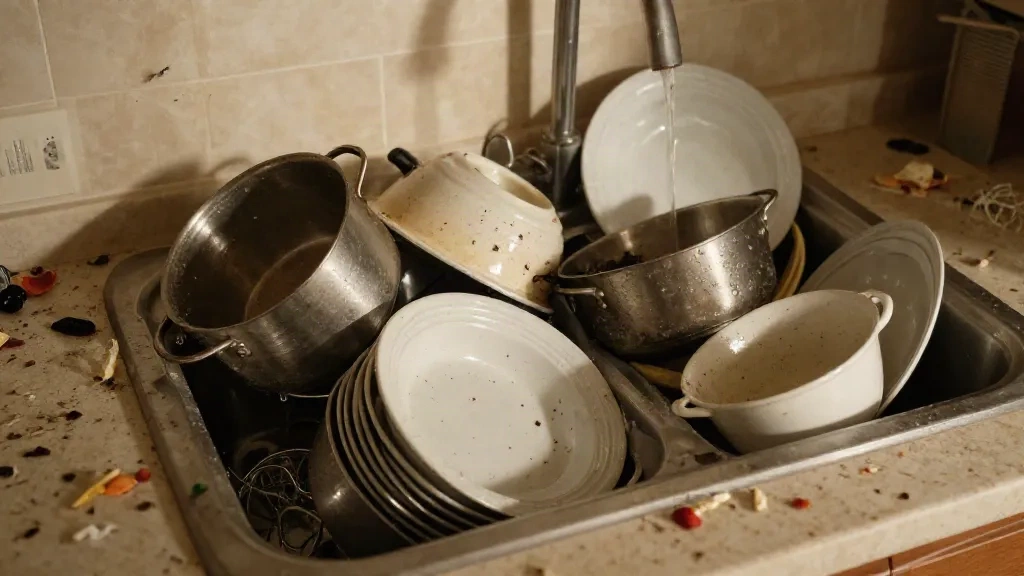
Let's clear something up: the dirty pan in the sink is almost never really about the dirty pan in the sink.
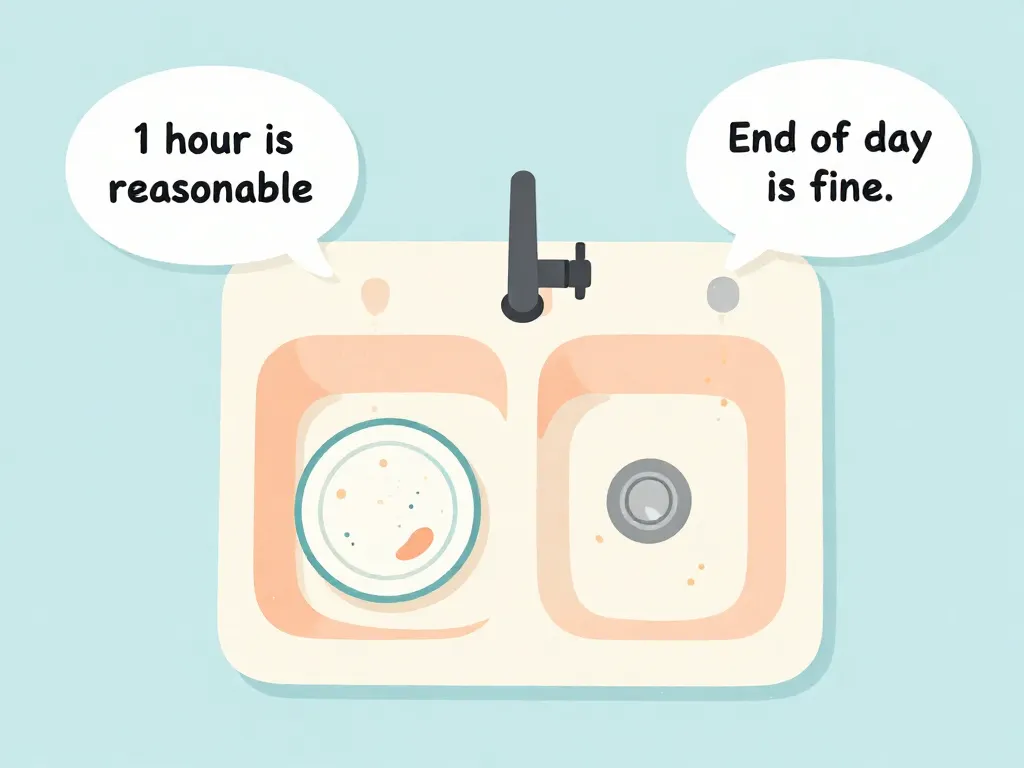
When campus housing mediators sit down with feuding roommates, a pattern emerges almost immediately. One person assumed dishes would be washed within a few hours. The other assumed the end of the day was reasonable. Neither ever said so out loud. By the time someone finally snaps, the conversation isn't about dishware anymore — it's about respect, consideration, and all the silent scorekeeping that's been happening for weeks.
Research from university residential life programs — including studies cited by institutions like UCLA and the University of Michigan — confirms this pattern. The overwhelming majority of roommate disputes don't originate from genuinely incompatible living styles. They originate from expectation gaps: the space between what you assumed and what your roommate assumed, with no conversation bridging the two.
Here's why that gap is so dangerous:
- Silence feels like agreement. When no one says anything, both parties assume the status quo is mutually accepted.
- Small irritations compound. A single unwashed dish is nothing. Six weeks of unwashed dishes, without a word spoken, becomes a symbol of disrespect.
- Resentment distorts perception. Once you're frustrated, you start interpreting neutral behavior as hostile. Your roommate isn't just forgetful — they "clearly don't care about you."
The fix isn't becoming a confrontational person. It's becoming a preemptive one.
The One Thing: Structured, Early Conversations
Campus housing experts don't use vague advice like "just talk it out." They teach a specific, learnable skill: initiating structured conversations before emotions are elevated. That's the "one thing" that resolves 80% of roommate conflicts — not because talking is magic, but because most conflicts simply wouldn't exist if the conversation had happened earlier.
Let's break this into two scenarios: preventive conversations (before anything goes wrong) and corrective conversations (when something already has).
Preventive Conversations: The Roommate Expectations Talk
The single highest-leverage conversation you can have with a roommate is the one that happens before conflict arises. Ideally, this is in the first week of living together — but it's never too late.
Here's a practical framework:
1. Name the purpose explicitly.
"Hey, I want to have a quick conversation about how we want things to work around here — not because anything is wrong, but because I've learned it's way easier to figure this stuff out now than after someone gets annoyed."
This framing matters. It signals that the conversation is collaborative, not accusatory.
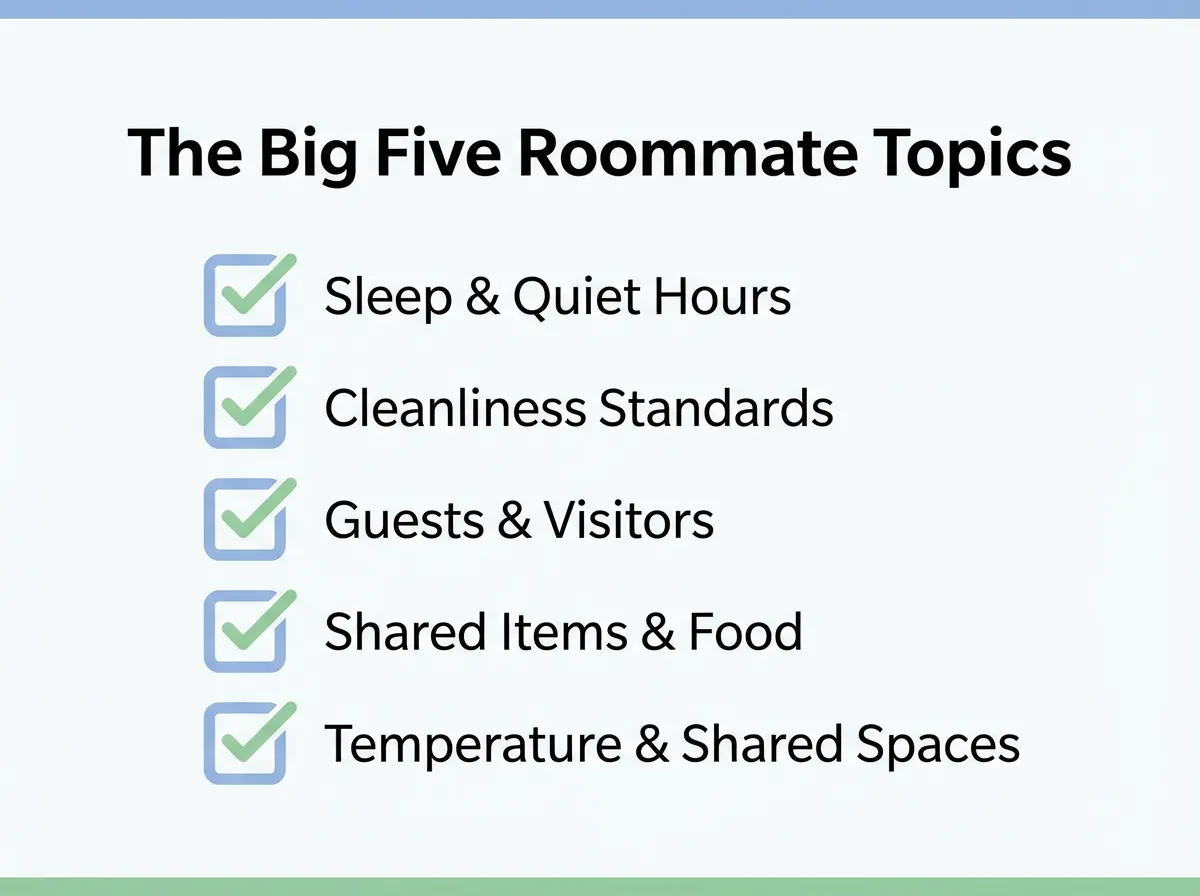
2. Cover the Big Five.
Residential life professionals have identified five categories that generate the most roommate friction:
- Sleep and quiet hours — When is "too loud"? When does quiet time start?
- Cleanliness standards — How clean is "clean enough"? Who does what, and how often?
- Guests and overnight visitors — How much notice is expected? Are there limits?
- Shared items and food — What's communal? What's off-limits?
- Temperature and shared spaces — Who controls the thermostat? How is common area use divided?
3. Write it down.
This is where most people drop the ball. A verbal agreement feels friendly in the moment but evaporates within days. Even a simple shared Google Doc or a notes-app list gives you something concrete to reference later — without it feeling like a personal attack. Tools like Servanda help roommates create written agreements that prevent future conflicts, giving both parties a neutral document to return to when memories differ.
4. Schedule a check-in.
Agree to revisit the expectations in two to three weeks. Living together is iterative — what seemed fine on paper might need adjustment once real life kicks in.
Corrective Conversations: The OFNR Script
So what if you're past the preventive stage? What if the issue already exists, and every day you don't say something, it gets heavier?
This is where most people freeze. They either blow up or shut down, because they've never been given actual words to say. Here they are.
The OFNR framework (adapted from Nonviolent Communication) gives you a four-sentence script that works for virtually any roommate issue:
| Step | What It Means | Example |
|---|---|---|
| O — Observation | State the specific, observable behavior. No interpretation, no judgment. | "I've noticed the dishes from dinner have been sitting in the sink for a couple of days." |
| F — Feeling | Name how it affects you. Use "I" language. | "It stresses me out because I like having a clean kitchen to cook in." |
| N — Need | Identify the underlying need. | "I need to feel like we're sharing the upkeep of common spaces." |
| R — Request | Make a specific, actionable request. | "Could we agree to wash our dishes within 24 hours, or at least put them in the dishwasher?" |
Put together, it sounds like this:
"Hey, I've noticed the dishes have been sitting in the sink for a couple of days. It stresses me out because I like having a clean kitchen to cook in. I need to feel like we're both contributing to keeping common spaces up. Could we agree to a 24-hour rule for dishes?"
That's it. No accusations. No passive-aggression. No "you always" or "you never." Just a clear, honest, respectful request.
Timing: When and Where to Have the Talk
The best script in the world will backfire if you deliver it at the wrong time. Here are the ground rules:
Do bring it up when: - You're both calm and sober - You have at least 15 uninterrupted minutes - You're in a private space (not in front of friends) - The issue is fresh but you've had time to cool down (the "24-hour rule" — wait a day, but no longer than a week)
Don't bring it up when: - One of you is walking out the door - Either person is stressed about something else (exams, a bad day at work) - You're texting — tone gets lost, defensiveness spikes - You're in front of other people
A useful opening line for timing:
"There's something I want to talk about — nothing major, but I want to make sure it doesn't become something bigger. Is now an okay time, or would later tonight be better?"
This small move — asking permission to have the conversation — immediately reduces defensiveness. It signals respect and gives your roommate a sense of agency.

Real Scenarios, Real Scripts
Let's walk through three common roommate conflicts and show exactly how the OFNR script applies.
Scenario 1: The Night Owl vs. The Early Riser
The situation: Your roommate stays up until 2 a.m. with the TV on in the shared living room. The light and sound bleed into your bedroom. You wake up at 6 for work.
The script:
"I've noticed the TV is usually on in the living room until around 2 a.m. [Observation]. I'm finding it hard to fall asleep because of the light and sound, and then I'm exhausted at work the next day [Feeling]. I really need to get solid sleep on weeknights to function [Need]. Would you be open to using headphones after midnight, or maybe watching in your room on weeknights? [Request]"
Scenario 2: The Uninvited Plus-One
The situation: Your roommate's partner has been staying over four or five nights a week. They're nice enough, but you didn't sign up for a third roommate — and the bathroom schedule is suffering.
The script:
"I've noticed [partner's name] has been staying over most nights this month [Observation]. I'm starting to feel like I have less privacy and personal space in the apartment, and mornings are getting cramped [Feeling]. I need to feel comfortable in my own home and have some predictability around shared spaces [Need]. Could we talk about setting a number of nights per week that works for both of us? [Request]"
Scenario 3: The Disappearing Groceries
The situation: You bought a carton of eggs, a block of cheese, and some specialty coffee. All three have been used without being asked or replaced.
The script:
"I noticed some of my groceries — the eggs and that coffee I bought — were used this week [Observation]. I felt frustrated because I'd been budgeting carefully and was counting on those for my meals [Feeling]. I need to be able to rely on my food being there when I plan around it [Need]. Can we set a clear rule — like, anything on my shelf is off-limits unless you ask, and vice versa? [Request]"
What If They React Badly?
Sometimes, even a well-delivered conversation doesn't land. Your roommate might get defensive, dismissive, or turn it around on you. Here's what to do:
- Stay calm and don't match their energy. If they escalate, you don't have to. A simple "I can see this is hitting a nerve — I'm not trying to attack you, I just want to figure this out together" can de-escalate quickly.
- Acknowledge their perspective. "I hear you — you didn't realize it was bothering me, and that makes sense because I hadn't said anything until now."
- Suggest a pause. "Let's both think about this and come back to it tomorrow. I don't want either of us to say something we don't mean."
- Bring in a neutral third party. If the conversation keeps going sideways, your RA, a mutual friend, or even an AI-powered mediation tool can provide the structure that one-on-one conversations sometimes lack.
The goal isn't to "win" the conversation. It's to surface the issue and begin problem-solving together. That alone is a massive shift from silence.
The Cost of Saying Nothing
If you're still on the fence about whether to have the conversation, consider the alternative. Unresolved roommate conflicts have measurable consequences:
- Academic performance drops. Students dealing with ongoing roommate tension report lower focus, worse sleep, and higher stress — all of which hit GPA.
- Mental health suffers. Living in a space that feels hostile or uncomfortable produces chronic low-grade anxiety. Home should be a place of rest.
- The relationship becomes unsalvageable. Small issues, left unspoken for months, eventually erupt in ways that can't be walked back. Lease-breaking, friend-group fractures, and bitter social media posts follow.
- You train yourself to avoid conflict. Every time you swallow a legitimate concern, you reinforce the pattern. This doesn't just affect your current roommate — it follows you into future relationships, workplaces, and partnerships.
Having the uncomfortable conversation today is almost always less painful than the explosion three months from now.
Frequently Asked Questions
How do I bring up a roommate issue without making it awkward?
Start by normalizing the conversation: "I want to talk about something small before it becomes something big." Use the OFNR script (Observation, Feeling, Need, Request) to keep things neutral and specific. Most awkwardness comes from vagueness — the more concrete you are, the less it feels like a personal attack.
What if my roommate refuses to talk about problems?
Some people genuinely struggle with direct conversations. Try offering alternatives: a shared notes document, a text exchange, or even framing it as "I wrote down some thoughts — would you mind reading them and letting me know what you think?" If they completely refuse to engage, that's when involving a mediator — an RA, mutual friend, or campus housing staff — becomes appropriate.
Is it too late to make a roommate agreement if we've been living together for months?
Absolutely not. In fact, mid-year agreements can be even more useful because they're based on real experience rather than hypotheticals. Frame it positively: "We've been figuring things out as we go, and I think it would help to put some of what's working — and some adjustments — in writing so we're on the same page."
How do you handle a roommate who gets defensive every time you bring something up?
Defensiveness usually signals that the person feels criticized or blindsided. Lead with something positive ("I think we generally live together well"), be specific rather than general (avoid "you always"), and give them control by asking when a good time to talk would be. If defensiveness is a consistent pattern regardless of your approach, a third-party mediator can change the dynamic significantly.
Should I text my roommate about issues or talk in person?
In person is almost always better for anything beyond a quick logistical reminder. Text strips away tone, facial expressions, and the ability to read the room — which means even gentle messages can land as aggressive. If you need to text first, use it only to set up the real conversation: "Hey, there's something I'd like to chat about when we're both free. Nothing serious — just want to get on the same page."
Conclusion
The 80% statistic isn't surprising once you've lived it. Most roommate conflicts don't come from malice — they come from silence. From assumptions that were never checked, boundaries that were never voiced, and small frustrations that were never addressed while they were still small.
You don't need to become a confrontation expert. You need one honest conversation, delivered with respect and specificity, at a time when both parties can actually listen. The OFNR script gives you the words. The preventive framework gives you the structure. And the decision to speak up — early, clearly, and without hostility — gives you the power to protect both your living space and your relationship.
The conversation you're avoiding right now? It's almost certainly smaller than you think it is. Have it today. Your future self — rested, less stressed, and still on speaking terms with your roommate — will thank you.