Why You Keep Blaming Your Roommate (And Why It Backfires)
It's 11:47 PM. You have a presentation in the morning. And your roommate is in the living room with three friends, a Bluetooth speaker, and zero awareness that walls are thin. You lie in bed staring at the ceiling, composing a mental essay titled "Everything Wrong With This Person." By morning, you've convicted them of being inconsiderate, selfish, and fundamentally incompatible with civilized society.
Sound familiar? If you've ever lived with someone—friend, stranger, partner—you've probably fallen into the trap of blaming your roommate for every friction point in your shared space. It feels satisfying in the moment, like building an airtight case. But here's the uncomfortable truth: that blame habit is almost certainly making your living situation worse, not better. This article digs into why your brain defaults to blame, what it actually costs you, and how to break the cycle with techniques that lead to real resolution instead of silent resentment.
Key Takeaways
- Your brain is wired for blame. The fundamental attribution error makes you overestimate your roommate's character flaws and underestimate situational factors—while doing the opposite for yourself.
- Blame feels productive but is actually a dead end. It creates a story where you're powerless and the other person must change first, which stalls any real resolution.
- Reframing conflict as a systems problem (not a people problem) unlocks solutions. Missing agreements, unclear expectations, and unspoken needs cause most roommate friction—not bad character.
- "I" statements aren't just therapy talk. Shifting from "You always..." to "I need..." changes the entire trajectory of a conversation.
- Writing down shared expectations early prevents the blame spiral before it starts. Informal agreements work; formalized ones work better.
The Psychology Behind Blaming Your Roommate
The Fundamental Attribution Error: Your Brain's Favorite Shortcut
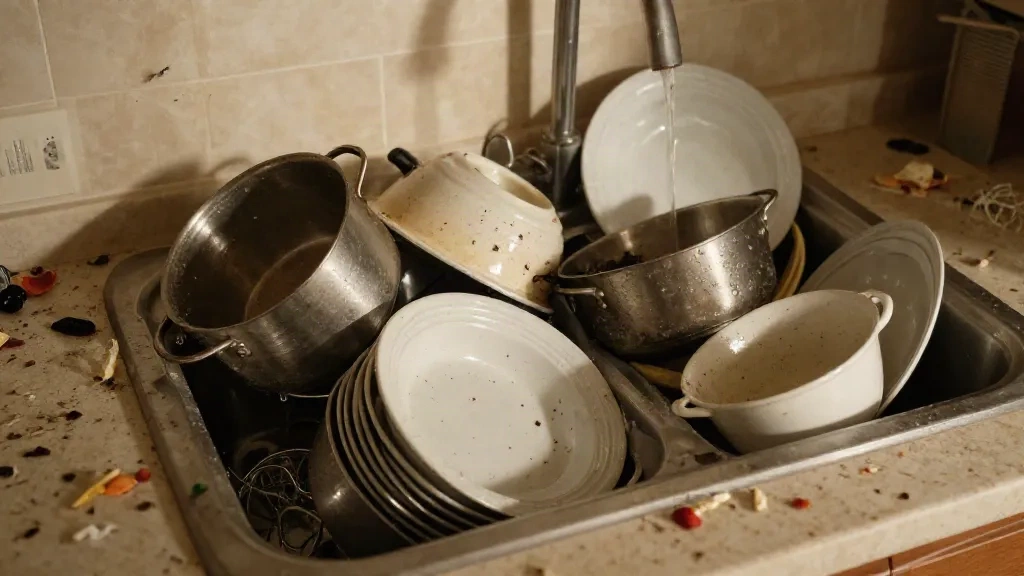
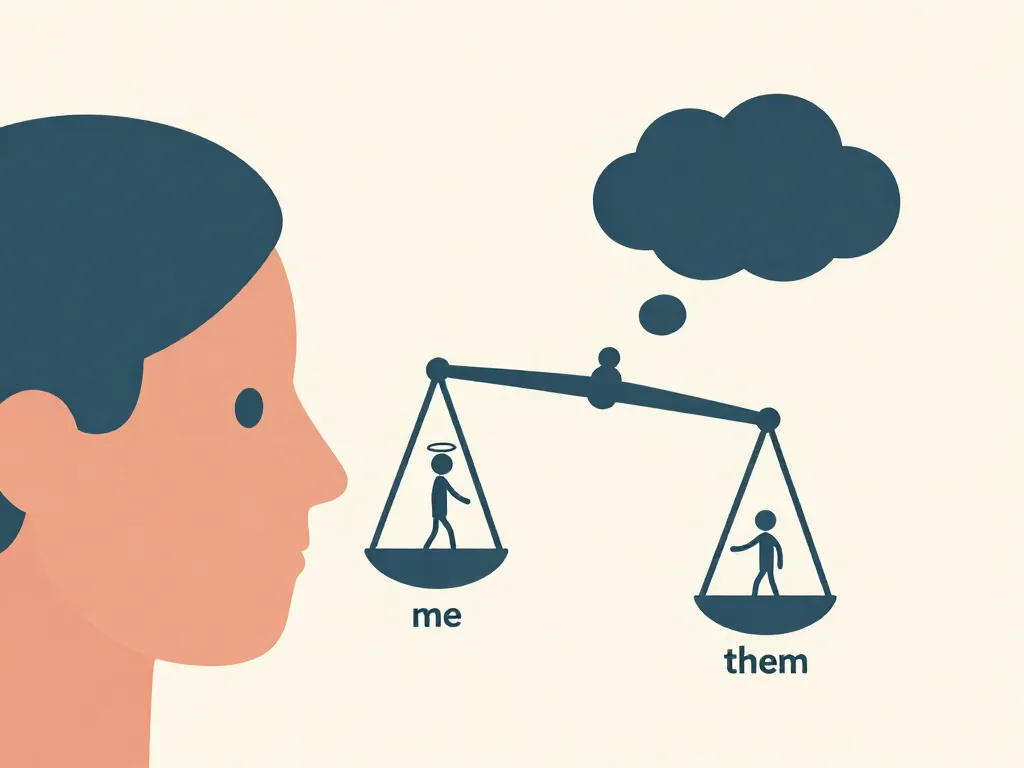
In social psychology, there's a well-documented cognitive bias called the fundamental attribution error. It works like this: when you leave dishes in the sink, it's because you had a brutal day at work and you'll get to them tomorrow. When your roommate leaves dishes in the sink, it's because they're lazy and disrespectful.
You judge yourself by your intentions and circumstances. You judge your roommate by their behavior alone.
This isn't a moral failing—it's a feature of how human brains process social information. We don't have access to other people's internal experiences, so we fill in the gaps with character-based explanations. And in shared living situations, where you're constantly exposed to another person's habits, the fundamental attribution error runs on a loop.
Over weeks and months, this creates a mental ledger of your roommate's offenses. Every unwashed pan, every loud phone call, every thermostat adjustment becomes another piece of evidence in a case you didn't realize you were building.
Confirmation Bias: The Evidence-Gathering Machine
Once you've decided your roommate is the problem, your brain starts filtering reality to confirm it. Psychologists call this confirmation bias, and it's relentless.
Your roommate cleaned the kitchen last Tuesday? You barely noticed. They left a single cup on the counter Wednesday? Noted. Filed. Added to the ledger.
This selective attention creates a distorted picture where your roommate is always the offender and you're always the reasonable one. The more evidence you gather, the more righteous you feel—and the less motivated you are to examine your own role in the dynamic.
The Comfort of the Victim Narrative
There's a reason blame feels good: it's emotionally simple. If the problem is entirely your roommate's fault, then:
- You don't have to change anything about your own behavior
- You don't have to have an uncomfortable conversation
- You get to feel morally superior
- You have a clear villain in your story
The catch? This narrative also makes you completely powerless. If the problem is 100% them, then the solution is also 100% dependent on them changing. You've handed over all your agency to the person you're most frustrated with.
How Blame Actually Backfires in Shared Living
It Turns Conversations Into Courtrooms
When you finally bring up an issue from a place of built-up blame, it rarely sounds like a conversation. It sounds like a prosecution.
"You never clean up after yourself. You always leave your stuff everywhere. I'm the only one who takes out the trash."
Words like "never," "always," and "only" are blame language. They're absolute terms that invite defensiveness, not dialogue. Your roommate's natural response isn't to agree—it's to counter-argue, deflect, or shut down. Now you're in a courtroom, not a kitchen.
Consider what happened with two roommates we'll call Jordan and Alex. Jordan had spent two months quietly fuming about Alex leaving shared groceries unlabeled and eating Jordan's food. When Jordan finally brought it up, the conversation opened with: "You clearly don't respect my things or my money." Alex—who genuinely hadn't realized the groceries weren't shared—heard a character attack, not a logistics problem. The conversation spiraled into a shouting match about respect, and the actual grocery issue went unresolved for another month.
It Erodes the Relationship Beneath the Conflict
Every roommate conflict exists on two levels: the practical level (dishes, noise, guests, rent) and the relational level (do I feel respected, heard, safe in my own home). Blame operates almost entirely on the relational level. When you say "You never clean up," the subtext your roommate hears is "You're a bad person."
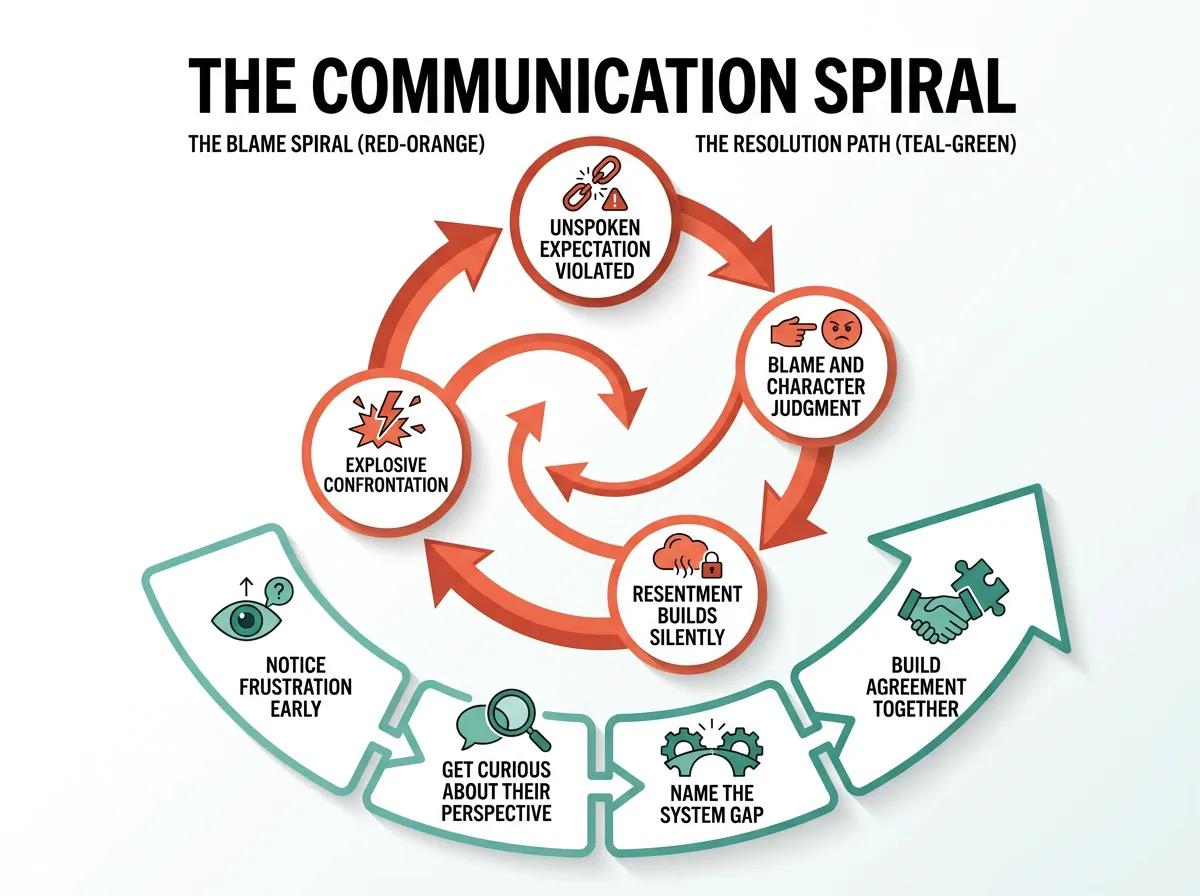
Over time, blame corrodes trust. Your roommate starts walking on eggshells or emotionally checking out. You start interpreting their withdrawal as further evidence of not caring. The practical problem—whatever it was originally—is now buried under layers of relational damage.
It Prevents You From Seeing Your Own Blind Spots
This is the part nobody wants to hear. Blaming your roommate can be a way of avoiding self-examination.
Ask yourself honestly:
- Did you ever clearly communicate your expectation, or did you assume it was obvious?
- Have you established shared agreements about the thing that's bothering you?
- Are there areas where you might be the difficult roommate and don't realize it?
- Could your standard be unusually high (or low) in ways you haven't acknowledged?
None of this means your frustrations aren't valid. They probably are. But blame keeps you focused on the other person's behavior while your own contributions to the problem remain unexamined.
Breaking the Blame Cycle: Actionable Reframing Techniques
1. Separate the Person From the Problem
This is the single most powerful reframe in conflict resolution. Instead of "My roommate is inconsiderate," try: "We don't have a shared agreement about quiet hours."
Notice the shift. The first version identifies a character flaw. The second identifies a missing system. Systems can be built. Character flaws feel permanent.
Here's a practical exercise: next time you're frustrated, complete this sentence:
"The problem isn't that my roommate is _. The problem is that we haven't agreed on _."
Examples: - ~~"My roommate is a slob."~~ → "We haven't agreed on how to split cleaning responsibilities." - ~~"My roommate is cheap."~~ → "We haven't agreed on how shared expenses get handled." - ~~"My roommate doesn't respect my space."~~ → "We haven't defined what 'personal space' means in this apartment."
2. Replace "You" Statements With "I" Statements (But Actually Do It)
You've probably heard this advice before. The reason it keeps getting repeated is that it genuinely works—when done properly. The key is specificity.
Weak version: "I feel like you don't care about cleanliness."
(This is just a "you" statement wearing an "I feel" costume.)
Strong version: "I feel stressed when I come home to a messy kitchen because I need a calm environment to decompress after work. Can we figure out a system that works for both of us?"
The strong version does three things: 1. Names a specific emotion (stressed) 2. Identifies a specific trigger (messy kitchen when arriving home) 3. Invites collaboration instead of demanding compliance
3. Get Curious Before Getting Angry

Before you confront your roommate, try asking yourself one question: "What might be going on for them that I don't know about?"
This isn't about making excuses for bad behavior. It's about interrupting the fundamental attribution error. Maybe your roommate has been leaving dishes because they just started a second job. Maybe they're loud on the phone because they're dealing with a family crisis. Maybe they have a completely different cultural norm around shared spaces.
You don't need to know the answer. The act of wondering is enough to shift you from judgment mode to curiosity mode—and curiosity leads to much better conversations than anger does.
4. Address Issues Early and Small
Blame tends to build up when you stockpile grievances. The first time your roommate leaves hair in the shower drain, it's mildly annoying. The fifteenth time, it's a symbol of their fundamental disregard for your existence.
The solution is to bring things up when they're still small. A quick, low-stakes comment in week one ("Hey, would you mind clearing the drain after you shower? It bugs me—thanks!") prevents the five-month silent buildup that ends in an explosive confrontation.
Timing matters too. Bring things up when: - You're both calm and not rushing - It's private, not in front of other people - You've had time to separate your frustration from the facts
5. Write It Down: The Power of Roommate Agreements
Many roommate conflicts aren't actually about behavior—they're about unspoken expectations. You expected the kitchen to be cleaned daily. Your roommate expected weekly. Neither of you ever said this out loud. Both of you feel the other person is being unreasonable.
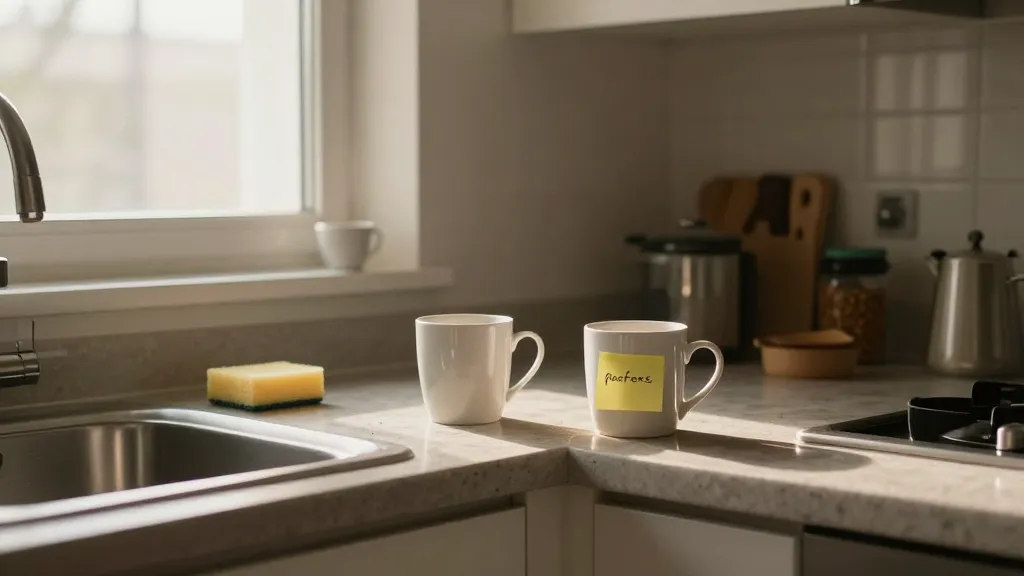
Written agreements eliminate this ambiguity. They don't have to be formal or legalistic—a shared Google Doc works. But they should cover the areas where friction is most common:
- Cleaning: Who cleans what, how often, and to what standard
- Noise: Quiet hours, guest policies, heads-up expectations
- Shared expenses: How you split groceries, utilities, and household supplies
- Shared spaces: How common areas get used, personal items vs. shared items
- Communication preferences: Text vs. in-person, how to flag issues
Tools like Servanda can help roommates create structured written agreements that prevent conflicts before they start—especially useful when having the conversation itself feels awkward.
The act of writing things down does something powerful: it moves expectations out of your head and into a shared reality. You can no longer assume your roommate "should have known." Either it's in the agreement or it isn't.
When Blame Is a Signal, Not a Solution
Sometimes blame isn't entirely misplaced. If your roommate consistently violates clearly communicated boundaries, refuses to engage in problem-solving, or behaves in ways that compromise your safety or well-being, the issue isn't your cognitive bias—it's their behavior.
The distinction matters. Blame as a habit is unproductive. Blame as a signal that something is genuinely wrong can be valuable—as long as you use it to drive action rather than fuel resentment.
Here's a quick self-check:
| Blame as a habit | Blame as a signal |
|---|---|
| You haven't communicated the expectation clearly | You've communicated it multiple times |
| You're assuming intent without evidence | You have clear evidence of disregard |
| You haven't proposed a solution | You've proposed solutions that were ignored |
| You're venting to friends instead of talking to your roommate | You've talked to your roommate and nothing changed |
If you're consistently in the right column, the issue may not be reframeable. At that point, it's worth considering mediation, involving your landlord, or making a plan to change your living situation.
FAQ
How do I stop resenting my roommate for things that already happened?
Resentment sticks around because the underlying need was never addressed. Identify the specific need behind each resentment (quiet, cleanliness, financial fairness), then have a forward-looking conversation about how to meet that need going forward. You can't undo the past, but you can build agreements that prevent the same frustrations from recurring.
Is it ever okay to tell my roommate they're being inconsiderate?
Labeling someone's character tends to trigger defensiveness, even when you're right. You'll get better results by describing the specific behavior and its impact on you: "When dishes sit in the sink for three days, I feel frustrated because I can't use the kitchen comfortably" works better than "You're inconsiderate." The first invites a solution; the second invites an argument.
What if my roommate blames ME for everything?
If your roommate is the one defaulting to blame, resist the urge to match their energy. You can model a different approach: "I hear that you're frustrated. Can we talk about what specifically isn't working and figure out a fix together?" If they refuse to engage constructively after multiple attempts, it may be time to involve a neutral third party.
How do roommate agreements actually prevent blame?
Agreements remove ambiguity, which is where blame thrives. When expectations are unspoken, both people fill in the gaps with their own assumptions—and then blame the other for violating invisible rules. A written agreement creates a shared reference point, so disputes become about logistics ("We agreed to X; let's revisit that") rather than character ("You're lazy / selfish / inconsiderate").
When should I just accept that the living situation isn't working?
If you've clearly communicated your needs, proposed practical solutions, made genuine efforts to understand their perspective, and the core problems remain unchanged after a reasonable period (usually a few months), it's not a failure to decide you're incompatible as roommates. Some people are wonderful humans who are terrible to live with—and that applies to all of us in someone else's eyes.
Conclusion
Blaming your roommate is one of the most natural things in the world. Your brain is literally built to do it. But understanding why you default to blame is the first step toward stopping it—and stopping it is the first step toward actually fixing what's broken in your living situation.
The core shift is deceptively simple: move from "my roommate is the problem" to "we have a problem we haven't solved yet." That single reframe opens up everything—better conversations, clearer agreements, less resentment, and a home that doesn't feel like a courtroom.
You don't have to become best friends with your roommate. You don't even have to like each other. But you do share a space, and that space works best when both people take ownership of the systems that govern it—rather than spending all their energy cataloging each other's flaws.