
Active Listening Scripts for Co-Parent Arguments
Key Takeaways
- You don't need to be a therapist to listen well. Active listening scripts give you exact phrases to use when your mind goes blank or your defenses go up during a co-parent argument.
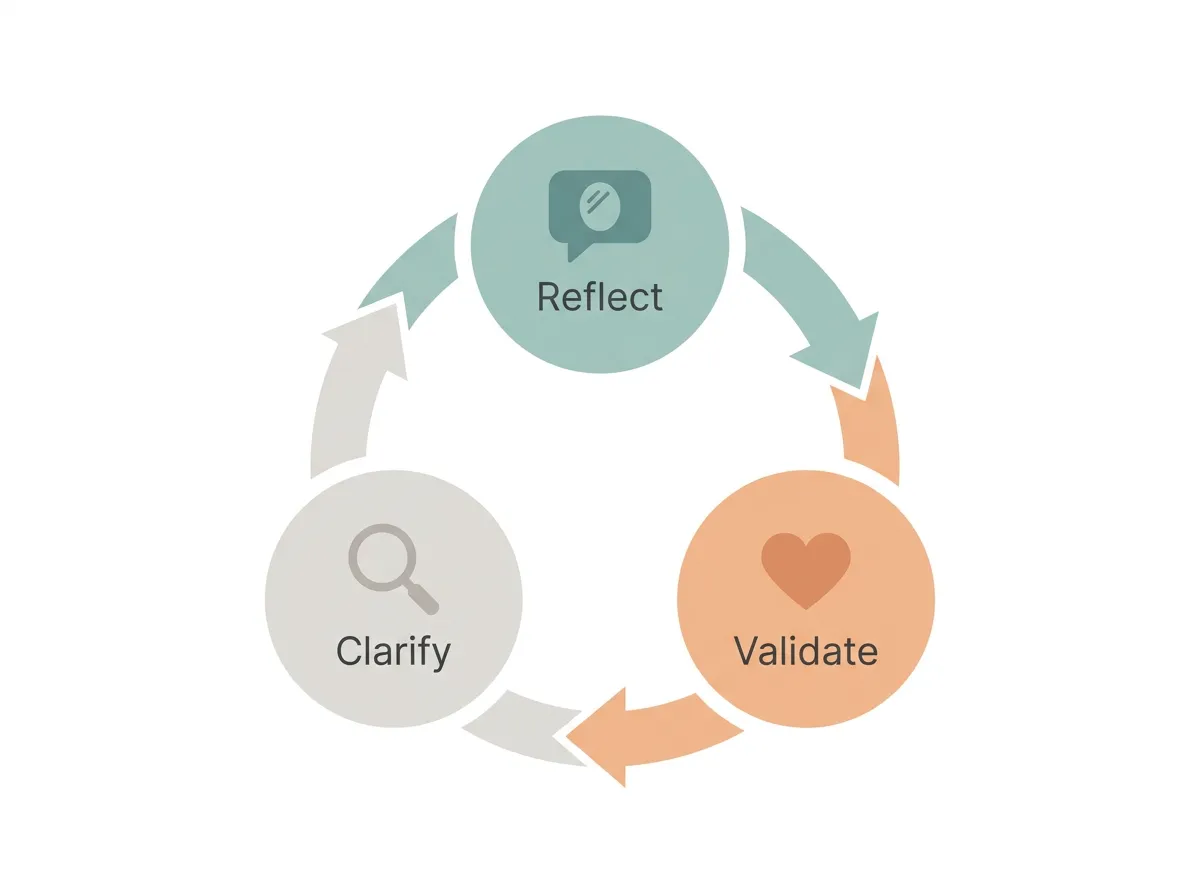
- Reflecting, validating, and clarifying are the three core moves. Master these three techniques and you can navigate almost any tense co-parenting conversation.
- Scripts aren't robotic — they're scaffolding. Think of them the way you'd think of training wheels: they keep you upright until the skill becomes second nature.
- The goal isn't agreement; it's understanding. Active listening doesn't mean you cave. It means you make your co-parent feel heard, which dramatically lowers the temperature of any disagreement.
- Practice off the battlefield first. Rehearse these scripts in low-stakes moments so they're available to you when emotions spike.
Introduction
It's 7:14 p.m. on a Wednesday. You're standing in the driveway during pickup, and your co-parent says something about the weekend schedule that catches you off guard. Your chest tightens. A dozen responses race through your mind — none of them productive. You know you're supposed to "communicate better," but in this moment, you can't remember a single thing your therapist, your sister, or that parenting book told you to do.
You freeze. Or you snap. Either way, the conversation goes sideways, and the kids feel it.
This article exists for that exact moment. Below, you'll find active listening scripts for co-parent arguments — not abstract principles, but actual sentences you can memorize, practice, and pull out when your nervous system is screaming at you to fight or flee. These are phrases real co-parents use to stay grounded, de-escalate tension, and solve problems without sacrificing their own boundaries.
Why Active Listening Breaks Down During Co-Parent Arguments
Most co-parents already understand the concept of active listening. The problem isn't knowledge — it's access. When your stress response activates, the prefrontal cortex (the part of your brain responsible for rational thought and empathy) goes partially offline. You literally lose access to your best communication skills at the precise moment you need them most.
This is why scripts matter. When you've rehearsed specific phrases enough times, they move from conscious effort to something closer to muscle memory. You don't have to think of the right thing to say — you already have it loaded.
Three common patterns sabotage active listening between co-parents:
- Defensive listening — You're not hearing what they're saying because you're mentally building your counterargument.
- History hijacking — One current issue triggers a cascade of old grievances, and suddenly you're relitigating 2019.
- Assumption spiraling — You interpret their tone or word choice through the worst possible lens and respond to the intent you've projected, not to what was actually said.
The scripts below are designed to interrupt all three patterns.
The Three Core Active Listening Techniques (With Scripts)
Every script in this article is built on three foundational moves: reflect, validate, and clarify. Think of them as a cycle you can repeat as many times as needed until both of you feel understood.
1. Reflect: Mirror What You Heard
Reflecting means restating your co-parent's point in your own words — not parroting, but showing you actually absorbed it. This is the single fastest way to slow down a heated exchange.
Scripts to try:
- "So what I'm hearing is that you're concerned about [specific issue]. Is that right?"
- "It sounds like you're saying [restate their point]. Am I getting that right?"
- "Let me make sure I understand — you're frustrated because [their concern]."
- "If I'm hearing you correctly, your main worry is [specific worry]."
Example in action:
Your co-parent says: "You always change the schedule at the last minute and it throws off everything I've planned."
Instead of: "That's not true, you changed it two weeks ago!"
Try: "It sounds like last-minute schedule changes are really disruptive for you. Is that the main issue?"
Notice you haven't agreed. You haven't admitted fault. You've simply proven that you heard them. That alone can lower the emotional temperature by several degrees.
2. Validate: Acknowledge the Feeling
Validation doesn't mean you agree with their interpretation or their facts. It means you acknowledge that their emotional experience is real. This is where most co-parents get stuck because it feels like conceding ground. It's not.
Scripts to try:
- "I can see why that would be frustrating."
- "That makes sense — if I were dealing with that, I'd probably feel the same way."
- "I understand this is important to you, and I want to take it seriously."
- "I hear that this has been really stressful for you."
- "Your concern about [specific thing] is valid."
Example in action:
Your co-parent says: "I feel like my time with the kids keeps getting cut short."
Instead of: "That's ridiculous, you literally had them all last weekend."
Try: "I can see why it would feel that way, and I know your time with them matters a lot. Can we look at the calendar together?"

3. Clarify: Ask Before You Assume
Clarifying questions prevent assumption spiraling. They also force the conversation to stay specific and present-tense rather than drifting into vague accusations about character.
Scripts to try:
- "Can you help me understand what specifically happened?"
- "When you say [their phrase], what do you mean by that?"
- "What would a good solution look like from your perspective?"
- "Is there a specific instance you're thinking of?"
- "What's the most important thing you need me to understand right now?"
Example in action:
Your co-parent says: "You never consider what works for my household."
Instead of: "I always consider you — you just don't notice!"
Try: "I want to do better with that. Can you give me a specific example so I understand what you need?"
Full Active Listening Scripts for 5 Common Co-Parent Arguments
Below are five scenarios co-parents commonly face, with complete script options for each. Think of these as templates — adjust the wording to match your natural voice.
Scenario 1: Schedule Disagreements
When they say: "You never stick to the custody schedule."
Your active listening script:
"I hear you — consistency with the schedule is important, and it sounds like you feel it hasn't been consistent recently. Can you point to the specific changes that have been the biggest problem? I want to understand so we can figure out a way to handle this."
Scenario 2: Disagreements About Discipline or Rules
When they say: "You're way too lenient. The kids come home and don't listen to any rules."
Your active listening script:
"It sounds like the transition back to your house has been rough, and you're noticing behavior differences. That must be really frustrating. Can we talk about which specific rules are the hardest to re-establish? Maybe there's some overlap we can agree on."
Scenario 3: Financial Disputes
When they say: "I'm always the one paying for their extracurriculars. You don't contribute fairly."
Your active listening script:
"I can see this feels unbalanced to you, and I don't want you to feel like you're carrying this alone. Can we go through the actual expenses together? I think if we lay out the numbers, we can find something that works for both of us."
Scenario 4: New Partner Tensions
When they say: "I don't want my kids around someone I don't even know."
Your active listening script:
"I understand — your concern is about the kids' comfort and safety, and that's completely reasonable. What would help you feel more at ease? Would it help if I shared more about how introductions are going, or is there another way to approach this?"
Scenario 5: Communication Breakdowns
When they say: "You never respond to my texts about the kids."
Your active listening script:
"I hear that it feels like I'm not responsive, and I get how that would be stressful when you need an answer. Can we talk about what a reasonable response time looks like? I want to make sure the important stuff doesn't fall through the cracks."

How to Practice Active Listening Scripts Before You Need Them
Knowing the scripts isn't enough. You need to practice them until they feel natural — not performative.
Rehearse with a Trusted Friend
Ask a friend or family member to role-play a tense co-parenting exchange. Have them push back, get emotional, even say unfair things. Practice responding with your scripts. The awkwardness fades faster than you'd expect.
Write Them Down and Keep Them Handy
Put your three favorite scripts in the Notes app on your phone. Before a scheduled conversation or pickup, review them. Some co-parents tape a card with key phrases to their dashboard — whatever works.
Start in Low-Stakes Conversations
You don't have to save active listening for arguments. Try reflecting and validating during an ordinary logistical text exchange:
- Co-parent: "Can you make sure the kids bring their jackets Friday?"
- You: "Got it — jackets packed for Friday. Anything else they'll need?"
This isn't a crisis, but it's training your brain to respond with acknowledgment instead of reaction.
Use Written Channels When Verbal Feels Too Charged
If face-to-face or phone conversations consistently derail, move the conversation to text or email where you have time to choose your words. AI-powered mediation platforms like Servanda can add additional structure to written exchanges, helping both parents stay focused on the issue at hand rather than escalating into old patterns.
Debrief After Difficult Conversations
After a tough exchange, take five minutes to journal or just mentally review: What did I do well? Where did I fall back into old patterns? Which script helped? This feedback loop is how scripts eventually become instincts.
What to Do When Active Listening Isn't Working
Active listening is powerful, but it has limits. Here's when to adjust your approach:
- If your co-parent is verbally abusive or threatening, active listening is not required. Your safety and your children's safety come first. Disengage and document.
- If you've reflected and validated and they keep escalating, it's okay to say: "I want to continue this conversation, but I think we both need a break. Can we revisit this tomorrow at [specific time]?"
- If they accuse you of being condescending for using these techniques, try: "I'm not trying to be a therapist here. I'm genuinely trying to understand what you need so we can solve this."
- If you're too activated to listen, be honest: "I'm having a hard time staying calm right now, and I don't want to say something I'll regret. Can we take 20 minutes and come back to this?"
Stepping away is not failure. It's one of the most advanced active listening moves there is — recognizing that you've temporarily lost the capacity to listen well.
A Quick-Reference Cheat Sheet
Keep these phrases somewhere accessible:
| Situation | Script |
|---|---|
| They make an accusation | "What I'm hearing is [restate]. Is that accurate?" |
| They're visibly upset | "I can see this is really important to you." |
| You don't understand their concern | "Help me understand — what specifically are you worried about?" |
| The conversation is spiraling | "Let's focus on one thing at a time. What's the most pressing issue?" |
| You need a pause | "I want to give this the attention it deserves. Can we come back to it at [time]?" |
| You want to move toward solutions | "What would a good outcome look like for you?" |
FAQ
Does active listening mean I have to agree with my co-parent?
Not at all. Active listening means demonstrating that you understood what they said and that you acknowledge their feelings. You can fully understand someone's perspective and still disagree with it. The point is to lower defensiveness so you can actually get to problem-solving.
What if my co-parent doesn't listen back?
You can only control your side of the conversation. That said, active listening is surprisingly contagious — when one person starts reflecting and validating, the other person often softens without even realizing it. If they consistently refuse to engage constructively, consider a parenting coordinator or mediator.
Will using scripts make me sound fake or robotic?
At first, it might feel stilted — that's completely normal. The scripts are starting points, not exact lines to perform. Adapt them to your natural voice. After a few weeks of practice, the underlying skills (reflecting, validating, clarifying) will start to feel like your own words.
How long does it take for active listening to improve co-parent communication?
Many co-parents notice a shift within the first few conversations where they consistently use these techniques. The dynamic doesn't transform overnight, but when one parent changes the pattern, the other often follows within weeks. Be patient with the process and with yourself.
Can I use these scripts in text and email too?
Absolutely. Written communication is actually an ideal place to practice because you have time to choose your response deliberately. Before hitting send, check whether your message reflects, validates, or clarifies — or whether it's reactive.
Conclusion
The gap between knowing you should listen better and actually doing it in a heated co-parent argument is enormous — and it's not a character flaw. It's a skills gap, and skills can be trained.
The active listening scripts in this article aren't magic phrases that eliminate conflict. But they are concrete tools that give your brain something productive to do when your instincts are pushing you toward fight or flight. Reflect what you heard. Validate the feeling. Clarify what you don't understand. Repeat.
Start with one script. Practice it this week in a low-stakes moment. Then try it during the next disagreement. You'll stumble. That's fine. The point isn't perfection — it's giving your kids two parents who are genuinely trying to hear each other, even when it's hard. That effort, repeated imperfectly over time, changes everything.