
Co-Parenting With a High-Conflict Ex: A Survival Guide
You re-read the text three times. It started as a question about Saturday's pickup time, but by the fourth message, your ex was relitigating a fight from 2019, accusing you of being a terrible parent, and threatening to "talk to my lawyer." Your stomach tightens. Your thumbs hover over the keyboard, drafting a response that dismantles every false claim point by point.
Then you stop. Because you've been here before. You know exactly how this script plays out—and it never ends well.
If this sounds familiar, you're not alone. Co-parenting with a high-conflict ex is one of the most emotionally exhausting experiences a person can face. The hardest part isn't the logistics of shared custody; it's the constant feeling that you're navigating a minefield where every interaction could explode. This guide isn't about fixing your ex—because you can't. It's about what you can control: your boundaries, your communication, and your own emotional health.
Key Takeaways
- You cannot change a high-conflict co-parent, but you can change how you respond. Shifting your focus to what you control is the single most powerful move you can make.
- The BIFF method (Brief, Informative, Friendly, Firm) drastically reduces conflict in co-parenting communication. It starves drama of the oxygen it needs.
- Parallel parenting—not cooperative co-parenting—is the realistic goal when one parent consistently creates chaos.
- Every agreement should be documented in writing. Verbal agreements with a high-conflict ex become ammunition later.
- Your children need to see you calm, not victorious. Winning an argument with your ex costs more than it's worth.

Why Traditional Co-Parenting Advice Falls Short
Most co-parenting advice assumes both parents are acting in good faith. "Just communicate openly." "Put the kids first." "Try to see their perspective." This advice is fine when both people are willing to cooperate. But when your co-parent uses communication as a weapon, "communicate openly" becomes an invitation to get manipulated.
High-conflict individuals often operate from a fundamentally different playbook. Researchers like Bill Eddy, president of the High Conflict Institute, describe a pattern where one parent:
- Escalates small disagreements into full-scale wars
- Rewrites history to position themselves as the victim
- Uses the children as messengers, spies, or pawns
- Refuses to follow agreed-upon plans, then blames you for the fallout
- Responds to reasonable requests with hostility, silence, or threats
If you're co-parenting with someone who fits this description, you don't need better communication skills. You need a completely different strategy.
Shift Your Mindset: Control What You Can
The most liberating—and most difficult—realization is this: you are not going to change your co-parent. Not through logic, not through kindness, not through proving them wrong.
Here's what you actually control:
- Your responses (tone, timing, and content)
- Your boundaries (what you will and won't engage with)
- Your documentation (keeping records that protect you)
- Your household (how you parent when the kids are with you)
- Your emotional regulation (how you process the stress)
Everything else—their behavior, their opinion of you, what they say to the kids about you—falls outside your control. This isn't about giving up. It's about directing your energy where it actually makes a difference.
The "Gray Rock" Principle
The gray rock method means making yourself as uninteresting as possible to someone who feeds on emotional reactions. In co-parenting terms, this means:
- Don't take the bait when they provoke you
- Keep responses factual and emotion-free
- Don't share personal information about your life, relationships, or feelings
- Treat interactions like a business exchange
Your ex sends a paragraphs-long rant about how you "never cared about the kids"? Your response addresses only the logistical question buried in the message: "I'll have them ready for pickup at 5 PM on Saturday."
It will feel wrong at first—like you're letting them win. You're not. You're refusing to play a game that has no winner.
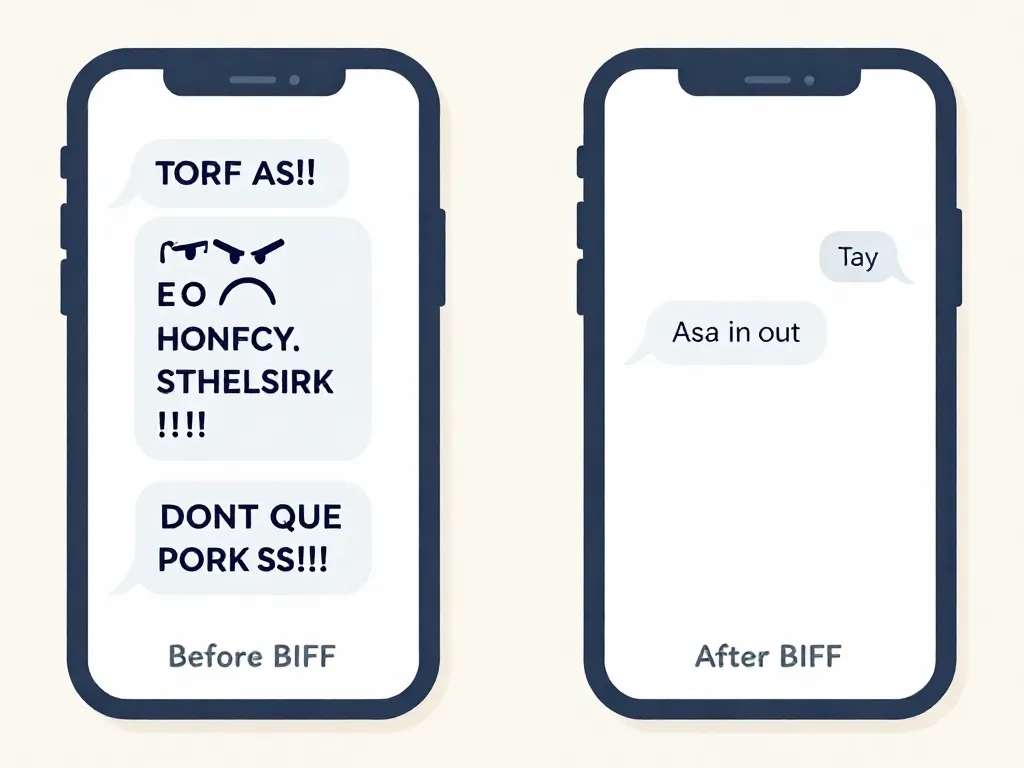
The BIFF Communication Method for High-Conflict Co-Parenting
Developed by Bill Eddy, the BIFF method is specifically designed for communicating with high-conflict personalities. Every message you send should be:
- Brief — Two to five sentences maximum. Long messages give them material to twist.
- Informative — Stick to facts. Dates, times, logistics. No opinions, no emotions, no accusations.
- Friendly — Not warm, not cold. Neutral and polite. "Thanks for letting me know" goes a long way.
- Firm — End the conversation. Don't leave openings for debate. "I'll follow the parenting plan as written" is a complete response.
BIFF in Action
The message you receive:
"You NEVER check whether the kids have done their homework. I'm always the one who has to clean up your mess. You clearly don't care about their education. My mom agrees you've always been irresponsible."
The response you want to send:
A 400-word breakdown of every time you've helped with homework since 2021, plus a pointed comment about their mother's involvement in your parenting.
The BIFF response:
"The kids completed their homework on Sunday evening before bed. Let me know if there's a specific assignment you're concerned about."
Notice what this response does: it addresses the legitimate concern (homework), provides a fact (it was completed), and closes with a specific, bounded question. What it doesn't do is defend, explain, or counter-attack.
The 24-Hour Rule
Unless there's a genuine emergency involving your children's safety, wait 24 hours before responding to any provocative message. This does three things:
- It lets your nervous system calm down so you respond from logic, not adrenaline
- It denies your ex the instant emotional reaction they're seeking
- It gives you time to run your draft through the BIFF filter
Set a reminder on your phone if you need to. The message will still be there tomorrow—and your response will be ten times better.
Parallel Parenting: The Realistic Alternative
Cooperative co-parenting requires two cooperative people. When that's not possible, parallel parenting is the evidence-based alternative.
Parallel parenting means:
- Each parent runs their own household independently
- Communication is limited to essential logistics only
- Decisions are divided by category (e.g., one parent handles medical, the other handles education) rather than made jointly
- Transitions happen in neutral locations with minimal direct contact
- A detailed parenting plan covers as many scenarios as possible, reducing the need for negotiation
What Parallel Parenting Looks Like Day to Day
| Cooperative Co-Parenting | Parallel Parenting |
|---|---|
| Frequent, flexible communication | Structured, minimal communication |
| Joint decision-making on most issues | Divided decision-making authority |
| Attending events together | Attending events separately |
| Adapting the schedule informally | Following the written schedule exactly |
| Sharing details about daily life | Sharing only essential child-related info |
Parallel parenting isn't the "lesser" option. For high-conflict situations, it's the healthier option—especially for your kids, who benefit most from reduced parental tension.

Document Everything (Without Becoming Obsessive)
With a high-conflict co-parent, your memory is not enough. You need a paper trail. But documentation should protect you, not consume you.
What to Document
- Schedule changes: Who requested them, when, and whether they were agreed upon
- Late pickups/dropoffs: Date, time, and how late
- Concerning messages: Screenshots with timestamps
- Violations of the parenting plan: Specific details, not interpretations
- Children's statements: What they said, in their words, without prompting them
What Not to Document
- Every minor annoyance (they were 3 minutes late once)
- Your emotional reactions to their behavior
- Secondhand information from friends or family
- Things your kids say that you've asked leading questions about
Keep a simple log—a shared Google Doc, a notes app, or a dedicated co-parenting journal. The goal is to have facts available if you need them for court or mediation, not to build a case out of resentment.
Set Boundaries That Actually Hold
Boundaries with a high-conflict ex aren't about telling them what to do—they won't listen. Boundaries are about defining what you will do.
Examples of Enforceable Boundaries
- "I will only respond to messages about the children's schedule, health, or safety."
- "I will not engage in conversations that include name-calling. I will end the conversation and revisit the topic in 24 hours."
- "I will communicate only through [the co-parenting app / email]. I will not respond to texts about parenting matters."
- "I will follow the parenting plan as written. I will not negotiate changes via phone call."
Notice these are all "I will" statements, not "You need to" statements. You can't enforce their behavior—but you can enforce your own.
When They Test Your Boundaries (And They Will)
High-conflict individuals will push harder when you first set boundaries. Expect an extinction burst—a temporary increase in the exact behavior you're trying to limit. They'll send more texts. They'll escalate the tone. They'll try new angles.
This is not a sign that your boundaries are failing. It's a sign that they're working. Hold steady.
If boundary violations involve custody agreement breaches, document them and consult your attorney. If they involve harassment, that's a legal matter, not a communication problem.
Protect Your Kids Without Badmouthing Your Ex
Your children don't need you to explain that their other parent is difficult. They'll figure that out on their own, eventually. What they need from you right now is stability, calm, and the freedom to love both parents without guilt.
Practical ways to protect them:
- Never use them as messengers. "Tell your dad that..." puts them in the middle.
- Don't interrogate them after visits. Ask open-ended questions: "What was the best part of your weekend?" not "Did Mom's boyfriend stay over?"
- Validate their feelings without editorializing. "It sounds like that was frustrating" instead of "Yeah, your dad always does that."
- Keep your adult support system separate from your children. Vent to your therapist, your friend, your journal—not your 10-year-old.
- Consider family therapy for your kids if they're showing signs of stress, anxiety, or behavioral changes.
Build Your Support System
Co-parenting with a high-conflict ex is a long game, and you cannot play it alone.
- A therapist who understands high-conflict dynamics is worth their weight in gold. Look for someone experienced in family systems or personality disorders.
- A family law attorney you can consult periodically—not just in emergencies—helps you stay proactive rather than reactive.
- A structured communication tool takes the guesswork out of agreements. AI-powered mediation platforms like Servanda can help you create clear, written agreements and keep communication focused when emotions run high.
- A trusted friend or family member who can be your sounding board—someone who will tell you honestly when you're overreacting and when you're under-reacting.
You don't need all of these at once. Start with whichever gap feels most urgent.
When It Crosses the Line: Recognizing Abuse
High-conflict co-parenting is exhausting. But some situations cross from difficult into dangerous. Seek immediate professional help if your co-parent:
- Threatens physical harm to you or the children
- Stalks, surveils, or shows up uninvited
- Uses the children to intimidate or control you
- Violates protective orders
- Engages in parental alienation that is causing measurable harm to your children
This guide is about managing conflict within the bounds of difficult but non-abusive dynamics. If you're experiencing abuse, contact the National Domestic Violence Hotline at 1-800-799-7233 or your local family court for emergency protective measures.
Frequently Asked Questions
How do I co-parent with someone who refuses to communicate?
When your co-parent won't respond or stonewalls, shift to written communication only (email or a co-parenting app) and document your attempts to communicate. Follow the parenting plan exactly as written, and if their non-communication leads to missed pickups or schedule confusion, log the details. You can't force someone to engage, but you can create a clear record showing that you tried.
Should I respond when my ex sends angry, accusatory messages?
Only respond to the logistical or child-related content in the message—ignore the rest entirely. If the entire message is purely an attack with no actionable content, you don't need to respond at all. Silence is a complete sentence, and not every provocation deserves your energy.
What's the difference between parallel parenting and co-parenting?
Cooperative co-parenting involves frequent communication, shared decision-making, and flexibility between households. Parallel parenting minimizes direct contact, divides decision-making authority, and relies on a detailed parenting plan to reduce the need for negotiation. Parallel parenting is specifically designed for situations where direct communication consistently leads to conflict.
Can a high-conflict co-parent ever change?
Some can, with sustained professional help and genuine motivation. But waiting for that change—or making your well-being dependent on it—is a losing strategy. Focus on building systems that work regardless of whether your co-parent changes, and let any improvement be a pleasant surprise rather than something you're banking on.
How do I handle my ex badmouthing me to our kids?
Resist the urge to counter with your own version of events. Instead, give your children a safe space to express their feelings and gently reinforce that they're allowed to love both parents. If the badmouthing is severe and persistent, document specific incidents and discuss them with your attorney or a family therapist, as this may constitute parental alienation.
Moving Forward, One Interaction at a Time
Co-parenting with a high-conflict ex isn't a problem you solve once—it's a situation you manage over time, one interaction at a time, one boundary at a time. Some weeks will feel like progress. Others will feel like you're back at square one.
But here's what's true even on the hardest days: every time you choose a measured response over a reactive one, every time you hold a boundary instead of caving to keep the peace, every time you shield your kids from adult conflict—you're building something. You're building stability. You're modeling emotional maturity. And you're showing your children what it looks like to handle difficult people with dignity.
You didn't choose this situation. But you're choosing, every day, how to move through it. That matters more than you know.