Blended Family Chore Chart That Actually Works
It's 8:47 p.m. on a Wednesday. The dishes from dinner—dinner you cooked—are still stacked in the sink. Your partner's kids left their shoes in the hallway again, and your own teenager hasn't touched the trash despite being asked three times. You bite your tongue, but something sharper is building underneath: Why am I the only one who cares about this house?
In a blended family, household chores become a lightning rod for deeper tensions—fairness, respect, whose rules matter, and who belongs. A chore chart isn't just an organizational tool. It's a framework for reducing the invisible resentment that erodes relationships one unwashed dish at a time.
Why Chore Conflicts Hit Blended Families Harder

In a first-marriage household, chore disagreements are frustrating. In a blended family, they're loaded.
Every unbalanced task carries a subtext. When a stepparent picks up after stepchildren without acknowledgment, their effort—and their role—feels invisible. When a biological parent senses their kids are being held to stricter standards than their partner's, protectiveness kicks in fast. When kids shuttle between two homes with different rules, consistency feels impossible.
What's really happening beneath the chore argument:
- Fairness anxiety: "My kids do more than yours" is rarely about dishes. It's about whether both sides of the family are valued equally.
- Role ambiguity: Stepparents often don't know how much authority they have—or should have—when assigning tasks.
- Loyalty conflicts: Kids resist chores assigned by a stepparent because compliance feels like a betrayal of their other biological parent.
- Invisible labor resentment: One partner—usually the one who manages the household mentally—carries a disproportionate load that no chart captures.
Step 1: Audit the Full Picture Before Assigning Anything
Before you write a single name on a chart, sit down together—just the two of you, without kids—and map out everything that keeps the household running.
This means going beyond the obvious (vacuuming, cooking, mowing) and including the invisible work:
- Scheduling appointments and school events
- Coordinating custody handoffs
- Buying birthday gifts, stocking the pantry, remembering picture day
- Emotional labor: checking in with a child who's struggling, mediating sibling conflicts
- Managing communication with ex-partners about logistics
A practical exercise:
| Daily Tasks |
Weekly Tasks |
Invisible/Mental Labor |
| Dishes |
Grocery shopping |
Scheduling appointments |
| Cooking dinner |
Laundry (all loads) |
Coordinating custody logistics |
| Wiping counters |
Bathroom cleaning |
Monitoring kids' homework |
| Packing lunches |
Vacuuming/mopping |
Restocking household supplies |
| Tidying common areas |
Yard work |
Managing school communications |
Be honest about who currently does what. This isn't about blame—it's about visibility. Many couples discover that one partner handles 70-80% of household management without either person fully realizing it.
A couple we'll call Marcus and Dana tried this exercise after months of bickering. Marcus was genuinely surprised to see that Dana managed not only most of the cooking and cleaning but also all communication with his ex-wife about his sons' schedules. "I thought we were pretty even," he admitted. They weren't—and the invisible gap was fueling Dana's growing withdrawal.
Step 2: Separate "Couple Decisions" from "Kid Assignments"

This is where most blended family chore charts fail. They jump straight to assigning kids tasks without the adults first agreeing on the framework.
The adults align first.
Before involving children, agree on these foundational questions:
- What standard of clean is "good enough"? If one of you grew up in a spotless home and the other is comfortable with some clutter, you need a shared baseline—not one person's standard imposed on everyone.
- What's age-appropriate? A 7-year-old and a 14-year-old shouldn't have identical expectations. Agree on tiers.
- Who enforces chores for which kids? In most successful blended families, the biological parent takes the lead on enforcement for their own children, especially in the first few years. The stepparent supports, but doesn't become the "chore police."
- What happens when kids are at their other parent's house? Chores need to flex around custody schedules. A child who's only home four days a week can't carry the same weekly load as a full-time resident.
These conversations can be difficult. If emotions run high when you try to negotiate household agreements like these, tools like Servanda can help you create structured, written agreements that prevent conflicts from recycling.
Then involve the kids—strategically.
Once the adults are aligned, bring the children in with some choices already made and some left open. Kids follow through when they have agency.
Present the list of household tasks and let each child choose a few from their age-appropriate tier. You're not asking if they'll contribute. You're asking how.
Step 3: Design the Chart for Your Actual Life
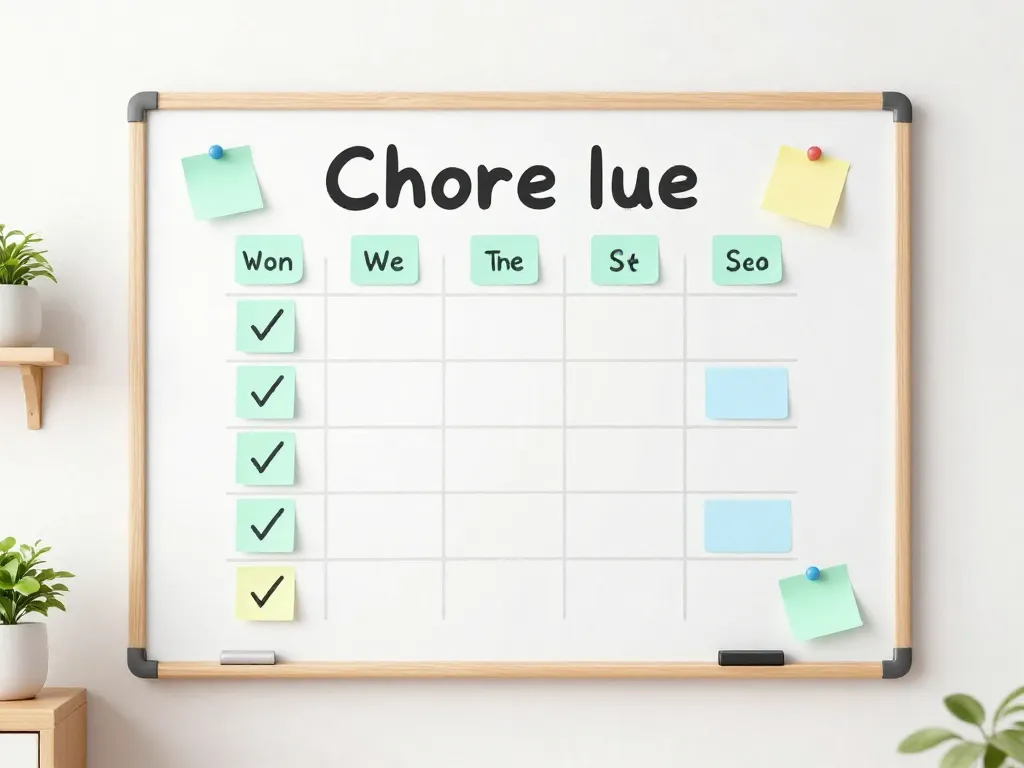
A blended family chore chart needs to account for variables that a standard household chart doesn't:
- Rotating custody schedules (kids present some weeks, not others)
- Age differences across step-siblings
- Different expectations kids may have from their other home
- Weekday vs. weekend energy levels
What the chart should include:
- Names: Every household member, adults included. Kids notice when parents exempt themselves.
- Tasks with clear definitions: "Clean the kitchen" means different things to different people. Spell it out: wipe counters, load dishwasher, sweep floor.
- Frequency: Daily, weekly, or as-needed.
- Rotation dates: If tasks rotate, when does the switch happen?
- A custody overlay: Mark which days each child is home so expectations are realistic.
- Whiteboard in the kitchen: Visible, easy to update, low-tech. Works well for younger kids.
- Shared digital list (Google Sheets, Trello, a family app): Better for teens and households with complicated schedules.
- Printed weekly chart on the fridge: Simple, tangible, effective for families who need a physical anchor.
Step 4: Build In Flexibility (Without Letting It Collapse)
Rigid systems break. A child comes home exhausted from a custody transition. Someone gets sick. A work deadline makes cooking impossible for a few days.
Build flex into the system from the start:
- "Swap" rules: Any family member can swap a chore with another person if both agree. This teaches negotiation and keeps resentment low.
- "Grace day" allowance: Each person gets one pass per week—no questions asked—as long as the task gets done within 24 hours.
- Monthly check-ins: Set a recurring date (the first Sunday of the month, for example) to review what's working and what isn't. Blended families evolve quickly—kids get older, custody schedules change, someone starts a new job.
What a check-in sounds like:
- "What's feeling unfair right now?"
- "Is there a task that's way harder than we thought? Should we redistribute?"
- "Kids, is there anything you'd like to swap or change?"
Keep it low-stakes. If the check-in feels like a tribunal, no one will be honest.
Step 5: Handle the Hard Part—When It's Not About Chores
Sometimes a child refuses to do their chores, and the real issue is that they resent the stepparent, miss their other home, or feel displaced by stepsiblings.
Watch for these signals:
- A child who was previously cooperative suddenly stops contributing
- Chore refusal that only happens with stepparent-assigned tasks
- Sibling or step-sibling comparisons: "Why does he never have to do anything?"
- One partner consistently undermining the other's enforcement
Practical approaches:
- One-on-one time: The biological parent checks in privately with their child. Not to interrogate, but to listen.
- Name the transition: "I know it's hard going back and forth between houses. That's real, and I see it."
- Avoid scorekeeping language: Phrases like "I do everything around here" or "Your kids never help" escalate fast. Stick to specific, observable behaviors: "The trash didn't go out Tuesday or Thursday. Let's figure out why."
Common Mistakes to Avoid
- Creating the chart without your partner's input. A unilaterally designed chore system feels like a mandate, not an agreement. It will be resisted.
- Holding stepchildren to higher standards than biological children. Even if it's unconscious, kids detect this immediately—and it poisons the family dynamic.
- Using chores as punishment. The moment chores become punitive, cooperation dies.
- Expecting instant buy-in. A new system takes 3-6 weeks to become routine. Anticipate resistance rather than abandoning ship after day four.
- Ignoring the adults' share. If the chart is only for kids, it sends the message that household labor is a child's burden, not a family value.
A Realistic Example
Jessica and Tom have four kids between them: Jessica's daughters (ages 9 and 13) and Tom's sons (ages 11 and 15). Tom's boys are with them every other week.
Their first attempt at a chore chart fell apart within days. Jessica's 13-year-old resented doing dishes on days Tom's boys were absent. Tom's 15-year-old ignored the chart entirely and Tom didn't enforce it, which infuriated Jessica.
Here's what they changed:
- They audited invisible labor and discovered Jessica was doing nearly all the scheduling, grocery planning, and school coordination. Tom took over grocery shopping and lunch prep.
- They created two chart versions—one for weeks all four kids are home, one for weeks with only Jessica's daughters. Workload adjusts accordingly.
- Tom became the primary enforcer for his sons. Jessica stepped back from nagging, which reduced tension between her and her stepsons.
- They introduced a "swap board" where kids could negotiate trades. Tom's 15-year-old hated dishes but didn't mind vacuuming—so he swapped with Jessica's 13-year-old, who felt the opposite.
- Monthly check-ins caught small issues early. When Tom's 11-year-old said he felt overwhelmed by his tasks on custody-transition days, they lightened his Monday load.
Six months later, chore arguments dropped significantly. The fights that did happen were about specific tasks, not about deeper resentment.
Frequently Asked Questions
How do you split chores fairly in a blended family with different custody schedules?
Create separate chart versions for weeks when all children are home versus weeks when only some are present, adjusting each child's workload proportionally to the days they're in the household. This prevents full-time resident children from feeling overburdened and part-time children from being either overloaded or left out. Pairing this with a monthly check-in ensures the system stays fair as schedules evolve.
Should a stepparent assign and enforce chores for their stepchildren?
In most successful blended families, the biological parent takes the lead on assigning and enforcing chores for their own children, especially during the first few years. The stepparent plays a supportive role rather than acting as the primary enforcer, which reduces resentment and loyalty conflicts. Over time, as trust builds, the stepparent's authority can naturally expand.
What age-appropriate chores can kids do in a blended family?
Younger children (ages 6–9) can handle tasks like setting the table, tidying their rooms, and feeding pets, while preteens (10–12) can take on laundry, vacuuming, and helping with meal prep. Teenagers (13+) are generally capable of cooking simple meals, deep cleaning bathrooms, and managing yard work. The key is creating age-based tiers that both adults agree on so no child feels singled out compared to step-siblings.
How do you handle it when kids refuse to do chores in a blended family?
First, look beneath the refusal—resistance often signals discomfort with the stepparent's authority, stress from transitioning between homes, or feelings of displacement rather than simple laziness. Have the biological parent check in privately with the child to listen without judgment, and avoid scorekeeping language like "your kids never help." Address the specific behavior calmly and separately from the deeper emotional conversation.
How often should you update a blended family chore chart?
Hold a monthly check-in to review what's working, redistribute tasks that turned out harder than expected, and let kids request swaps. Blended family dynamics shift frequently due to custody changes, new school schedules, and kids aging into new responsibilities, so a chart that worked a few months ago may need significant adjustments. Treating the chart as a living agreement rather than a fixed document is what keeps it sustainable long-term.