5 Co-Parenting Conflict Styles (And How to Fix Them)
It's 9:47 PM on a Tuesday. You just got a text from your co-parent about this weekend's schedule—and within three messages, you're relitigating an argument you've had seventeen times. Your chest tightens. You start typing a paragraph-long response. Delete it. Type another. You already know how this ends: nothing gets resolved, and you both go to bed angry.
The content of your arguments usually isn't the real problem. It's the pattern. You and your co-parent have likely fallen into a specific conflict style—a predictable loop of action and reaction that replays on every topic, from holidays to homework. And until you name that pattern, you can't break it.
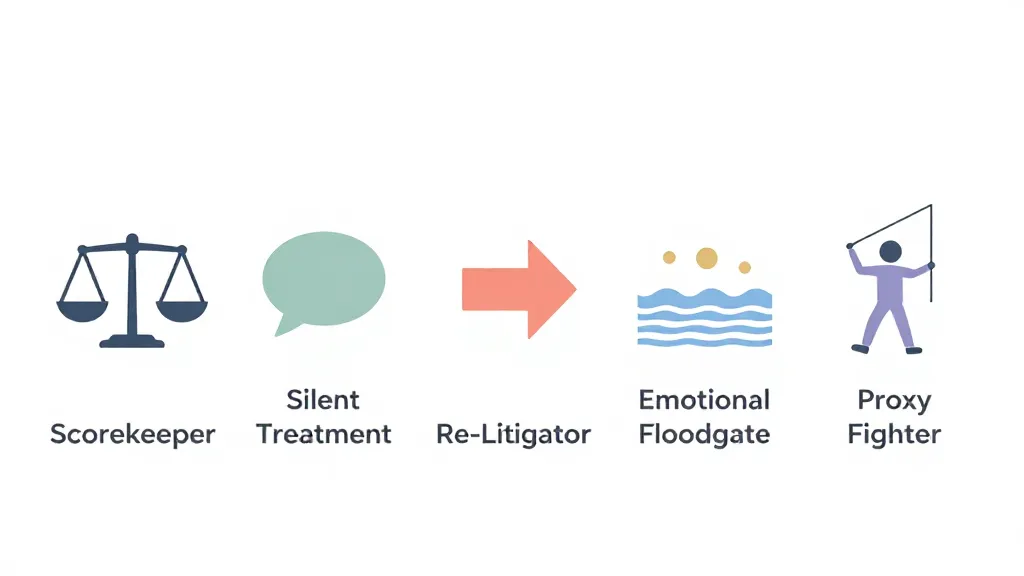
The five patterns below are the diagnosis: they explain why you keep getting stuck and where the intervention has to happen. You'll almost certainly recognize your co-parent in one of them. Resist the urge to stop there, because the leverage is in what you can change.
Style #1: The Scorekeeper
What It Looks Like
The Scorekeeper tracks every perceived imbalance—every extra pickup, every late child support payment, every time they took the kids to the dentist and the other parent didn't. Conversations get derailed by a running tally of who has done more, sacrificed more, or been more inconvenienced.
Example: Marcus asks his co-parent, Janelle, to swap weekends so he can attend a family reunion. Instead of a yes or no, the conversation becomes: "I swapped for you in March AND April. I covered three sick days this year. When was the last time you adjusted YOUR schedule for me?"
The weekend swap—a simple logistical question—never gets answered.
Why It's Destructive
Scorekeeping reframes every interaction as a transaction. Neither parent ever feels "even," and children learn that generosity comes with strings attached.
How to Fix It
- Separate the current request from the historical record. Respond to what's being asked right now before raising past grievances. Literally answer the question first: "Yes, I can swap" or "No, that doesn't work." Then, if needed, address the pattern separately.
- Create a shared tracking system. If you genuinely feel the workload is lopsided, propose a shared calendar or log—not as a weapon, but as data. When both parents can see the actual record, perceived imbalances often shrink.
- Set a quarterly check-in. Instead of litigating fairness in every text thread, agree to review the overall balance once a quarter. This contains the scorekeeping to a single, structured conversation.
Style #2: The Silent Treatment Giver
What It Looks Like
The Silent Treatment Giver doesn't yell—they vanish. They leave texts unread for days. They respond to detailed messages with "k." They're physically present at handoffs but emotionally walled off. Their weapon isn't words; it's absence.
Example: After a disagreement about summer camp costs, David stops responding to his co-parent Priya's messages entirely. Priya sends the enrollment deadline, the cost breakdown, a proposed split—all unanswered. The deadline passes. The child misses camp. David later says he "needed space."
Why It's Destructive
Silence isn't neutral. It's a decision with consequences, usually for the child. It forces the other parent into a double bind: chase the silent parent and be labeled controlling, or decide unilaterally and be labeled steamrolling. Gottman's research identifies stonewalling as one of the most corrosive behaviors in any relationship.
How to Fix It
If you're the Silent Treatment Giver:
- Recognize that silence is a response—and it's a hostile one, even if it doesn't feel that way to you. You may experience it as self-protection; your co-parent experiences it as punishment.
- Replace silence with a boundary statement: "I need 48 hours before I can respond to this. I will reply by Thursday at 5 PM." This gives you space without leaving your co-parent in limbo.
- Identify your shutdown trigger. Is it feeling criticized? Overwhelmed? Controlled? Naming the trigger lets you address it directly instead of going dark.
If you're co-parenting with a Silent Treatment Giver:
- Include clear deadlines in your messages: "Please respond by Wednesday so I can confirm enrollment."
- Build decision-making defaults into your parenting plan: "If no response is received within 72 hours, the proposing parent may proceed."
- Keep messages short, specific, and low-emotion. Walls of text trigger shutdown in avoidant communicators.

Style #3: The Re-Litigator
What It Looks Like
The Re-Litigator can't let the past stay in the past. Every current conflict becomes a doorway to old grievances—the reasons for the divorce, who did what to whom in 2019, the thing that was said at last Thanksgiving. No disagreement stays contained to its actual topic.
Example: When co-parents Aisha and Tom disagree about their daughter's screen time rules, Tom's response includes: "This is just like when you unilaterally decided to switch her schools without asking me. You've always made decisions like you're the only parent who matters."
The screen time discussion is now about trust, control, and wounds from three years ago.
Why It's Destructive
Every small conflict now carries the emotional weight of every previous one, so both parents become afraid to raise minor issues. Children pick up on that fear and learn their parents can't handle simple conversations.
How to Fix It
- Use the "one topic per conversation" rule. When you feel the pull to connect the current issue to a past one, stop. Write down the past issue if you need to. But keep this conversation about this topic.
- Adopt a strict text/email format. Start every message with the specific topic in a subject line or first sentence: "RE: Screen time rules for weeknights." This creates a structural boundary that makes it harder to drift.
- Acknowledge the pattern out loud. If your co-parent starts re-litigating, try: "I hear that the school decision still bothers you, and I'm willing to talk about that separately. Right now I need us to figure out screen time. Can we stay on that?"
- Consider formalizing your existing agreements with a tool like Servanda so that resolved issues have a documented endpoint—making it harder (and less necessary) to keep reopening them.
Style #4: The Emotional Floodgate
What It Looks Like
The Emotional Floodgate processes feelings in real-time, out loud, in the co-parenting channel. Every logistics discussion becomes an emotional conversation. They may cry during handoffs, send long messages about their feelings of betrayal, or express hurt and anger in contexts that call for a simple scheduling confirmation.
Example: When Carla asks her co-parent Miguel to confirm whether he'll pick up their son at 3 or 5 on Friday, Miguel responds with four paragraphs about how the divorce was the hardest thing he's ever been through and how he feels like he's losing his relationship with his child.
Carla still doesn't know what time to have their son ready.
Why It's Destructive
The Emotional Floodgate is often the parent doing the most emotional processing work. But when that processing happens inside the co-parenting channel, it overwhelms the other parent and blurs boundaries, until they start avoiding necessary conversations to prevent an avalanche.
How to Fix It
- Separate your processing channel from your co-parenting channel. Journal, call a friend, see a therapist—do your emotional work somewhere other than in messages to your co-parent. Your feelings are valid; the co-parenting text thread just isn't the place for them.
- Use the BIFF method for co-parenting messages. Keep communications Brief, Informative, Friendly, and Firm. Before sending, ask: Does this message contain a request, a response, or necessary information? If it's primarily emotional expression, redirect it.
- Create a 24-hour draft rule. Write the emotional message, save it as a draft, and come back a day later to rewrite it as logistics only.
A Note for the Other Parent
If your co-parent is an Emotional Floodgate, resist the urge to engage with the emotional content in the moment. Don't dismiss it ("You're being dramatic"), but don't absorb it either. A neutral redirect works: "I can see this is bringing up a lot. For now, can you let me know—3 or 5 on Friday?"

Style #5: The Proxy Fighter
What It Looks Like
The Proxy Fighter doesn't fight directly—they route conflict through the children, through new partners, through grandparents, or through attorneys. They say things like "Your daughter told me she doesn't like the food at your house" or "My mom thinks the custody schedule isn't fair." The conflict is always attributed to someone else.
Example: Instead of telling her co-parent Brian that she's unhappy with the holiday schedule, Melissa tells their 10-year-old: "I wish I could see you on Christmas morning, but your dad won't let me." The child then confronts Brian, becoming an unwitting messenger in a conflict between adults.
Why It's Destructive
This is the most harmful style because it puts children inside adult disputes. Children who serve as messengers, spies, or emotional caretakers between parents are at elevated risk for anxiety, depression, and loyalty conflicts.
How to Fix It
- Commit to direct communication. If you have a problem with your co-parent, tell your co-parent, not your child, not your mother, not your new partner. Direct conflict is healthier than triangulated conflict, even when it's messy.
- Remove children from the information chain entirely. Children should never carry messages, relay schedule changes, or report on the other parent's household. If you catch yourself asking your child questions about your co-parent's life, stop.
- When your child brings a "message," redirect it. If your child says "Mom says you need to pay for the field trip," respond with: "Thanks for letting me know, buddy. That's something for me and Mom to work out—you don't need to worry about it." Then contact your co-parent directly.
- Call out triangulation without attacking. If your co-parent is routing conflict through others, name the pattern: "I'd rather hear your concerns directly from you. Can we set up a time to talk about the holiday schedule?"
How to Identify Your Own Style
Four questions:
- After a co-parenting disagreement, what do I do first? (Calculate what I'm owed? Shut down? Bring up the past? Vent my feelings? Tell someone else?)
- What would my co-parent say my conflict style is? Even if you think they'd be unfair, their perception reveals something real.
- What did I see modeled in my own family growing up? Conflict styles are almost always inherited. You fight the way you were taught to fight.
- What am I afraid will happen if I communicate directly, calmly, and in the present moment? The answer to this question usually reveals why you've adopted your particular style.
You and your co-parent may have complementary destructive styles: a Scorekeeper and a Silent Treatment Giver, locked in a cycle where one pursues and the other withdraws. Recognizing the pair, not just your own, is often the breakthrough.
Breaking the Cycle: One Pattern Change Shifts Everything
You don't need your co-parent's cooperation to change the dynamic. These patterns are dances, and when one person changes their steps, the dance changes. That isn't fair. It is effective.
Start with the smallest possible change:
- If you're a Scorekeeper, answer the next logistical question without mentioning the tally.
- If you're a Silent Treatment Giver, send a one-sentence response within 24 hours.
- If you're a Re-Litigator, keep your next message to one topic only.
- If you're an Emotional Floodgate, write the emotional message—then rewrite it as logistics.
- If you're a Proxy Fighter, have one conversation directly with your co-parent that you would normally route through someone else.
One change is enough to prove to yourself that a different pattern is possible.
FAQ
What is the most common co-parenting conflict style?
Scorekeeping and re-litigation are the two most frequently reported patterns among co-parents. They're especially common in the first two years after separation, when feelings of inequity and unresolved hurt are at their peak. Many co-parents exhibit a combination of styles that shift depending on the topic and their stress level.
How do I deal with a co-parent who won't communicate at all?
If your co-parent consistently refuses to respond, focus on what you can control. Build decision-making defaults into your parenting plan (e.g., if no response within 72 hours, the proposing parent proceeds). Keep all communication in writing. Document your attempts to communicate. And consider whether parallel parenting—where each parent operates independently within agreed-upon boundaries—might be more realistic than cooperative co-parenting for now.
Should co-parents go to therapy together?
Co-parenting counseling (distinct from couples therapy) can be effective, especially when both parents are stuck in complementary conflict patterns. A skilled co-parenting therapist acts as a neutral third party who can name the patterns, interrupt the cycles, and help build new communication structures. It's not about reconciliation—it's about functional collaboration.
How do co-parenting conflict styles affect children?
Children are acutely sensitive to the way their parents communicate, not just whether they argue. Scorekeeping teaches children that love is transactional. Silent treatment models emotional avoidance. Re-litigation creates chronic anxiety. Emotional flooding overwhelms children's developing regulation systems. Proxy fighting forces them into adult roles. Changing your conflict style protects your child's emotional development.
None of these five are character flaws. They're coping strategies that made sense during the worst chapter of your life, and that now sabotage the long game of raising a child with someone you're no longer with. Naming the pattern is most of the work. You'll fall back into it sometimes. Each time you don't, the cycle gets weaker.