
Cofounder Breakup: How to Know When It's Over
You used to finish each other's sentences in pitch meetings. Now you can barely finish a conversation without one of you shutting down or walking out. The Slack messages that once had exclamation points and rocket emojis have been replaced by terse, one-word replies—or silence. You tell yourself every partnership has rough patches. You tell yourself it'll get better after the fundraise, after the launch, after the next hire. But deep down, a question keeps nagging: Is this thing already over?
You're not alone. Research from Harvard Business School professor Noam Wasserman found that 65% of high-potential startups fail due to conflict among cofounders. And yet, most founders have zero framework for distinguishing a rough season from a terminal diagnosis. This article gives you that framework—drawn from real cofounder post-mortems, including Yiren Lu's candid account of her own cofounder breakup—so you can see the red flags clearly and make the hard call before it destroys both you and the company.
Key Takeaways
- Not all conflict is fatal. Healthy cofounders fight about strategy; dysfunctional ones fight about trust, values, and identity. Learn to tell the difference.
- Five concrete red flags predict a cofounder relationship that's past the point of repair—contempt, silent vetoes, divergent visions, effort asymmetry, and emotional dread.
- The "Would I choose this person again?" test is the single most honest diagnostic question you can ask yourself.
- Staying too long is more expensive than splitting. The sunk-cost fallacy kills more startups than early breakups do.
- A structured, documented separation protects both people. Cofounder breakups handled poorly can generate lawsuits, IP disputes, and reputational damage that lasts years.

The Anatomy of a Cofounder Breakup: Lessons from Real Stories
In 2023, software engineer and writer Yiren Lu published a searingly honest essay about the dissolution of her cofounder relationship. The details were specific—disagreements over product direction, a widening gap in day-to-day commitment, a growing sense that the partnership had become performative—but the pattern was universal. What struck readers wasn't the drama. It was the familiarity.
Lu described a slow erosion, not a sudden explosion. There was no single betrayal. Instead, dozens of small disappointments compounded until the relationship was hollowed out from the inside. She stayed longer than she should have because the sunk costs—emotional, financial, reputational—felt too large to walk away from.
Her story mirrors what researchers and startup accelerators see over and over. Y Combinator's internal data has shown that cofounder conflict is the leading cause of early-stage startup death. And the pattern is almost always the same: the relationship dies slowly, the founders notice too late, and the breakup is messier than it needed to be.
Let's look at the specific red flags that signal you've crossed the line from "normal startup stress" into "this partnership is over."
Five Red Flags That Signal a Cofounder Breakup Is Inevitable
1. Contempt Has Replaced Respect
Relationship researcher John Gottman famously identified contempt—eye-rolling, sarcasm, dismissiveness—as the single strongest predictor of divorce. The same principle applies to cofounder relationships.
Healthy cofounders can disagree fiercely about a pricing model and still walk away thinking, "They're wrong, but I get why they see it that way." When contempt takes over, the internal monologue shifts: "They're wrong because they don't get it. They've never gotten it."
Watch for these signs:
- You describe your cofounder to friends or advisors with words like "clueless," "lazy," or "impossible"
- You've stopped explaining your reasoning because you've decided they won't understand
- You feel a flash of irritation—not curiosity—when they share a new idea
- Board meetings or investor calls feel like performances where you mask your real feelings about your cofounder
Contempt is corrosive because it poisons the assumption of good faith. Once you stop believing your cofounder is competent and well-intentioned, every disagreement becomes evidence for a prosecution rather than a problem to solve together.
2. The Silent Veto
In Lu's account, one of the most telling dynamics was the emergence of what I call the "silent veto." One cofounder stops openly disagreeing and instead simply... doesn't execute. Decisions get made in meetings but never implemented. Timelines slip. Commitments evaporate.
This is different from procrastination or being overwhelmed. The silent veto is passive resistance. It looks like:
- Agreeing to a plan in person, then doing nothing to advance it
- Consistently "forgetting" to follow through on commitments that reflect the other cofounder's priorities
- Reintroducing already-decided debates weeks later as if the decision never happened
- Building features, hiring people, or making commitments outside the agreed-upon plan
The silent veto is especially dangerous because it's deniable. If you confront it, the response is usually, "I just got busy" or "I thought we were still discussing that." But the pattern is unmistakable once you see it: one person has opted out of the shared project without saying so.

3. Your Visions for the Company Have Fundamentally Diverged
Early-stage disagreements about tactics—which channel to prioritize, whether to hire a salesperson or an engineer next—are normal and even healthy. But a divergence in vision is a different animal entirely.
Ask yourself:
- If the company succeeds wildly, do you and your cofounder picture the same company five years from now?
- Do you agree on what kind of business this is? (Venture-scale vs. profitable lifestyle business? B2B vs. B2C? Platform vs. services?)
- When you talk about "why we're doing this," do you mean the same thing?
One anonymous founder I spoke with described the moment he realized it was over: "I wanted to build a category-defining SaaS company. She wanted to build an agency that used our tool. Neither was wrong. But they were fundamentally different businesses, and every single decision we made—hiring, pricing, product roadmap—was a proxy war for which company we were actually building."
Vision divergence is not a communication problem. It's a compatibility problem. No amount of offsites or facilitated conversations will resolve it, because neither person is wrong—they're just wrong for each other.
4. The Effort Gap Has Become a Chasm
Startup life is inherently uneven. There will be weeks when one cofounder carries more weight because of a product launch, a family emergency, or a fundraising sprint. That's normal.
What's not normal is a sustained, structural imbalance where one cofounder is consistently working at a fundamentally different intensity level than the other. Signs include:
- One founder is routinely unavailable during critical periods without explanation or apology
- You've stopped assigning important tasks to your cofounder because you don't trust they'll get done
- The team has noticed and started routing around one cofounder entirely
- Conversations about workload feel like accusations rather than planning
Yiren Lu described this dynamic in her own breakup—the creeping realization that she and her cofounder were not equally invested in the day-to-day reality of building the company. This is especially painful because it feels personal. It's hard to separate "you're not working hard enough" from "you don't care enough—about the company, or about me."
The effort gap becomes fatal when it breeds resentment on one side and guilt (or defensiveness) on the other. At that point, every interaction is colored by an unspoken ledger of who's given more.
5. You Dread Interacting With Your Cofounder
This is the red flag that founders are most reluctant to name, because it feels irrational. You can't point to a specific betrayal. You might not even be able to articulate what's wrong. But the feeling is unmistakable:
- You feel a sinking sensation when their name appears on your phone
- You delay responding to their messages
- You find yourself fantasizing about what the company would look like if you were running it alone
- Sunday nights are heavy with dread—not about the work, but about facing your cofounder
This emotional signal is data. Your nervous system is telling you something your rational mind hasn't accepted yet: the trust is gone. And without trust, you don't have a partnership. You have an arrangement.
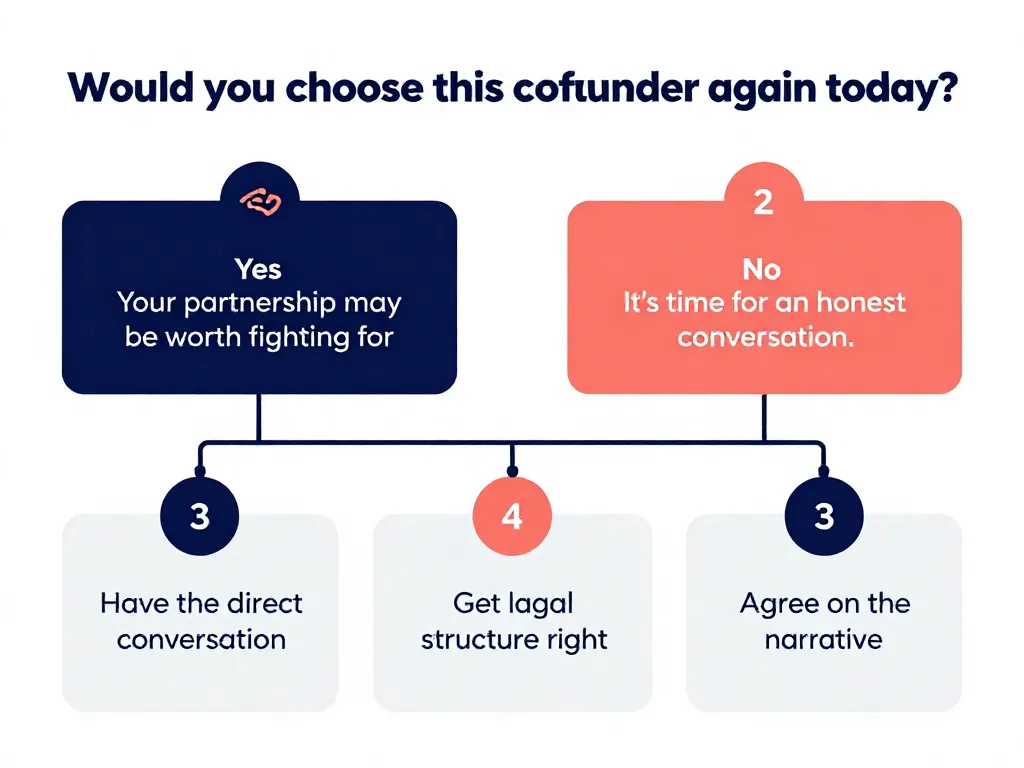
The Diagnostic Question Every Founder Should Ask
If you're reading this article and nodding along, try this exercise. It comes from a venture capitalist who's mediated dozens of cofounder separations:
"Knowing everything you know now—their strengths, their weaknesses, how they handle pressure, how they communicate—would you choose this person as your cofounder today?"
Not "Do I owe them loyalty?" Not "Would leaving be too disruptive?" Just: would you choose them?
If the answer is an immediate, gut-level "no," that tells you something important. It doesn't mean you have to leave tomorrow. But it means the relationship is failing on its most fundamental terms.
Why Founders Stay Too Long (and Why It's So Costly)
Most cofounder breakups happen 6-18 months later than they should. The reasons are predictable:
- Sunk-cost fallacy. "We've been through so much together. I can't throw that away."
- Fear of external perception. "What will investors think? What will the team think?"
- Identity entanglement. The startup is the relationship. Leaving the cofounder feels like leaving the company.
- Guilt. "They moved across the country for this. I can't abandon them."
- Hope without evidence. "Maybe once we close this round, things will improve."
But the cost of staying in a dead cofounder relationship compounds daily. The team feels the tension. Decision-making slows to a crawl. Investors sense the dysfunction. And the emotional toll on both founders bleeds into every part of their lives.
A clean, structured breakup at month six is almost always less destructive than a messy collapse at month eighteen.
How to Navigate the Breakup Once You've Decided
If you've recognized the red flags and decided it's time, the process matters enormously. Cofounder breakups handled poorly generate lawsuits, destroy cap tables, and poison reputations. Here's how to do it right:
Have the Honest Conversation First
Don't ghost. Don't hint. Don't let it come out in a board meeting. Have a direct, private conversation where you name the reality: "I don't think our partnership is working, and I think we need to talk about what a separation looks like."
This conversation will be uncomfortable. That's okay. Discomfort is not the same as cruelty. In fact, the kindest thing you can do is tell the truth before things get worse.
Get the Legal and Financial Structure Right
Before you have the emotional conversation, know the answers to these questions:
- What does your operating agreement say about departures?
- How is equity currently allocated, and what vesting provisions exist?
- Who owns the IP, and is that documented?
- Are there personal guarantees, loans, or shared credit lines?
If you never formalized these things—and many early-stage cofounders haven't—this is where the breakup gets expensive. AI-powered platforms like Servanda can help cofounders create written agreements that prevent these exact disputes, but if you're past that point, you'll need a startup attorney to help structure the separation.
Agree on the Narrative
You'll need to tell your team, your investors, and your network what happened. The worst outcome is two contradictory stories circulating simultaneously. Before you announce anything, agree on a shared, truthful narrative. It doesn't have to be detailed. "We realized we had different visions for the company's future and decided a separation was the best path forward" is honest and sufficient.
Protect the Company
If the company is going to survive the breakup, the departing cofounder needs a clean transition plan: knowledge transfer, customer introductions, access handoffs. Set a specific timeline—30 to 60 days is standard—and put it in writing.
When It's Not Over: Signs Your Partnership Can Be Saved
Not every rough patch is terminal. Some cofounder relationships hit bottom and come back stronger. Here's what distinguishes a fixable partnership from a dead one:
- Both people want to fix it. Not just one person dragging the other to therapy. Both cofounders independently express a desire to repair the relationship.
- The problems are situational, not structural. Stress from a fundraise or a bad quarter is different from incompatible values or divergent visions.
- You still respect each other's competence. If you genuinely believe your cofounder is excellent at what they do, disagreements can be resolved. If you've lost respect for their judgment entirely, they can't.
- You can name the problem specifically. "We need to restructure decision-making authority" is solvable. "I just don't trust them anymore" usually isn't.
If you're in a gray area, try setting a specific, time-bound experiment: "Let's implement these three changes for 60 days and honestly assess whether things have improved." A clear timeline prevents indefinite hope from substituting for real change.
FAQ
How do I know if my cofounder disagreements are normal or a sign we should split?
Normal disagreements center on what to do—strategy, tactics, priorities. Dangerous disagreements center on who we are—values, commitment levels, and the fundamental purpose of the company. If you're fighting about the same core issues repeatedly with no resolution, and the fights are generating contempt rather than clarity, that's a signal worth taking seriously.
Can a cofounder breakup happen without killing the startup?
Absolutely. Many successful companies—including Tinder, Twitter, and Plaid—survived cofounder departures. The key factors are a clean legal separation, a clear transition plan, and honest communication with the team and investors. Companies die not from the breakup itself, but from a breakup handled badly.
What should I do if my cofounder wants to leave but I want to keep going?
First, resist the urge to guilt them into staying. A resentful cofounder is worse than no cofounder. Focus on negotiating a fair equity arrangement for their departure, securing a transition period for knowledge transfer, and being transparent with your investors about the change. Many VCs have seen this before and will support you if you handle it maturely.
How do I split equity when a cofounder leaves?
This depends heavily on your vesting schedule, operating agreement, and how much each person has contributed. If you have a standard four-year vesting schedule with a one-year cliff, the departing cofounder keeps their vested shares and forfeits the unvested portion. If you never set up vesting—a painfully common oversight—you'll need to negotiate. Get a lawyer involved early.
Should we try mediation before deciding to split?
Mediation can be extremely valuable, especially if the issues are specific and both cofounders are genuinely open to change. It's less useful when one or both people have already mentally checked out, or when the core issue is vision divergence rather than communication breakdown. A good mediator will tell you honestly if the situation is reparable or not.
Moving Forward
A cofounder breakup is one of the most painful experiences in a founder's life. It carries echoes of every other kind of breakup—romantic, familial, friendship—layered with financial stakes, public scrutiny, and the potential death of a dream you built together.
But here's what the post-mortem stories consistently show: founders who recognized the red flags and acted decisively—even when it was terrifying—came out the other side with their companies intact, their reputations preserved, and their sanity recovered. The ones who suffered most were those who saw the signs and looked away for another six months, another year, another round of funding.
If you're reading this article because something in your cofounder relationship feels broken, trust that instinct. It doesn't mean you have to decide today. But it means the conversation is overdue. And having it honestly, with clarity and structure, is the most respectful thing you can do—for your cofounder, for your company, and for yourself.