
How to Know When to Quit Your Startup
At 3 a.m. on a Tuesday, Marcus sat in his car in the parking lot outside his apartment. He couldn't go inside yet. His cofounder had just told him — over Slack, not even a phone call — that he'd pivoted their product roadmap without discussion. Again. Marcus's jaw ached from grinding his teeth. He'd lost twelve pounds in two months, not from some founder-hustle diet, but from a stomach that refused to hold food. He kept asking himself the same question: Is this just what building a company feels like, or is this something I need to walk away from?
If you're a cofounder asking a version of that question right now — maybe while doomscrolling at 2 a.m., maybe while staring at a Slack thread that makes your chest tighten — this article is for you. Knowing when to quit your startup isn't a sign of weakness. It's one of the most complex, high-stakes decisions you'll ever make, and it deserves a framework, not just a gut feeling.
Key Takeaways
- Quitting your startup is not failure — it's a strategic decision that should be evaluated with the same rigor you'd apply to any business problem.
- Your body often knows before your mind does. Chronic insomnia, unexplained weight changes, and persistent anxiety are data points, not inconveniences to push through.
- Use the "Three Signals" framework — evaluate whether the market, the team dynamics, and your personal capacity are each still viable before deciding.
- The sunk cost fallacy is the single biggest trap that keeps founders in situations that are destroying them.
- Having a written cofounder agreement with exit terms makes walking away cleaner and less traumatic for everyone involved.

The Mythology That Keeps You Stuck
Startup culture has a toxic relationship with quitting. The stories we celebrate are survival stories — the founder who maxed out credit cards, slept under their desk, and emerged with a billion-dollar company. What we don't talk about are the thousands of founders who did the same things and ended up with nothing but debt, broken relationships, and long-term health consequences.
This mythology is especially dangerous for cofounders in conflict. When you're fighting with your cofounder, you might interpret the misery as a test. Real founders push through. But there's a difference between productive struggle — the kind that comes from solving hard problems with a team you trust — and destructive struggle, where the company itself has become the source of harm.
Recognizing which one you're in is the first step.
What Founders Actually Feel Before They Quit
The stories that surface online and in founder communities reveal a striking pattern. Before cofounders walk away, they almost always experience a combination of physical, emotional, and cognitive symptoms that they initially dismiss.
Physical Symptoms
- Chronic insomnia or waking up at 3-4 a.m. with racing thoughts about the company
- Jaw pain, headaches, or teeth grinding (bruxism is remarkably common among stressed founders)
- Gastrointestinal problems — nausea, loss of appetite, IBS flare-ups
- Unexplained weight loss or gain
- Heart palpitations or chest tightness when you see your cofounder's name on your phone
Emotional and Cognitive Symptoms
- A sense of dread on Sunday evenings (or every evening)
- Hypervigilance — constantly scanning your cofounder's tone, words, or actions for threats
- Emotional numbness about the product or mission you once cared about deeply
- Fantasizing about the company failing so you'd have an excuse to leave
- Difficulty making even simple decisions, a phenomenon psychologists call decision fatigue
One founder, who we'll call Priya, described it this way: "I realized I was hoping our biggest client would cancel so I'd have a reason to shut everything down. When you're rooting against your own company, something is very wrong."
These symptoms aren't weakness. They're information. Treat them the same way you'd treat declining revenue or rising churn — as signals that demand investigation.
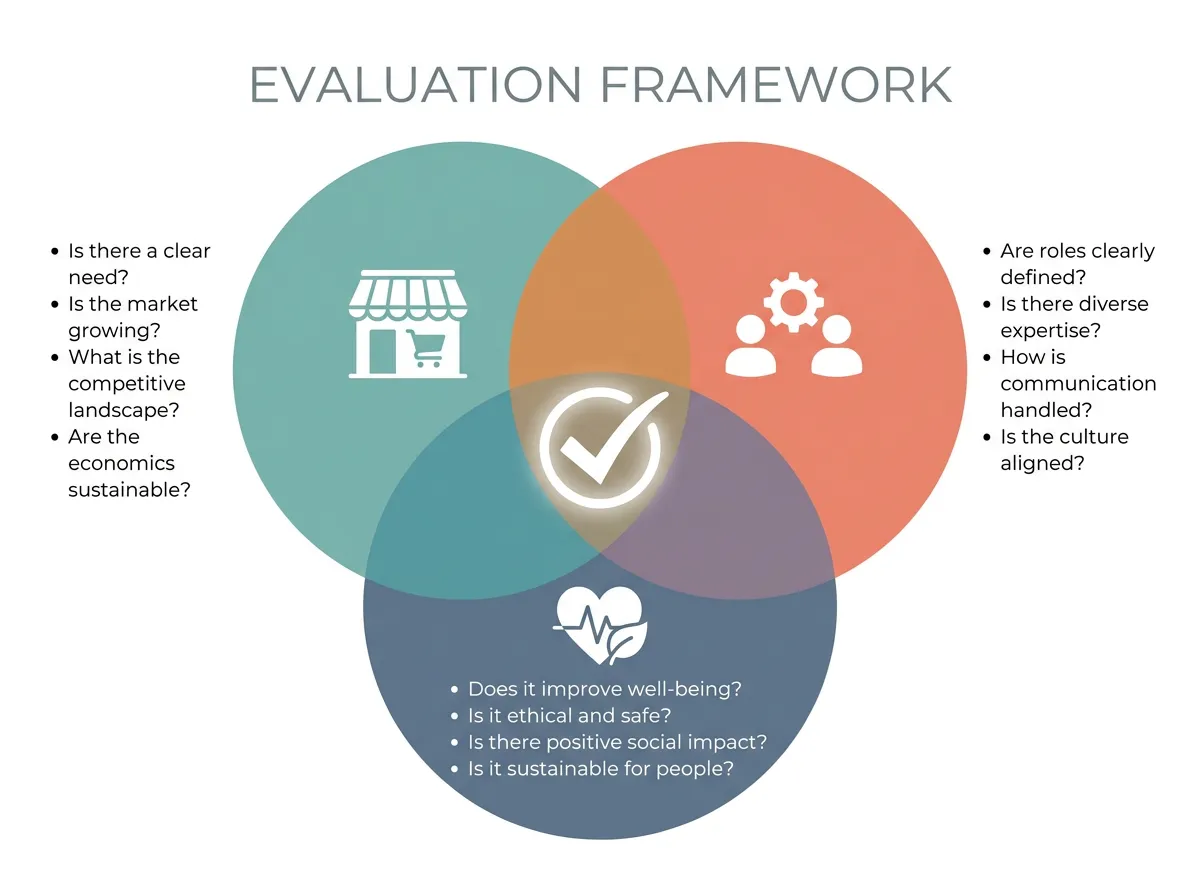
The Three Signals Framework: A Rational Way to Decide When to Quit Your Startup
Instead of relying on a single dramatic moment — a blowout fight, a missed payroll — use a structured approach. Evaluate three dimensions independently, then look at the picture they create together.
Signal 1: Is the Market Still There?
This is the most straightforward signal, and it's the one founders are usually best at evaluating because it feels "business-y" rather than personal.
Ask yourself:
- Has customer demand materially changed since we started?
- Are we seeing evidence of product-market fit, or are we still searching after 18+ months of iteration?
- Has a well-funded competitor made our positioning untenable?
- Would a rational outside investor put money into this market right now?
If the market signal is dead, quitting isn't giving up — it's reading the data correctly. Even Y Combinator tells founders that "the market doesn't care about your perseverance."
Signal 2: Is the Cofounder Relationship Repairable?
This is the signal most founders avoid examining honestly because it feels like a relationship problem rather than a business problem. But cofounder conflict is a business problem — it's the second most common reason startups fail, right after "no market need."
Honest questions to sit with:
- When was the last time you and your cofounder had a productive disagreement — one that ended with a better decision than either of you would have made alone?
- Do you trust your cofounder's intentions, even when you disagree with their judgment?
- Have you attempted structured conflict resolution (not just arguing until someone caves)?
- Is there a pattern of one cofounder making unilateral decisions?
- Have you both clearly articulated what you need to change, and has anything actually changed?
A useful litmus test: If a trusted mentor sat in on your last five cofounder conversations, would they describe what they saw as collaboration, or something else?
Some cofounder relationships hit rough patches and recover stronger. Others are fundamentally broken by misaligned values, eroded trust, or incompatible working styles. Distinguishing between the two requires honesty that's almost physically painful. Tools like Servanda can help cofounders create written agreements and structured frameworks for resolving disagreements before they become existential — but they work best when both parties are genuinely willing to engage.
Signal 3: Do You Have the Personal Capacity to Continue?
This is the signal founders feel most guilty about evaluating. It feels selfish. It feels like the question a "real founder" wouldn't ask.
Ask it anyway:
- Has your physical health materially deteriorated since you started this company?
- Are your closest relationships (partner, family, friends) being damaged?
- Have you lost the ability to feel excited about anything, not just the startup?
- If you're being honest, are you staying because you believe in the company, or because you're afraid of what quitting says about you?
- Can you sustain your current state for another 12-18 months without serious consequences?
Personal capacity isn't infinite. It's a resource, like runway. And just like runway, when it's gone, the company is over whether you "quit" or not.

The Sunk Cost Trap: Why Good Founders Make Bad Staying Decisions
You've invested two years. You've put in $50,000 of your savings. You've told your parents, your friends, your LinkedIn network. You've turned down job offers.
None of that is a reason to stay.
The sunk cost fallacy is the cognitive bias that makes us weigh past investments — time, money, reputation — when making decisions about the future. In a startup context, it sounds like:
- "We've come too far to quit now."
- "If I leave, the last two years were wasted."
- "I can't tell my investors I'm walking away."
Here's a reframe that helps: If you were starting from scratch today — no history, no sunk costs — would you choose to start this exact company, with this exact cofounder, in this exact market?
If the answer is no, the only question left is how you exit, not whether you should.
How to Quit Without Burning Everything Down
Deciding to leave is one decision. Executing the exit well is another. Here's what founders who've been through it recommend:
1. Review Your Legal Agreements First
Before you have any conversation with your cofounder, understand what your operating agreement, vesting schedule, and any cofounder agreement actually say. If you don't have written agreements — and a troubling number of cofounders don't — consult a startup attorney before making any moves.
2. Have the Conversation in Person
Not over Slack. Not over email. Not through a mutual friend. The conversation where you tell your cofounder you're leaving deserves the dignity of being face-to-face (or at minimum, a video call). Prepare what you want to say. Keep it about your own experience and decisions, not about cataloging their failures.
3. Propose a Transition Plan
Quitting doesn't have to mean vanishing overnight. Offer a 30-60-90 day transition window. Document your responsibilities. Introduce key contacts. This isn't just generous — it protects your reputation and your equity.
4. Get the Terms in Writing
Whatever you agree to — equity treatment, IP assignment, non-compete terms, public messaging — put it in a written separation agreement reviewed by both parties' attorneys. Handshake deals between departing cofounders almost always lead to disputes later.
5. Protect the Narrative (For Both of You)
Agree on a shared story for investors, employees, and the public. This isn't about spin — it's about mutual respect. "We decided to go in different directions" is fine. Airing grievances on Twitter is never fine.
The Other Side: What Founders Say After They Quit
Almost universally, founders who leave a broken startup or cofounder relationship describe the same thing: relief so profound it's physical.
"The first morning I woke up without a knot in my stomach, I cried," said one founder who left a three-year venture after irreconcilable differences with her cofounder. "I'd forgotten what it felt like to not be in constant fight-or-flight mode."
Another, a technical cofounder who walked away from a company that went on to raise a Series A without him, reflected: "Do I wonder about what could have been? Sure. But I also know I was three months away from a breakdown. No equity is worth your nervous system."
Quitting is not the end of your founder story. It's often the prerequisite for the next chapter being better.
FAQs
How do I know if I should quit my startup or just take a break?
A break can help with burnout, but it won't fix structural problems like a broken cofounder relationship or a dead market. If the issues you're escaping will be exactly the same when you return, time off is a bandage, not a solution. Use your time away to honestly evaluate the Three Signals — market, team, and personal capacity — rather than just recovering enough energy to re-enter the same situation.
Is it normal for cofounders to fight a lot?
Disagreement is normal and even healthy. What's not normal is persistent contempt, unilateral decision-making, or feeling unsafe raising concerns. Research on relationships (business and personal) consistently shows that it's not the frequency of conflict that predicts failure — it's whether conflicts get resolved or just accumulate. If you have a growing backlog of unresolved disputes, that's a red flag.
What happens to my equity if I quit my startup?
This depends entirely on your vesting schedule and operating agreement. In a standard four-year vesting arrangement with a one-year cliff, you keep whatever has vested by your departure date. Unvested shares typically return to the company. If you have no written agreement, this becomes much more complicated and potentially contentious — which is exactly why you should have one from day one.
Can I start another startup after quitting one?
Absolutely. Many successful founders have a "failed" or abandoned startup in their past. Investors and partners generally respect founders who made a hard, rational decision to walk away over those who drove a failing venture into the ground out of stubbornness. What matters is what you learned and how you conducted yourself on the way out.
Conclusion
Knowing when to quit your startup is not about finding a single dramatic breaking point. It's about honestly evaluating whether the market, your cofounder relationship, and your personal capacity still support the mission — and having the courage to act on what you find.
The startup ecosystem glorifies endurance, but endurance without discernment is just suffering. If you're reading this article at 2 a.m. with a tight chest and a clenched jaw, that's not grit. That's your body casting a vote.
You can honor the work you've done, the relationships you've built, and the vision you once shared — and still choose to walk away. Sometimes quitting isn't the opposite of building something great. It's the prerequisite.