
Cofounder Breakup Post-Mortem: Lessons From Real Splits
You built something together. Late nights shipping code, splitting a single ramen budget, texting at 2 a.m. about a pivot that might save everything. Then one morning, you realize the person sitting across from you isn't your partner anymore—they're a stranger with a different vision, a different appetite for risk, and a growing file of things they've never said out loud. The cofounder breakup doesn't arrive like a thunderclap. It creeps in like mold behind drywall: invisible until the damage is structural.
If you're reading this because you're in the middle of a split—or recovering from one—you're not alone. Cofounder conflict is the leading cause of early-stage startup failure, ahead of product-market fit and running out of cash. Yet founders rarely talk about it publicly, which means the rest of us keep repeating the same mistakes in isolation.
This article aggregates real post-mortem accounts—public essays, Hacker News threads, anonymized conversations—and distills the repeatable patterns that cause cofounders to break apart. More importantly, it gives you a framework to understand what went wrong so you can move forward.
Key Takeaways
- Most cofounder breakups follow three predictable patterns: misaligned ambition, vision drift, and unspoken resentment—often all three at once.
- The "equal partner" myth is dangerous: Undefined roles and 50/50 equity splits without clear decision-making authority create fragile partnerships.
- Breakups rarely happen because of a single event: They're the accumulation of avoided conversations over months or years.
- A formal operating agreement—written early—is your best insurance: It won't prevent disagreements, but it gives you a shared playbook for navigating them.
- Recovery is possible: A cofounder breakup isn't a career death sentence. Many founders go on to build stronger companies with clearer self-awareness.

The Anatomy of a Cofounder Breakup
When Yiren Lu published her essay about her cofounder split, the Hacker News comments exploded—not with criticism, but with recognition. Dozens of founders chimed in with their own stories, and the patterns were eerily similar. Not identical circumstances, but identical dynamics.
After studying these accounts alongside anonymized conversations from founder communities, three core patterns emerge again and again. Think of them as fault lines. Any one of them can crack a partnership. Together, they're almost always fatal.
Pattern #1: Misaligned Ambition
When "Big Enough" Means Different Things
This is the most common and most misunderstood cause of cofounder breakups. It's not that one founder is lazy and the other is a hustler—that split would be obvious early. The dangerous version is subtler: both founders are hardworking, but they have fundamentally different definitions of success.
Consider this real example (details changed):
Alex and Jordan started a SaaS company together. Two years in, they had $40K MRR and were growing 10% month-over-month. Alex wanted to raise a Series A and go after enterprise clients. Jordan wanted to stay bootstrapped, keep the team small, and optimize for personal freedom. Neither was wrong. But they'd never had this conversation explicitly, and by the time they did, each felt betrayed by the other's "sudden" change in direction.
The problem wasn't the disagreement itself. The problem was that both founders assumed alignment because they'd never tested it.
What This Looks Like in Practice
- One founder starts talking about "lifestyle business" while the other is pitching VCs
- Disagreements about hiring pace—grow fast vs. stay lean
- Different risk tolerances around personal financial runway
- One founder quietly resenting the other's side projects or outside commitments
What You Can Do About It
Have the "What does winning look like?" conversation early and revisit it every six months. Write it down. Not in a Slack message—in a document you both sign. Include:
- Target outcome: Are you building to sell, building to IPO, or building a sustainable cash-flow business?
- Timeline: How long are you each willing to operate at below-market salary?
- Risk appetite: How do you each feel about taking on debt, dilution, or personal financial exposure?
- Exit triggers: Under what conditions would either of you want to walk away?
Pattern #2: Vision Drift
The Slow Divergence Nobody Notices
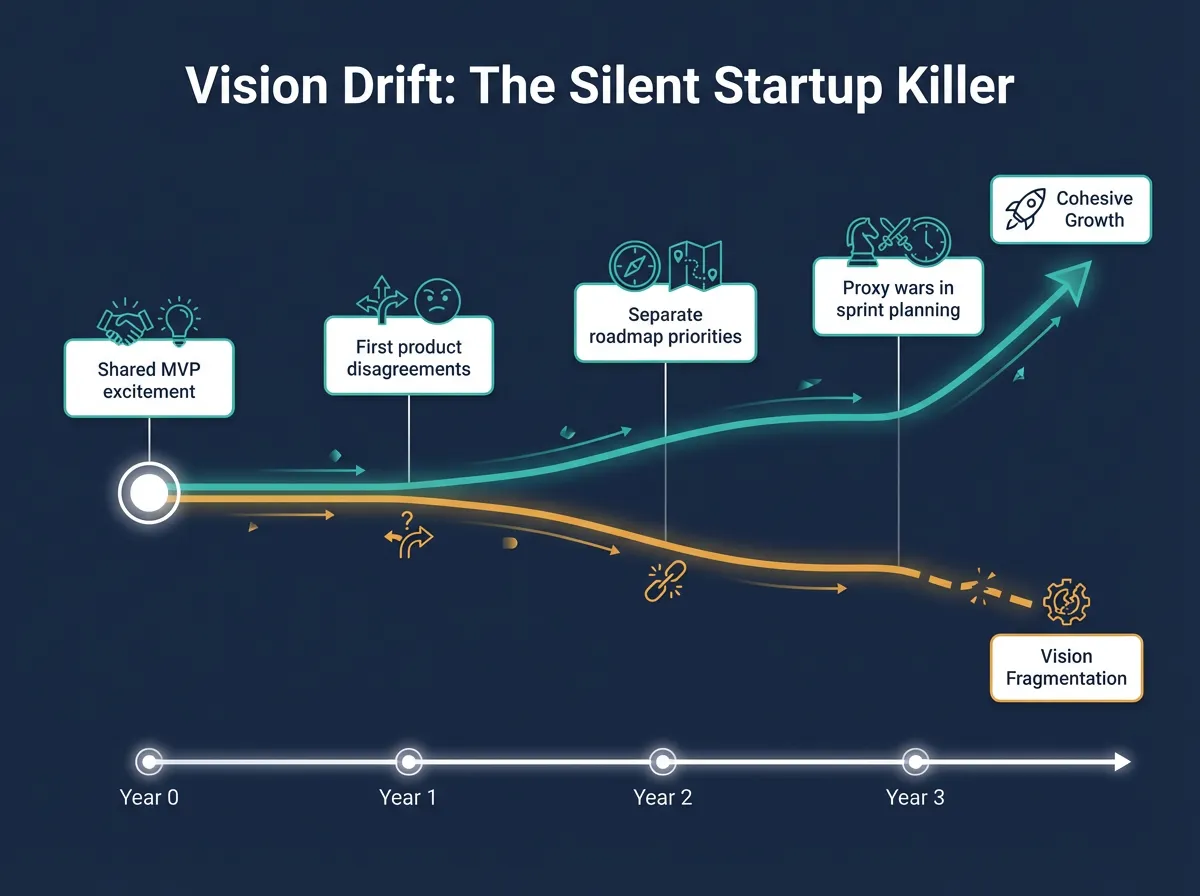
Vision drift is what happens when cofounders start the company on the same page but gradually—almost imperceptibly—move in different directions. It's the startup equivalent of growing apart in a marriage.
A recurring story from Hacker News threads goes something like this:
Sam and Taylor cofounded a developer tools company. In year one, they were completely aligned: build the best CLI tool for deploying microservices. By year two, Sam became convinced the future was a full platform play with a visual UI. Taylor believed the CLI-first approach was their competitive moat. Every product decision became a proxy war for a deeper disagreement they couldn't name. Sprint planning meetings turned into debates about company identity. Engineers started choosing sides.
Vision drift is particularly insidious because both cofounders often remember the "original vision" differently. Memory is self-serving, and each founder genuinely believes the other is the one who changed.
The Warning Signs
- Product roadmap discussions consistently stall or cycle
- Cofounders start giving different pitches to investors, customers, or new hires
- One founder starts building features or pursuing partnerships without consulting the other
- The phrase "that's not what we agreed on" becomes a recurring refrain
What You Can Do About It
Create a living strategy document—not a business plan that sits in a drawer, but a one-page artifact you revisit monthly. It should answer:
- Who is our core customer right now?
- What is the one problem we solve better than anyone?
- What are we explicitly not doing this quarter?
- What would make us change our strategy?
When cofounders argue about tactics, it's almost always a symptom of unresolved strategic misalignment. The document doesn't prevent disagreement—it makes the actual disagreement visible so you can address it directly.
Pattern #3: Unspoken Resentment
The Conversations That Never Happen
This pattern is the quietest and the most destructive. Unspoken resentment is the accumulation of small frustrations that never get aired—until they calcify into contempt.
From one anonymous post-mortem shared in a founder community:
"I didn't say anything when she took credit for the product redesign in the board meeting. I didn't say anything when she started showing up at 11 a.m. while I'd been there since 7. I didn't say anything when she hired her friend without running it by me. By the time I finally said something, I wasn't bringing up one issue—I was bringing up thirty. And she had her own list of thirty. We weren't having a conversation. We were serving each other indictments."
This account captures the dynamic perfectly. Resentment builds not from major betrayals but from dozens of micro-grievances that each feel "too small to bring up." The irony is that any one of these issues, addressed in real time, would have been a five-minute conversation. Addressed in bulk, they become evidence of fundamental incompatibility.
Why Founders Avoid These Conversations
- Fear of fragility: "If we can't handle this, maybe the partnership isn't strong enough."
- Conflict avoidance: Many founders are builders, not confronters. They'd rather route around a problem than face it head-on.
- Power dynamics: If one founder controls the technical stack or the investor relationships, the other may feel they can't push back.
- Sunk cost: "We've been through so much together—I don't want to blow it up over something small."
What You Can Do About It
Build a structured feedback cadence that normalizes difficult conversations:
- Weekly 1:1s between cofounders—not about tasks, about the partnership. A standing agenda item: "What's one thing that frustrated you this week?"
- Quarterly cofounder retrospectives: What's working? What's not? What do we need to renegotiate?
- A written operating agreement that covers decision-making authority, conflict resolution processes, and exit terms. Tools like Servanda help cofounders create these kinds of structured agreements early, so that when friction arises, there's a shared framework instead of a power struggle.
- An outside advisor or coach: Someone who is not an investor, not a friend, not an employee. Someone whose only job is to hold space for the conversations you're avoiding.

The Breakup Itself: What Real Founders Wish They'd Done Differently
Across the post-mortems studied for this article, several regrets came up repeatedly. These are the things founders said after the dust settled:
1. "We should have had a vesting schedule with a cliff."
Multiple accounts describe situations where a cofounder left early but retained a full equity stake because there was no vesting agreement. This isn't just a legal issue—it's an emotional one. The remaining founder carries the weight of building a company while their ex-cofounder benefits from equity they're no longer earning.
Action item: If you haven't already, establish a four-year vesting schedule with a one-year cliff. This is standard, and skipping it is not a sign of trust—it's a sign of avoidance.
2. "We should have defined roles clearly from day one."
The "we both do everything" approach works for the first few months. After that, it breeds confusion, duplication, and resentment. Who has final say on product? On hiring? On spending? If the answer is "we decide together," you haven't actually answered the question.
Action item: Write down explicit domains of ownership. Not just titles—actual decision-making authority. "CEO has final call on fundraising. CTO has final call on technical architecture. Both must agree on hires above $X salary."
3. "We should have talked about money earlier."
Salary expectations, personal burn rates, outside income, financial obligations—these are conversations many cofounders consider taboo. They shouldn't be. A founder who's burning through savings and a founder with a working spouse have fundamentally different risk profiles, and pretending otherwise is a ticking clock.
Action item: Share personal financial situations transparently. Agree on founder salaries (even if $0 initially) and define the triggers for revisiting compensation.
4. "We should have agreed on what 'fair' looks like before we needed it."
When the breakup happens, every discussion about equity buybacks, IP ownership, and transition timelines is poisoned by emotion. The founders who navigated their splits most cleanly were the ones who had pre-negotiated these terms while they still liked each other.
Action item: Draft a cofounder prenup. It should cover: what happens if one founder leaves voluntarily, what happens if one is asked to leave, how equity is handled in each scenario, and who retains what IP.
After the Split: What Comes Next
A cofounder breakup can feel like a death—of a relationship, of a shared dream, sometimes of the company itself. But the post-mortems also contain something else: recovery stories.
Founders who went through painful splits and came out the other side consistently report:
- Sharper self-awareness: Understanding their own working style, risk tolerance, and communication patterns
- Better partner selection: Knowing exactly what to screen for in future collaborators
- Stronger boundaries: Willingness to have uncomfortable conversations early instead of letting issues fester
- Renewed clarity: Many founders describe their next venture as "the company I should have built the first time"
The split itself isn't the failure. The failure is not learning from it.
Frequently Asked Questions
How do I know if my cofounder relationship is fixable?
If both founders are willing to have honest conversations about the underlying issues—not just the symptoms—there's usually a path forward. The relationship becomes unfixable when one or both parties have lost the willingness to try. If you find yourself dreading every interaction or building a mental case against your cofounder, that's a signal to seek outside mediation before making irreversible decisions.
What should a cofounder agreement actually include?
At minimum: equity split and vesting schedule, roles and decision-making authority, salary and compensation terms, IP assignment, what happens if a founder leaves or is asked to leave, and a defined process for resolving disputes. Think of it as the relationship's operating manual—not a sign of distrust, but a sign of maturity.
How do you split equity fairly when a cofounder leaves?
This depends entirely on your vesting agreement. If vesting is in place, the departing founder keeps their vested shares and forfeits unvested ones. If there's no vesting agreement, you're in negotiation territory—which is emotionally costly and legally complex. This is precisely why establishing vesting terms before any conflict arises is so critical.
Can you stay friends after a cofounder breakup?
Some founders do, but it usually requires time and space. The splits that preserve friendship tend to be the ones handled with transparency and clear agreements—not the ones where someone ghosts or lawyers up without warning. Treat the breakup with the same respect you'd want for yourself, and the relationship has a better chance of surviving in some form.
How long does it take to recover from a cofounder split?
Most founders describe a recovery arc of six to twelve months before they feel fully clear-headed. The legal and operational unwinding can be faster if agreements are in place, but the emotional processing takes its own time. Give yourself permission to grieve the partnership before jumping into the next thing.
Moving Forward
Cofounder breakups follow patterns. Misaligned ambition, vision drift, and unspoken resentment aren't random misfortunes—they're predictable failure modes with known countermeasures. The founders who avoid them aren't luckier or more compatible. They're the ones who did the uncomfortable work of writing things down, having hard conversations on a regular cadence, and building structural safeguards while the relationship was still healthy.
If you're in the middle of a split right now, know this: what you're feeling is normal, it's survivable, and it doesn't define your future as a founder. Extract the lessons, formalize what you can, and carry the self-knowledge forward.
The best cofounder relationships aren't the ones that never experience conflict. They're the ones that built the scaffolding to hold it.