
Early Signs Your Co-Founder Conflict Will Escalate
You used to finish each other's sentences. Now you can barely finish a meeting without one of you checking out emotionally. The pitch deck still says "we," but lately everything feels like "me vs. you."
If this sounds familiar, you're not alone — and you're not imagining things. Research consistently shows that roughly 65% of high-potential startups fail due to co-founder conflict, not because of bad markets or weak products, but because the people at the top couldn't hold it together. The tragedy isn't the breakup itself. It's that most founders only recognize the warning signs in hindsight, after the damage is done.
This article is the early-detection system you wish you'd had. Below is a practical checklist of red flags — drawn from real founder accounts — that signal your co-founder conflict is about to escalate from low-grade tension into something that threatens the entire company.
Key Takeaways
- Avoidance is the real enemy. The most dangerous co-founder conflicts don't look like shouting matches — they look like silence, delayed replies, and meetings that never happen.
- Misaligned expectations don't self-correct. If you and your co-founder haven't explicitly agreed on roles, equity logic, and decision-making authority, you're building on a fault line.
- Resentment compounds like debt. Small, unspoken frustrations about workload, credit, or commitment level grow exponentially when left unaddressed.
- Scorekeeping replaces collaboration. When you start tracking who does more, you've already shifted from partners to opponents.
- Early intervention is a survival skill. The founders who make it aren't the ones who never fight — they're the ones who address tension while it's still manageable.
The Myth of the Sudden Blowup
Almost every co-founder breakup story sounds sudden from the outside. "Things just fell apart." "We woke up one day and realized we wanted different things."
But talk to the founders themselves, and a different picture emerges. The fracture didn't appear overnight. It started months — sometimes years — earlier, with small signals that both parties rationalized away.
A founder we'll call Priya described it this way: "I thought the tension was just startup stress. We were grinding, we were tired, and I assumed things would feel better after we closed our seed round. They didn't. By Series A, we weren't even speaking outside of board meetings."
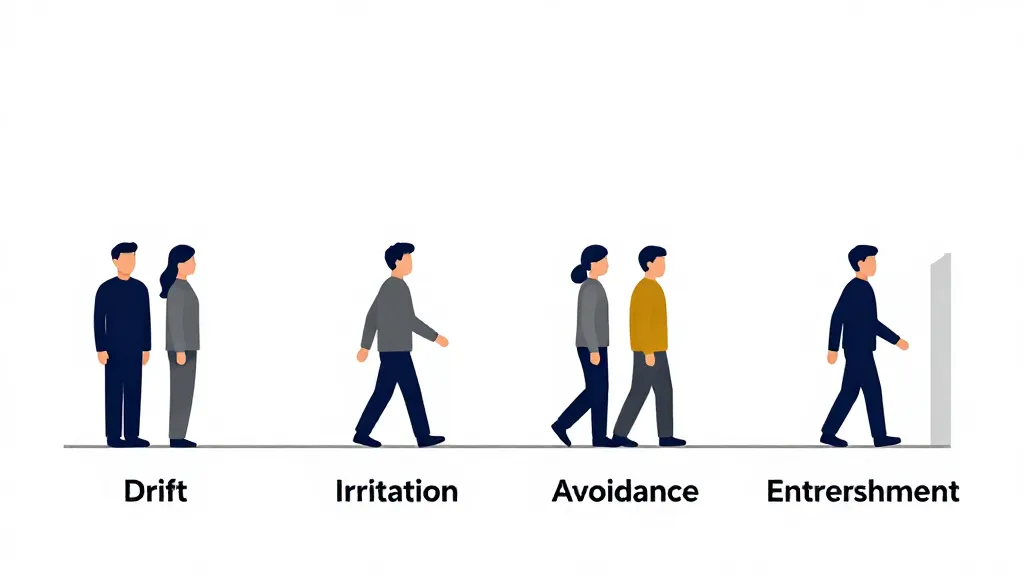
The pattern is remarkably consistent. Co-founder conflict escalates through predictable phases, and each phase has observable signs. Here's what to watch for.
Phase 1: The Drift — When Alignment Quietly Breaks Down
This is the most dangerous phase because it doesn't feel like conflict at all. It feels like busyness, independence, or simply "dividing and conquering." But underneath, something fundamental is shifting.
You've stopped having real conversations about vision
In the early days, you probably spent hours debating where the company was headed. Now those conversations feel redundant or uncomfortable, so you skip them. You each operate from your own mental model of the company's future and assume your co-founder shares it.
Red flag: You can't confidently articulate your co-founder's top three priorities for the next quarter — and they probably can't articulate yours.
Decisions are being made in silos
One founder hires a contractor without discussing it. The other pivots the product roadmap based on a single customer conversation. Neither mentions it until it's done.
This isn't efficiency. It's avoidance dressed up as autonomy.
Your assumptions about equity and workload have never been stress-tested
Many co-founders split equity 50/50 in the early days based on enthusiasm and optimism. But as the company evolves, contributions shift. One founder may be working 70-hour weeks while the other is coasting at 40 — or at least, that's how it feels to one of them.
If you've never had an explicit conversation about what each person's equity is supposed to represent — time, skills, capital, risk — you're sitting on an unexploded assumption.

Phase 2: The Irritation — When Small Things Start to Sting
Phase 2 is where feelings enter the picture, but in a muted, deniable way. You're not angry. You're just... annoyed. A lot.
You're mentally keeping score
You notice when your co-founder leaves early. You remember that you were the one who stayed up until 2 a.m. fixing the deployment issue. You start thinking in terms of "fair" and "unfair" rather than "we."
Scorekeeping is one of the most reliable early indicators that co-founder resentment is building. It means you've stopped trusting that effort will balance out over time — and you've started building a case.
You're venting to other people instead of to each other
You tell your partner, your best friend, or an advisor about something your co-founder did. Not in a "processing my thoughts" way — in a "can you believe this?" way.
The moment your co-founder becomes a character in a complaint narrative you share with third parties, the dynamic has shifted. You're recruiting allies, even if you don't realize it yet.
Feedback feels personal
Early on, you could tell your co-founder their idea was bad and they'd shrug it off. Now, even mild pushback triggers defensiveness — from either of you. The trust buffer that allowed honest disagreement has eroded.
A founder named Marcus described this turning point: "I made an offhand comment about our sales approach and she went completely cold for two days. That's when I realized we weren't just stressed. Something was broken between us."
Phase 3: The Avoidance — When You Stop Trying
This is where things accelerate. Paradoxically, the conflict becomes harder to see from the outside because both founders have learned to avoid triggering it.
You're working around each other, not with each other
You schedule your days so you don't overlap. You communicate through Slack messages instead of face-to-face conversations. You handle problems in your domain and don't ask about theirs.
This feels like peace. It's actually decay.
Important conversations keep getting postponed
"Let's talk about the equity issue after the launch." "We'll revisit roles once we close this round." "Now isn't the right time."
There is no right time. There's only the time before things get worse and the time after. Postponing hard conversations is the single most common behavior that turns manageable co-founder tension into terminal co-founder conflict.
You've started imagining the company without them
This is the quiet thought that founders rarely admit to: What if I were doing this alone? What if I could just make the decisions I want to make?
Having this thought once is human. Having it regularly is a signal that you've mentally begun the separation process, even if you haven't said a word.
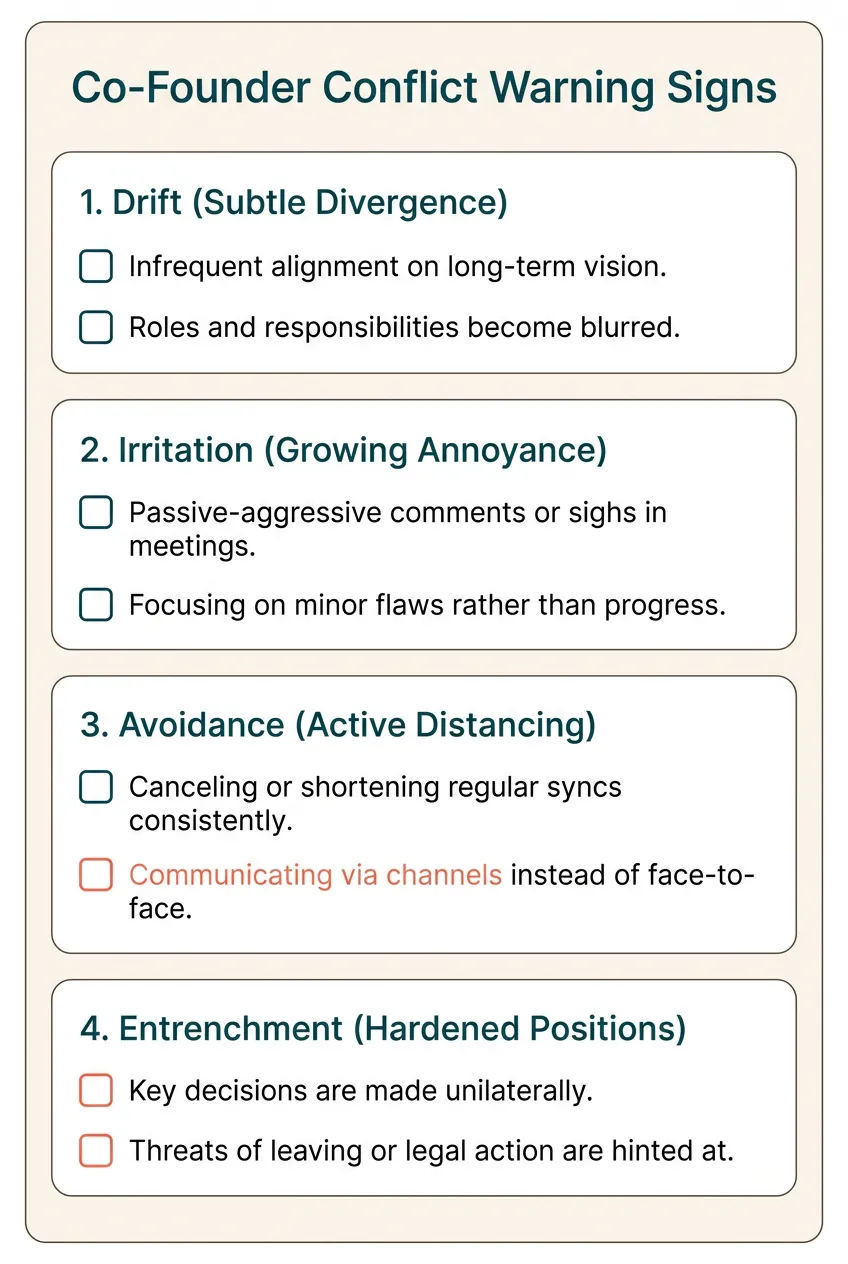
Phase 4: The Entrenchment — When Positions Harden
By this stage, the conflict is visible to the team, to investors, and to anyone paying attention. Both founders have constructed narratives about who's right and who's wrong.
Every disagreement triggers the same underlying argument
The surface topic changes — pricing, hiring, product direction — but the subtext is always the same: You don't respect me. You're not pulling your weight. You don't trust my judgment.
When you find yourself having the same emotional argument wearing different costumes, you've moved from a disagreement to an entrenched conflict.
You're involving the team
Whether intentionally or not, employees start to sense the divide. They learn which founder to go to for which kind of answer. Factions form. Information stops flowing freely.
This is where co-founder conflict becomes an organizational problem, not just a personal one. It poisons culture, slows decision-making, and drives away your best people.
You've stopped giving each other the benefit of the doubt
Early in a partnership, you interpret your co-founder's actions charitably. They were late because they were dealing with something important. They forgot because they're overwhelmed.
In Phase 4, the same behaviors get the least charitable interpretation. They were late because they don't care. They forgot because this isn't their priority.
Psychologists call this "negative sentiment override," and it's extremely difficult to reverse once established.
What to Do If You Recognize These Signs
Recognizing these signs isn't a diagnosis of failure — it's an opportunity. Co-founder relationships, like all relationships, can be repaired. But only if you act while the window is still open.
1. Name the tension out loud
You don't need a perfect speech. You need honesty. Something as simple as, "I've noticed we're not communicating the way we used to, and I want to fix that before it gets worse," can break the avoidance cycle.
2. Get your agreements in writing — all of them
Verbal understandings about equity splits, roles, decision-making authority, and exit scenarios are not agreements. They're assumptions waiting to be disputed. Sit down and formalize every understanding you think you share. You'll be surprised how many you don't actually agree on. Tools like Servanda can help co-founders create structured, written agreements that prevent ambiguity from festering into conflict.
3. Bring in a neutral third party early
Don't wait until you need a mediator to find one. A trusted advisor, an executive coach, or even a structured framework for difficult conversations can provide the safety that makes honesty possible.
4. Schedule recurring check-ins specifically about the relationship
Not the product. Not the metrics. The partnership itself. How are you feeling about how decisions are being made? What's frustrating you that you haven't said? What do you need more of?
This feels awkward. It works.
5. Revisit your operating agreement regularly
The terms that made sense when you started may not make sense now. Roles evolve. Contributions shift. Markets change. Build in regular moments — quarterly, at minimum — to revisit and update your working agreements so they reflect reality, not nostalgia.
FAQ
How do you know if co-founder conflict is normal or serious?
All co-founders disagree — that's healthy. The distinction is whether disagreements get resolved or accumulate. If you find yourself avoiding topics, keeping score, or losing trust in your co-founder's intentions, the conflict has moved beyond normal friction and needs direct attention.
Can a co-founder relationship be saved after a major conflict?
Yes, but it requires both people to want to repair it and to commit to changing specific behaviors, not just "trying harder." Relationships that recover usually involve an honest reckoning about what went wrong, new written agreements, and often the help of a neutral third party.
What's the biggest mistake co-founders make when they start fighting?
Waiting. The most common and most costly mistake is assuming tension will resolve on its own. It almost never does. The founders who navigate conflict successfully are the ones who address it at Phase 1 or 2, not Phase 4.
Should co-founders have a prenup-style agreement?
Absolutely. A co-founder agreement that covers equity, roles, decision-making, IP ownership, and exit terms isn't a sign of distrust — it's a sign of maturity. The best time to negotiate these terms is when you still like each other and think clearly.
How do you bring up co-founder issues without making things worse?
Lead with observation, not accusation. Instead of "You never listen to me," try "I've noticed we're making more decisions separately, and I want to understand why." Focus on the pattern you're seeing, express what you want to change, and ask for their perspective before proposing solutions.
Conclusion
Co-founder conflict rarely arrives as a dramatic blowup. It seeps in — through postponed conversations, unspoken resentments, and assumptions that were never tested. The 65% failure statistic isn't a death sentence. It's a reflection of what happens when smart, driven people treat relationship maintenance as less important than product-market fit.
The founders who beat those odds aren't conflict-free. They're conflict-aware. They watch for drift before it becomes distance. They name tension before it becomes resentment. They formalize agreements before they need lawyers.
If you recognized your partnership anywhere in this article, that awareness is itself the first step. The second step is doing something about it — today, not after the next milestone, not when things calm down. Now.
Your startup can survive a bad quarter. It probably can't survive a co-founder breakup you saw coming and chose to ignore.