
Founders Agreement 101: Prevent Equity Fights
Key Takeaways
- A founders agreement is the single cheapest form of dispute prevention. Drafting one while you still have goodwill costs almost nothing; litigating an equity fight later can cost six figures and the company itself.
- Equity splits should reflect future contributions, not just the original idea. Use vesting schedules with a one-year cliff to protect every cofounder—including yourself.
- Five non-negotiable clauses belong in every founders agreement: equity allocation, vesting, roles and decision-making, IP assignment, and an exit or departure clause.
- You don't need a lawyer on day one, but you do need a written, signed document. Start with a structured template, then upgrade to attorney-reviewed docs before you raise money.
- Revisit the agreement at every major milestone—first hire, first funding round, first pivot—before misalignment hardens into resentment.
Introduction
You and your cofounder are sketching wireframes on a napkin, finishing each other's sentences, and genuinely excited about the same problem. The last thing you want to talk about right now is what happens when one of you wants out.
That reluctance is exactly why so many early-stage startups end up in equity fights. According to a Noam Wasserman study of over 10,000 founders, 73% of founding teams experience a significant dispute over roles or equity within the first three years. The damage isn't just emotional—unresolved equity ambiguity is one of the top reasons VCs walk away from otherwise fundable companies.
A founders agreement won't guarantee harmony, but it will guarantee clarity. And clarity, it turns out, is what keeps goodwill alive long after the napkin gets recycled. This guide walks you through exactly what your agreement needs, clause by clause, so the cheapest dispute you ever have is the one you never have.

What Is a Founders Agreement (and Why Most Teams Skip It)?
A founders agreement is a written contract between cofounders that spells out equity ownership, vesting terms, roles, intellectual property assignments, and what happens if someone leaves. It sits below your articles of incorporation but above a handshake.
Most first-time cofounders skip it for one of three reasons:
- It feels premature. "We don't even have revenue yet—why are we talking about percentages?"
- It feels adversarial. Bringing up departure clauses can feel like you're planning the divorce before the wedding.
- It feels expensive. Founder teams assume they need a startup attorney to draft one, and they're bootstrapping.
All three assumptions are wrong. It's never too early to write down what you've verbally agreed to. Putting expectations on paper actually strengthens trust because nobody has to rely on memory. And while attorney review is valuable later, a well-structured template signed by all cofounders is legally meaningful and vastly better than nothing.
The 5 Non-Negotiable Clauses in Every Founders Agreement
Below are the five sections your founders agreement absolutely must include. Skip any one of them, and you're leaving a door open for the kind of ambiguity that turns into a courtroom.
1. Equity Allocation
This is the clause people fixate on, and for good reason—it determines who owns what percentage of the company.
Practical guidance:
- Start with contributions, not equality. A default 50/50 split feels fair in the moment, but it creates deadlock if you ever disagree. Consider weighting for the person who had the original idea, who quit their job first, or who is contributing capital.
- Use a framework. The Slicing Pie model by Mike Moyer or a simple contribution matrix (idea, capital, time, expertise, network) can depersonalize the conversation.
- Document the rationale. Write one paragraph explaining why you chose the split you chose. When you revisit this document in 18 months, that paragraph will save you a painful reconstruction of logic nobody remembers.
Example: Two cofounders, Amir and Priya, decide on a 55/45 split. Amir originated the concept and had been working on it solo for six months. Priya brings deep domain expertise and a $30K cash contribution. They document both factors in the agreement. When a third cofounder joins later, the rationale helps them calculate a new allocation without Amir and Priya renegotiating from scratch.
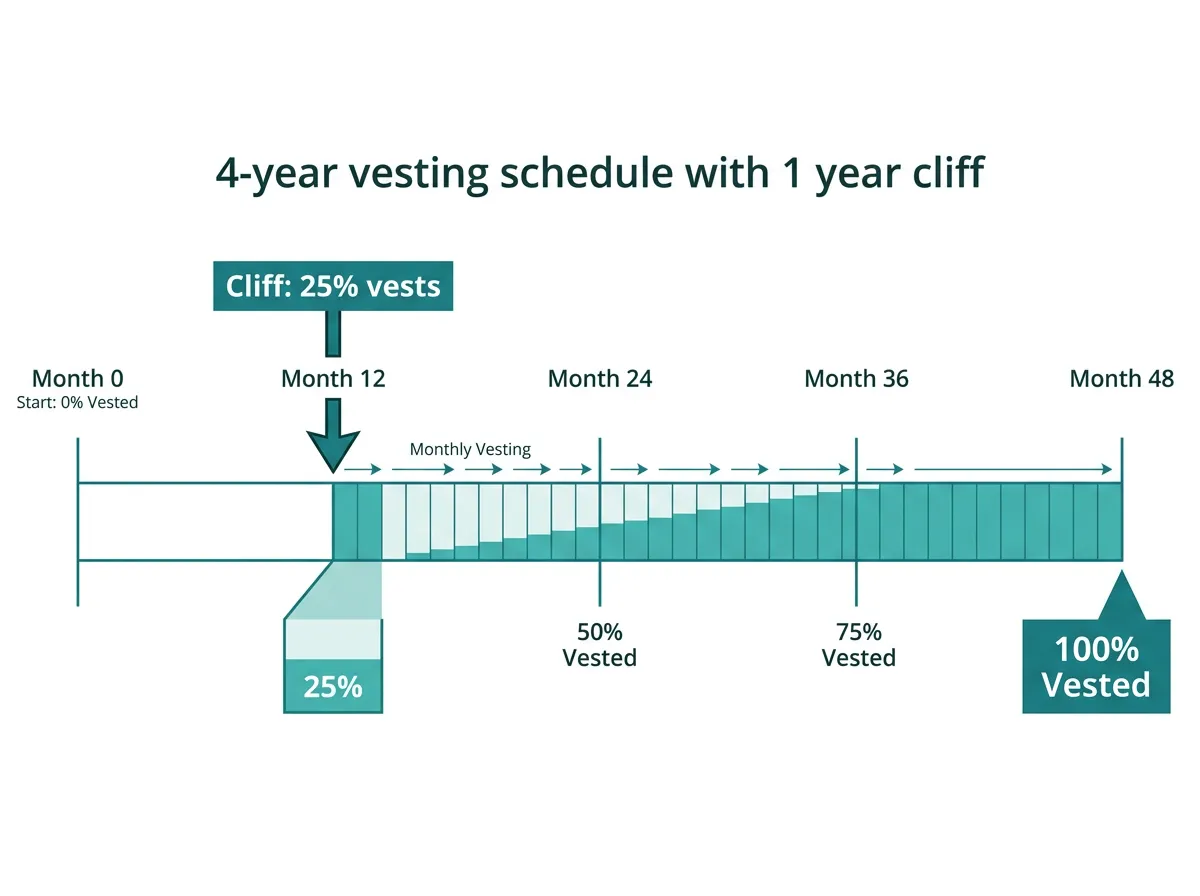
2. Vesting Schedule
Equity without vesting is a ticking time bomb. If your cofounder leaves after three months and owns 40% of the company outright, you've just given away nearly half your cap table for 90 days of work.
The standard structure:
- 4-year vesting with a 1-year cliff. No equity is earned until the first anniversary. After that, shares vest monthly or quarterly.
- Apply vesting to every cofounder, including yourself. This signals credibility to future investors and protects the team.
- Consider acceleration clauses for specific events (e.g., single-trigger acceleration on acquisition).
Why the cliff matters: Without a cliff, a cofounder who leaves after two months still walks away with roughly 4% of the company (2/48 months of a 4-year schedule on a significant equity stake). The cliff ensures that short-lived partnerships don't create permanent cap table problems.
3. Roles, Responsibilities, and Decision-Making
Equity tells you who owns what. This clause tells you who does what—and how you resolve disagreements without a stalemate.
What to include:
- Titles and domains of authority. One cofounder handles product; the other handles go-to-market. Write it down, even if it feels obvious.
- Decision-making thresholds. Define which decisions a single cofounder can make unilaterally (e.g., expenses under $5,000), which require a majority, and which require unanimity (e.g., taking on debt, issuing new equity).
- A deadlock-breaking mechanism. Options include a trusted advisor as a tiebreaker, a rotating final-say system, or agreeing to a structured mediation process. Tools like Servanda can help cofounders formalize these kinds of dispute resolution frameworks early, before emotions enter the picture.
Example: Carlos and Dev are 50/50 cofounders. They define that product roadmap decisions belong to Carlos, hiring decisions belong to Dev, and any expenditure over $10,000 requires both signatures. Six months in, they disagree on a pivotal product direction. Because their agreement names a mutual advisor as a tiebreaker, they resolve it in a single meeting—not a months-long cold war.
4. Intellectual Property Assignment
This clause is non-negotiable if you ever plan to raise money. Investors will not fund a company that doesn't clearly own its own IP.
What it should say:
- All IP created by any cofounder in connection with the company belongs to the company, not the individual.
- Any pre-existing IP that a cofounder contributes is either assigned to the company or licensed to it under defined terms.
- Cofounders agree not to use company IP for side projects or competing ventures.
Common mistake: Founders who keep working a full-time job while building the startup often have employment agreements that assign IP to their employer. If your day-job contract contains a broad IP assignment clause, you may need to disclose the startup to your employer or wait until you leave. Ignoring this creates an ownership cloud that can kill a funding round.
5. Departure and Separation Clause
This is the clause nobody wants to write. It's also the one you'll be most grateful for.
Key questions it should answer:
- What happens to unvested shares when a cofounder leaves voluntarily?
- Does the company (or remaining cofounders) have the right to repurchase vested shares? At what price?
- What constitutes "cause" for forced departure, and how does that affect equity treatment?
- Is there a non-compete or non-solicitation period? (Keep it reasonable—6 to 12 months for a startup.)
- How is "leaving" defined? Reducing hours? Taking another job? Disagreeing about direction?
Example: Three cofounders agree that if any one of them departs voluntarily within the first two years, the company may repurchase their vested shares at fair market value determined by an independent 409A valuation. After two years, vested shares are fully retained. When one cofounder does leave at month 14 to pursue a PhD, the buyback clause triggers cleanly—no negotiation, no hard feelings, no lawsuit.
How to Actually Draft Your Founders Agreement: A Step-by-Step Process
You don't need to lock yourselves in a conference room for a weekend. Here's a practical, low-friction process:
Step 1: Have the Conversation Before You Write Anything
Set aside 90 minutes—preferably in person—to discuss each of the five clauses above. Don't negotiate yet. Just surface each person's assumptions. You'll be surprised how often cofounders think they agree but have quietly different expectations.
Step 2: Fill Out a Structured Template
Use a founders agreement template as your starting framework. Good free options include:
- Y Combinator's Cofounder Handshake template (covers the basics in plain English)
- Clerky or Stripe Atlas templates (more legally robust, designed for Delaware C-Corps)
- The Founder Institute's FAST Agreement (specifically designed for equity splits)
Fill in every field. If a section doesn't apply, write "N/A—will revisit before Series A" so it's clear the omission was intentional.
Step 3: Sign It
Print two copies. Sign both. Each cofounder keeps one. A signed agreement, even without attorney review, is dramatically more enforceable than a verbal understanding.
Step 4: Schedule a Review Date
Put a calendar reminder for 6 months out. Re-read the agreement together. Does it still reflect reality? Has someone's role shifted? Did you add a third cofounder without updating the doc? Adjust and re-sign.
Step 5: Upgrade to Attorney-Reviewed Before You Raise
Once you're preparing for a priced round, have a startup attorney review and formalize your founders agreement. Most will convert it into a combination of corporate bylaws, restricted stock purchase agreements, and an IP assignment. Budget $2,000–$5,000 for this, or use a startup legal services package.
Red Flags That Your Current Agreement (or Lack of One) Is a Problem
If any of the following are true, you have urgent work to do:
- "We agreed on the split verbally." Verbal agreements are technically enforceable in some jurisdictions—but proving the terms is nearly impossible.
- "We're equal partners in everything." Without defined roles and decision-making authority, a 50/50 partnership becomes a recipe for paralysis.
- "One cofounder isn't vesting." This usually means the person who proposed the agreement exempted themselves. That's a power imbalance, and it will surface later.
- "We haven't discussed what happens if someone leaves." This is the most common gap—and the most expensive one to fill retroactively.
- "Our agreement is in a Slack thread somewhere." Informal written records are better than nothing, but they don't constitute a signed agreement.
What a Good Equity Conversation Actually Sounds Like
Many cofounders freeze at the equity conversation because they've never seen one modeled well. Here's a realistic version:
Cofounder A: "I want to talk about how we split equity. I know it's awkward, but I'd rather have this conversation now when we're both excited than later when there's money on the table. Can we walk through what each of us is contributing?"
Cofounder B: "Totally. I've been thinking about it too. I think we should look at time commitment, financial contribution, and what each of us is giving up to do this."
Cofounder A: "Agreed. And whatever we land on, I think we should both vest over four years. That way, we're both proving our commitment going forward, not just banking on what we've done so far."
Notice what's happening: both people frame the conversation as a shared problem, not a negotiation against each other. That framing matters enormously.
FAQ
Do cofounders really need a formal agreement if they trust each other?
Yes—not because trust isn't real, but because memory is unreliable. A founders agreement doesn't replace trust; it protects it. Two years from now, you may genuinely remember different versions of what you agreed to. A signed document removes that risk entirely.
What's the biggest mistake cofounders make with equity splits?
Splitting equity based solely on the idea. Ideas are worth very little compared to execution. The biggest mistake is giving a permanent, fully-vested equity stake to someone based on a concept they contributed, rather than tying equity to ongoing contribution through a vesting schedule.
Can we change the founders agreement later?
Absolutely, and you should plan to. A founders agreement is a living document. Any amendment should be agreed to by all parties, written down, and signed—just like the original. Major changes (like adding a cofounder or altering the equity split) should trigger an attorney review.
Is a founders agreement the same as an operating agreement?
Not exactly. An operating agreement is a formal governance document required for LLCs. A founders agreement is a contract between the individual cofounders and can exist alongside (or before) the company's formal corporate documents. Think of the founders agreement as the "relationship" document and the operating agreement as the "entity" document.
How much does it cost to have a lawyer draft a founders agreement?
For a straightforward agreement between two to three cofounders, expect $1,500–$5,000 from a startup-focused attorney. Some accelerators and incubators provide legal templates as part of their programs. Starting with a strong template and upgrading to attorney review before fundraising is a cost-effective approach.
Conclusion
The best time to write a founders agreement is when you still genuinely like your cofounder—when the conversation feels unnecessary because you're so aligned. That feeling of alignment is precisely the goodwill that makes the conversation easy. Don't waste it.
Your agreement doesn't need to be perfect. It needs to be written, signed, and specific enough that a stranger could read it and understand who owns what, who does what, and what happens when things change. Cover equity, vesting, roles, IP, and departure terms. Use a template today, and upgrade with an attorney before your first funding round.
The cheapest dispute is the one you never have. A few hours of honest conversation and a signed document are all that stands between you and a future where your partnership survives the hardest parts of building a company.