
Cofounder Conflict Avoidance: The Silent Startup Killer
You and your cofounder haven't had a real argument in months. On the surface, things feel smooth. You finish each other's sentences in pitch meetings. You divide the work without much discussion. Friends say you're the perfect founding team.
But there's a product decision from three months ago that still gnaws at you. You disagreed, said nothing, and watched your cofounder run with it. There's a growing gap between what you think the company should become and what your cofounder seems to be building. You tell yourself it's fine—you'll figure it out later. You never do.
Then one morning, over something trivially small—a Slack message about a hire, a line item in the budget—everything detonates. The partnership that "never had problems" is suddenly in freefall.
This isn't a rare story. It's the most common cofounder failure pattern. Research from Initialized Capital and years of startup postmortems reveal a counterintuitive truth: the most dangerous cofounder relationships aren't the ones with too much fighting. They're the ones with too little.
Key Takeaways
- Cofounder conflict avoidance is more dangerous than open disagreement. Small unspoken frustrations compound into partnership-ending resentment over months and years.
- "We never fight" is a red flag, not a badge of honor. Healthy cofounder relationships require regular, structured friction.
- Avoidance has a predictable escalation pattern. Recognizing the stages—silence, resentment, withdrawal, explosion—lets you intervene early.
- Scheduled disagreement rituals prevent unscheduled blowups. Tactical practices like monthly "state of the union" meetings create safe containers for hard conversations.
- Formalizing agreements early removes the biggest sources of avoidance. Written clarity on equity, roles, and decision rights eliminates the ambiguity that makes conflicts feel too scary to raise.

Why Cofounders Avoid Conflict (And Why It Feels Rational)
Conflict avoidance between cofounders isn't laziness or cowardice. It's usually a rational-seeming response to a set of very real pressures.
The Stakes Feel Too High
When you're building a company together, every disagreement carries implicit weight. Pushing back on your cofounder's product vision doesn't feel like a normal workplace debate—it feels like threatening the foundation of the entire venture. So you stay quiet. You tell yourself you're "picking your battles."
The Relationship Predates the Company
Many cofounders are friends, former colleagues, or even family. The friendship feels precious, and the startup already strains it. Raising a difficult topic risks damaging the personal relationship on top of the professional one. The calculus feels simple: absorb the frustration now, protect the friendship.
Early-Stage Chaos Provides Cover
In the first year of a startup, everything moves fast. There's always a more urgent fire to fight than an interpersonal tension that hasn't fully surfaced yet. Avoidance disguises itself as prioritization: "We'll deal with the equity conversation after we close this round." "We'll define roles once we hire more people." The right time never arrives.
Cultural Conditioning
Startup culture celebrates harmony. "Cofounder fit" is discussed as if it's a static trait—you either have it or you don't. This framing makes disagreement feel like evidence that something is broken, rather than a normal and necessary part of building together.
The Avoidance Spiral: How Small Silences Become Existential Crises
Cofounder conflict avoidance follows a remarkably predictable pattern. Understanding these stages is the first step to breaking the cycle.
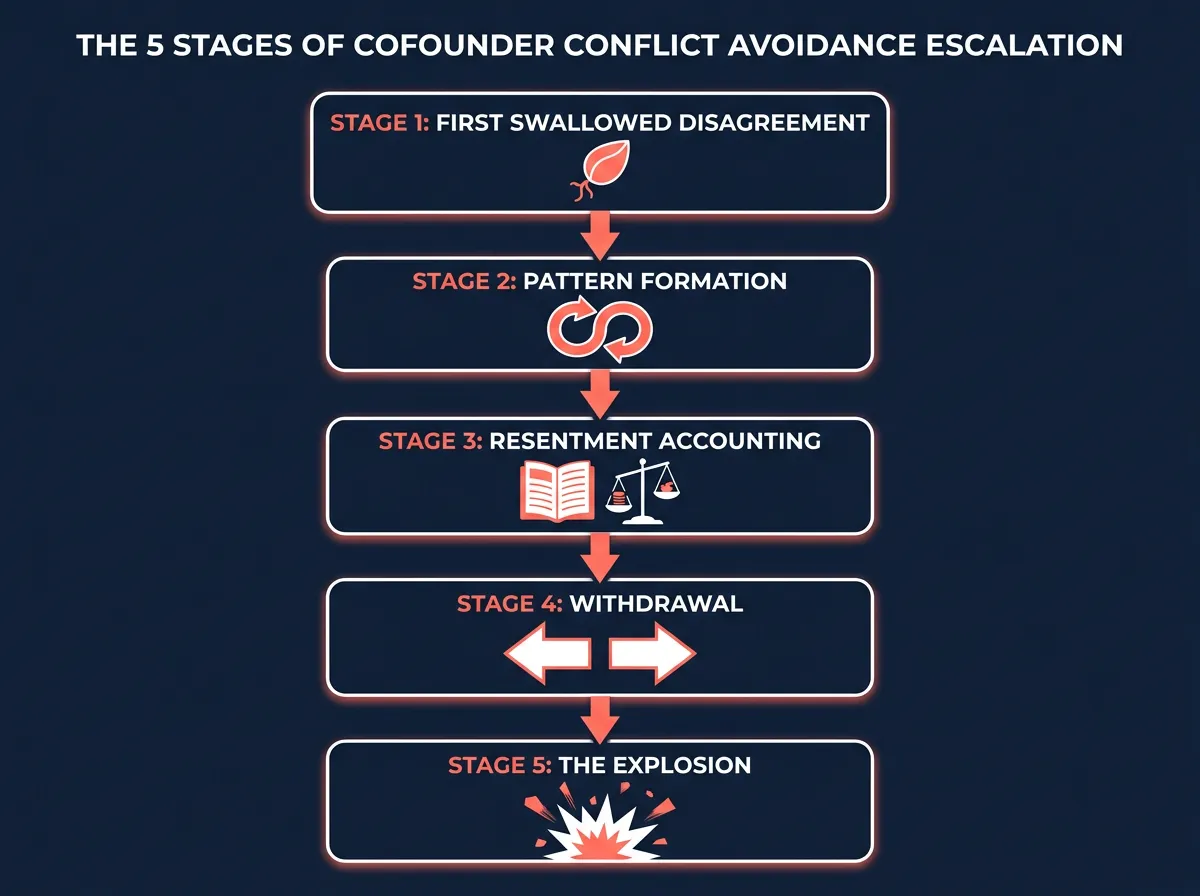
Stage 1: The First Swallowed Disagreement
It starts small. One cofounder disagrees with a decision—a pricing change, a hire, a pivot direction—but says nothing, or offers only mild, easily-dismissed pushback. The internal justification: "It's not worth a fight." "Maybe they're right." "I'll bring it up if it becomes a real problem."
Stage 2: Pattern Formation
The first swallowed disagreement makes the second one easier. A precedent forms: certain topics become implicitly off-limits. Maybe it's how one cofounder manages the engineering team, or how the other handles investor relationships. Each partner develops a private mental list of "things we don't talk about."
Stage 3: Resentment Accounting
With no outlet for disagreement, frustrations accumulate. Each cofounder begins keeping an internal ledger of grievances. "I let them have their way on the rebrand. I gave in on the hiring timeline. I've been compromising for months, and they don't even notice." The ledger grows silently.
Stage 4: Withdrawal and Parallel Tracking
Cofounders begin operating in parallel rather than together. Communication becomes transactional—task updates, logistics, surface-level check-ins. Strategic conversations dry up. Each cofounder starts making unilateral decisions in their domain, not out of agreed-upon autonomy but out of disengagement.
Stage 5: The Trigger Event
Something—often something minor—finally breaks the dam. A Slack message that feels dismissive. A decision made without consultation. A board meeting where one cofounder feels blindsided. The explosion that follows isn't actually about the trigger. It's about every swallowed disagreement from the past six, twelve, or eighteen months detonating simultaneously.
At this stage, many cofounder relationships are beyond repair—not because the underlying disagreements were irreconcilable, but because the accumulated resentment and broken trust are.
Real Patterns From Real Breakups
These anonymized examples are composites drawn from common startup postmortem patterns.
"We just grew apart." Two technical cofounders launched a developer tools company. One gradually became more interested in enterprise sales; the other wanted to stay focused on the open-source community. Neither raised the divergence directly. Over a year, they built increasingly separate organizations within their own startup. When a Series A term sheet forced the question—enterprise or community-first?—they discovered they'd been building toward incompatible visions for months. The round fell apart. So did the company.
"I thought we agreed." A CEO and CTO cofounded a health-tech startup. The CTO assumed they'd agreed to a 50/50 equity split based on an early conversation. The CEO assumed the split would be revisited once their respective contributions became clearer. Neither put it in writing. Neither raised it again. Eighteen months later, during a funding round that required a cap table, the conversation finally happened—loaded with eighteen months of unspoken assumptions, perceived promises, and mounting bitterness.
"They changed." A cofounder pair had different risk tolerances that surfaced slowly. One wanted to grow conservatively and reach profitability; the other wanted to raise aggressively and scale fast. Each noticed the difference but attributed it to temporary circumstances rather than a fundamental strategic disagreement. By the time they named it, they'd each hired teams and made commitments aligned with their individual (and contradictory) strategies.
How to Break the Avoidance Pattern
The goal isn't to create conflict for its own sake. It's to build systems and habits that make productive disagreement routine, so tensions get addressed when they're small and manageable.
1. Schedule Structured Friction
Don't wait for disagreements to surface organically. Create recurring forums where they're expected.
- Monthly "State of the Union" meetings: Dedicated time (60-90 minutes, away from day-to-day work) where each cofounder answers three questions: What's working well? What's bothering me that I haven't said? What decision do we need to make that we've been postponing?
- Quarterly strategy alignment sessions: Longer sessions focused specifically on whether you still share the same vision for the company's direction, growth pace, and priorities.
- Decision retrospectives: After major decisions, revisit them together. Not to relitigate, but to ask: Did we make this decision well? Did both of us feel heard?
The key is that these meetings exist on the calendar regardless of whether there's a "problem" to discuss. They normalize disagreement as part of the operating rhythm.
2. Formalize Agreements Early and in Writing
The topics cofounders avoid most—equity splits, roles, decision-making authority, exit scenarios—are exactly the ones that cause the most damage when left unresolved.
Put these in writing. Not because you distrust each other, but because written agreements remove ambiguity, and ambiguity is what makes these conversations feel dangerous.
A cofounder agreement should cover, at minimum:
- Equity split and vesting schedule
- Roles, responsibilities, and decision-making authority
- What happens if one cofounder wants to leave
- How disputes will be resolved
- Compensation expectations
Tools like Servanda can help cofounders create these written agreements together, using structured prompts that surface the hard questions before they become hard feelings.
3. Adopt a Disagreement Protocol
Agree in advance on how you'll handle disagreements. Having a process removes the emotional overhead of deciding whether and how to raise a concern in the moment.
A simple protocol might look like:
- Raise it within 48 hours. If something bothers you, name it within two days. Even a simple "I want to flag something that's been on my mind" prevents accumulation.
- Separate the topic from the relationship. Use framing like "I see this differently" rather than "You're wrong." Obvious, maybe—but having it as an explicit agreement gives both partners permission to invoke it.
- Designate a tiebreaker mechanism. For decisions where you genuinely can't align, agree in advance on how you'll break ties. Options include: deferring to the domain owner, bringing in an advisor, running a time-boxed experiment, or escalating to your board.
4. Build External Accountability
Cofounders in isolated, closed systems are more likely to avoid conflict. External touchpoints create gentle pressure to surface issues.
- An advisory board or mentor who asks pointed questions about the cofounder relationship during regular check-ins
- A coach or facilitator who meets with both cofounders periodically—not just during crises, but as ongoing maintenance
- Peer cofounder groups where founders can compare notes and realize that disagreement is universal
5. Reframe What "Good" Looks Like
Stop using "we never fight" as a measure of cofounder health. Replace it with better indicators:
- "We disagree regularly and resolve things within days."
- "We've had hard conversations about equity, roles, and strategy—and we're still aligned."
- "When one of us is frustrated, the other usually knows within 48 hours."
These are signs of a cofounder relationship built to last. Perpetual calm is not.
The Cost of Waiting
If you're reading this and recognizing your own cofounder dynamic, the instinct will be to keep waiting. The avoidance pattern is self-reinforcing: the longer you've avoided a topic, the scarier it feels to raise it, because now you have to explain why you waited so long.
But the math doesn't get better with time. A disagreement about strategic direction at month three is a straightforward conversation. The same disagreement at month eighteen—after both cofounders have hired teams, made promises to investors, and built resentment—is a potential company-ending crisis.
The best time to start having hard conversations was at the beginning. The second-best time is now.
Frequently Asked Questions
How do I bring up a problem with my cofounder without making things weird?
Start by normalizing the conversation itself. Try: "I want to start a habit of checking in on how we're working together—not because anything is wrong, but because I've seen too many cofounder relationships break down from avoiding stuff." Framing it as a structural improvement rather than a complaint about your partner makes the first conversation much easier.
Is it too late to fix cofounder conflict avoidance if we've been doing it for a year?
It's harder, but usually not too late. The key is to resist the urge to dump every accumulated grievance at once. Start with one or two forward-looking topics—decisions you need to make together right now—and use those as practice for rebuilding the muscle of direct conversation. Work backward to historical tensions only after you've rebuilt some trust in the process.
What's the difference between healthy compromise and conflict avoidance?
Healthy compromise involves both cofounders explicitly acknowledging the disagreement, discussing it, and consciously choosing a path forward—even if it's not either person's first choice. Conflict avoidance skips the acknowledgment and discussion entirely. The test: does your cofounder know you disagreed? If the answer is no, that's avoidance, not compromise.
Should cofounders get a mediator or coach before things go wrong?
Yes, and this is actually when coaching or facilitation is most effective—before entrenched resentments form. Think of it like a startup advisor for your working relationship. Regular sessions with a neutral third party create space for conversations that might not happen otherwise and build patterns that persist between sessions.
Do cofounder agreements actually prevent conflict?
They don't prevent disagreements, but they prevent ambiguity—and ambiguity is what makes disagreements feel too risky to raise. When equity, roles, and decision rights are clearly documented, cofounders can disagree about strategy or execution without the conversation being shadowed by unresolved foundational questions.
Conclusion
Cofounder conflict avoidance is insidious precisely because it feels like peace. The absence of arguments gets mistaken for alignment. The silence gets mistaken for agreement. And by the time the pattern becomes visible, the accumulated damage is severe.
The fix isn't dramatic. It's structural. Schedule the hard conversations. Write down your agreements. Build a shared protocol for disagreement. Create external accountability. And above all, abandon the myth that great cofounder relationships are frictionless ones.
The startups that survive the cofounder relationship aren't the ones where the founders never disagreed. They're the ones where the founders built the habit of disagreeing early, openly, and with mutual respect—then got back to building.
Your cofounder relationship is too important to leave to chance. Treat it with the same intentionality you bring to your product, your customers, and your fundraise. Start the conversation today.