
Why Cofounders Break Up (And How to Prevent It)
You launched together with matching energy, complementary skills, and a shared conviction that this idea was the one. Six months later, one of you is doing all the fundraising while the other is quietly building resentment over unacknowledged late nights. A year in, you realize you never actually agreed on whether this was a venture-scale company or a lifestyle business. By month eighteen, you're communicating through Slack messages that read like legal depositions.
This isn't a hypothetical. It's the lived reality of roughly 65% of startups that fail due to cofounder conflict, according to research from Harvard Business School professor Noam Wasserman. The pattern is so common it's practically a genre: the cofounder breakup post-mortem.
But here's what makes these stories useful rather than just cautionary — they reveal the same fracture points over and over. Which means the damage is preventable, if you know where to look.
Key Takeaways
- Most cofounder breakups stem from unspoken assumptions, not sudden betrayals. The issues that destroy partnerships are usually present from day one — they just go unaddressed.
- Equity, roles, and vision misalignment are the three most common fracture points, and all three can be addressed with explicit, early conversations.
- Resentment builds in silence. Scheduling structured check-ins — not just about the business, but about the relationship — is one of the highest-leverage things founders can do.
- Written agreements aren't a sign of distrust; they're a sign of maturity. The best cofounder relationships are built on clarity, not blind faith.
- Prevention is a practice, not a one-time event. The framework that protects your partnership at launch needs to evolve as the company grows.
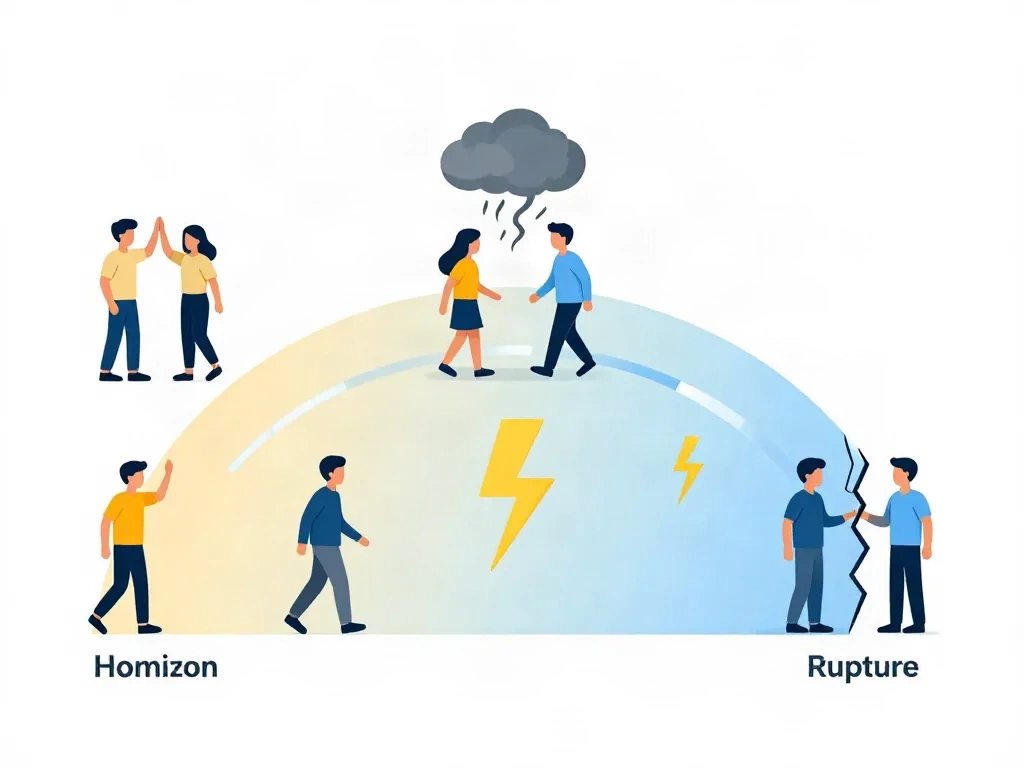
The Anatomy of a Cofounder Breakup
When founders publicly share their breakup stories — on blogs, podcasts, Hacker News threads — the narratives tend to follow a recognizable arc. Not a single explosive fight, but a slow erosion.
Here's how it typically unfolds:
- The Honeymoon: Everything is possibility. You finish each other's sentences. Disagreements feel productive.
- The Drift: Small misalignments appear — different work habits, different risk tolerances, different definitions of "success." Neither person names them.
- The Resentment Phase: Unspoken frustrations calcify. One founder feels they're carrying more weight. The other feels micromanaged or sidelined.
- The Trigger Event: A funding round, a hiring decision, a pivot — something forces the underlying tension to the surface.
- The Rupture: By now, the relationship is too damaged for a clean resolution. One founder leaves, often painfully and expensively.
The tragedy isn't that these breakups happen. It's that most founders, looking back, can identify the exact moment they should have spoken up — and didn't.
The Five Reasons Cofounders Break Up
After studying dozens of public post-mortems and founder interviews, the same five fault lines appear with striking regularity.
1. The Equity Conversation That Never Happened (Or Happened Too Fast)
One of the most common stories in cofounder breakup post-mortems goes like this: two friends split equity 50/50 on day one because it "felt fair." Six months later, one founder is working 70-hour weeks while the other has a full-time job and contributes on weekends.
The problem isn't the split itself — it's that the split was based on the relationship at the time rather than a forward-looking agreement about contributions, vesting, and what happens if circumstances change.
What founders say in retrospect:
"We split 50/50 because we didn't want the awkward conversation. That decision cost us the company." — Anonymous founder, Indie Hackers post-mortem
What actually helps: - Use a vesting schedule with a one-year cliff. This is non-negotiable. - Tie equity discussions to explicit expectations about time commitment, capital contribution, and role scope. - Revisit the equity conversation when circumstances materially change (someone goes part-time, a new cofounder joins, etc.).
2. Role Ambiguity That Breeds Territorial Conflict
In the early days, everyone does everything. That's necessary. But "we'll figure out roles as we go" has an expiration date — and most cofounders blow past it.

Without clear ownership, two things happen simultaneously: important work falls through the cracks and founders step on each other's toes. One founder makes a product decision the other considers their domain. Neither is wrong, but neither has a framework for resolving it.
A founder who publicly documented his breakup with his technical cofounder described it this way: "We both thought we were the CEO. We just never said it out loud."
What actually helps: - Define who has final decision-making authority in each major area: product, engineering, sales, hiring, finance. - Agree on a decision-making protocol for cross-functional issues. (Does one person have veto power? Do you need consensus? What happens when you deadlock?) - Write it down. A verbal agreement you remember differently isn't an agreement at all.
3. Misaligned Vision Disguised as Strategic Disagreement
This one is insidious because it looks like a series of tactical disagreements when it's actually a fundamental values mismatch.
One founder wants to bootstrap and build a profitable, sustainable business. The other wants to raise a Series A and swing for a billion-dollar outcome. Both are legitimate paths — but they're incompatible paths.
These misalignments often don't surface until a decision forces them into the open. Should we take this angel investment? Should we hire aggressively or stay lean? Should we pivot toward enterprise or stay consumer?
Each individual debate feels resolvable. But the pattern reveals a deeper rift: you're not building the same company.
What actually helps: - Before you write a line of code, answer these questions together — in writing: - What does success look like in 5 years? - Are we building to sell, building to IPO, or building to own? - How do we feel about taking outside investment? - What's our risk tolerance? - Revisit these answers every six months. People change. Companies change. Your alignment needs to keep pace.
4. Unequal Sacrifice Without Acknowledgment
This is the resentment engine. One founder relocates; the other doesn't. One founder depletes savings; the other has a safety net. One founder is heads-down coding until 2 AM; the other clocks out at 6 PM for family commitments.
None of these differences are inherently problematic. What's corrosive is when they go unacknowledged — when one founder feels their sacrifice is invisible, or when the other founders feel judged for having boundaries.
A founder who shared her story on a popular startup podcast described the turning point: "I stopped being angry about how much I was working and started being angry that she didn't seem to notice how much I was working."
What actually helps: - Make workload and sacrifice a regular topic of conversation — not in a scorekeeping way, but in an honest, transparent way. - Define what "full commitment" means in concrete terms. Ten hours a week? Fifty? Is it about output or input? - Build explicit mechanisms for rebalancing when life circumstances change (new baby, health issue, side project).
5. Conflict Avoidance Until It's Too Late
This is the meta-problem — the one that makes all the others lethal. Cofounders avoid difficult conversations because the relationship feels fragile, because they don't want to seem "difficult," because they hope the problem will resolve itself.
It won't.
A Y Combinator partner once noted that the cofounder pairs who survive aren't the ones who avoid conflict — they're the ones who develop a practice of engaging with it early. The distinction matters. Conflict isn't the disease. Avoidance is.
What actually helps: - Schedule a monthly "state of the partnership" conversation. Not about OKRs. Not about the product roadmap. About the relationship. - Use a structured format: What's working? What's not? What do I need from you that I'm not getting? - Agree in advance on an escalation path if you can't resolve something between yourselves — a mentor, an advisor, or a mediation tool like Servanda that can help you work through disagreements with structure before they become existential.
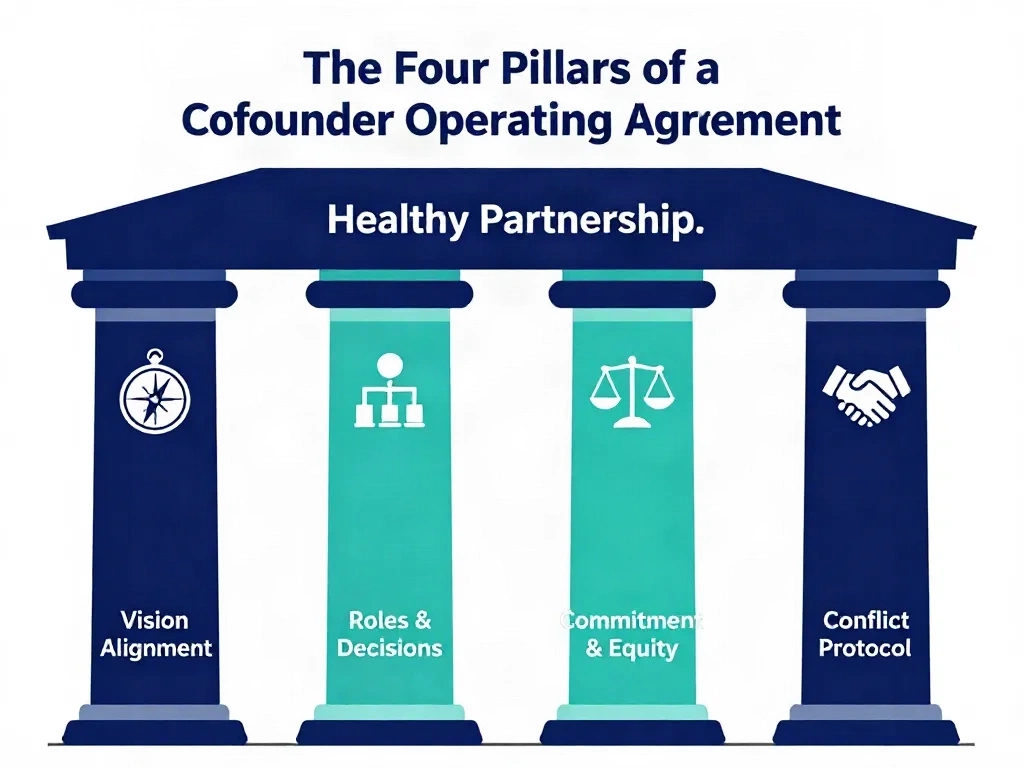
A Preventive Framework: The Cofounder Operating Agreement
The common thread in every breakup story is the absence of explicit agreements. Not legal contracts (though those matter too), but operating agreements — shared documents that capture how you'll work together, make decisions, and handle conflict.
Here's a lightweight framework you can build together in a single afternoon:
The Four Pillars
| Pillar | Key Questions to Answer |
|---|---|
| Vision Alignment | What are we building? What does success look like? What are our non-negotiables? |
| Roles & Decision Rights | Who owns what? Who breaks ties? How do we handle disagreements? |
| Commitment & Equity | What does each person contribute? How is equity earned? What triggers a conversation about rebalancing? |
| Conflict Protocol | How do we raise concerns? What's our escalation path? When do we involve a third party? |
This isn't a legal document. It's a living artifact that you revisit and revise. The act of writing it together is itself a diagnostic — if you can't agree on these fundamentals, that's critical information to have before you've raised money, hired a team, and entangled your finances.
What to Do If You're Already in Trouble
If you're reading this and recognizing your own situation, you're not too late — but you do need to act.
- Name the problem. Not the symptoms ("we disagree about the product") but the underlying issue ("we have different visions for the company" or "I feel my contribution isn't valued").
- Request a structured conversation. Not over Slack. Not in the heat of a sprint. Set aside dedicated time with a clear agenda.
- Bring a draft, not a demand. Write down what you think the agreement should be and invite your cofounder to do the same. Compare. Negotiate.
- Get outside perspective. A mentor, an advisor, a coach — someone who can see the dynamic you can't see from inside it.
- Consider whether the partnership is still viable. Sometimes the most responsible thing is an amicable separation. That's not failure — it's maturity.
Frequently Asked Questions
How do I bring up a cofounder agreement without making it seem like I don't trust my cofounder?
Frame it as preparation, not suspicion. You can say something like: "I've been reading about how many cofounder relationships fail because of unspoken assumptions. I don't want that to be us. Can we spend an afternoon getting aligned on the big stuff?" Most cofounders will be relieved you brought it up.
What's the number one reason cofounders break up?
Research and post-mortem data consistently point to misaligned expectations — about equity, roles, vision, or commitment — that were never made explicit. It's rarely a single dramatic event; it's the accumulation of unaddressed tensions over months or years.
Should cofounders split equity 50/50?
There's no universally right answer, but a 50/50 split should be a deliberate choice, not a default. The important thing is that the split reflects expected contributions and includes a vesting schedule. A 50/50 split without vesting is one of the most common precursors to cofounder conflict.
When should cofounders consider mediation?
Before you think you need it. If you've had the same unresolved argument more than twice, if conversations about the business consistently turn personal, or if one of you is avoiding the other — those are all signs that a structured third-party process could help. Waiting until you're considering a breakup usually means waiting too long.
Can a cofounder relationship survive a major conflict?
Absolutely — and often emerges stronger for it. The couples therapy analogy is apt: relationships that survive hard conversations develop resilience and trust that untested relationships lack. The key is engaging with the conflict honestly and early, rather than letting it metastasize.
Moving Forward Together
The cofounder relationship is, statistically, one of the biggest risk factors for any startup. But it's also one of the most addressable. The founders who share their breakup stories almost always say the same thing: the warning signs were there, and we ignored them.
You don't have to. The conversations are uncomfortable, the agreements take effort, and the ongoing maintenance of the relationship requires intentionality that can feel unnatural when you're sprinting to build a product. But every hour you invest in alignment now saves you weeks — or months — of painful unraveling later.
Start today. Not with a 40-page legal contract, but with a single honest conversation: What are we building, and how are we going to build it together?
The answer might be the most important thing you ever write down.