
Why Cofounder Conflicts Are Preventable, Not Inevitable
There's a story that circulated through the startup world a few years ago. A founder, reflecting on the collapse of his cofounder relationship, said something that stuck: "Looking back, the rift was entirely preventable." Not unlikely. Not difficult to avoid. Preventable.
He wasn't describing a personality clash or some irreconcilable difference in vision. He was describing a series of small, uncomfortable conversations that never happened. An assumption about equity that was never spoken aloud. A disagreement about workload distribution that festered for months behind polite smiles. A growing resentment that, by the time it surfaced, had already metastasized into something neither founder could fix.
This pattern is strikingly common. And the most important thing to understand about it is this: cofounder conflicts are not a natural cost of building a company together. They are the predictable result of specific, avoidable communication failures.
This article is about those failures—and how to prevent them before they take root.
Key Takeaways
- Most cofounder breakups trace back to conversations that were avoided, not to fundamental incompatibility. The real danger isn't disagreement—it's silence.
- Resentment builds in the gap between assumptions and explicit agreements. If you haven't written it down, you haven't agreed on it.
- Structured check-ins prevent small frustrations from compounding into existential crises. A 30-minute monthly conversation can save a company.
- The window for easy conflict resolution is early and short. The same conversation that takes ten minutes in month two can take ten months (and a lawyer) in year two.
- Formalized agreements aren't a sign of distrust—they're a sign of maturity. The best cofounder relationships are built on clarity, not blind faith.

The Myth of the "Incompatible Cofounder"
When a cofounder relationship falls apart, the post-mortem almost always sounds like a compatibility story. "We just had different visions." "Our working styles didn't mesh." "We wanted different things."
These explanations are comforting because they imply the outcome was unavoidable—that the founders were simply wrong for each other from the start. But when you dig into the actual sequence of events, a different picture emerges.
What the Data Actually Shows
Research from the Kauffman Foundation and Noam Wasserman's landmark study of over 10,000 founders found that 65% of high-potential startups fail due to conflict within the founding team. But here's the critical nuance: the conflicts that destroy these companies are rarely about big, philosophical disagreements. They're about the mundane stuff.
- Who gets what percentage of equity—and why?
- What happens if one cofounder stops contributing equally?
- How are major decisions made when cofounders disagree?
- What does "full-time commitment" actually mean?
- Who controls the company if the relationship ends?
These aren't exotic questions. They're obvious ones. And yet, the majority of cofounder teams never discuss them explicitly until a problem forces the conversation—at which point both parties are already entrenched in opposing positions, clouded by months or years of accumulated frustration.
The Real Culprit: Avoidance, Not Incompatibility
The founder from the Initialized Capital story didn't discover, years in, that he and his cofounder were fundamentally different people. He discovered that they had been operating under conflicting assumptions the entire time—and that neither of them had ever felt comfortable enough to surface those assumptions.
This is the core reframe: most cofounder conflicts are communication failures disguised as compatibility problems.
The distinction matters enormously, because compatibility problems feel permanent and unsolvable, while communication failures are fixable—especially if you catch them early.
How Preventable Conflicts Actually Develop
Cofounder resentment doesn't arrive as a sudden earthquake. It grows like mold—slowly, in the dark, in the spaces you're not looking.
Here's the typical progression:
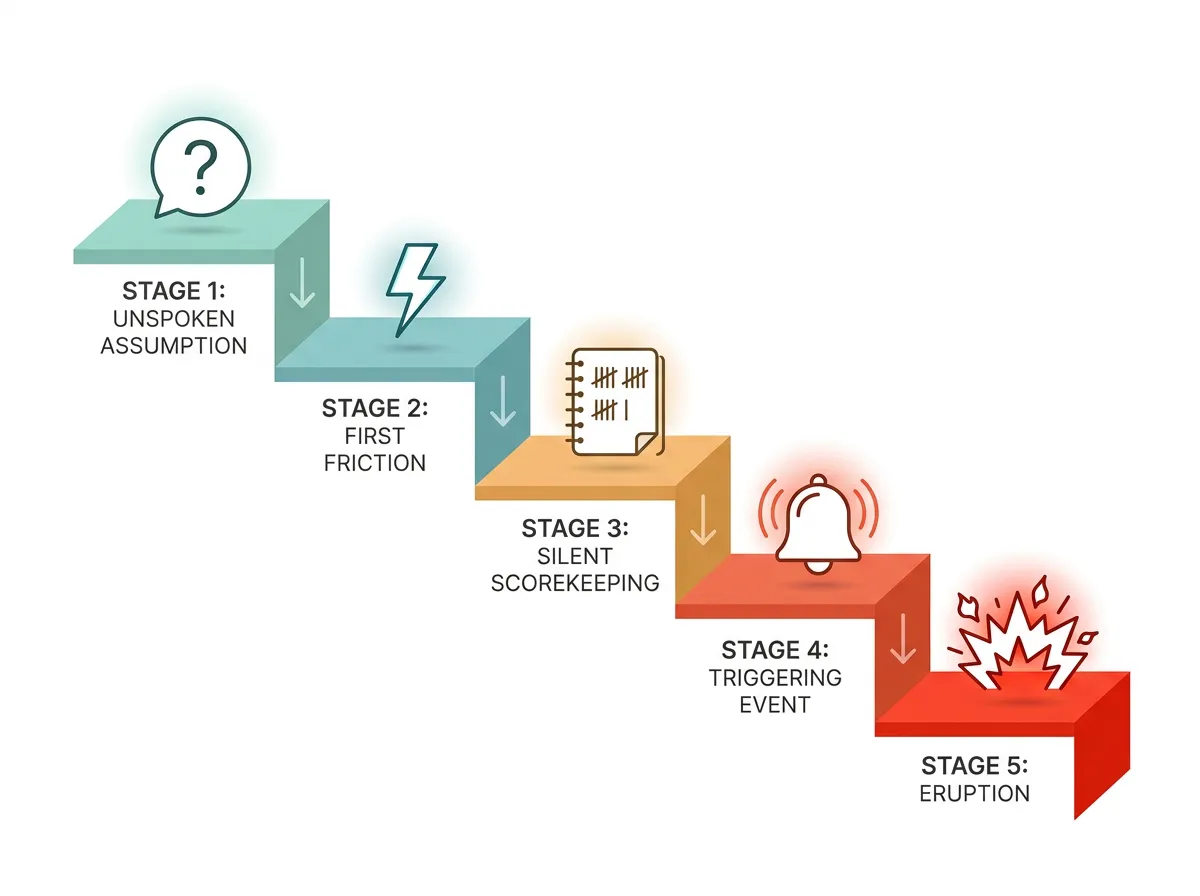
Stage 1: The Unspoken Assumption
Two cofounders launch a company. They're excited, aligned on the big picture, and eager to move fast. In their enthusiasm, they skip over—or superficially address—foundational questions. "We'll figure out equity later." "We both know we're 50/50 on decisions." "We don't need a formal agreement—we trust each other."
Each founder fills the silence with their own assumptions. One assumes equity will be split evenly. The other assumes it'll be weighted by who brought the original idea. Neither says this out loud.
Stage 2: The First Friction
A few months in, small irritations appear. One cofounder feels they're carrying more of the technical workload. The other feels their business development efforts are undervalued. These frustrations are minor individually, but they don't get addressed because bringing them up feels petty, confrontational, or premature.
"It's too early to make a big deal out of this."
Stage 3: The Silent Scorekeeping
With no mechanism for raising small issues, both cofounders begin keeping mental tallies. Every late arrival, every dropped task, every unilateral decision gets logged internally but never discussed externally. The relationship starts to feel transactional, but the surface remains cordial.
Stage 4: The Triggering Event
Something forces the underlying tension into the open. A term sheet arrives and forces an equity conversation. A major hire requires a decision and reveals that the cofounders have incompatible ideas about the company's direction. A personal crisis shifts one cofounder's availability, and there's no agreement about what happens next.
Stage 5: The Eruption
The conversation that should have happened in Month 1 now happens in Month 18—but with eighteen months of accumulated resentment packed behind it. What could have been a calm, collaborative negotiation becomes an emotional, adversarial confrontation. Lawyers get involved. The company stalls. Sometimes, it dies.
Every stage in this progression is an intervention point. And the earlier you intervene, the less damage there is to repair.
The Conversations That Prevent Cofounder Breakups
If avoidance is the disease, structured honesty is the treatment. Here are the specific conversations that most cofounder teams skip—and shouldn't.
1. The Equity and Ownership Conversation
This is the single most common source of cofounder conflict, and it needs to happen before you write a line of code or make your first sales call.
Don't just agree on a split. Discuss the reasoning behind it:
- What is each person contributing (capital, IP, time, connections)?
- Is the split fixed, or does it adjust based on future contributions?
- What vesting schedule applies, and what triggers acceleration?
- What happens to a cofounder's equity if they leave?
A 50/50 split isn't inherently fair or unfair. What matters is that both founders can articulate why the split is what it is and genuinely agree it's reasonable.
2. The Roles and Decision-Making Conversation
Who has final say on product decisions? On hiring? On fundraising? On spending over a certain threshold?
"We'll decide everything together" sounds egalitarian but becomes paralyzing at scale. Define domains of authority early. Agree on a tiebreaking mechanism for the decisions that span domains.
3. The Workload and Commitment Conversation
This one is especially important when cofounders are at different life stages or have different financial situations.
- What does "full-time" mean in hours per week?
- Is one cofounder keeping a side job or consulting engagement?
- What happens if one cofounder needs to step back temporarily for personal reasons?
- How will you handle the perception (or reality) of unequal effort?
4. The Exit and Dissolution Conversation
Nobody wants to discuss the prenup before the wedding. But this conversation, had calmly and early, is one of the highest-leverage things you can do for your cofounder relationship.
- Under what circumstances can a cofounder be asked to leave?
- How is a departing cofounder's equity handled?
- What happens to the company's IP if the partnership dissolves?
- Who keeps the company name, the domain, the customer relationships?
Having this conversation doesn't mean you expect things to go wrong. It means you respect the relationship enough to protect it with clarity.
Building a System for Ongoing Alignment
Even after the foundational conversations, cofounder alignment isn't a one-time achievement. It's an ongoing practice. Here's what that practice looks like:
Monthly Cofounder Check-ins
Set a recurring 30-minute meeting dedicated exclusively to the cofounder relationship—not to product updates or metrics, but to how you're working together.
A simple framework:
- What's working well in how we're collaborating?
- What's one thing that's been frustrating me that I haven't mentioned?
- Are our current roles and responsibilities still making sense?
- Is there anything we assumed but haven't explicitly agreed on?
The agenda itself is less important than the habit. Regularity creates safety. When you know there's a dedicated space for raising concerns, you're less likely to let them fester.
Written Agreements That Evolve
Your cofounder agreement shouldn't be a static document signed once and filed away. Treat it as a living artifact that gets updated as the company evolves. When you raise a new round, revisit it. When you hire your tenth employee, revisit it. When one of you gets married or has a child, revisit it.
Tools like Servanda can help cofounders create and maintain written agreements that adapt to changing circumstances—turning abstract verbal understandings into concrete, shared reference points before ambiguity has a chance to breed conflict.
Normalize Disagreement
The healthiest cofounder relationships aren't conflict-free. They're conflict-competent. The founders disagree openly, resolve disagreements using agreed-upon processes, and don't treat every difference of opinion as evidence of a fundamental rift.
If you can't disagree with your cofounder about a product feature without it feeling like a personal attack, that's a signal your conflict resolution infrastructure is missing—not that your cofounder is the wrong person.
Why Early Action Has Outsized Returns
There's a concept in engineering called "the cost of change curve." It describes how the cost of fixing a problem increases exponentially the later you catch it. A bug caught during design costs almost nothing to fix. The same bug caught in production can cost thousands of hours and dollars.
Cofounder conflicts follow the same curve. A conversation about equity in week one takes twenty minutes and a handshake. The same conversation in year two takes twenty weeks and a mediator. In year four, it takes a lawsuit.
The founders who avoid early-stage discomfort aren't avoiding conflict. They're borrowing it—at a ruinous interest rate.
FAQ
How do you prevent cofounder conflict before it starts?
The most effective prevention is having explicit conversations about equity, roles, decision-making, and exit scenarios before your company is operational. Write down what you agree on, revisit it regularly, and create a habit of surfacing small frustrations before they compound. Prevention is about building communication infrastructure, not about choosing a "perfect" cofounder.
What are the most common causes of cofounder breakups?
The most frequent triggers are disagreements about equity splits, unequal workload distribution, diverging visions for the company's direction, and unclear decision-making authority. However, the root cause in nearly all cases is the same: these issues were never discussed explicitly, and both founders operated under conflicting assumptions until the tension became unmanageable.
When should cofounders create a formal agreement?
Ideally, before you start working together in any serious capacity. At a minimum, before you incorporate, accept funding, or bring on employees. A formal cofounder agreement isn't a sign that you don't trust each other—it's a tool that protects the relationship by eliminating ambiguity. The earlier you formalize, the easier and less emotionally charged the process will be.
Can a cofounder relationship be saved after a major conflict?
It depends on how entrenched the positions have become and whether both founders are genuinely willing to rebuild trust. If the underlying issue is a communication failure (which it usually is), structured mediation and a willingness to create explicit agreements going forward can restore the relationship. If one or both founders have already emotionally exited the partnership, the focus should shift to a respectful separation that preserves the company.
Is a 50/50 equity split between cofounders a bad idea?
Not inherently. A 50/50 split works well when both cofounders are contributing roughly equally and have agreed on a clear tiebreaking mechanism for deadlocked decisions. The problems arise when a 50/50 split is chosen by default—because no one wanted to have the uncomfortable conversation about whether a different split might be more appropriate. The split itself matters less than the process and reasoning behind it.
Moving Forward
The most dangerous myth in startup culture is that cofounder conflict is just part of the journey—a rite of passage that strong teams survive and weak teams don't. This framing turns a solvable problem into a fatalistic inevitability and gives founders permission to avoid the conversations that would actually protect their relationships.
The truth is quieter and more empowering: the vast majority of cofounder breakups follow a predictable pattern of avoidance, assumption, and accumulation. And that pattern can be interrupted at almost any point—most easily at the beginning, but at any point.
If you're in the early stages of a cofounder relationship, you have an extraordinary advantage: the ability to set the foundation before cracks appear. Have the uncomfortable conversations now, while they're still easy. Write down what you agree on. Build the habit of checking in. Treat clarity as an act of respect, not suspicion.
Your future selves—and your company—will thank you for it.