
Why Cofounder Breakups Happen (And Warning Signs)
You started this company together. Late nights whiteboarding in a cramped apartment, splitting the first ramen-budget paycheck, finishing each other's pitch sentences. Somewhere along the way, though, something shifted. Maybe it was a hire you disagreed on. Maybe it was the quiet resentment when one of you started showing up less. Maybe it was the equity conversation you never had — until it became a fight.
Cofounder breakups don't happen in a single dramatic blowout. They happen slowly, then all at once. And the painful truth is that most founders don't recognize the warning signs of a cofounder breakup until the relationship is already beyond repair, leaving emotional wreckage and financial fallout in its wake.
This article draws on real post-mortem stories and pattern analysis to help you identify the red flags early — while you still have time to do something about them.
Key Takeaways
- Most cofounder breakups stem from misaligned expectations, not a single betrayal. The slow drift is more dangerous than the dramatic fight.
- Unequal commitment is the most cited reason cofounders split. When effort levels diverge and nobody names it, resentment compounds fast.
- Avoiding hard conversations early guarantees harder conversations later. Equity splits, role definitions, and exit scenarios need to be discussed before they become urgent.
- The warning signs are observable months before the breakup. Passive-aggressive Slack messages, decision-making bottlenecks, and emotional withdrawal are all measurable signals.
- Written operating agreements aren't a sign of distrust — they're a sign of maturity. The partnerships that survive formalize expectations early.

The Anatomy of a Cofounder Breakup
Startup lore romanticizes the cofounder relationship. "It's like a marriage," people say, and they're not wrong — including the part where roughly 65% of high-potential startups fail due to cofounder conflict, according to a widely cited Harvard Business School study by Noam Wasserman.
But unlike marriages, cofounder relationships rarely get pre-marital counseling. There's no cultural script for sitting down before you incorporate and asking: What happens if one of us wants out? What if we disagree on a fundamental strategic direction? What does "equal effort" actually look like?
The result is that founders build companies on top of unspoken assumptions — and those assumptions eventually crack.
The Initialized Capital Pattern
Garry Tan and Harj Taggar's public split at Initialized Capital offers a case study in how misalignment accumulates. Their breakup didn't stem from one catastrophic event. It emerged from diverging visions for the fund's future, different leadership styles, and — critically — a period where those differences went unaddressed. By the time the split became public, the underlying tensions had been building for months.
The lesson isn't that they should have agreed on everything. It's that the gap between their perspectives widened silently until it became unbridgeable.
The Yirenlu Breakdown
Tech writer and former founder Yiren Lu has written candidly about cofounder dynamics in the startup ecosystem, documenting how personal relationships fracture under the pressure of competing incentives. Her observations highlight a recurring theme: cofounders often mistake early-stage camaraderie for deep alignment. When the adrenaline of launch fades and the grind of operations begins, the differences that were always there become impossible to ignore.
The 6 Most Common Reasons Cofounder Breakups Happen
After analyzing dozens of startup post-mortems, founder interviews, and conflict case studies, the same patterns emerge with striking consistency.
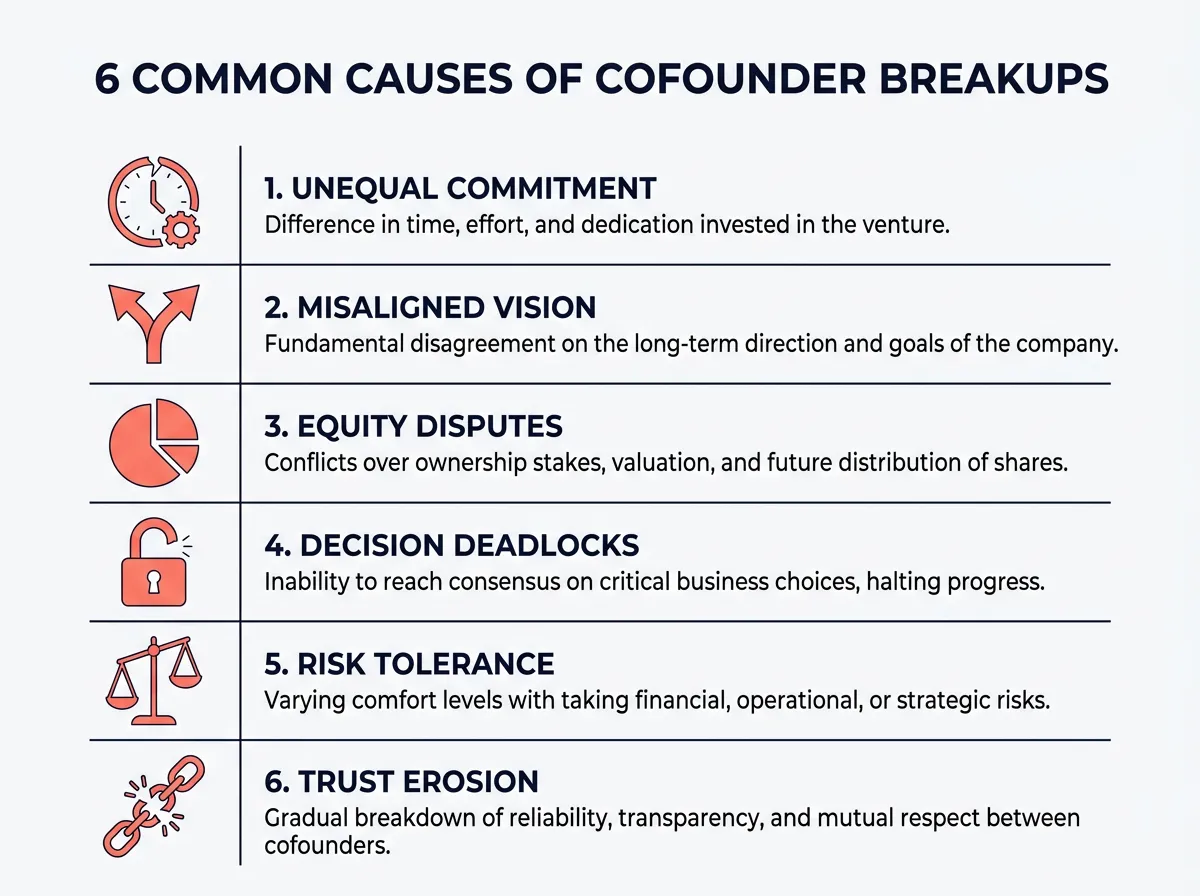
1. Unequal Commitment and Effort
This is the single most corrosive dynamic in a cofounder relationship. One founder is working 70-hour weeks; the other has started treating the startup like a side project. Neither has explicitly discussed what "full commitment" means.
The founder working harder starts tracking the other's hours — mentally, bitterly. The founder working less feels micromanaged and defensive. Neither says anything directly. Instead, it leaks out in passive-aggressive comments during standups or pointed questions at board meetings.
What this looks like in practice: - One cofounder consistently misses deadlines or meetings without explanation - Conversations about workload feel charged or are avoided entirely - One founder starts making major decisions alone because "it's faster"
2. Misaligned Vision for the Company's Future
You both wanted to "build something meaningful." But one of you meant a bootstrapped lifestyle business, and the other meant a venture-backed rocketship aimed at an IPO. These aren't minor differences — they determine every subsequent decision about hiring, fundraising, product, and personal sacrifice.
This misalignment often hides during the early stage because the immediate tasks are the same regardless of long-term ambition: build the MVP, get the first customers, survive. The divergence reveals itself when real strategic decisions arrive. Do you take the VC money or not? Do you hire aggressively or stay lean? Do you pivot toward a bigger market even if it means abandoning your original customers?
3. Undefined or Resented Equity Splits
The classic 50/50 split feels fair on day one. Six months later, when one founder has contributed the technical architecture and the other has contributed "ideas and connections," it feels like a raw deal to someone.
Equity resentment is particularly toxic because it's tied directly to identity and self-worth. Questioning the split feels like questioning your cofounder's value as a person. So it festers.
A real pattern from startup post-mortems: Founders who split equity equally without vesting schedules are significantly more likely to experience breakups. Without vesting, there's no mechanism to reflect actual contribution over time — and no structured off-ramp if someone leaves early.
4. Decision-Making Deadlocks
Two cofounders. Two votes. No tiebreaker. This governance structure guarantees deadlock on any decision where they disagree.
Some cofounder pairs solve this informally through natural deference — one founder leads product decisions, the other leads business decisions. But without explicit agreement on decision-making authority, any cofounder can veto any decision at any time. The result is paralysis, frustration, and eventually a power struggle.
5. Different Risk Tolerances
One founder has $200K in savings and no dependents. The other has a mortgage, two kids, and a spouse who's already nervous about the startup. Their tolerance for financial risk, runway management, and salary decisions will be fundamentally different — and both perspectives are completely valid.
Problems arise when neither founder acknowledges these differences explicitly. The founder with more financial cushion may push for aggressive moves that feel reckless to the other. The more cautious founder may advocate for choices that feel timid to the first.
6. Erosion of Personal Trust
Sometimes the business conflict is a symptom, not the cause. The real issue is that one founder feels the other has been dishonest — about outside commitments, about conversations with investors, about financial decisions. Or perhaps the trust erosion is subtler: a pattern of small commitments broken, deadlines missed, or credit quietly taken.
Once trust erodes past a certain threshold, every interaction gets filtered through suspicion. A neutral Slack message reads as passive-aggressive. A reasonable request feels like a power grab. The relationship enters a negative feedback loop that's extraordinarily difficult to reverse without external intervention.
Warning Signs: What to Watch For Before It's Too Late
Cofounder breakups are rarely surprises to outside observers. Advisors, early employees, and even investors often see the signs months before the founders themselves admit there's a problem.
Here are the early warning signs, roughly ordered from earliest to latest:
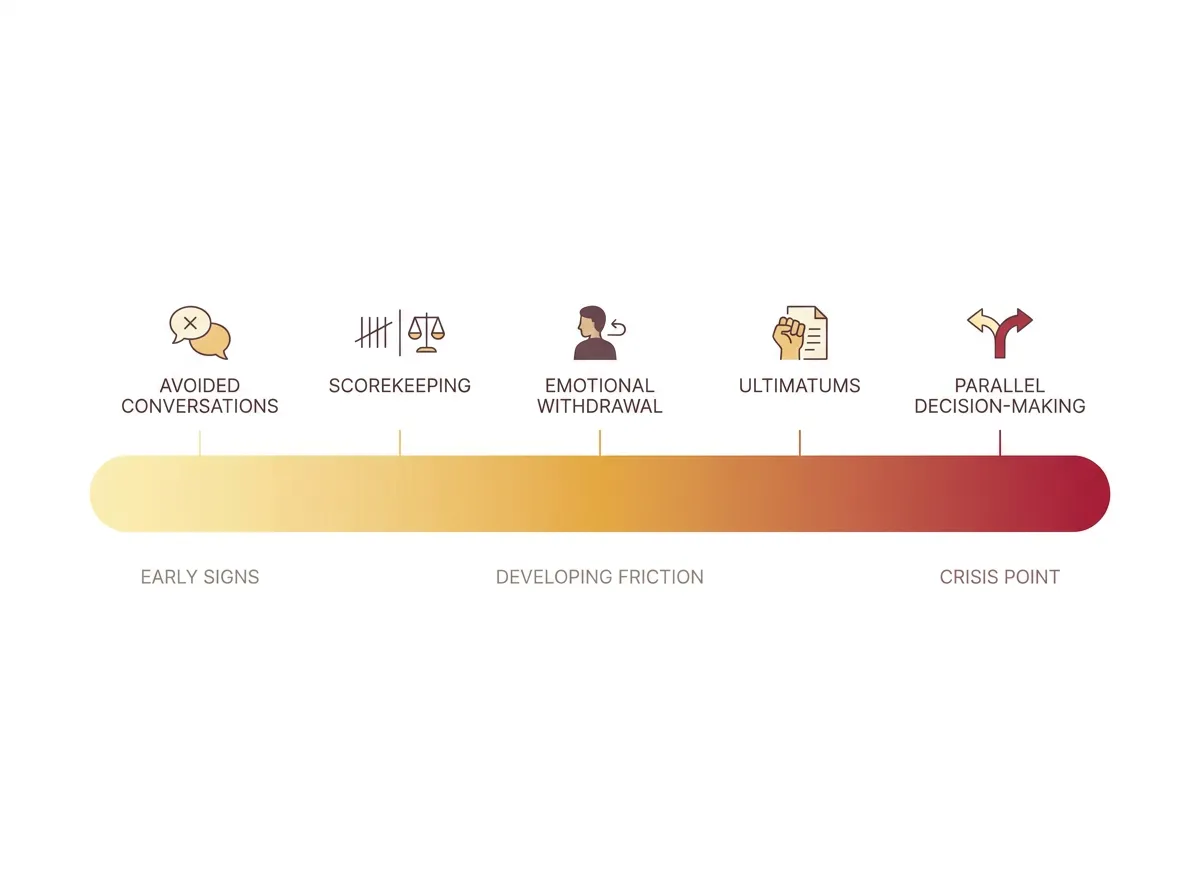
Early Warning Signs (Months 1-6 of Tension)
- Avoiding one-on-one conversations. You used to talk daily. Now you communicate through Slack, email, or — worse — through other team members.
- Scorekeeping. You've started mentally tracking who does what, who works more, who gets more credit. This is the emotional accounting that precedes resentment.
- Vague discomfort you can't name. A gut feeling that something is off, but you tell yourself you're overthinking it. You're probably not.
- Increased formality. Conversations that used to be casual become stiff. You start cc'ing people on emails that would previously have been a quick DM.
Middle Warning Signs (Months 3-9)
- Decisions get relitigated. Something you thought was settled keeps coming back up, often with a different framing.
- One founder starts building alliances. Seeking validation from employees, advisors, or investors for their "side" of an undisclosed disagreement.
- Emotional withdrawal. One founder goes quiet — not in an angry way, but in a checked-out way. They stop volunteering ideas, stop pushing back, stop caring visibly.
- Conversations about the future become tense or stop entirely. You used to brainstorm the 5-year plan enthusiastically. Now you can't get through a conversation about next quarter.
Late Warning Signs (The Relationship Is in Crisis)
- Ultimatums. "Either we do it my way or I'm out."
- Involving lawyers before involving each other. When a cofounder's first call is to an attorney instead of to you, the relationship has crossed a threshold.
- Parallel decision-making. Both founders start making unilateral decisions in their domains without consulting the other, effectively running two companies under one roof.
- The "founder therapy" conversation with everyone except your cofounder. If you're processing your cofounder frustrations with your partner, your friends, your advisor, and your therapist — but not with your cofounder — you already know the answer.
What You Can Actually Do About It
Recognizing the warning signs only matters if you act on them. Here's what the research and real post-mortems suggest actually works.
Have the Conversation You're Avoiding
Not "we should communicate better" — that's advice so generic it's useless. Instead, identify the specific conversation you've been putting off and schedule it within the next 48 hours.
Is it about equity? About effort levels? About whether to take funding? Name it. Write down what you want to say. Then say it — with the understanding that your cofounder probably has their own version of the conversation they've been avoiding too.
Write Down Your Operating Agreements
Verbal agreements are future conflicts in disguise. Get your shared understanding in writing — not as a legal document initially, but as a plain-language operating agreement that covers:
- Roles and responsibilities: Who owns which decisions?
- Equity and vesting: What's the split, and what's the vesting schedule?
- Commitment expectations: What does "full-time" mean? Are side projects allowed?
- Conflict resolution process: What happens when you disagree? Who breaks ties?
- Exit scenarios: What happens if one founder wants to leave?
Tools like Servanda can help cofounders create these written agreements with AI-guided structure, turning the conversations you've been avoiding into documented, fair frameworks — before conflicts calcify.
Establish a Regular Cofounder Check-In
Not a business standup. A dedicated, recurring conversation — biweekly or monthly — where the only agenda is the health of the cofounder relationship. Some founders use structured prompts:
- What's one thing that frustrated you about our dynamic this month?
- Where do you feel we're misaligned right now?
- What decision are we avoiding?
This feels awkward at first. That's fine. Awkward conversations that happen proactively are infinitely less painful than the explosive ones that happen reactively.
Bring in a Third Party Early
Waiting until you need a mediator means you've waited too long. The most effective cofounder teams bring in an advisor, coach, or structured process before the relationship is in crisis — the same way you'd see a doctor for a checkup, not just an emergency.
FAQ
How common are cofounder breakups in startups?
Extremely common. Research by Noam Wasserman at Harvard found that cofounder conflict is the leading cause of early startup failure, contributing to roughly 65% of high-potential startup breakdowns. The rate is high enough that investors routinely evaluate cofounder dynamics as a risk factor during due diligence.
Can a cofounder relationship be repaired after serious conflict?
Yes, but it requires both founders to actively choose repair — and usually some form of structured process or external support. The key variables are whether trust has been fully broken and whether both founders are willing to have honest conversations about what went wrong. Relationships where only one person wants to fix things rarely recover.
What should a cofounder agreement include to prevent breakups?
At minimum: equity split and vesting schedule, role definitions and decision-making authority, commitment expectations, intellectual property ownership, and exit provisions (what happens if someone leaves voluntarily or involuntarily). A good agreement also includes a defined conflict resolution process — how you'll handle disagreements before they escalate.
When is it better to split up than to keep working together?
When the cost of staying together exceeds the cost of separating — and that cost includes emotional health, company performance, and team morale. Specific signals include: persistent inability to make decisions together, fundamental disagreements on company direction that can't be compromised, or a complete breakdown of personal trust. Sometimes the healthiest thing for the company and both founders is a clean, structured separation.
How do I bring up concerns with my cofounder without making things worse?
Lead with observation, not accusation. Instead of "You're not pulling your weight," try "I've noticed we haven't aligned on workload expectations, and I want to talk about what full commitment looks like for both of us." Frame the conversation as a shared problem to solve, not a grievance to air. And do it in person or on a call — never over text or Slack.
Moving Forward
Cofounder breakups aren't inevitable, but they are predictable. The same patterns — unspoken expectations, diverging commitment, unresolved equity tensions, eroding trust — show up in post-mortem after post-mortem. The founders who survive these pressures aren't the ones who never disagree. They're the ones who built the habit of naming problems early, formalizing agreements before they became urgent, and treating the cofounder relationship as something that requires active maintenance.
If you recognized your own situation in any of the warning signs above, the worst thing you can do is bookmark this article and do nothing. The best thing you can do is identify the single hardest conversation you need to have with your cofounder and put it on the calendar this week.
The cracks don't fix themselves. But caught early, they don't have to become breaks.