
The split has been agreed. You said it out loud in a car, or over a beer, or at the tail end of a fight that went quiet around 1am, and both of you meant it. Six weeks later there is no cofounder separation agreement, your cofounder still owns 38% of the company, their GitHub account still has owner permissions on the org, and the domain is registered to their personal Namecheap login.
I've mediated a lot of these. The verbal agreement is real. The problem is that a verbal agreement decays. Week one, you both remember the same deal. Week six, one of you remembers "you keep what's vested" and the other remembers "you keep what's vested plus the six months I worked without salary." Nobody is lying. Memory just does this.
Noam Wasserman's research in The Founder's Dilemmas (Princeton University Press, 2012) put cofounder conflict behind 65% of failures among high-potential startups. My experience is that the conflict itself rarely kills the company. The unpapered aftermath does.
There are two ways founders handle this, and I want to name them plainly so we can compare them: Fast Paper and Full Paper.
What does a cofounder separation agreement actually need to cover?
A complete cofounder separation agreement covers eleven things: equity treatment, vesting acceleration or forfeiture, repurchase mechanics and price, IP and code assignment, access and credential revocation, board and officer resignation, non-disparagement with agreed language, confidentiality, customer and investor notification, transition work and pay, and a mutual release of claims. Everything else is drafting detail.
Here's the list I hand people in the room, in the order that fights break out over them:
- Equity. How many shares does the departing founder walk away with, stated as a number, not a percentage. Percentages move.
- Unvested shares. Forfeited, accelerated, or partially accelerated. Name the repurchase price (usually the original purchase price, often $0.0001 per share) and the deadline for the company to exercise the repurchase.
- Options and the 90-day window. Under IRC §422, an incentive stock option must be exercised within three months of termination to keep ISO tax treatment. Miss it and the option converts to an NSO with ordinary-income tax on the spread. Say in writing whether you're extending it.
- IP assignment. A fresh, signed assignment of everything they touched, including work done before incorporation.
- Access revocation. Named systems, named date, named person responsible.
- Resignations. Board seat, officer title, bank signatory, registered agent contact.
- Non-disparagement, with the actual sentence both of you will say.
- Confidentiality, including the cap table and the runway number.
- Notification. Who tells investors, customers, and the team, in what order, with what words.
- Transition. Hours, duration, pay or no pay.
- Mutual release, with carve-outs for fraud and for indemnification the departing founder is still owed as a former director.
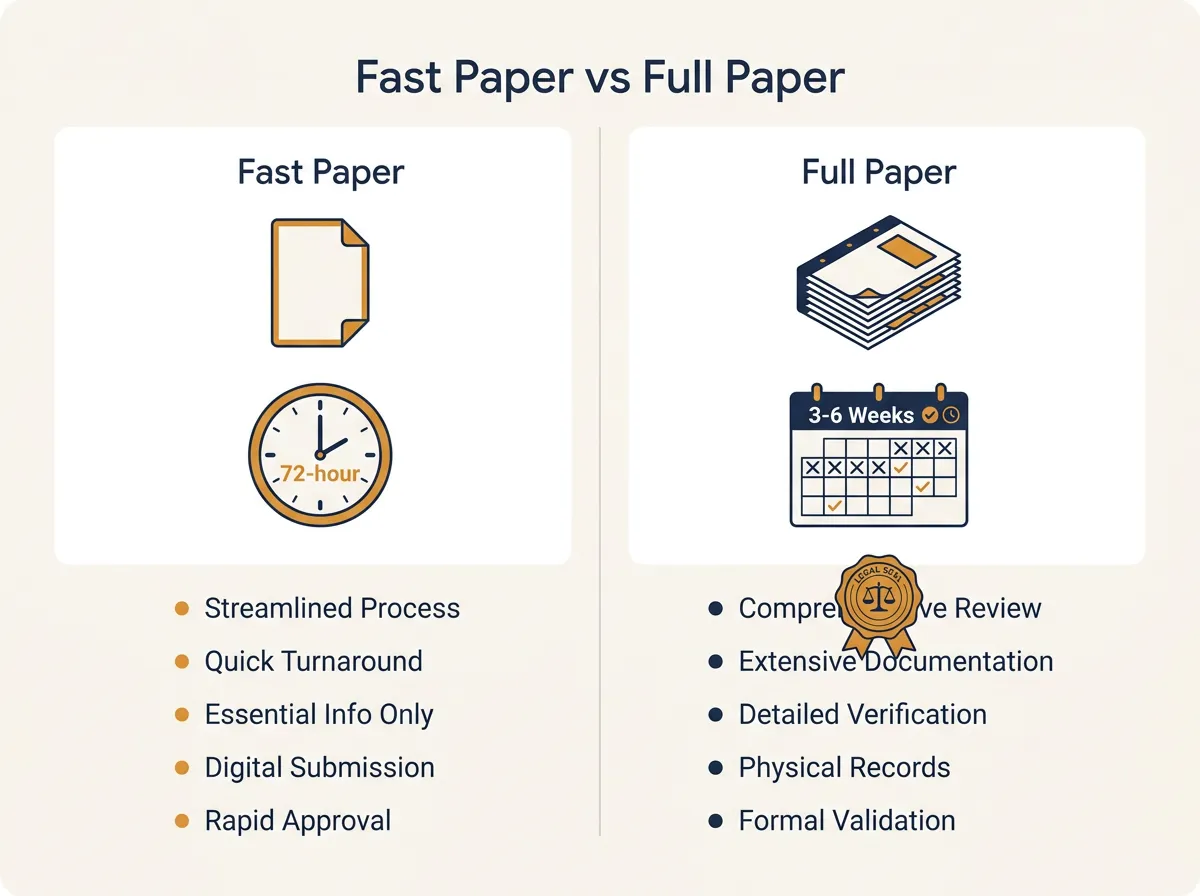
Fast Paper: sign one page within 72 hours
Fast Paper means you write a one-page, binding term sheet the same week you agree to split, sign it, and have lawyers convert it into a definitive cofounder separation agreement over the following month. The one page is short, plain, and enforceable on the points that decay fastest: share count, vesting cutoff date, access cutoff date, IP assignment, and a standstill on public statements until the long form is signed.
What it looks like in practice: eight bullets, no defined terms, both signatures, dated. "As of March 14, Dan holds 2,500,000 vested shares. The remaining 1,500,000 unvested shares are forfeited and repurchased at $0.0001. Dan's access to GitHub, AWS, Google Workspace, Stripe, and the domain registrar ends March 16 at 5pm. Dan assigns all work product to the company and will sign the company's standard assignment on request. Neither party will describe the departure to anyone outside the company before April 15."
That's it. You can write it in an evening. Have counsel review it for $1,000 to $2,000 before you sign, which most startup lawyers will do on a flat quote.
Fast Paper works because the window when both people still want to be decent to each other is short. In my experience it's about three weeks. After that, one of them talks to a friend who says "you got screwed," or gets a term sheet at a competitor, or reads a Twitter thread about founder acceleration, and the deal you had in the car is gone.
Tools like Servanda are useful here for exactly this reason: getting the terms into a structured written record while both of you are still in the version of the conversation where you're being fair.
Full Paper: nothing gets signed until everything is drafted
Full Paper means you go straight to the definitive document. Counsel on both sides, a full separation and release agreement, share repurchase agreement, IP assignment, resignation letters, and board consent, all executed together as one closing. Three to six weeks. Legal fees typically $8,000 to $15,000 across both sides at seed stage, more if there's a dispute over pre-incorporation IP.
Full Paper is the right call when the stakes are structural rather than emotional. If you've raised institutional money, your NVCA-style documents likely contain a key-person provision, a founder vesting schedule the investors negotiated, and a board consent requirement for any share repurchase. You can't paper around your investors. Try it and you'll find out during diligence on your Series A, which is the worst possible moment.
It also holds up when there's genuine disagreement about facts. If one founder claims they were promised acceleration verbally at the seed round, and the other says that never happened, a one-page term sheet doesn't resolve it. It just moves the fight later.
Where each approach breaks
Fast Paper breaks when the one-pager is vague enough to re-litigate. I sat with two founders whose signed memo said "Elena retains her vested equity." Vested as of when? Her last day in the office was February 2. Her last day on payroll was February 28. Her board resignation was signed March 11. Monthly vesting on 4,000,000 shares means those five weeks were worth roughly 104,000 shares. They spent four months and about $22,000 in fees arguing over 104,000 shares.
Write the date. Not "as of separation." A date.
Fast Paper also breaks when it's silent on something material and one party treats silence as permission. The classic: the memo covers equity and access but says nothing about the departing founder's side project that shares 400 lines of code with your core repo. Six months later they've launched it. The IP clause you skipped was the whole ballgame.
Full Paper breaks in a different way, and it's the failure mode I see most. It breaks by taking too long while nothing is enforced in the meantime. The lawyers are drafting. The departing founder still has admin on Google Workspace. On day 19, they export the customer list because their new employer asked what they could bring. On day 26, they forward a board deck to a friend. None of this is malicious in their head. They still feel like an owner, because on paper they still are one.
The other Full Paper failure is cost asymmetry. If the company has counsel and the departing founder doesn't, they will stall. And they should. Someone hands you a 24-page release drafted by the other side's lawyer and you don't sign it in a week. That's not obstruction, that's sense. But it means Full Paper only moves fast when both sides are represented, which means both sides are paying, which means the founder who just lost their income is spending $6,000 to negotiate their own exit.
What happens to equity and vesting when a cofounder leaves?
Unvested shares are forfeited and repurchased by the company at the original purchase price unless your documents or your cofounder separation agreement say otherwise. Vested shares stay with the departing founder as a shareholder, which means they keep voting rights, information rights, and a seat on the cap table for as long as the company exists.
That last part surprises people. Founders say "they're gone" and mean gone from the cap table. They're not. If your cofounder leaves at month 30 of a four-year schedule holding 2,500,000 vested shares, they own those shares through your Series B, your Series C, and your exit. They vote on the recapitalization. They sign the drag-along.
This is why the transfer restrictions matter more than the acceleration argument. Check your bylaws and stock purchase agreements for right of first refusal and co-sale provisions. If they're weak, negotiate them in the separation agreement: the company gets a right of first refusal on any transfer, and the departing founder signs a proxy or agrees to vote with the majority of common on standard corporate matters.
On acceleration: I don't think acceleration for a founder leaving voluntarily at month 30 is unreasonable, and I've watched a lot of deals close where the remaining founder gave three to six months of extra vesting to make the exit clean and fast. Call it what it is. You're buying speed and goodwill. Six months of vesting on a 4,000,000 share grant is 500,000 shares, which at a seed valuation is worth less than the legal fees of a contested departure.
Who kills the logins, and when?
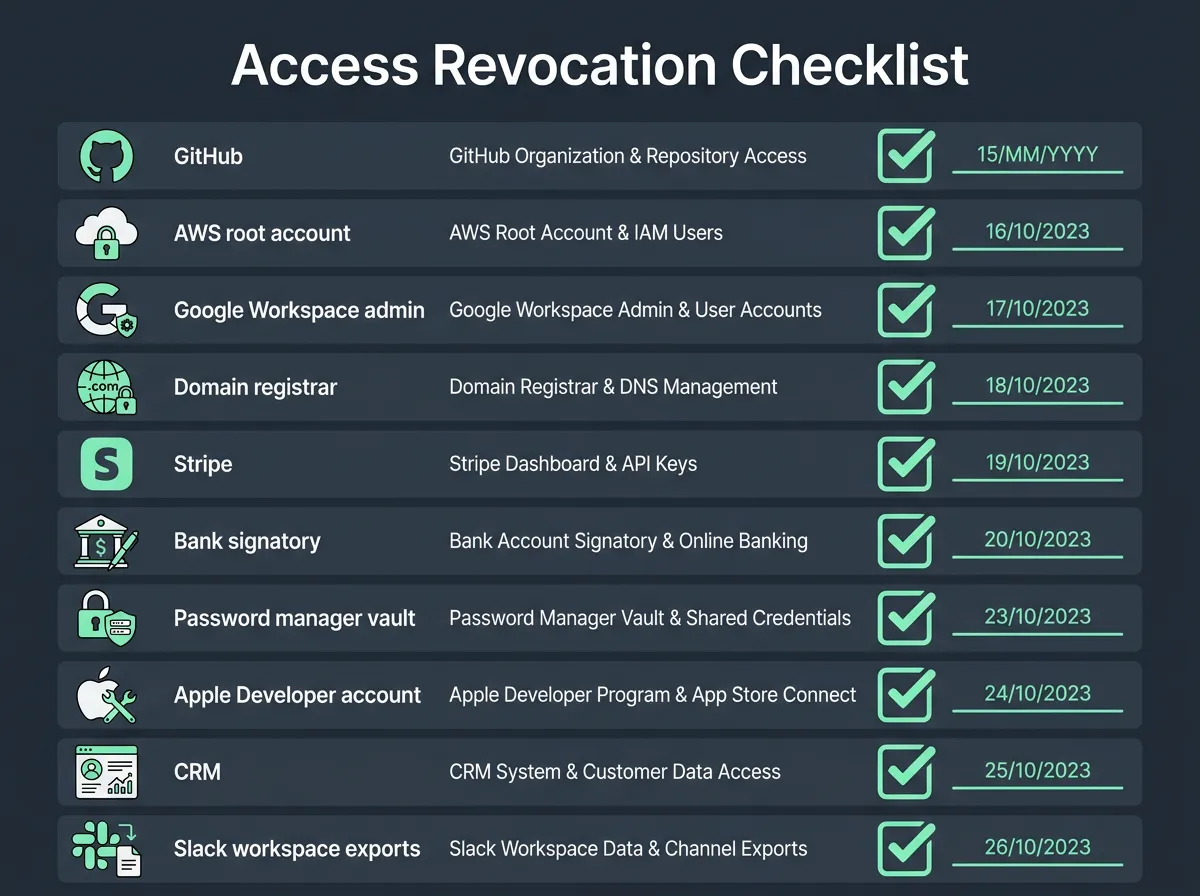
One named person revokes access on one named date, and the list of systems goes in the agreement as an appendix, not in someone's head. In practice this is the single most-skipped clause and the one that produces the ugliest surprises.
The list I make people write out, item by item:
- GitHub or GitLab org ownership, plus any personal access tokens and deploy keys
- AWS/GCP root account and IAM users, plus the MFA device attached to root
- Google Workspace super admin, plus mail forwarding rules already set up
- Domain registrar and DNS (this one is regularly in someone's personal account with a personal card on file)
- Stripe, the bank, and any signatory authority
- Apple Developer and Google Play accounts
- The password manager vault, and whether it was exported
- Customer support tooling, CRM, and the analytics dashboards
- Slack, Notion, Linear, and whether workspace exports were run in the last 30 days
- Anything with a personal credit card attached, because you'll find out about those when the card expires
Add a line stating that the departing founder confirms they have returned or deleted company data on personal devices, and that they'll cooperate on transferring accounts registered in their name. Then actually do the revocation on the stated day. I've seen agreements that specified a cutoff and nobody executed it, which is worse than not specifying one, because now you have written evidence you didn't follow your own document.
The clauses founders skip and regret
The four most-skipped clauses are IP assignment, non-disparagement with agreed language, investor and customer notification, and the mutual release. Each one has a specific way of coming back.
IP assignment. Get a fresh signature even if they signed a Confidential Information and Invention Assignment Agreement at incorporation. Acquirer diligence will ask. If any code, design, or model weights predate incorporation, list them explicitly as assigned or explicitly as excluded. Ambiguity here has blown acquisitions.
Non-disparagement with agreed language. Don't write "neither party shall disparage the other" and stop. Write the sentence. "Dan left in March to work on his own project. The split was mutual and we're on good terms." Both of you say that version, to investors, to candidates, to the podcast host. The reason this works is that ambiguity is what customers and recruits interpret badly, and a shared script removes the ambiguity without either of you having to lie.
Notification. Order matters: lead investor first, by phone, before the email. Then the rest of the cap table. Then the team, in a room, same day. Then key customers, by the account owner. Put the sequence and the date in the agreement so nobody freelances. A departing founder who texts three investors before you do has changed the story permanently.
Mutual release. Both directions, with carve-outs for fraud and for the indemnification the departing founder is owed for their time as a director. And reconcile the money: unpaid salary accruals, expense reimbursements, loans to the company, and any personal guarantee they signed on a lease or a card. I've watched a clean split fall apart over an $8,400 accrued salary claim that nobody put in the document because it felt petty to raise it.
Which one I'd pick
Fast Paper, then Full Paper. Sign one page within 72 hours covering share count, vesting cutoff date, access cutoff date, IP assignment, and a communications standstill. Then take four weeks and do the definitive documents properly. The one-pager should say it's binding and that the parties intend to execute definitive agreements, so it survives if the long form stalls.
I'd switch to straight Full Paper under three conditions. First, if you have institutional investors with a board seat and consent rights over share repurchases, because a binding one-pager you can't actually perform is worse than nothing. Second, if there's a live dispute about facts, a promise one of you says was made and the other says wasn't, because a fast document just defers that fight to a worse moment. Third, if you're in an active fundraise or acquisition process, where a half-papered founder departure showing up in diligence will cost you more than four weeks of legal time.
And if you're reading this at week ten with nothing signed and access still live: kill the access today, then write the page. You can negotiate equity for another month. You cannot un-export a customer list.