
How to Have Hard Conversations With Your Cofounder
You've been thinking about it for three weeks. Maybe it's the equity split that felt fair at the napkin stage but doesn't reflect reality anymore. Maybe your cofounder keeps making product decisions without looping you in. Maybe you're quietly resenting the workload imbalance but smiling through every standup.
You know the conversation needs to happen. And every day you postpone it, the gap between you widens a little more.
Here's what the data tells us: cofounder breakups are the leading cause of early-stage startup failure, and the root cause is almost never a single explosive argument. It's the slow rot of avoidance. The topics that feel too awkward, too risky, or too "early" to raise. The tension that gets swallowed instead of surfaced.
This article gives you a concrete protocol for having hard conversations with your cofounder — not someday, but this week. No therapy-speak. No vague advice about "communicating better." Just a framework you can use the next time you feel that knot in your stomach.
Key Takeaways
- Avoidance, not disagreement, is what destroys cofounder relationships. The conversations you're dodging are the ones that matter most.
- Use a structured conflict protocol — a predictable format that removes ambiguity about when and how to raise difficult topics.
- Separate the topic from the threat. Frame conversations around the business problem, not personal blame.
- Formalize outcomes in writing. Verbal agreements erode. Written ones create accountability and reduce repeated conflict.
- Schedule recurring "pressure release" check-ins so that hard conversations become routine, not crisis events.

Why Cofounders Avoid Hard Conversations (And What It Costs)
Let's name the real reasons you haven't brought it up yet:
- You're afraid of damaging the relationship. This person is your partner. You chose each other. Raising a grievance feels like a betrayal of that trust.
- You're not sure you're "right." The issue feels real in your gut but hard to articulate. You worry you'll sound petty or unreasonable.
- You think it'll resolve itself. Maybe if you just give it another sprint, another milestone, the dynamic will shift on its own.
- You don't have a precedent. You've never had this type of conversation with this person before, and there's no template for how it should go.
Every one of these reasons is understandable. And every one of them leads to the same place: compounding resentment.
The Initialized Capital blog documented a pattern across dozens of failed startups: cofounders who described their breakups didn't point to a single blowout fight. They pointed to months — sometimes years — of unspoken frustration that eventually became unsalvageable. By the time the conversation finally happened, both sides had already mentally checked out.
The cost of avoidance isn't just emotional. It's strategic. Misaligned cofounders make slower decisions, duplicate effort, send mixed signals to employees, and erode investor confidence.
The Topics Most Likely to Be Avoided
In cofounder conflicts, the same subjects come up repeatedly:
- Equity and compensation — "Is our split still fair given how much has changed?"
- Roles and decision-making authority — "Who actually owns this?"
- Work ethic and commitment levels — "I feel like I'm carrying more weight."
- Strategic vision — "I think we want different things for this company."
- Exit and personal timelines — "How long are you in this for?"
If you recognized yourself in any of those, you have a conversation to schedule.
A Practical Protocol for Hard Cofounder Conversations
What follows isn't theory. It's a repeatable process you can use for any difficult topic, starting today.
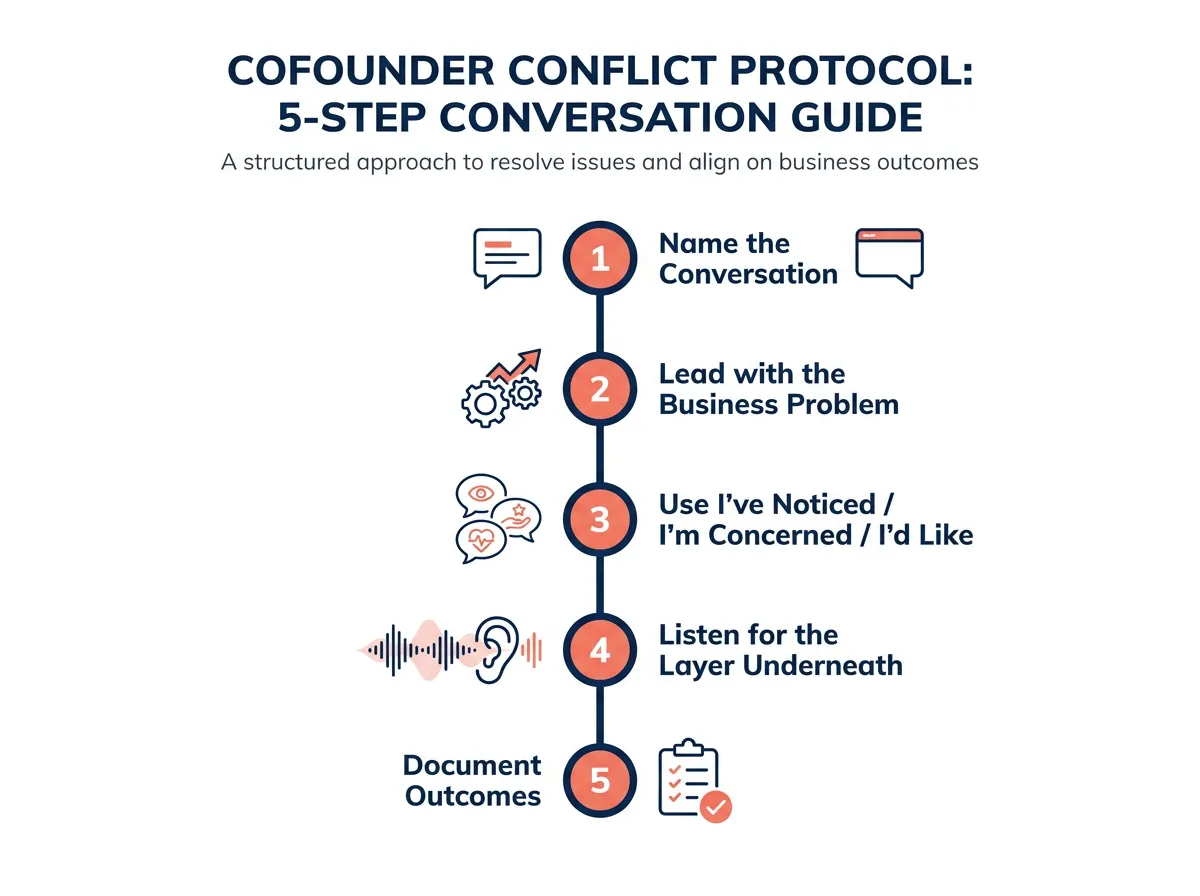
Step 1: Name the Conversation Before You Have It
Don't ambush your cofounder. The worst way to start a hard conversation is to spring it during an unrelated meeting or fire off a loaded Slack message at 11 PM.
Instead, request the conversation explicitly:
"Hey, I want to talk about how we're splitting product vs. business decisions. It's been on my mind and I think it's worth a focused conversation. Can we block 45 minutes this week?"
This does three things: - It signals respect. You're treating this as important enough to deserve dedicated time. - It gives your cofounder time to reflect instead of react. - It frames the conversation as collaborative, not confrontational.
What to avoid: Don't say "we need to talk" without context. That phrase triggers a threat response in most people. Be specific about the topic.
Step 2: Lead With the Business Problem, Not the Personal Grievance
This is the single most important reframe. Most cofounder conflicts feel personal — but they're almost always rooted in a structural ambiguity.
Compare these two openings:
❌ "I feel like you don't respect my time. You keep making decisions without me and it's really frustrating."
✅ "We don't have a clear decision-making framework for product changes. I've noticed a few decisions happened without input from both of us, and I think that's going to create problems as we scale. Can we define who owns what?"
The second version addresses the same issue — but it points at the gap in the system, not at your cofounder's character. This makes it dramatically easier for the other person to engage without becoming defensive.
Step 3: Use the "I've Noticed / I'm Concerned / I'd Like" Framework
If you're not sure how to structure what you want to say, this three-part framework keeps things grounded:
- I've noticed: State the observable fact. No interpretation, no mind-reading. Just what happened.
- I'm concerned: Explain why it matters to the business or the partnership. This is where you connect the fact to a real risk.
- I'd like: Propose a concrete next step. Don't just raise the issue — offer a path forward.
Example:
"I've noticed that our last three investor updates had different messaging about our target market. I'm concerned that we're not aligned on our ICP, and that it's going to confuse our fundraise narrative. I'd like us to spend an hour this week aligning on our positioning doc."
This framework works because it's specific, non-accusatory, and action-oriented. It turns a vague feeling into a solvable problem.
Step 4: Listen for the Layer Underneath
When your cofounder responds, resist the urge to rebut immediately. Hard conversations between cofounders often have a surface layer and a deeper layer:
| Surface Topic | Deeper Layer |
|---|---|
| "You made that hire without consulting me" | "I don't feel like an equal partner" |
| "We need to revisit the equity split" | "I don't think my contributions are valued" |
| "You're not around enough" | "I'm worried about your commitment" |
You won't always get to the deeper layer in the first conversation. But if you listen without defending — even for two minutes — you'll often hear it surface on its own.
A practical technique: after your cofounder finishes a thought, summarize it back before responding. "So what I'm hearing is..." This alone defuses more tension than most people realize.
Step 5: Document Outcomes, Not Just Feelings
This is where most cofounder conversations fail. You have a good talk. You feel relieved. You go back to work. And six weeks later, you realize nothing actually changed — because there was no written record of what you agreed to.
After any substantive conversation, document:
- What was discussed — the specific topic and context
- What was agreed — decisions, role changes, new processes
- What happens next — who does what, by when
- When you'll revisit — a specific date to check in on whether the agreement is working
This doesn't need to be a legal document. A shared note in your project management tool is fine. What matters is that it exists outside of your memories, which will inevitably diverge.
Tools like Servanda can help cofounders formalize these agreements into structured, written documents — especially for high-stakes topics like equity, roles, and decision-making authority — so that the hard conversation leads to a durable outcome rather than a temporary truce.
Building a Conflict-Ready Cofounder Relationship
A single conversation protocol isn't enough. The goal is to build a relationship where hard conversations are normal — expected, even.

Schedule Monthly "State of the Partnership" Check-Ins
The best cofounder teams treat their relationship like a product: they iterate on it. Set a recurring monthly meeting — separate from your operational standups — where you discuss:
- What's working well in our dynamic?
- What's creating friction?
- Are our roles still clear?
- Is there anything either of us has been hesitant to raise?
The last question is the most important one. By creating a predictable, low-stakes venue for difficult topics, you reduce the activation energy required to raise them.
Establish Decision Rights Early
A surprising number of cofounder conflicts aren't about disagreement — they're about ambiguity. Both cofounders think they own a decision, or neither does.
Create a simple decision-rights matrix:
| Domain | Decision Owner | Must Consult |
|---|---|---|
| Product roadmap | CTO | CEO |
| Hiring (engineering) | CTO | CEO |
| Fundraising | CEO | CTO |
| Pricing | CEO | CTO |
| Brand/marketing | CEO | CTO |
Your version will look different. The specifics matter less than the act of making it explicit. Once you've written it down, 80% of the "you went over my head" conflicts simply vanish.
Agree on Your Conflict Norms
Before you're in the middle of a disagreement, agree on how disagreements should work:
- Escalation timeline: If we disagree on something, how long do we debate before the decision owner makes the call?
- Cooling off: Is it okay to say "I need 24 hours before I respond to this"? (Yes. Always yes.)
- No triangulation: Agree that neither of you will vent to employees or board members before talking to each other first.
- Revisit rights: Any decision can be revisited if new information emerges — but not relitigated simply because the losing side is still upset.
Writing these norms down — even informally — creates a shared operating system for conflict. It means you're not inventing the rules while simultaneously trying to follow them.
When the Conversation Doesn't Go Well
Sometimes you follow the protocol and it still goes sideways. Your cofounder shuts down, gets defensive, or dismisses the issue entirely. That's information too.
A few options:
- Give it a day and try again. Some people need processing time. A bad first reaction doesn't always predict the final outcome.
- Put it in writing. If verbal conversations aren't productive, write a thoughtful email or shared doc. Some people engage more honestly in text.
- Bring in a third party. A mutual advisor, a board member, or a professional mediator. This isn't a failure — it's a sign you're taking the relationship seriously enough to get help.
- Recognize a pattern. If your cofounder consistently refuses to engage with legitimate concerns, that's not a communication problem. It's a compatibility problem. And it's better to face that now than after your Series A.
Frequently Asked Questions
How do I bring up equity with my cofounder without ruining the relationship?
Start by framing it as a forward-looking conversation, not a grievance. Say something like, "As our roles evolve, I want to make sure our equity structure still reflects our contributions — can we revisit it together?" Anchor the discussion in fairness and business logic, not emotion. Having this conversation early, before resentment builds, makes it dramatically easier.
When should cofounders consider bringing in a mediator?
Consider a mediator when the same issue keeps resurfacing without resolution, when conversations consistently escalate into personal attacks, or when one cofounder refuses to engage with a legitimate concern. A neutral third party can help identify underlying issues and facilitate agreements that stick. It's a sign of maturity, not weakness.
How often should cofounders have check-in conversations about their partnership?
Monthly is the minimum recommended cadence for a dedicated "state of the partnership" conversation. In high-stress periods — fundraising, pivots, major hires — increase to biweekly. The key is consistency: these check-ins should happen whether or not there's an obvious issue to discuss. That predictability is what makes it safe to raise harder topics.
What if my cofounder gets defensive every time I raise a concern?
First, examine your delivery — are you leading with blame or with business impact? If you're confident in your approach, acknowledge the pattern directly: "I've noticed these conversations tend to feel tense. I want us to be able to talk about hard things without it feeling like an attack. How can we make that easier?" If defensiveness persists despite good-faith effort, a third party may be necessary.
Moving Forward
The hard conversation you've been avoiding? It's not going to get easier with time. It's going to get harder. The equity conversation you skip today becomes the lawsuit next year. The role ambiguity you tolerate this quarter becomes the employee exodus next quarter.
But here's the genuinely good news: cofounder relationships that survive hard conversations don't just survive — they get stronger. Every difficult topic you navigate together builds trust, clarifies expectations, and deepens your ability to work under pressure.
You don't need to be a perfect communicator. You need to be a willing one. Pick the conversation that's been weighing on you most. Name it. Schedule it. Use the framework. And write down what you agree on.
The founders who last aren't the ones who never fight. They're the ones who learned how to fight well.