
Why Cofounders Break Up: 5 Preventable Mistakes
They'd been building together for two years. Late nights. Shared Notion boards. The kind of shorthand that only comes from surviving a failed product launch side by side. Then one Tuesday, over a Slack message that should have been a conversation, it was over.
If you're a cofounder, some version of this story probably keeps you up at night—or maybe it already sounds familiar. Cofounder breakups are the leading cause of early startup death, responsible for an estimated 65% of high-potential startup failures according to Harvard Business School research. And the most painful part? The vast majority of these breakups are preventable.
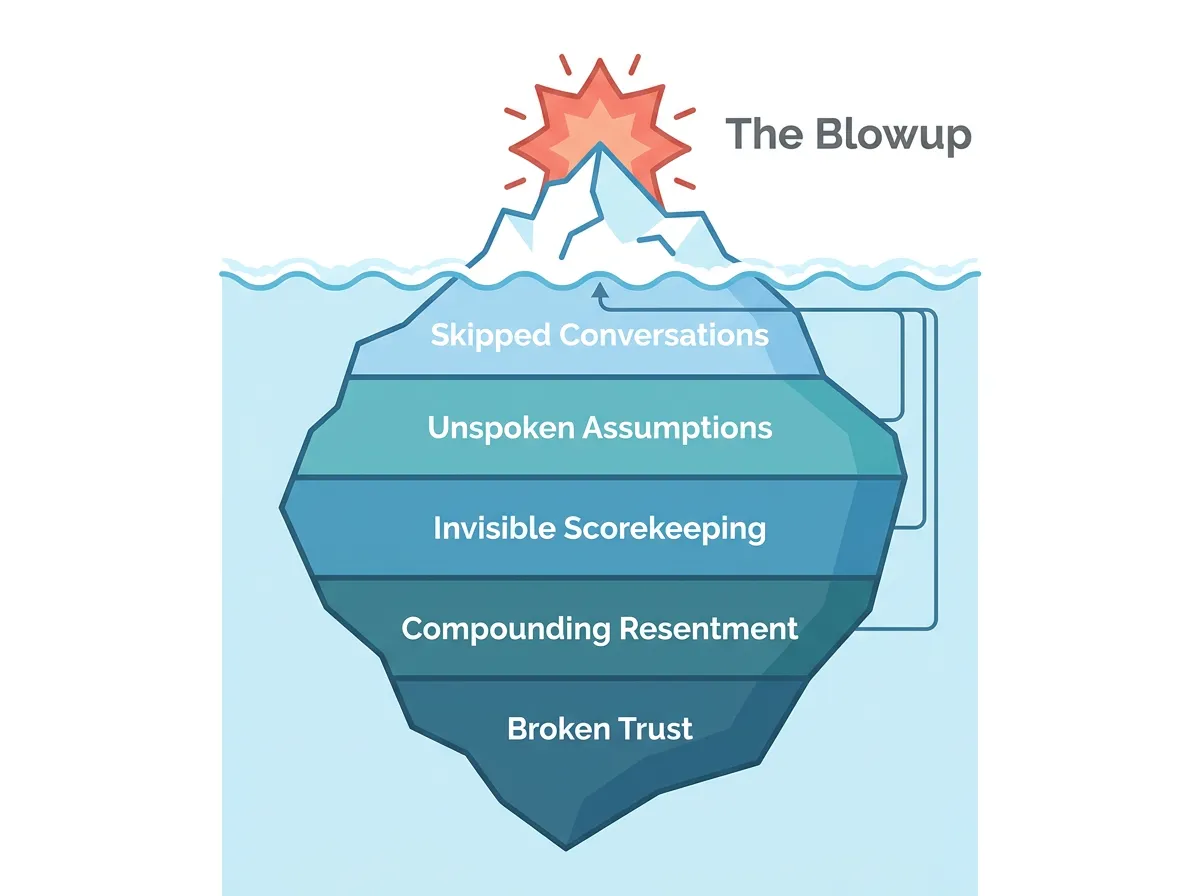
The fractures almost never start with a dramatic blowout. They start with a skipped conversation, an assumption that goes unchecked, a slow drift that nobody names out loud until it's too late to reverse. After studying dozens of startup post-mortems and real cofounder separation stories, five patterns emerge again and again—each one a mistake that compounds quietly before it detonates.
Key Takeaways
- Most cofounder breakups aren't caused by a single event—they result from conflict avoidance that compounds over months or years.
- Unequal, unspoken expectations around equity, roles, and workload are the most common root cause of founder resentment.
- Formalizing agreements early (vesting schedules, decision-making frameworks, exit terms) isn't a sign of distrust—it's an act of respect.
- Regular, structured check-ins between cofounders can surface friction before it becomes irreparable.
- The cofounders who survive aren't the ones who never fight—they're the ones who built systems for handling disagreement.
Mistake #1: The Equity Handshake That Haunts You
It's the most common origin story for cofounder resentment: two friends split equity 50/50 over beers, never revisiting it as one person's contribution dwarfs the other's.
Consider the story of a SaaS startup we'll call Relay. Two cofounders agreed to equal equity the week they incorporated. Eighteen months later, one cofounder had quit her day job, raised a pre-seed round, and built the product. The other was still "advising" a few hours a week. Neither had discussed it directly. The working cofounder felt exploited. The part-time cofounder felt entitled. By the time they finally had the conversation, there was nothing left to save.
What makes this preventable
The problem isn't a 50/50 split itself—it's a static agreement applied to a dynamic relationship. Here's what actually works:
- Use a vesting schedule with a cliff. Standard four-year vesting with a one-year cliff means nobody walks away with half the company after three months of work.
- Define contribution expectations in writing. Not a legal treatise—a simple shared document that says: "Here's what each of us is committing to in terms of time, money, and responsibility."
- Schedule an equity review. Agree in advance to revisit equity allocation at a specific milestone (six months in, post-funding, etc.).
The conversation feels awkward now. It will feel catastrophic later.
Mistake #2: Assuming Alignment Instead of Testing It
You finish each other's sentences. You share the same vision deck. You've never really disagreed. That last part isn't a green flag—it's a red one.
Many cofounder pairs mistake chemistry for alignment. They feel so in sync during the honeymoon phase that they skip the hard specificity of asking: What do we actually want this company to become? What does success look like in three years? What happens if we get a $5 million acquisition offer?

A pair of cofounders behind an edtech startup—let's call them Mira and David—discovered this the hard way. Mira wanted to build a venture-scale business. David wanted a profitable lifestyle company. They never discussed it because the early work looked the same: build a product, find users. The divergence only became visible when Mira wanted to raise a Series A and David wanted to take distributions. By then, each felt betrayed.
What makes this preventable
- Run a "cofounder alignment exercise" before you incorporate. Ask each other: What's your personal financial runway? When would you accept an acquisition? How do you feel about taking on debt? Do you want to be CEO forever?
- Revisit vision alignment quarterly. People change. Markets change. The vision document you wrote in month one may not survive month twelve—and that's fine, as long as you're evolving together.
- Get specific about the uncomfortable stuff. Abstract agreement ("We want to make an impact") masks concrete disagreement ("I want to sell in three years; you want to IPO").
Mistake #3: Undefined Roles and Invisible Scorekeeping
When roles aren't explicit, everyone fills in the gaps with their own narrative. One cofounder believes she's carrying the company because she handles fundraising, sales, and product decisions. The other believes he's carrying it because he writes every line of code and answers every support ticket at midnight.
Neither is wrong. But without a clear, shared understanding of who owns what, both feel underappreciated. Resentment builds through invisible scorekeeping—a mental ledger of sacrifices that never gets reconciled because it never gets spoken.
This played out at a consumer app startup we'll call Glint. Both cofounders had the title "Co-CEO." In practice, this meant neither had final authority on anything. Every decision became a negotiation. Small ones (which logo?) became proxies for larger power struggles (who's really in charge?). Within a year, the company's velocity had slowed to a crawl, and both cofounders felt more like adversaries than partners.
What makes this preventable
- Assign domains of ownership, not just titles. "You own product and engineering. I own go-to-market and finance. Here are the three decisions we make together." This doesn't have to be rigid—but it has to exist.
- Agree on a tiebreaker mechanism. When you disagree on a shared decision, what happens? Does CEO have final call? Do you bring it to an advisor? Flip a coin? (Seriously—some successful cofounders use a coin flip for low-stakes deadlocks.)
- Make the invisible visible. Try a monthly "contribution check-in" where each person shares what they've been doing. Not to compete—to see each other clearly.
Mistake #4: Letting Small Conflicts Compound Into Identity Threats
This is the mistake that underpins all the others, and it's the one cofounders are least likely to recognize in real time.
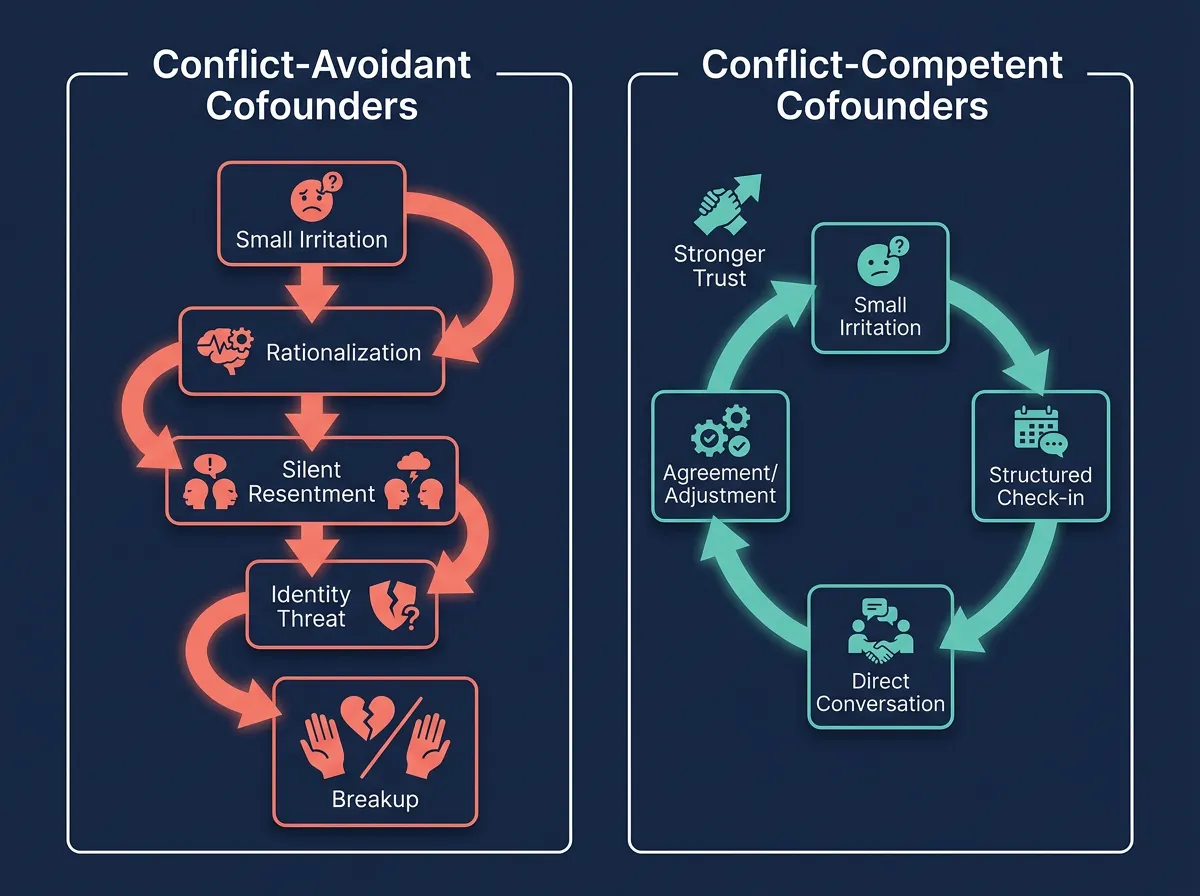
It starts small. One cofounder makes a hire without consulting the other. A moment of irritation—but it passes. Then it happens again with a product decision. Then again with a pricing change. Each incident is individually minor, easy to rationalize: It's not worth the argument. We're too busy for this. I'll bring it up next time.
"Next time" never comes. Instead, each unresolved micro-conflict deposits a thin layer of resentment. Over months, those layers calcify into something much harder to address: a fundamental questioning of the relationship itself. Do they even respect me? Do they think they're more important? Maybe I should just go build this alone.
By the time the conversation finally happens, it's no longer about a hiring decision—it's about identity, worth, and trust. That's an almost impossible conversation to have productively.
What makes this preventable
- Create a regular forum for friction. A biweekly cofounder check-in with a standing agenda: What's working? What's bothering you? Any decisions we need to align on? The structure matters more than the content—it normalizes the act of raising concerns before they fester.
- Name the pattern, not just the incident. When something bothers you, try: "I've noticed we're making bigger decisions unilaterally, and I want to talk about our process" instead of "You hired someone without asking me."
- Consider using a structured framework for difficult conversations. Tools like Servanda can help cofounders document agreements and create clear decision-making protocols, giving you a reference point when memories and emotions diverge.
Mistake #5: No Prenup—Skipping the Exit Conversation
Nobody wants to talk about breaking up during the excitement of starting up. That's exactly why you have to.
The absence of a cofounder separation agreement—what some founders call a "startup prenup"—is one of the most reliably destructive oversights in early-stage companies. When breakups happen without pre-agreed terms, the departing cofounder's equity, IP ownership, non-compete terms, and vesting acceleration all become ammunition in a fight that can consume the surviving company.
One widely covered case involved a two-person fintech startup where a departing cofounder retained 40% equity with no vesting, no non-compete, and no obligation to contribute. The remaining cofounder spent eight months in legal proceedings instead of building. The company never recovered.
What makes this preventable
- Include separation terms in your operating agreement from day one. Cover: What happens to unvested shares? Is there a buyback provision? How is IP assigned? What are the non-compete and non-solicitation terms?
- Define "cause" for forced departure. Nobody wants to imagine firing their cofounder. But documenting what constitutes a terminable breach—fraud, abandonment, competing ventures—protects both of you.
- Revisit these terms at each funding round. Your company at pre-seed is not your company at Series B. Your agreements should evolve accordingly.
Think of it this way: a separation agreement isn't a prediction that things will go wrong. It's a shared commitment to handling adversity like adults if it does.
The Common Thread: Conflict Avoidance Is the Real Killer
If you look across all five mistakes, one thread connects them: the instinct to avoid uncomfortable conversations. Not because cofounders are cowards—but because the stakes feel so high that any friction seems existential.
The irony is that avoiding the conversation is what makes it existential. A small disagreement about equity is manageable in month two. By month eighteen, it's a lawsuit. A misalignment on vision is a rich conversation when raised early. Discovered during a board meeting, it's a crisis.
The cofounders who make it aren't conflict-free. They're conflict-competent. They've built habits, rituals, and documents that make hard conversations routine instead of catastrophic.
FAQ
How do you know if your cofounder relationship is in trouble?
Watch for these signals: you're avoiding certain topics, you feel resentment after meetings, you're making decisions without consulting each other, or you find yourself venting to employees or advisors instead of talking directly. If any of these feel familiar, it's time for a structured conversation—not next quarter, this week.
Can a cofounder breakup be reversed once it starts?
Sometimes, yes—but only if both parties are willing to acknowledge the patterns, not just the latest incident. Some cofounder pairs have successfully used mediation, advisory intervention, or restructured roles to rebuild trust. The key variable is timing: the earlier you intervene, the more options you have.
What should a cofounder agreement include?
At minimum: equity split and vesting schedule, roles and decision-making authority, intellectual property assignment, financial commitments, what happens if one person leaves (voluntarily or involuntarily), and a dispute resolution process. Think of it as a living document—revisit it every six to twelve months.
Is it a bad sign if cofounders disagree a lot?
Not necessarily. Frequent, productive disagreement can be a sign of a healthy partnership with diverse perspectives. The warning sign isn't disagreement itself—it's how you handle it. If disagreements are resolved through avoidance, silent resentment, or power plays rather than direct conversation, that's when you should be concerned.
Moving Forward Together
Cofounder breakups rarely happen because two good people become bad partners. They happen because good people avoid small, manageable conversations until those conversations become large, unmanageable crises.
The good news is that every pattern described here is reversible—if you're willing to start now. Write down your agreements. Schedule the check-in. Have the awkward conversation about equity, roles, vision, and what happens if one of you wants out. It won't feel natural at first. It will feel like the most important thing you do for your company.
Because the startups that survive aren't built on the absence of conflict. They're built on the willingness to face it early, name it clearly, and resolve it together.