College Roommate Horror Stories & How to Survive
It's 2 a.m. on a Tuesday. You have an 8 a.m. organic chemistry exam. Your roommate has just invited six people over for an impromptu karaoke session — and they're belting out "Bohemian Rhapsody" like their life depends on it. You're lying in bed, staring at the ceiling, wondering how the cheerful person you met during move-in day turned into your personal antagonist.
If this sounds familiar, you're far from alone. Nearly 70% of college students report significant conflicts with their roommates during their first year, according to campus housing research. The jump from living at home to sharing a tiny dorm room with a stranger is one of the most jarring transitions in a young adult's life. But here's the thing most orientation leaders won't tell you: almost every college roommate horror story follows a predictable pattern — and most of them are survivable once you know what you're dealing with.
This article collects real (anonymized) horror stories from college students, breaks down what went wrong in each one, and gives you a concrete playbook for handling similar situations yourself.
Key Takeaways
- Most roommate horror stories escalate because small issues go unaddressed — not because one person is inherently terrible to live with.
- Written agreements created in the first two weeks of living together prevent the vast majority of blow-up conflicts about noise, guests, and shared spaces.
- You have more power than you think: RAs, housing offices, and mediation resources exist specifically for situations that feel unresolvable.
- "Normal" roommate friction is real and expected — the difference between a rough patch and a horror story is whether both people are willing to problem-solve.
- Documenting issues early protects you if you ever need to request a room change or involve housing staff.

The Horror Stories (And What They Really Teach Us)
Let's start with the stories. These are drawn from real student experiences shared on forums, in campus surveys, and through interviews — names and identifying details have been changed.
Horror Story #1: The Phantom Borrower
What happened: Maya arrived back at her dorm after a weekend trip home to find her favorite hoodie on her roommate Jess's Instagram story. Over the following weeks, Maya noticed her shampoo draining faster, her snacks disappearing, and her laptop charger perpetually "borrowed" without asking. When Maya finally said something, Jess laughed it off: "We're roommates, I thought we shared everything."
What went wrong: Maya and Jess never discussed what sharing meant to each of them. For Jess, growing up with siblings meant communal property was the default. For Maya, an only child, personal items were exactly that — personal. Neither assumption was wrong, but neither was communicated.
The survival lesson: Before resentment builds, have a specific conversation about belongings. Not "let's respect each other's stuff" (too vague), but: "I'm not comfortable with people using my things without asking first. Can we agree to always text before borrowing?" The more specific the boundary, the harder it is to accidentally cross.
Horror Story #2: The Overnight Guest Who Never Left
What happened: Carlos's roommate Derek started dating someone in October. By November, Derek's partner was sleeping over five to six nights a week. Carlos was essentially living with a third person who hadn't signed a housing agreement — someone who used his shower caddy space, left dishes in the room, and made Carlos feel like an intruder in his own dorm.
What went wrong: Carlos didn't say anything for six weeks because he didn't want to seem "uncool" or unsupportive of the relationship. By the time he brought it up, Derek was defensive: "You never said it bothered you."
The survival lesson: Guest policies need to be established before there's a specific guest to argue about. A proactive conversation during move-in week — "How do we feel about overnight guests? What's a reasonable limit per week?" — removes the personal sting when you later need to enforce the boundary. Most universities also have overnight guest policies in their housing contracts. Know yours.

Horror Story #3: The Noise War
What happened: Priya was a morning person who woke at 6 a.m. to study. Her roommate Alexa was a night owl who stayed up until 3 a.m. gaming with a headset on — but still clicked her mechanical keyboard loudly and kept her desk lamp blazing. Priya started retaliating by setting her alarm extra early and not using headphones for her morning podcasts. Within a month, neither of them was speaking.
What went wrong: This is the classic escalation spiral. Instead of addressing the original problem (incompatible schedules), both roommates began punishing each other. Passive aggression replaced communication, and the conflict became about winning rather than coexisting.
The survival lesson: When you catch yourself thinking, "Well, if she's going to do X, then I'm going to do Y," stop. That impulse is a red flag that you've shifted from problem-solving to score-keeping. Reset by addressing the root issue: "Our schedules are really different. Can we figure out a lights-off time and a quiet hours agreement that works for both of us?"
Horror Story #4: The Cleanliness Standoff
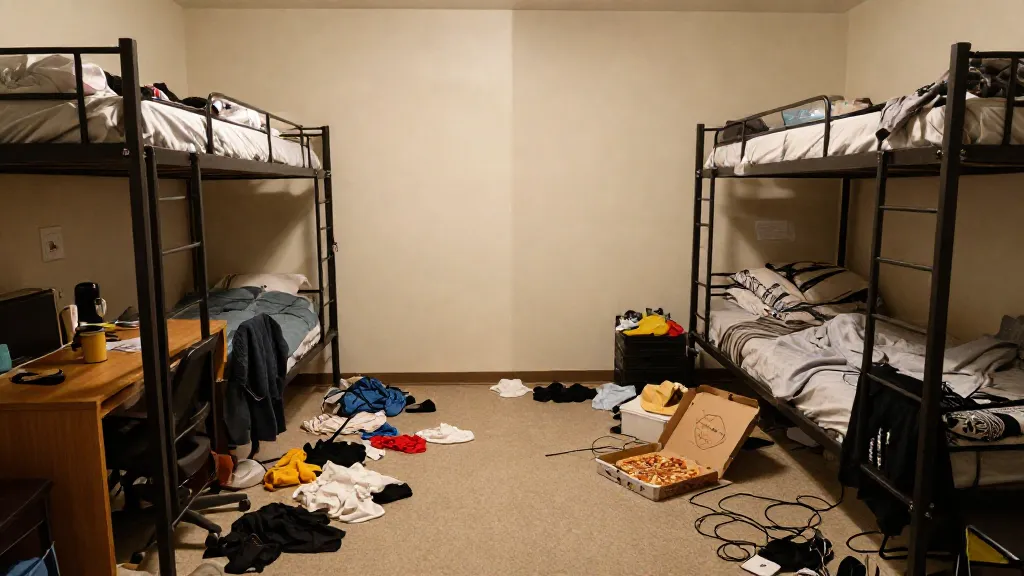
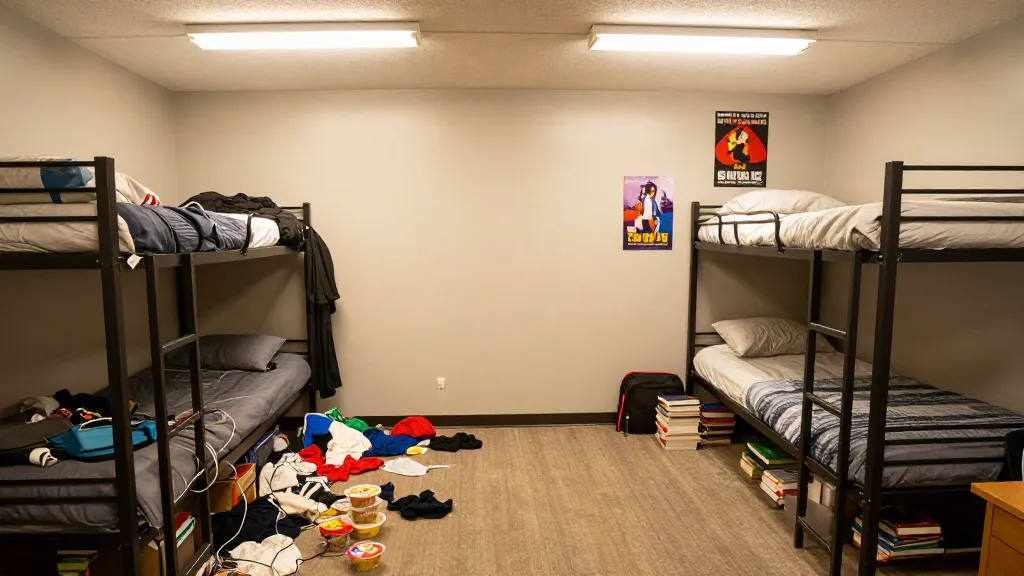
What happened: Tyler's roommate left dirty dishes on his desk for days, let laundry pile up until it smelled, and never once took out the trash. Tyler tried hinting ("Wow, it's getting kind of ripe in here"), then tried cleaning everything himself, then gave up entirely. Their room was eventually flagged during a health and safety inspection.
What went wrong: Hinting doesn't work. Martyring yourself by cleaning everything doesn't work either — it just breeds resentment and teaches your roommate that the problem will solve itself. Tyler never made a direct, non-judgmental request.
The survival lesson: Use this formula: "When [specific thing happens], it affects me because [specific impact]. Can we agree to [specific solution]?" Example: "When the trash sits for more than three days, the smell makes it hard for me to study in here. Can we set up a rotation where we each take it out on alternating days?" Put the rotation on a shared calendar or whiteboard. Written systems beat verbal promises.
Why College Roommate Horror Stories Follow the Same Patterns
If you read enough of these stories — and trust me, the internet has thousands — you start to see the same five root causes over and over:
- No explicit agreements were made upfront. Both roommates assumed the other would "just know" the rules.
- Small irritations were ignored until they became big resentments. The dirty dish isn't really about the dish. It's about feeling disrespected after six weeks of dirty dishes.
- Confrontation was avoided because it felt awkward. Most 18-year-olds have never had to negotiate living terms with a peer before.
- Passive aggression replaced direct conversation. Notes on the fridge, pointed sighs, retaliatory behavior — all of it makes things worse.
- Neither person knew what resources were available. RAs, housing mediators, and counseling centers exist for exactly these situations, but students often don't reach out until the conflict is at a breaking point.
Recognizing these patterns is genuinely powerful. When you can see that your situation fits Pattern #2 (small irritation snowball), you can intervene before it becomes a full-blown horror story of your own.
Your Roommate Survival Playbook
Here's a concrete, step-by-step approach to preventing — or de-escalating — the most common roommate nightmares.
Step 1: Create a Written Roommate Agreement in Week One
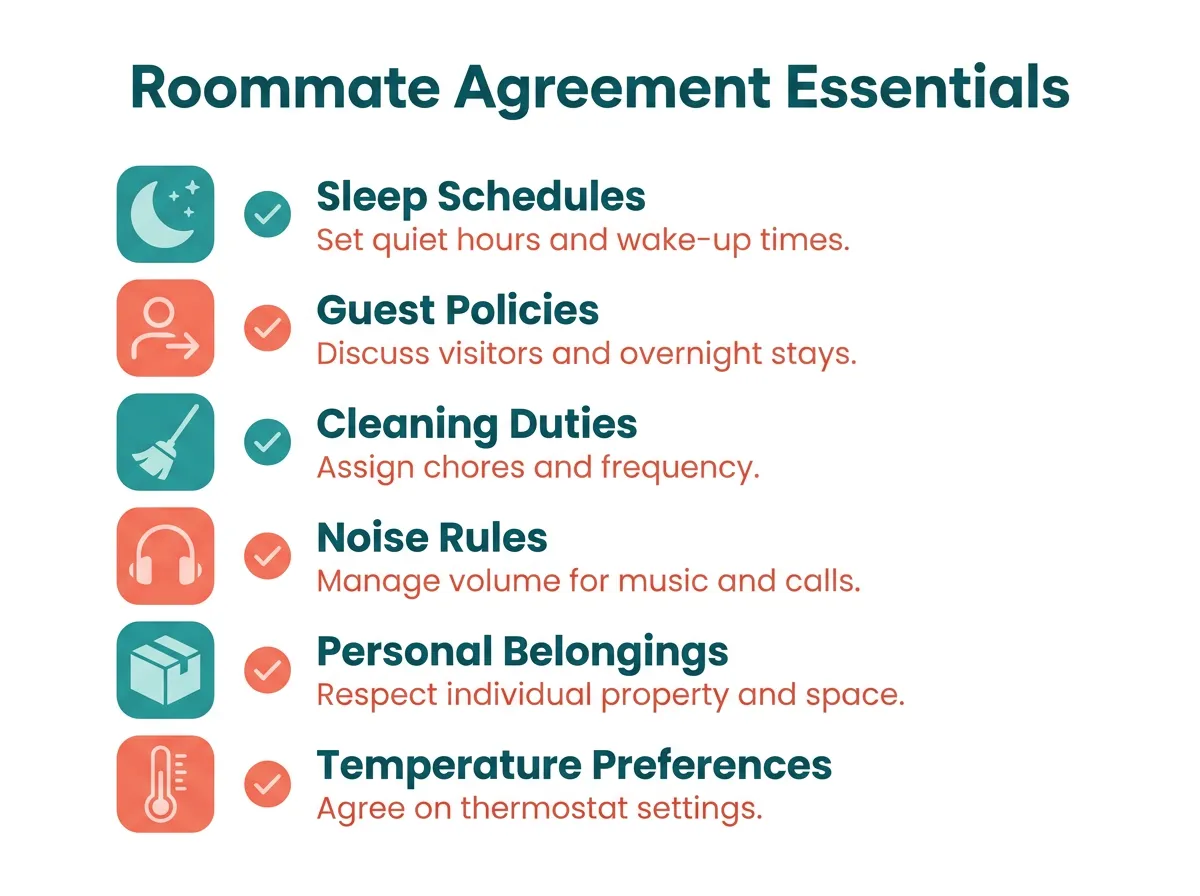
Don't wait for problems to emerge. During your first week together, sit down and hash out agreements on these specific topics:
- Sleep schedules: Agreed quiet hours and lights-off times
- Guests: How many nights per week are overnight guests allowed? How much advance notice is expected?
- Shared vs. personal items: What's communal? What's off-limits? What requires asking?
- Cleaning responsibilities: Who does what, and how often? Use a rotating schedule.
- Noise during study hours: Headphones policy, phone calls in the room vs. hallway
- Temperature and window preferences: This sounds trivial until it isn't.
Write these down. Seriously — on paper or in a shared document. A verbal agreement is just a suggestion waiting to be forgotten. Tools like Servanda can help you and your roommate build a structured written agreement that covers all of these areas, so nothing falls through the cracks when memory gets fuzzy mid-semester.
Step 2: Address Issues Within 48 Hours
The 48-hour rule is simple: if something your roommate does bothers you, bring it up within two days. Not two weeks. Not two months. Here's why this works:
- The issue is still small enough to discuss calmly
- Your roommate is less likely to feel ambushed
- You haven't had time to build a mental case against them
- The specific incident is still fresh, so you can reference it clearly
Opening lines that actually work: - "Hey, can we talk about something small before it becomes a thing?" - "I want to bring something up while it's minor — it's not a big deal yet, and I'd like to keep it that way." - "I noticed [specific thing]. Can we figure out a system for that?"
Step 3: Use "Both/And" Framing Instead of "Either/Or"
The biggest mistake in roommate conflicts is framing the situation as winner-takes-all. Instead of "Either you stop having guests over or I'm going to the RA," try:
"I want you to be able to spend time with your partner, and I need to be able to sleep in my own room. How can we make both of those things work?"
This framing signals that you're not trying to control them — you're trying to solve a logistics problem together. It dramatically reduces defensiveness.
Step 4: Know When (and How) to Escalate
Not every conflict is solvable between two people, and that's okay. You should involve your RA or housing office when:
- You've tried to address the issue directly at least once and nothing changed
- Your roommate refuses to discuss the problem at all
- The situation involves safety concerns (substance abuse, threats, harassment)
- Your academic performance or mental health is being affected
- You've documented a pattern of issues over time
When you do escalate, bring specifics: dates, what happened, what you tried, and what you're requesting. "My roommate is annoying" won't get you far. "My roommate has had overnight guests five or more nights per week for the past month, and I've asked twice for us to set a limit — here are the texts" tells a clear story.
Step 5: Protect Your Own Well-Being
While you're working through a conflict, don't forget to take care of yourself:
- Find alternate study spaces. The library, a campus café, or a friend's room can be a pressure-release valve.
- Build a support network beyond your roommate. Don't rely on one person for all your social and emotional needs.
- Use campus counseling services. They've heard every roommate story imaginable and can help you process frustration without it boiling over.
- Keep a private log. Not to build a case against your roommate, but to help you distinguish between a bad week and a bad pattern.
What If You're the "Bad" Roommate?
Here's something most articles won't say: sometimes you're the one causing the problem, and you genuinely don't realize it. A few signs to watch for:
- Your roommate has started spending almost no time in the room
- They've become noticeably short or distant with you
- They've brought up the same issue more than once
- A mutual friend has gently mentioned something
If you recognize any of these, ask your roommate directly: "Hey, is there anything about our living situation that's not working for you? I'd rather know now than have it blow up later." This takes real courage, but it's also the single most effective way to prevent your own name from ending up in someone's horror story.
Frequently Asked Questions
Is it normal to not get along with your college roommate?
Absolutely. Most college roommates experience some level of conflict, especially in the first semester. Having friction doesn't mean either of you is a bad person — it means you're two strangers learning to share a very small space with different habits and expectations. The question isn't whether conflict will happen, but whether you both handle it constructively.
How do I ask for a room change without making things worse?
Start by talking to your RA or housing office privately. Most schools have a formal process that doesn't require your roommate's consent. Be honest about what you've tried and why the situation isn't working. Room changes typically don't happen overnight, and many housing offices will require an attempted mediation first — but you have the right to request one.
What should a roommate agreement actually include?
A solid roommate agreement covers sleep schedules, quiet hours, guest and overnight visitor policies, cleanliness responsibilities with a specific rotation, rules about borrowing personal items, and how you'll handle disagreements when they come up. The more specific and written-down it is, the better it works. Vague agreements like "we'll be respectful" don't hold up under real-life pressure.
Can I involve my parents in a roommate conflict?
You can absolutely talk to your parents for advice and emotional support, but having them call your RA or contact your roommate directly tends to escalate situations rather than resolve them. Housing staff take student-initiated complaints more seriously, and handling this yourself — even if it's uncomfortable — builds skills you'll use for the rest of your life.
What if my roommate retaliates when I set boundaries?
If you bring up an issue respectfully and your roommate responds with hostility, silent treatment, or intentional boundary-crossing, that's a clear sign to involve your RA. Document what happened (dates, what was said, what followed), and frame your report around the retaliation, not just the original issue. You have the right to live in a space that feels safe.
Moving Forward
College roommate horror stories make for great Reddit threads, but living inside one is genuinely stressful. The good news is that the vast majority of these situations are either preventable with early agreements or fixable with direct, timely conversations and the right support.
Your roommate doesn't need to be your best friend. They don't even need to be someone you'd choose to hang out with. They just need to be someone you can share a space with respectfully — and that bar, while it sometimes feels impossibly high at 2 a.m. during karaoke night, is actually achievable with the right tools and the willingness to speak up before things spiral.
The students who survive roommate horror stories aren't the lucky ones who got a perfect match. They're the ones who learned to set boundaries early, address problems directly, and ask for help when they needed it. You can be one of them.