5 Communication Mistakes That Start Every Fight
It never starts as a fight. It starts as a sigh. A clipped answer. A question that sounds more like an accusation. One partner says, "You forgot to call the plumber again," and twenty minutes later, you're both dredging up an argument from 2019 that you thought was resolved.
Here's what most couples eventually realize: the topic rarely causes the fight. The dishes, the in-laws, the budget—these are just the stage. The real spark is almost always a communication mistake that neither partner notices in the moment. A poorly timed comment. A dismissive tone. A word that lands like a verdict instead of an observation.
Once you can name these communication mistakes that start fights, you can catch them before they ignite. This article breaks down the five most common triggers—not the subjects couples argue about, but the habits that turn any subject into a battlefield.
Mistake #1: Leading with "You Always" or "You Never"
Why It Triggers a Fight
Few phrases shut down a conversation faster than absolute language. When you say, "You never help with the kids" or "You always leave your dishes in the sink," you're no longer talking about a dish or a diaper change. You're making a sweeping statement about your partner's character—and your partner knows it.
Absolute language triggers defensiveness because it feels inaccurate and unfair. Your partner's brain immediately jumps to the counterexample: "What about last Tuesday when I did bath time?" Now they're not hearing your underlying need. They're building a legal case.
What It Sounds Like in Real Life
Sara and David came to mediation after months of escalating arguments about household responsibilities. Sara would say, "You never think about what needs to be done around here." David would respond, "That's not true—I took the car in for service last week." Within minutes, they'd be arguing about who does more, each pulling out receipts to prove the other wrong.
The real issue? Sara felt unseen. She wanted David to notice tasks without being asked. But her opening line—"you never"—turned a vulnerable need into an indictment.
What to Do Instead
- Replace absolutes with specifics. Instead of "You never help," try: "I handled dinner and bedtime alone three nights this week, and I'm feeling drained."
- Lead with "I" and a feeling, not "you" and a verdict. The goal is to describe your experience, not to prosecute your partner's behavior.
- Name what you need, not just what's missing. "I need us to split bedtime this week" is a conversation starter. "You never help" is a conversation ender.
Mistake #2: Choosing the Worst Possible Timing
Why It Triggers a Fight
You've been stewing about something all day. Your partner walks through the door, sets down their bag, and before they've even taken off their shoes, you launch into the issue that's been eating at you.
From your perspective, you've been patient. From your partner's perspective, they've just been ambushed.
Timing is one of the most underestimated communication mistakes that start fights. Research from The Gottman Institute consistently shows that the way a conversation begins—what they call the "startup"—predicts its outcome with remarkable accuracy. A harsh startup almost always leads to a harsh ending.
Common Timing Traps
- The doorway dump: Raising an issue the moment your partner arrives home, before they've had a chance to decompress.
- The bedtime bomb: Bringing up something serious when one or both of you are exhausted and have zero emotional bandwidth.
- The public stage: Raising a grievance in front of friends, family, or children, which adds shame to the mix.
- The digital ambush: Sending a loaded text mid-workday when your partner can't fully respond and you can't read their tone.
What to Do Instead
- Ask for a time, don't just take one. A simple "I want to talk about how we're splitting weekends—when's a good time for you today?" gives your partner the chance to show up prepared and present.
- Check the emotional weather. Before launching in, do a quick mental scan: Is my partner stressed? Hungry? Distracted? Am I? If the answer to any of these is yes, wait.
- Create a ritual for hard conversations. Some couples designate a weekly check-in—Sunday coffee, a walk after dinner—where both people know it's safe to raise concerns. This removes the element of surprise.

Mistake #3: Dismissing Your Partner's Feelings
Why It Triggers a Fight
Dismissal doesn't always look like eye-rolling or saying "You're overreacting" (though those certainly qualify). Often, it's subtler:
- "That's not what I meant, so you shouldn't be upset."
- "I don't see why this is such a big deal."
- "You're being too sensitive."
- Jumping straight to problem-solving before acknowledging the emotion.
Every one of these responses, however well-intentioned, communicates the same message: Your feelings are wrong. And when people feel their emotions are being invalidated, they don't calm down—they escalate. They repeat themselves louder. They look for more evidence to prove their feelings are justified. The argument grows.
The Subtle Version Most People Miss
Marco and Priya had a recurring fight about social plans. Priya would feel overwhelmed when Marco committed them to back-to-back weekend events without checking with her. When she raised it, Marco would respond, "But you always have fun once we're there!" He genuinely believed he was being reassuring. But what Priya heard was: Your feelings before the event don't matter because the outcome was fine.
Marco wasn't dismissing Priya on purpose. He was trying to solve the problem by pointing to evidence that everything works out. But solving and acknowledging are two different steps—and you can't skip the first one.
What to Do Instead
- Acknowledge before you respond. Before offering your perspective, try: "I hear you—you're feeling overwhelmed by the weekend plans. That makes sense." This costs you nothing and gives your partner the signal that they've been heard.
- Separate intent from impact. You may not have meant to upset your partner, but that doesn't erase the fact that they are upset. Both things can be true.
- Resist the urge to fix immediately. Sometimes your partner doesn't need a solution. They need to know their experience registers with you.
Mistake #4: Keeping Score and Then Unloading
Why It Triggers a Fight
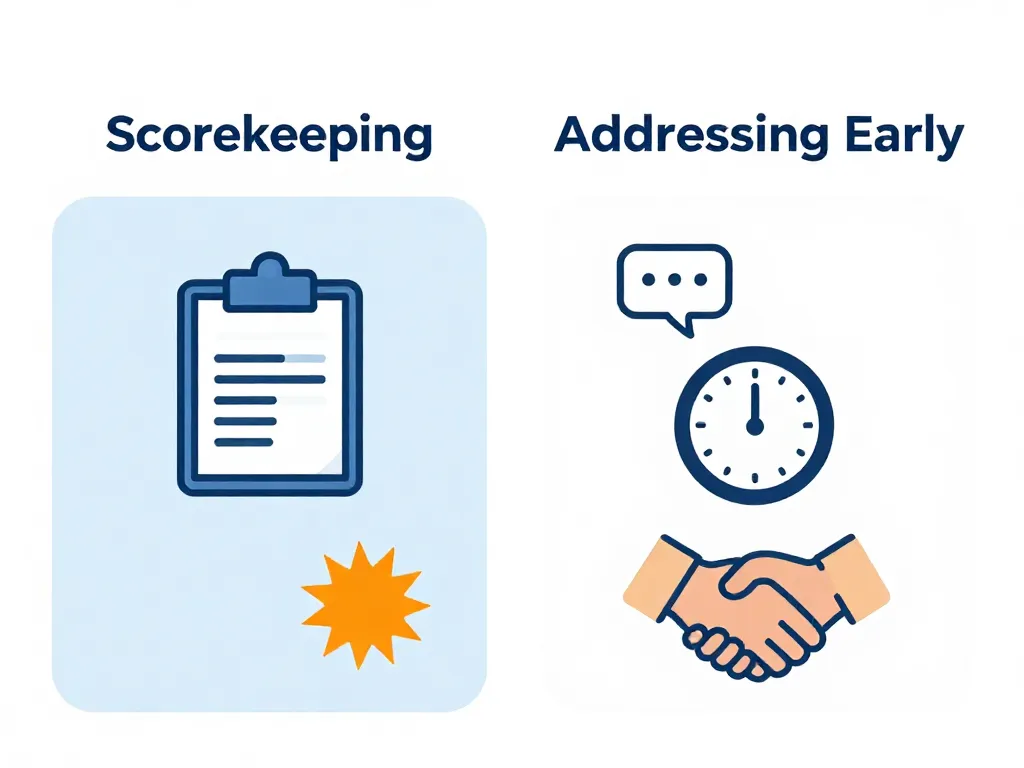
Silent scorekeeping is one of the most corrosive communication mistakes in relationships. It works like this: something bothers you, but it feels too small to mention. So you file it away. Then it happens again. And again. Each time, the mental tally grows. Then one day, something relatively minor happens—your partner forgets to pick up milk—and the dam breaks. Out comes every stored grievance from the past three months, delivered in a flood.
Your partner, who thought they were having a conversation about milk, is now defending themselves against seventeen accusations they didn't know existed. They feel blindsided. You feel like you've been endlessly patient. Both of you are right, and both of you are hurt.
Why We Do It
Scorekeeping usually comes from a good place—you're trying to be easygoing, to not make a fuss over small things. But avoidance isn't the same as resolution. Every unspoken frustration accumulates interest, and the eventual payout is always worse than the original cost would have been.
What to Do Instead
- Address things when they're small. A calm "Hey, it bugged me when you were on your phone during dinner" on Tuesday is easier to hear than a comprehensive list of phone-related grievances delivered on Saturday.
- Use a 24-hour rule. If something bothers you and it still bothers you 24 hours later, bring it up. If it fades, let it go genuinely—meaning you're not filing it for later use.
- If you've been keeping score, own it. If you've already accumulated a list, don't dump it all at once. Pick the one or two issues that matter most, and address those. You can work through the rest over time. AI-powered mediation platforms like Servanda can provide structure when emotions run high and there's a backlog of unresolved issues to work through together.
Mistake #5: Matching Escalation Instead of Breaking the Pattern
Why It Triggers a Fight
Your partner raises their voice, so you raise yours. They use a sarcastic tone, so you fire back with something sharper. They bring up something from the past, so you pull out your own archive of old grievances.
This is escalation matching, and it's the most instinctive communication mistake on this list. It feels fair in the moment—if they're going to fight dirty, why should you stay calm? But matching your partner's intensity doesn't level the playing field. It doubles the damage.
Every fight has an escalation point—a moment where the conversation shifts from disagreement to conflict. Usually, it happens when one partner raises the emotional stakes (a louder voice, a harsher word, a more hurtful example) and the other matches or exceeds it. Once both partners are escalating, the original issue becomes irrelevant. Now you're just trying to win—or at least not lose.
What Escalation Matching Looks Like
| One partner says... |
The other matches with... |
| "That was thoughtless." |
"Oh, and you're so thoughtful?" |
| Raises voice |
Raises voice louder |
| "Your mother does the same thing." |
"At least my mother doesn't—" |
| Walks away mid-sentence |
Follows, demanding a response |
What to Do Instead
- Be the pattern-breaker, not the pattern-matcher. One person choosing to stay calm doesn't mean they're "losing." It means they're steering the conversation somewhere productive. This isn't about being passive—it's about being strategic.
- Name the escalation out loud. "I notice we're both getting louder. I don't want this to turn into a fight. Can we reset?" This pulls both of you out of the emotional current and onto the bank where you can see what's happening.
- Take a genuine pause. If you feel your heart rate climbing and your responses getting sharper, call a timeout. Not a storming-off, door-slamming exit—a mutual agreement to take 20-30 minutes to cool down and return to the conversation. Research suggests it takes at least 20 minutes for physiological stress responses to subside enough for productive dialogue.
- Agree on a word or signal. Some couples use a code word—something neutral or even slightly funny—that either partner can use to flag that things are escalating. It works because it's a shared agreement made in calm, invoked during chaos.
The Pattern Behind All Five Mistakes
If you look at these five communication mistakes together, a common thread emerges: each one prioritizes being right over being connected.
Absolute language tries to prove a point. Poor timing prioritizes your urgency over your partner's readiness. Dismissing feelings prioritizes your interpretation over their experience. Scorekeeping prioritizes the record over the relationship. Escalation matching prioritizes winning over resolving.
None of these impulses make you a bad partner. They make you a human one. But awareness is the first step toward choosing differently. The next time you feel a disagreement starting to heat up, pause and ask yourself: Am I trying to be right, or am I trying to be understood? Am I trying to win, or am I trying to reconnect?
That question, asked honestly, can change the trajectory of your next argument—and every one after it.
Frequently Asked Questions
Why do my partner and I keep fighting about the same things?
Recurring arguments usually signal an unmet need that hasn't been fully understood or addressed—not that you've failed to "fix" the topic. The fights repeat because the underlying communication pattern repeats. When you change how you talk about the issue (using specifics instead of absolutes, choosing better timing, acknowledging feelings first), you often discover the actual need beneath the recurring topic.
How do I stop a fight once it's already started escalating?
The most effective in-the-moment tool is to name what's happening: "We're escalating, and I don't want to say something I'll regret. Can we take 20 minutes and come back to this?" This only works if both partners agree that pausing isn't the same as avoiding—you're committing to return, not retreating. Over time, building this habit makes it easier to de-escalate earlier.
Is it better to bring up issues right away or wait until I've calmed down?
Neither extreme works well. Bringing up an issue in the heat of the moment often leads to harsh startups and reactive language. But waiting too long can lead to scorekeeping and resentment. A good middle ground: take enough time to move past the initial emotional spike (usually 20 minutes to a few hours), then raise the issue while it's still relevant and specific.
What if my partner is the one making these communication mistakes, not me?
It's tempting to read a list like this and assign all the mistakes to your partner. But communication patterns are co-created. Even if your partner leads with absolutes or picks bad timing, your response to that habit is also part of the pattern. Focus on what you can change—your own reactions, your own word choices, your own timing—because that's the one variable you fully control. Often, changing your part of the pattern naturally shifts theirs.
Can you actually prevent fights, or is conflict inevitable in relationships?
Conflict is inevitable and even healthy—it means two people with different needs and perspectives are being honest. But fights—the destructive, repetitive, scorched-earth kind—are largely preventable. The difference between productive conflict and a damaging fight almost always comes down to communication habits: how you raise issues, how you respond to emotions, and whether you escalate or de-escalate when tensions rise.
Moving Forward: Small Shifts, Big Changes
You don't need to overhaul your entire communication style overnight. Start with one mistake from this list—the one that hits closest to home—and focus on catching it in your next disagreement. Maybe it's replacing "you always" with a specific example. Maybe it's asking "when's a good time to talk?" instead of launching in at the worst possible moment. Maybe it's pausing to say "that makes sense" before jumping to your defense.
These aren't grand gestures. They're micro-adjustments that compound over time. Each one sends your partner the same message: I care more about us than about being right. And that message, delivered consistently through small, everyday choices, is what transforms the way you fight—and, eventually, whether you need to fight at all.