
5 Communication Scripts for High-Conflict Co-Parents
It's 9:47 PM on a Tuesday. Your phone buzzes. Your co-parent wants to swap weekends—again—and the message is worded in a way that immediately puts you on the defensive. Your thumbs hover over the keyboard. You start typing something sharp. Delete it. Start again. Delete it again. You know that whatever you send next will either defuse this or turn it into a three-day text war that leaves both of you exhausted and your kid caught in the middle.
If this sounds familiar, you're not alone. One of the hardest parts of co-parenting after a high-conflict separation isn't the logistics—it's knowing what to actually say when tensions flare. Old relationship patterns hijack the conversation before you even realize it's happening.
These five communication scripts for high-conflict co-parents give you exact language you can copy, paste, and customize for the most common flashpoints. They're built on a simple framework: stay brief, stay focused on the child, and remove emotional bait.
Key Takeaways
- Use the B.I.F.F. principle: Keep messages Brief, Informative, Friendly, and Firm to prevent escalation.
- Copy-paste scripts work because they give you a starting point when emotions make it hard to think clearly—customize them to your situation.
- Never respond in the moment: Draft your reply using a script, wait 30 minutes, then review before sending.
- Focus every message on your child's needs, not on your co-parent's behavior or your past relationship.
- Document everything in writing—scripts create a paper trail that protects you and keeps agreements clear.
The Framework Behind Every Script
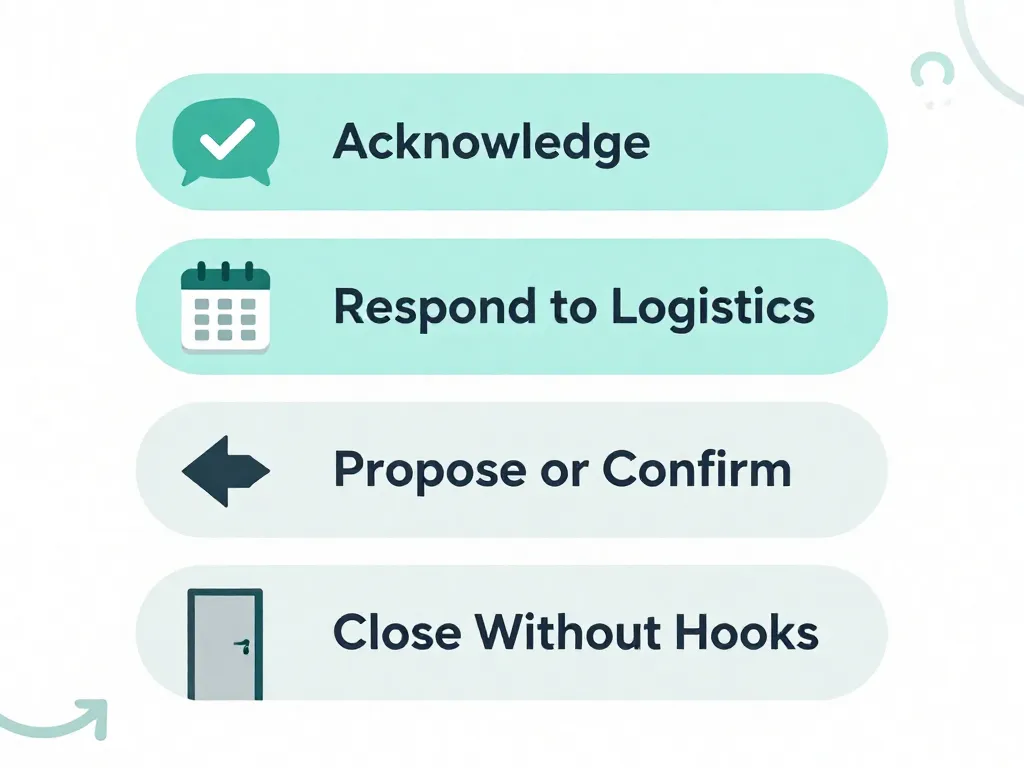
Before we get to the scripts themselves, here's the approach that makes them work. Every message in this article follows a structure designed to reduce conflict:
- Acknowledge — Show you received and understood the request (this alone prevents many escalations).
- Respond to the logistics — Address the actual issue with facts, dates, and specifics.
- Propose or confirm — Offer a clear next step or confirm the agreement.
- Close without hooks — End the conversation without leaving emotional bait that invites a combative reply.
The goal isn't to "win" the exchange. It's to get the logistical outcome your child needs while protecting your own peace.
Script 1: Handling Last-Minute Schedule Changes
This is the single most common flashpoint in high-conflict co-parenting. One parent requests a change; the other feels disrespected, blindsided, or taken advantage of. Here's how to handle both sides.
When You Need to Request a Change
"Hi [Name], I have a conflict on [date] during my scheduled time. Would it work for you to have [child's name] that evening? I'm happy to swap with [specific alternative date] so the overall schedule stays balanced. Let me know by [deadline] so I can make arrangements either way."
Why it works: It states the problem without over-explaining, offers a fair swap, and gives a clear deadline—no ambiguity, no guilt-tripping.
When You Receive a Change Request
If you can accommodate it:
"Got it. I can take [child's name] on [date]. Let's plan on the swap happening on [alternative date] to keep things even. I'll adjust my schedule accordingly."
If you can't:
"I understand you have a conflict on [date]. Unfortunately, that doesn't work on my end this time. You'll need to arrange alternative care for your scheduled time. Let me know if there's a different swap date that might work in the future."
Why it works: You're not punishing, lecturing, or explaining why you're busy. You're just stating what's possible.
What to Avoid
- ❌ "You always do this at the last minute."
- ❌ "I had plans too, you know."
- ❌ "Fine, I guess I'll just rearrange my entire life again."
Each of these invites a defensive response. The script keeps the exchange functional.
Script 2: Navigating Expense Disputes
Money is the second biggest trigger. Whether it's an unexpected medical bill, an extracurricular activity fee, or school supplies, expense disputes can spiral fast—especially when there's no clear prior agreement.
Requesting Reimbursement or Split Payment
"Hi [Name], [child's name] had [specific expense — e.g., a dental appointment / new cleats for soccer] on [date]. The total was [amount]. Per our agreement, I'm requesting your share of [amount or percentage]. I've attached the receipt. Can you confirm you've received this and let me know your preferred timeline for reimbursement?"
Why it works: It's factual, includes documentation, references an existing agreement, and asks for a specific response—not an argument.
When You Disagree With an Expense
"I received your request for [amount] for [expense]. I don't believe this falls under our shared expense agreement because [brief, factual reason—e.g., it wasn't discussed in advance / it's not covered under our order]. I'd like to resolve this. Can we refer back to our agreement and clarify how to handle similar expenses going forward?"

Why it works: You're disagreeing without attacking. You're pointing to the agreement (not your feelings) as the authority. And you're suggesting a path forward rather than just saying "no."
Pro Tip: Prevent Future Expense Disputes
If your current arrangement is vague on expenses, consider using a tool like Servanda to create a clear, written agreement covering categories like medical costs, extracurriculars, and school fees. Having specifics in writing removes the guesswork that fuels these arguments.
Script 3: Addressing Different Parenting Rules
Your child comes home and says, "At Dad's house I get to stay up until 11" or "Mom lets me have my phone in my room all night." Your blood pressure spikes. You want to fire off a message about how irresponsible that is. Don't.
Different households will have different rules. The question is: does this specific difference pose a genuine safety or wellbeing concern, or is it just... different?
When It's a Safety or Wellbeing Concern
"Hi [Name], [child's name] mentioned [specific behavior or situation]. I want to make sure I'm understanding correctly before jumping to conclusions. Can you give me some context? My concern is [specific concern related to the child's health, safety, or wellbeing], and I'd like us to be on the same page about how to handle it."
Why it works: You're leading with curiosity, not accusation. Kids sometimes misreport or exaggerate, and this message gives your co-parent a chance to clarify without feeling ambushed.
When It's Just a Difference in Style
Honestly? Sometimes the best script is no message at all. If your child has a later bedtime at the other house but is otherwise healthy and doing well, this may not be a battle worth fighting. Instead, hold your boundary at your own house:
To your child: "I hear that things are different at [other parent's] house, and that's okay. In this house, our rule is [rule]. Both houses have their own rules."
This approach—sometimes called parallel parenting—is especially effective in high-conflict situations where direct negotiation about parenting styles tends to escalate rather than resolve.
When You Do Need to Set a Boundary
"Hi [Name], I've noticed [child's name] has been [specific observable behavior — e.g., exhausted on school mornings / anxious about a specific situation]. I'm not looking to dictate what happens at your house, but I'd like to figure out a solution together that helps [child's name] with [specific issue]. Are you open to discussing it?"
Script 4: Responding to Hostile or Baiting Messages
This is the hardest one. Your co-parent sends something inflammatory—a personal attack, a blame-filled rant, a passive-aggressive jab disguised as a question. Every instinct tells you to defend yourself or fire back.
Here's the truth: you don't have to respond to everything. You only have to respond to legitimate logistical questions about your child.
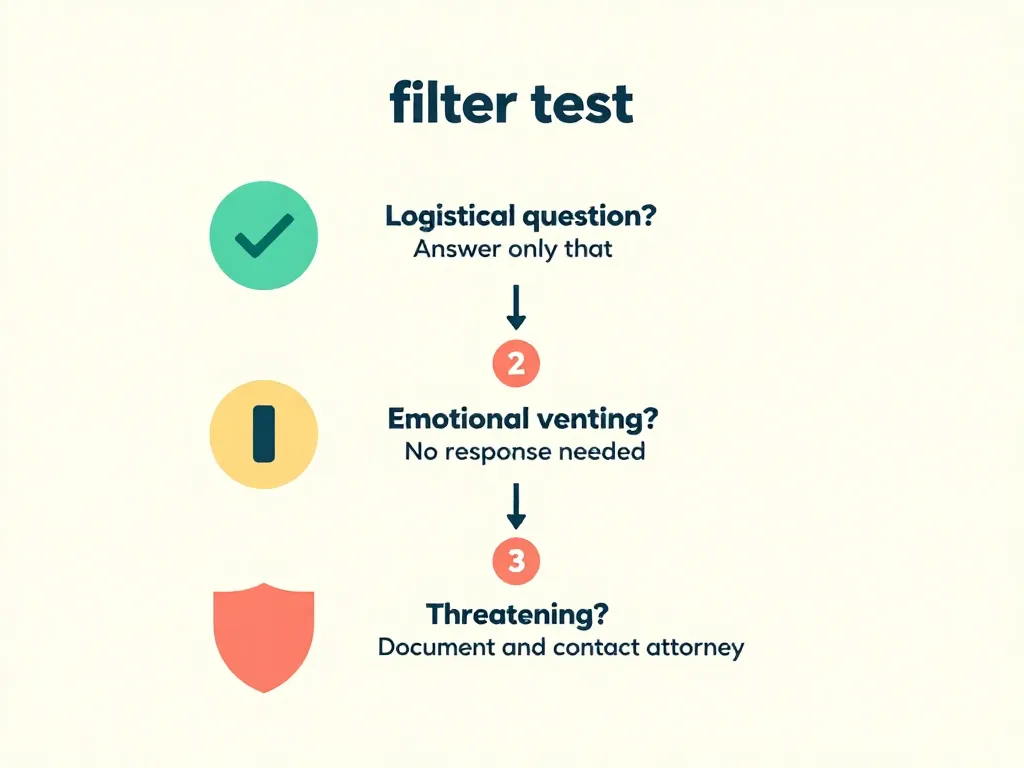
The Filter Test
Before you respond, run the message through this filter:
- Is there a logistical question buried in here? → Answer only that.
- Is it purely emotional venting or blame? → You don't owe a response.
- Is it threatening or harassing? → Document it and contact your attorney.
Script for Responding to a Hostile Message With a Legitimate Question
Let's say your co-parent sends: "You never think about anyone but yourself. Are you even going to pick up [child] on Friday or should I just assume you'll flake again like last time?"
Your response:
"I'll pick up [child's name] at [time] on Friday as scheduled. See you then."
That's it. You answered the question. You ignored the bait. You didn't correct the record, defend yourself, or match their tone.
Script for Setting a Communication Boundary
If hostile messages are a pattern:
"I'm committed to communicating about [child's name]'s needs. Going forward, I'll respond to messages that are about scheduling, health, education, or logistics. I won't be responding to messages that are about our past relationship or personal criticisms. This isn't about ignoring you—it's about keeping our communication productive for [child's name]."
Send this once. Then follow through. Consistently. Without re-explaining.
Script 5: Coordinating on Medical, School, or Legal Decisions
Big decisions—choosing a therapist, agreeing to a medical procedure, selecting a school—require collaboration even when collaboration feels impossible.
Proposing a Decision
"Hi [Name], [child's name]'s [teacher/doctor/therapist] has recommended [specific recommendation]. I've gathered some information and narrowed it down to [2-3 options]. Here's what I've found:
- Option A: [brief summary] - Option B: [brief summary]
Do you have a preference, or would you like to look into other options? I'd like us to make a decision by [date] so we can move forward. Let me know your thoughts."
Why it works: You've done the legwork, presented it neutrally, given them a voice in the decision, and set a timeline. It's collaborative without being controlling.
When You Disagree With a Proposed Decision
"Thanks for sharing those options. I have some concerns about [option] because [specific, child-focused reason]. I'd like to suggest we [alternative — e.g., get a second opinion / attend the consultation together / each do independent research and compare notes by a specific date]. What do you think?"
When You've Reached an Impasse
"It seems like we see this differently, and I don't think we're going to resolve it over text. I'd like to suggest we [specific next step: consult the child's provider together / use a mediator / refer to our parenting plan]. I want to make sure [child's name] gets what they need, even if we disagree on the approach."
Putting It All Together: The 30-Minute Rule
Every script in this article works best when combined with one simple habit: the 30-minute rule.
When you receive a message that triggers an emotional reaction:
- Read it once. Put your phone down.
- Wait 30 minutes. Go for a walk, do dishes, breathe.
- Open this article. Find the relevant script.
- Draft your response using the template. Customize it.
- Read it aloud. Would a judge see this as reasonable? Would your child be proud of it in ten years?
- Send it.
Over time, you won't need the scripts anymore. The patterns will become second nature. But until then, there's no shame in keeping a cheat sheet.
Frequently Asked Questions
What if my co-parent doesn't respond to my calm messages?
You can't control their communication style—only yours. Send your message, give a reasonable response window (24-48 hours for non-urgent matters), and follow up once. If they consistently ignore logistical messages, document the pattern and consult your family law attorney about next steps. Your calm, documented messages become evidence of good-faith effort.
Should I communicate with my high-conflict co-parent by text or email?
Written communication is almost always better in high-conflict situations. It gives you time to think before responding, creates a documented record, and removes the vocal tone and body language cues that often trigger old relationship dynamics. Many co-parents find that a dedicated co-parenting app or email thread helps keep everything organized and separate from personal messaging.
How do I stop myself from reacting emotionally to co-parenting messages?
The 30-minute rule described above is a strong starting point. Beyond that, try reading your co-parent's message as if a stranger wrote it—strip away the history and respond only to the factual content. Some co-parents also find it helpful to have a trusted friend or therapist review their draft messages before sending, especially in the early months after separation.
Can I use these scripts in a co-parenting app?
Absolutely. These scripts work in any written format—text, email, or co-parenting platforms like OurFamilyWizard or TalkingParents. In fact, co-parenting apps that create timestamped records are ideal for high-conflict situations because they provide accountability for both parties.
What if my co-parent accuses me of sounding robotic or using templates?
That's okay. You're not trying to impress them—you're trying to communicate effectively about your child. If they push back on your tone, a simple response works: "I'm trying to keep our communication clear and focused on [child's name]. I hope we can both stay on that track." You don't owe them emotional engagement.
Conclusion
High-conflict co-parenting communication doesn't get easier because someone tells you to "just be civil." It gets easier when you have actual words to use in the moments that matter most. These five scripts cover the flashpoints that derail most co-parenting conversations: schedule changes, money, different rules, hostile messages, and big decisions.
You don't have to memorize them. Bookmark this page. Screenshot the ones you need most. Tape them to your fridge. The point is to have a tool within arm's reach when your stress response is telling you to react instead of respond.
Every measured message you send is a small act of protection—for your peace, for your boundaries, and most importantly, for your child's sense of stability. It won't always feel satisfying in the moment. But over weeks and months, these patterns build something that matters: a co-parenting dynamic your child doesn't have to recover from.