
5 Mediation Tactics That End Co-Parenting Fights
It's 9:47 PM on a Sunday. You just got a text from your co-parent: "I'm keeping the kids for Thanksgiving this year. We already discussed this." You feel your stomach drop. You never agreed to that. You scroll back through months of messages looking for proof, your chest tightening with every swipe. Within ten minutes, you're both firing off paragraphs. By Monday morning, nothing is resolved, the kids sense the tension, and you're googling "family law attorney near me" even though you swore you'd never go back to court.
This cycle — the miscommunication, the escalation, the exhaustion — is painfully common among co-parents. But here's what most people don't realize: professional mediators use specific, learnable techniques to break exactly this kind of deadlock. You don't need a mediator in the room to use them. You just need to know what they are.
These five co-parenting mediation tactics are drawn from real dispute resolution practice. They're designed to help you reach agreements faster, fight less, and keep your children out of the middle.
Key Takeaways
- Separate positions from interests — most co-parenting fights aren't really about the schedule; they're about unmet needs like fairness, time, or respect.
- Use a structured "issue, options, agreement" framework to move from arguing to problem-solving in any single conversation.
- The "two-house test" helps you let go of battles that don't actually affect your child's wellbeing.
- Write it down before you walk away — verbal agreements between co-parents almost always unravel.
- Time-limited trial periods reduce the stakes of every decision and make it easier for both parents to say yes.

Tactic 1: Separate Positions from Interests
What mediators actually do
When two people walk into a mediation session, they almost always lead with positions — fixed demands about what they want. "I want the kids every Christmas Eve." "I want final say on school choice." A skilled mediator's first job is to dig beneath those positions to find the interests — the underlying needs, fears, or values driving the demand.
This distinction, first popularized in the negotiation classic Getting to Yes by Fisher and Ury, is the single most powerful reframe in conflict resolution. And it works remarkably well in co-parenting disputes.
How to apply it at home
The next time your co-parent makes a demand that feels unreasonable, resist the urge to counter it immediately. Instead, ask yourself — and, if possible, ask them — "What's important to you about that?"
Example: Marcus and Diane were stuck in a months-long argument about after-school activities. Marcus wanted their 10-year-old in travel soccer, three evenings a week. Diane said no — it was too much. Their positions were incompatible.
But when Marcus asked himself why soccer mattered so much, his real interest surfaced: he wanted to be the parent who showed up at games. He'd missed a lot during the separation, and coaching from the sidelines made him feel like a present father. Diane's interest was different but equally valid: she didn't want their daughter's homework suffering, and she was tired of being the "taskmaster" parent while Marcus got to be the "fun" one.
Once they understood each other's actual interests — involvement for Marcus, balance for Diane — they found a solution neither had initially considered: two evenings of soccer plus one weekend practice, with Marcus taking over homework help on practice nights.
The key question to ask
Before every disagreement, try this prompt: "I hear what you want. Can you help me understand why it matters to you?" You don't have to agree with the answer. You just need to hear it. That alone changes the direction of the conversation.
Tactic 2: Use the Issue–Options–Agreement Framework
Why co-parenting arguments spiral
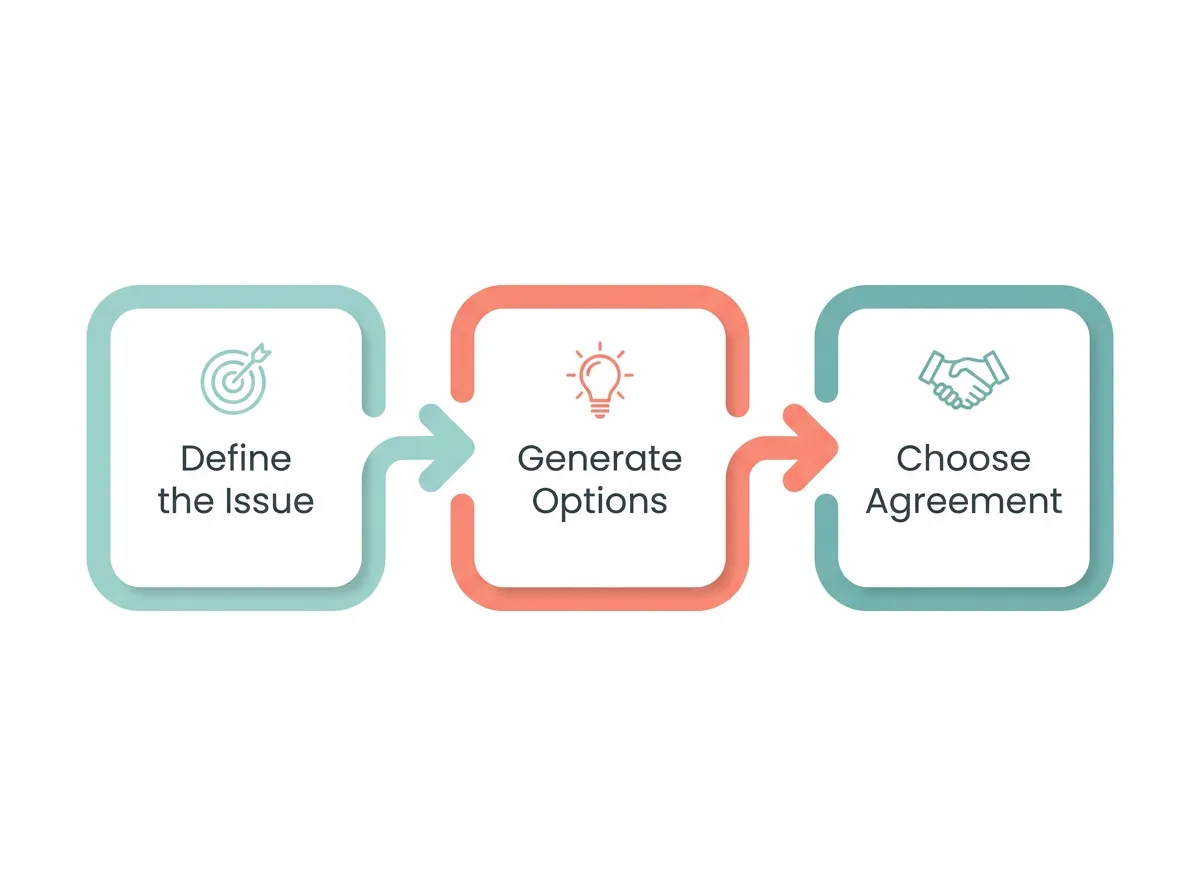
Most co-parenting fights go sideways because the conversation has no structure. One parent raises a scheduling concern, the other responds with a grievance about something that happened three months ago, and suddenly you're relitigating the entire relationship. Mediators prevent this by moving conversations through a clear sequence: identify the issue, generate options, select an agreement.
The three steps
Step 1 — Define the single issue. Write it down in one sentence. Not "you never respect my time" but "We need to decide who has the kids for spring break 2025." If multiple issues surface, list them separately and tackle them one at a time.
Step 2 — Generate at least three options. This is critical. When people only see two options (my way or your way), everything feels zero-sum. Mediators always push for a third, fourth, or fifth possibility. Some will be impractical — that's fine. The act of brainstorming loosens the grip of binary thinking.
Step 3 — Evaluate and choose. Review each option against a shared standard. The most effective standard for co-parents is simple: "Which option works best for the kids while being workable for both of us?"
A practical example
Janet and Rob couldn't agree on holiday schedules. Janet's position: alternating years. Rob's position: splitting every holiday in half so the kids see both parents each time.
Using the framework: - Issue: How to divide Thanksgiving, Christmas, and spring break for the next two years. - Options generated: (1) Alternate years, (2) Split each holiday, (3) Assign fixed holidays to each parent based on family traditions, (4) Alternate years but the off-year parent gets a special "bonus day" the weekend before or after, (5) Let the kids weigh in with preferences now that they're teenagers. - Agreement: They chose option 4. Rob got every Thanksgiving (his family reunion was a major tradition), Janet got every Christmas Eve and Christmas morning, and the off-year parent always got a dedicated celebration day. No more annual negotiations.
The framework took one focused 45-minute conversation. Without it, they'd been arguing about this for two holiday seasons.
Tactic 3: Apply the Two-House Test
The battle you don't need to fight
Some of the most draining co-parenting conflicts are about things that happen in the other parent's house — bedtimes, screen time limits, what the kids eat for dinner, whether shoes are worn inside. These fights feel urgent because they involve your children. But mediators often guide parents toward a deceptively simple question:
"Is this a safety issue, or is this a different-household issue?"
How the test works
If a concern involves genuine safety — abuse, neglect, substance use around the children, dangerous driving — that's non-negotiable and may require legal action.
But if the concern is that your co-parent lets the kids stay up until 10 PM on weeknights, feeds them cereal for dinner, or doesn't enforce the same chore chart you use — that's a different-household issue. Children in two-home families are remarkably adaptable. Research from the Journal of Family Psychology consistently shows that children adjust well to different routines across households, as long as both environments are loving and stable.
When to let go
Applying the two-house test doesn't mean you stop caring. It means you redirect your energy toward the conflicts that actually matter. Every fight you don't have is emotional bandwidth you get back — for your kids, for yourself.
Ask yourself honestly: "If my neighbor's child had this bedtime or ate this meal, would I call it harmful?" If the answer is no, this might be a battle worth releasing.
When to speak up
The two-house test doesn't apply to shared decisions that affect both homes: school enrollment, medical treatment, religious upbringing, relocation. These are joint-domain issues, and they deserve the full mediation treatment using Tactics 1 and 2.

Tactic 4: Write It Down Before You Walk Away
The agreement that vanished
Here's a scene mediators see constantly: two parents have a productive phone call. They agree on a summer schedule. Both feel relieved. Two weeks later, one parent remembers it differently. The other swears they said something else. There's no record. The goodwill evaporates instantly, replaced by mutual accusations of dishonesty.
Verbal agreements between co-parents are almost worthless. Not because anyone is lying — but because memory is unreliable, especially when emotions are involved. Professional mediators always close a session by drafting a written summary of what was decided, reviewed and confirmed by both parties.
How to do this yourself
After any conversation where you reach an agreement — even a small one — send a brief summary message:
"Just to confirm what we discussed: I'll pick up the kids Friday at 5 PM. You'll have them back Sunday by 6 PM. Emma's soccer bag needs to come with her. Does this match your understanding?"
Wait for written confirmation before considering it settled. This isn't about distrust. It's about clarity. It protects both of you.
Making written agreements stick
For bigger decisions — holiday rotations, extracurricular commitments, expense-sharing arrangements — go beyond a text thread. Create a shared document or use a structured tool designed for this purpose. AI-powered mediation platforms like Servanda can help co-parents formalize written agreements and keep a clear record, which prevents the "I never agreed to that" problem from surfacing weeks later.
The format matters less than the habit. What matters is that both parents leave every conversation with the same written understanding.
Tactic 5: Propose Time-Limited Trial Periods
Why "forever" decisions feel impossible
Many co-parenting negotiations stall because both parents treat every decision as permanent. If you agree to a new custody schedule, you might feel locked into it for years. If you say yes to your co-parent's proposed bedtime rule, you worry you'll never be able to revisit it. The perceived permanence makes every choice feel enormous — so both sides dig in harder.
Professional mediators break this deadlock with one of the simplest tools in their toolkit: the trial period.
How to use trial periods
Instead of asking "Do you agree to this permanently?" reframe the proposal: "Can we try this for 60 days and then check in?"
Trial periods work for several reasons:
- They lower the stakes. Saying yes to a two-month experiment feels less risky than agreeing to something indefinitely.
- They build trust incrementally. If the trial goes well, you've created evidence that cooperation is possible — and that makes the next agreement easier.
- They give you real data. Instead of arguing hypotheticals ("The kids will hate that schedule!"), you get to see what actually happens.
- They create a built-in review date. Both parents know there's a checkpoint coming, which reduces the urge to constantly renegotiate.
Example in action
Sarah wanted to shift the midweek overnight from Wednesday to Thursday so it aligned better with her new work schedule. Her co-parent, Tom, was resistant — he'd built his routine around Wednesdays and didn't want to disrupt it.
Instead of escalating, Sarah proposed: "Let's try Thursday overnights for six weeks. If it's not working for you or the kids, we go back to Wednesdays. We'll check in on March 15th."
Tom agreed. Six weeks later, both parents admitted Thursday worked better — their daughter had been arriving at school less rushed. What could have been a drawn-out argument became a calm, evidence-based transition.
The check-in conversation
When the trial period ends, use a structured check-in:
- What worked well?
- What didn't work?
- Do we continue, adjust, or revert?
Keep the conversation focused on observations, not blame. "Emma seemed tired on Thursday mornings" is useful. "You clearly don't care about her sleep" is not.
Putting It All Together: A Quick-Reference Guide
| Situation | Tactic to Use |
|---|---|
| You're stuck in a "my way vs. your way" loop | Tactic 1 — Separate positions from interests |
| A conversation keeps spiraling into old grievances | Tactic 2 — Use the Issue–Options–Agreement framework |
| You're angry about what happens at your co-parent's house | Tactic 3 — Apply the two-house test |
| You reached a verbal agreement that later fell apart | Tactic 4 — Write it down before you walk away |
| Neither parent wants to commit to a permanent change | Tactic 5 — Propose a time-limited trial period |
These tactics aren't sequential — you'll often use two or three of them within a single disagreement. The more you practice them, the more automatic they become.
Frequently Asked Questions
What if my co-parent refuses to cooperate with any of these tactics?
You can use several of these techniques unilaterally. Separating positions from interests (Tactic 1) changes how you listen, regardless of what the other parent does. Writing down agreements (Tactic 4) protects you even if your co-parent doesn't reciprocate. Over time, when one parent consistently shows up with structure and calm, the other parent often begins to mirror that approach — not always, but more often than you'd expect.
Can these mediation tactics replace going to court?
For many everyday co-parenting disputes — schedules, holidays, extracurriculars, minor expense disagreements — yes, these tactics can resolve issues faster and cheaper than litigation. However, if you're dealing with safety concerns, violations of a court order, or a co-parent who is abusive or consistently acting in bad faith, legal intervention may be necessary. These tactics are designed for two imperfect but well-meaning parents who are stuck, not for situations involving harm.
How do I bring up using mediation tactics without sounding condescending?
Don't announce that you're "using mediation tactics." Just use them. Ask questions about what matters to the other parent (Tactic 1). Suggest brainstorming three options instead of arguing about two (Tactic 2). Propose a trial period (Tactic 5). If you want to be transparent, try: "I read something about how to make these conversations less stressful for both of us. Want to try it?" Frame it as something you're doing together, not something you're doing to them.
At what age should kids be involved in co-parenting decisions?
Most family therapists suggest that children around age 12 and older can meaningfully weigh in on scheduling preferences, though this depends on the child's maturity. Involvement doesn't mean decision-making power — it means their feelings are heard and considered. Younger children should never be asked to choose between parents or be made aware of parental conflicts about logistics.
How long does it take for these tactics to actually work?
Some of these tactics — like writing down agreements or proposing trial periods — produce immediate results from the first conversation. Others, like consistently separating positions from interests, are skills that improve with practice over weeks and months. Most co-parents who commit to structured communication report a noticeable reduction in conflict within 30 to 60 days.
Moving Forward
Co-parenting conflict doesn't have to be a permanent feature of your life after separation. The fights that feel endless right now — about holidays, schedules, screen time, whose turn it is — aren't actually unsolvable. They're just unstructured.
The five tactics in this article give you that structure. They won't make your co-parent perfect, and they won't erase the frustration overnight. But they will change the pattern. Instead of the same argument recycling every few weeks, you'll have a way to move through disagreements and come out the other side with something concrete.
Start with one tactic. The next time a dispute surfaces, try separating positions from interests, or propose a 60-day trial. See what happens. You might be surprised how quickly a different approach produces a different result — and how much lighter you feel when you're no longer bracing for the next fight.