5 Communication Tools for High-Conflict CoParents
It's 9:47 p.m. on a Tuesday. You open a text from your co-parent about this weekend's pickup time, and your stomach drops. The message is three paragraphs long, loaded with blame, and ends with a veiled threat about "taking this to my lawyer." You type a furious reply. Delete it. Type another one. Delete that too. Your thumbs hover over the screen while your heart pounds.
If this scene feels familiar, you're not alone. Millions of co-parents navigate this exact cycle — where even a simple logistics question spirals into a full-blown argument. The toll isn't just on you. Research consistently shows that ongoing parental conflict is one of the strongest predictors of poor outcomes for children after separation.
But here's the thing worth knowing: you don't need your co-parent to change for communication to get better. The right communication tools for high-conflict co-parents can act as guardrails — keeping exchanges on-topic, reducing emotional escalation, and giving your kids the stability they deserve.
Here are five specific, actionable tools you can start using this week.
Key Takeaways
- The BIFF Response Method gives you a repeatable framework for responding to hostile messages without escalating conflict.
- Dedicated co-parenting apps like OurFamilyWizard and TalkingParents create accountability by logging all communication in a court-admissible format.
- Parallel parenting boundaries reduce the total volume of communication needed, which means fewer opportunities for conflict.
- Structured email templates remove emotion from routine logistics, turning potential arguments into boring (and effective) business exchanges.
- AI-powered conflict resolution tools can help you draft neutral language and formalize agreements before disagreements escalate.
1. The BIFF Response Method: Your First Line of Defense
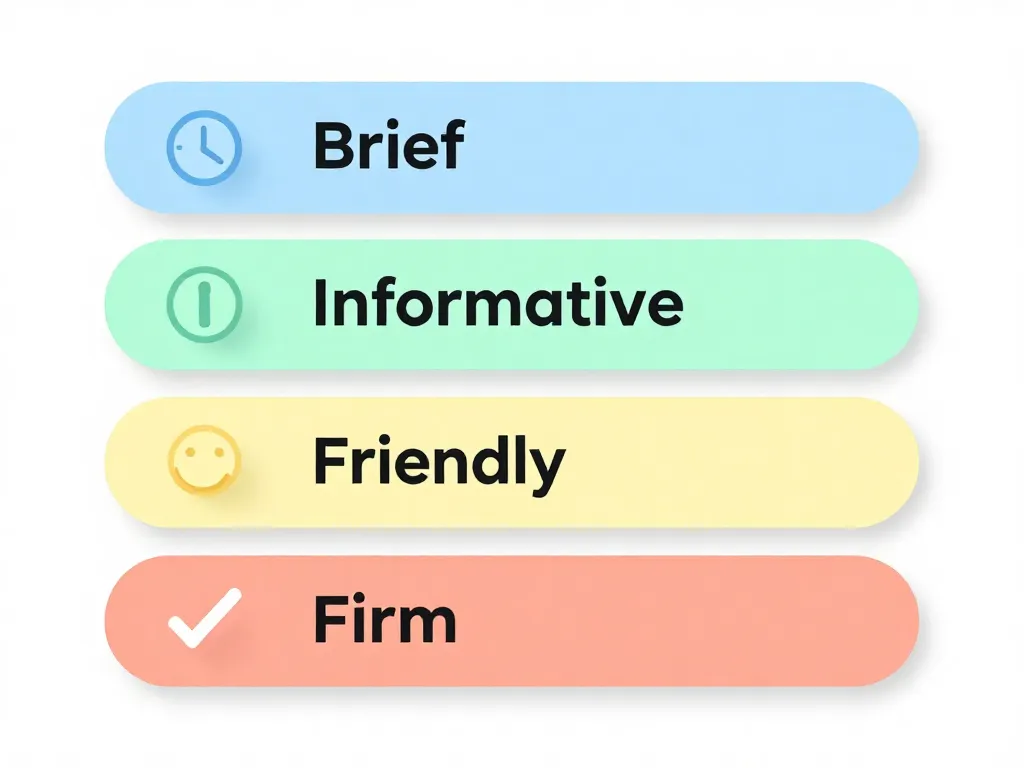
Developed by high-conflict expert Bill Eddy, the BIFF Response method is one of the most practical communication tools for high-conflict co-parents available — and it's completely free. BIFF stands for:
- Brief — Keep your response short. Two to five sentences maximum.
- Informative — Stick to objective facts. No opinions, no interpretations.
- Friendly — One brief, neutral-to-warm statement. ("Thanks for letting me know.")
- Firm — End the conversation on that topic. No open-ended questions that invite a new round.
BIFF in Action
Incoming message from your co-parent:
"You ALWAYS drop the kids off late. You clearly don't care about their routine. I'm documenting everything for court."
Your instinct might be:
"Are you kidding me? YOU'RE the one who changed the pickup location last minute three weeks ago…"
A BIFF response looks like this:
"Thanks for raising this. I'll make sure drop-off is at 6:00 p.m. as agreed. See you Sunday."
Notice what happened. You didn't take the bait. You didn't defend yourself, correct the record, or match their tone. You acknowledged, confirmed the plan, and closed the loop.
Why BIFF Works
High-conflict communication thrives on reactivity. When one person escalates and the other matches that energy, the cycle feeds itself. BIFF breaks the loop by giving the hostile message nowhere to go. Over time, many co-parents find that the volume and intensity of aggressive messages actually decreases when they stop producing the desired reaction.
Pro tip: Before you send any response to a difficult message, run it through the BIFF checklist. Is it Brief? Informative? Friendly? Firm? If it fails on any count, revise.
2. Dedicated Co-Parenting Communication Apps
If texting and email have become a battlefield, it's time to move communication onto neutral ground. Co-parenting apps are specifically designed to reduce conflict by adding structure, transparency, and accountability to every exchange.
Top Options Worth Considering
| App | Key Feature | Cost |
|---|---|---|
| OurFamilyWizard | Court-admissible message logs, shared expense tracking, ToneMeter™ that flags hostile language before you send | ~$100/year per parent |
| TalkingParents | Uneditable, timestamped records; free basic plan available | Free–$4.99/month |
| AppClose | Shared calendar, expense splitting, messaging — all in one simple interface | Free basic plan |
| Cozi Family Organizer | Best for lower-conflict situations needing shared calendars and lists | Free |
Why Apps Beat Texting
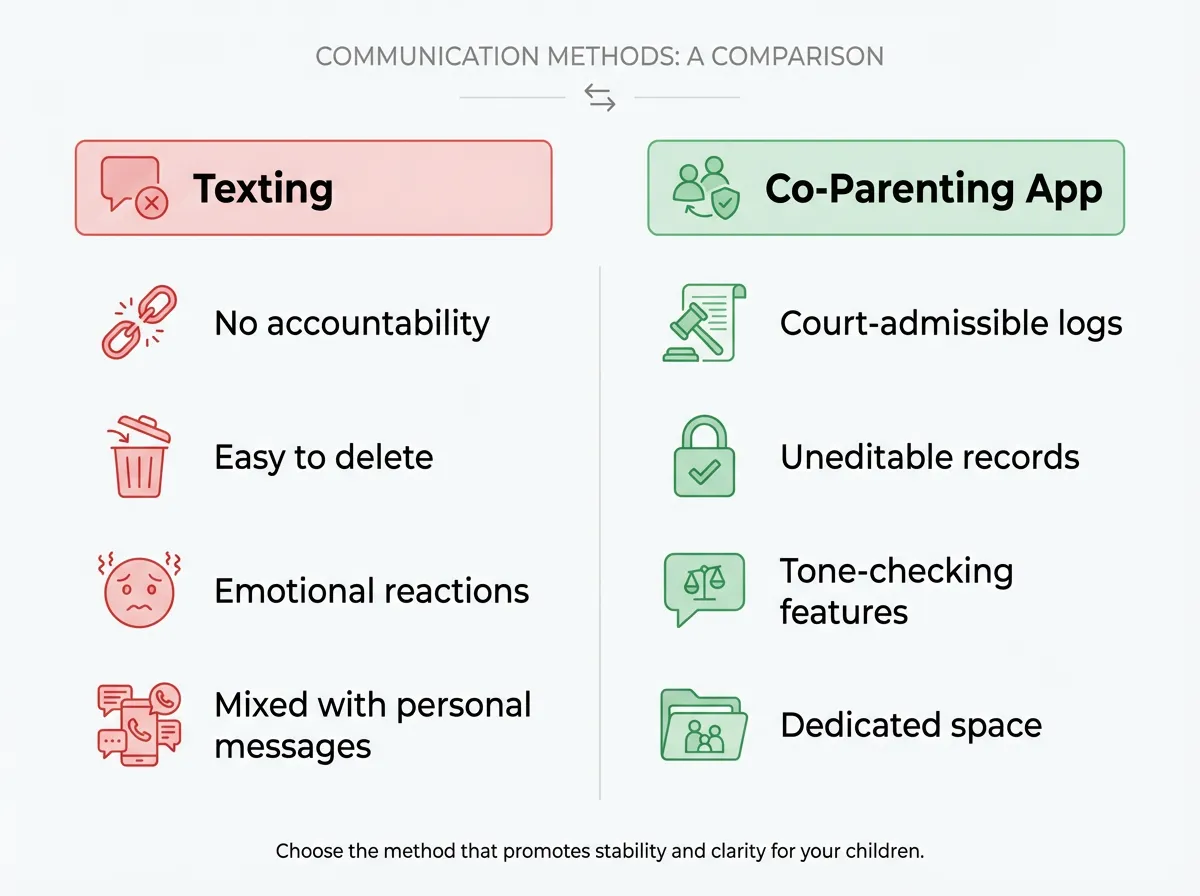
- Accountability through documentation. Every message is logged, timestamped, and uneditable. This discourages hostile communication because both parties know the record is permanent — and potentially court-admissible.
- Built-in conflict reduction features. OurFamilyWizard's ToneMeter, for example, analyzes your message before it sends and warns you if the language could be perceived as inflammatory. It's like having a mediator review your texts in real-time.
- Boundary enforcement. Moving all co-parenting communication to one app means your personal text thread and email inbox become yours again. That boundary alone can reduce anxiety significantly.
- Shared calendars and tools. Most apps include shared schedules, expense tracking, and document storage — eliminating the need for back-and-forth about logistics that often triggers arguments.
A Real-World Example
Consider "Marcus" and "Tanya" (names changed). After their separation, text messages regularly devolved into personal attacks. Their family mediator recommended OurFamilyWizard as a condition of their parenting plan. Within three months, Marcus reported that the hostile messages dropped by roughly 80%. "When you know everything's on the record," he said, "you think twice before typing something you'll regret."
3. The Parallel Parenting Model: Less Contact, Less Conflict
Cooperative co-parenting is the gold standard — but it requires two willing participants. When your co-parent consistently uses communication as a weapon, parallel parenting is a more realistic and often healthier alternative.
What Parallel Parenting Looks Like
Unlike cooperative co-parenting, where both parents collaborate closely on decisions, parallel parenting minimizes direct contact while keeping both parents involved in the child's life. Key principles include:
- Each parent has full authority during their parenting time. Bedtime, meals, activities — these are decided by whoever has the kids, without the other parent's input or approval.
- Communication is limited to essential logistics only. "Saturday pickup is at 10 a.m. at the school parking lot." That's it. No recaps of the kids' week. No commentary on parenting choices.
- A detailed parenting plan replaces ongoing negotiation. The more specific your plan, the less you need to talk. Specify holidays, transportation responsibilities, communication windows — leave nothing open to interpretation.
- Written communication only. No phone calls. No face-to-face conversations at drop-off beyond a brief greeting. Everything goes through the app or email.
When to Consider Parallel Parenting
Parallel parenting isn't about being petty or withholding information. It's a strategic decision to protect your children from exposure to parental conflict. Consider it when:
- Nearly every direct interaction results in an argument
- Your co-parent regularly violates boundaries during conversations
- Your children show signs of stress around transitions and exchanges
- A therapist, mediator, or attorney has recommended reduced contact
Some families stay in parallel parenting mode permanently. Others use it as a cooling-off period before transitioning to a more collaborative arrangement. Both outcomes are valid.

4. Structured Email Templates: The "Business Partner" Approach
One of the simplest yet most effective high-conflict co-parenting communication strategies is treating your co-parent like a business colleague — not an ex. Structured email templates help you do exactly that.
The B.R.I.E.F. Email Framework
This is a template you can copy and reuse for virtually any co-parenting exchange:
- B — Background: One sentence of context. ("I'm writing about Thanksgiving scheduling.")
- R — Request: What you need, stated clearly. ("I'd like to have the kids from Wednesday at 5 p.m. through Friday at noon.")
- I — Information: Relevant details. ("My parents are visiting from out of state and would like to see the kids.")
- E — End: Proposed next step. ("Please let me know by October 15 if this works.")
- F — Friendly close: One neutral line. ("Thanks for considering this. I hope we can make it work for everyone.")
Sample Template in Practice
Subject: Winter Break Schedule — Response Requested by Nov. 1
Hi [Co-Parent's Name],
I'm writing to confirm our plan for winter break. Per our parenting agreement, I have the kids from December 23 through December 28 this year.
I'll pick them up at 10:00 a.m. on the 23rd at the usual location and drop them off at 10:00 a.m. on the 28th.
Please confirm this works on your end by November 1 so we can both finalize our plans.
Thanks, [Your Name]
Notice the tone: neutral, specific, professional. There's no emotion to latch onto, no ambiguity to exploit, and no invitation for a debate.
Why Templates Work in High-Conflict Situations
- They remove the decision fatigue of figuring out what to say every time. You fill in the blanks and send.
- They standardize your tone, which makes it harder for your co-parent to claim you're being hostile or unreasonable.
- They create a paper trail of clear, professional communication — valuable if matters ever go before a judge.
5. AI-Powered Drafting and Conflict Resolution Tools
This is the newest category of communication tools for high-conflict co-parents, and it's evolving fast. AI-powered tools can help in two critical ways: drafting neutral messages and formalizing agreements before they become disputes.
AI Message Drafting
Several tools now allow you to paste in a hostile message you've received and generate a BIFF-style response automatically. You can also draft your own message and ask the AI to strip out emotional language, check for tone, and suggest more neutral phrasing.
This is especially useful when you're flooded with emotion and can't access your "rational brain" — which is exactly when most regrettable messages get sent.
Formalizing Agreements
Many co-parent conflicts don't start with a single hostile text. They start with a vague agreement made verbally or over text that each parent later remembers differently. "You said I could have them that weekend." "No, I said I'd think about it."
AI-powered mediation platforms like Servanda can help co-parents create clear, written agreements in structured language — reducing the ambiguity that fuels so many disputes. When both parties have a documented, mutually acknowledged record of what was decided, there's simply less to fight about.
Practical Ways to Use AI Tools Today
- Before you hit send: Paste your draft response into an AI tool and ask, "Is this brief, informative, friendly, and firm?"
- When you're triggered: Instead of responding immediately, use an AI tool to generate a neutral draft. Edit it to your voice, then send.
- When making new agreements: Write the agreement in plain language and use a tool to formalize it into a clear document both parties can reference.
Putting It All Together: A Realistic Communication Strategy
These five tools aren't mutually exclusive — they work best in combination. Here's what a practical high-conflict communication system might look like:
- Move all communication to a co-parenting app (Tool #2) to establish accountability and boundaries.
- Adopt parallel parenting principles (Tool #3) to reduce the total volume of communication needed.
- Use structured email templates (Tool #4) for any exchanges that happen outside the app.
- Apply the BIFF method (Tool #1) to every response, especially when emotions are running high.
- Use AI tools (Tool #5) to draft, review, and formalize communication and agreements.
Will your co-parent still send hostile messages sometimes? Probably. But with these systems in place, those messages lose their power. You'll have a framework for responding that protects your peace, documents everything, and — most importantly — shields your children from the crossfire.
Frequently Asked Questions
What is the best app for high-conflict co-parenting communication?
OurFamilyWizard is widely considered the best app for high-conflict situations because of its ToneMeter feature, court-admissible records, and built-in expense tracking. However, TalkingParents offers a strong free option. The best app is the one both parents will actually use consistently.
How do I respond to a hostile co-parenting text without making things worse?
Use the BIFF method: keep your response Brief, Informative, Friendly, and Firm. Don't defend yourself, don't correct their version of events, and don't ask open-ended questions. Acknowledge the logistics, confirm the plan, and close the conversation.
What is parallel parenting and how is it different from co-parenting?
Parallel parenting is a co-parenting arrangement where both parents remain actively involved in their child's life but minimize direct contact with each other. Unlike cooperative co-parenting, each parent makes day-to-day decisions independently during their parenting time, and communication is limited to essential logistics only.
Can a judge order us to use a co-parenting app?
Yes. Family courts in many jurisdictions now order high-conflict co-parents to use specific communication platforms like OurFamilyWizard. Even without a court order, voluntarily using an app demonstrates good faith and provides a valuable record if disputes later end up in court.
How do I set communication boundaries with a difficult co-parent?
Start by moving all communication to a single written channel (app or email). Establish a response window — for example, you'll respond to non-emergency messages within 24 hours, but not instantly. Ignore any content that isn't directly related to your children's logistics, health, or safety. You don't owe a response to every sentence in a hostile message.
Moving Forward
High-conflict co-parenting communication isn't something you can fix with a single conversation or a change in attitude. It's a structural problem that requires structural solutions. The five tools outlined here — BIFF responses, co-parenting apps, parallel parenting, structured email templates, and AI-powered assistance — give you that structure.
You can't control what your co-parent says. But you can control the systems you use, the boundaries you enforce, and the tone you set. Every neutral message you send, every boundary you hold, and every escalation you refuse to participate in is a small act of protection for your children.
Start with one tool today. The one that feels most manageable. Build from there. Progress in high-conflict co-parenting isn't about perfection — it's about having a plan for the moments when perfection feels impossible.