
How to Respond When Your Co-Parent Picks a Fight
Your phone buzzes. You glance down and see a wall of text from your co-parent — all caps, accusations, blame. Your stomach drops. Your thumbs hover over the keyboard. Part of you wants to fire back, line by line, dismantling every unfair claim. Another part of you wants to surrender just to make it stop.
You do neither. You take a breath. And then — what?
This article is for that exact moment. Not the big-picture therapy session, not the long-term co-parenting plan, but the right now. When your co-parent picks a fight and you need to respond without escalating, without caving, and without losing yourself in the process. Below you'll find specific phrases, real-time tactics, and boundary-setting scripts you can use today — whether the conflict comes through text, at pickup, or over the phone.
Key Takeaways
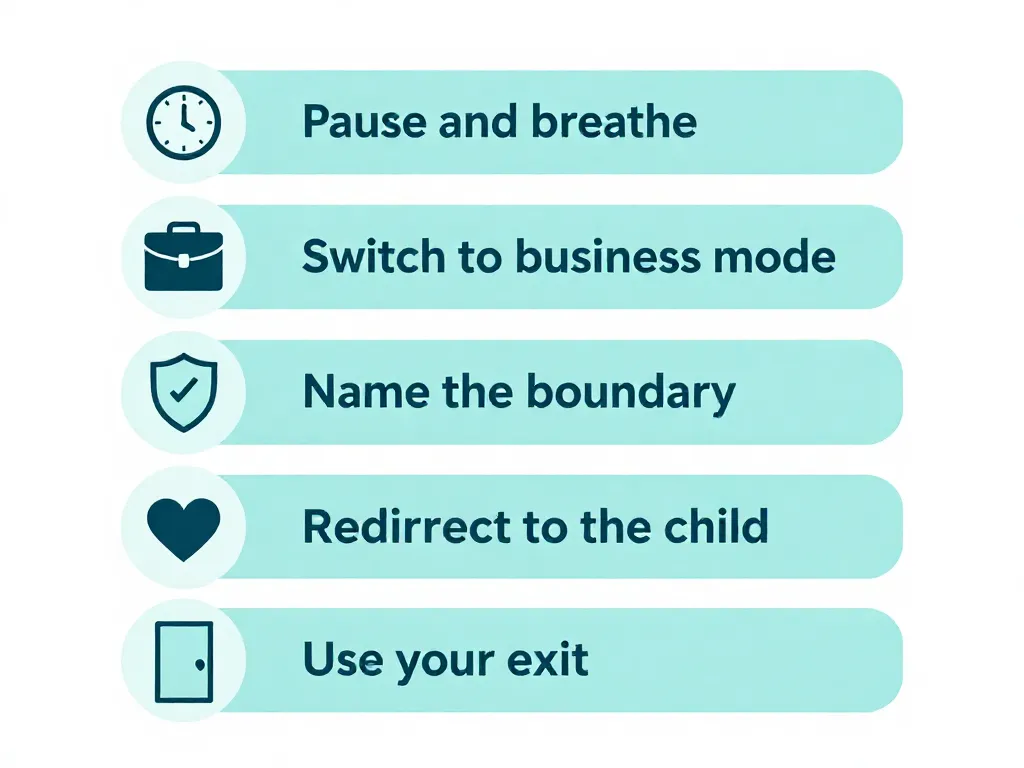
- You don't have to respond immediately. A deliberate pause is not avoidance — it's strategy.
- Use "business-tone" scripts to keep the conversation focused on logistics, not emotions.
- Name the boundary, not the behavior. Saying "I'm going to stick to the topic of pickup time" is more effective than "You're being aggressive."
- Redirect every exchange back to the child's needs. It's the one frame both parents have a harder time arguing against.
- Know your exit lines. Having pre-planned phrases for ending an unproductive conversation prevents you from getting pulled in.

Why Your Co-Parent Picks Fights (and Why It Doesn't Matter Right Now)
There are many reasons a co-parent might escalate. They could be struggling with unresolved grief over the relationship. They might feel a loss of control. They may have learned that conflict gets results — that if they push hard enough, you'll give in to end the discomfort.
Understanding the why can be useful in therapy or mediation. But in the moment, diagnosing their motivation isn't your job. Your job is to protect the co-parenting relationship from further damage and to model emotional regulation — both for yourself and for your children.
So let's skip the analysis and go straight to what you can actually do.
Step 1: Buy Yourself Time Before You Respond
The single most powerful thing you can do when your co-parent picks a fight is not respond immediately. This isn't the silent treatment. It's a tactical pause.
When you respond in the heat of the moment, you're operating from your amygdala — the part of your brain built for survival, not diplomacy. Even a 20-minute delay can shift you out of fight-or-flight and into clearer thinking.
Scripts for Buying Time
- Via text: "I've read your message. I want to give it a thoughtful response, so I'll reply by [specific time]."
- On the phone: "I can hear this is important to you. I need to check on something before I respond. I'll call you back at 7."
- At pickup: "I don't think we'll resolve this in the driveway. Let's discuss it over text tonight after the kids are settled."
Notice none of these phrases are dismissive. They acknowledge the other person while establishing that you control the timing.
What If They Demand an Immediate Response?
They might say, "I need an answer now." Unless it's a genuine emergency involving the child's safety, you don't owe an instant reply. Repeat your time-bound commitment: "I'll respond by 7 tonight." Then stop. Repetition without elaboration is a de-escalation tool.
Step 2: Switch to "Business Mode" Communication
Think of your co-parenting relationship less like a personal relationship and more like a business partnership. The "business" is raising your child. This mental shift changes the way you write, speak, and react.

Business mode means:
- Short, factual sentences. "Saturday pickup will be at 10 a.m. as agreed."
- No emotional bait. If they write four paragraphs about what a terrible person you are, respond only to the logistical content embedded in the message.
- No defending your character. You don't need to prove you're a good parent in a text thread. Your parenting speaks for itself.
Example: Filtering Out the Noise
Their message:
"You NEVER think about anyone but yourself. You changed the pickup time without even asking me and now my whole weekend is ruined. Typical. You've always been selfish and the kids can see it too."
What you might want to say:
A point-by-point rebuttal of every accusation.
What you actually say:
"I understand there's confusion about the pickup time. My understanding was 10 a.m. based on our agreement from last Tuesday. Can you let me know what time works for you so we can confirm?"
You responded to the one operational issue and let everything else pass without acknowledgment. This isn't weakness. It's discipline.
Step 3: Name the Boundary, Not the Behavior
Calling out your co-parent's behavior almost always backfires. Saying "You're being hostile" or "Stop yelling at me" tends to escalate rather than de-escalate, because it feels like an attack to the other person — even if it's objectively true.
Instead, state what you will and won't engage with.
Boundary-Setting Phrases That Actually Work
| Instead of This | Try This |
|---|---|
| "You're being unreasonable." | "I'm only able to discuss the schedule right now." |
| "Stop bringing up the past." | "I want to focus on what we're deciding for this weekend." |
| "You always do this." | "I'm going to step away from this conversation and we can revisit it tomorrow." |
| "You're manipulating me." | "I've shared my position. I don't have anything new to add right now." |
| "You can't talk to me like that." | "I'm available to continue this conversation when we can keep it focused on [child's name]." |
The pattern: state what you will do, not what they're doing wrong. You're setting the terms of engagement without giving them something to push back against.
Step 4: Redirect to the Child
When a conversation spirals, bring it back to the one person both of you care about. This isn't a manipulation tactic — it's a genuine reorientation toward what actually matters.
Redirect Phrases
- "What I want to figure out is what's going to work best for Emma this weekend."
- "Let's focus on making sure Jake has what he needs for Monday."
- "I think we both want the transition to be smooth for Lily. Here's what I suggest…"
Framing your response around the child's name and the child's needs does two things: it lowers the emotional temperature, and it makes it very difficult for the other parent to keep attacking without sounding like they've lost sight of the child.
Step 5: Know Your Exit Lines
Every conversation needs an off-ramp. If you don't plan yours in advance, you'll either stay too long in a toxic exchange or exit in a way that feels like storming off — which gives your co-parent ammunition.
Pre-planned exit lines let you leave cleanly.
Exit Lines for Different Scenarios
When the conversation is going in circles:
"I think we've both shared our perspectives. I don't see us reaching a resolution tonight. Let's revisit this on Thursday."
When insults start:
"I'm going to end this conversation for now. I'm happy to discuss [topic] when we can keep it focused on logistics."
When they try to rope you back in after you've disengaged:
"I've said what I need to say for now. I'll be in touch on Thursday as planned."
When they escalate at a custody exchange, in front of the children:
"Let's not do this here. I'll text you once the kids are settled."
Then follow through. Don't send one more message. Don't get in the last word. The discipline of the clean exit is one of the hardest skills in co-parenting — and one of the most powerful.
What to Do After the Fight
Once the immediate conflict has passed, there are a few quiet steps that protect you going forward:
- Screenshot and save. If the exchange happened over text, keep it. Not to weaponize later, but to have an accurate record in case you ever need it for mediation or legal proceedings.
- Write a brief note to yourself. What triggered it? What did you try? What worked? Patterns become visible over time.
- Don't vent to your child. This is critical. Even if your co-parent behaved terribly, your child should never become your confidant or ally in adult conflict.
- Consider formalizing agreements. If the same issues keep sparking fights — pickup times, holiday schedules, communication expectations — it may be time to put things in writing. AI-powered mediation platforms like Servanda can help co-parents create structured, written agreements that reduce ambiguity and prevent the same conflicts from recurring.
- Check in with yourself. Were you safe? Was the exchange abusive? There's a meaningful difference between a high-conflict co-parent and a dangerous one. If you feel threatened, contact a family law attorney or the National Domestic Violence Hotline (1-800-799-7233).
When De-Escalation Isn't Enough
The strategies above work well for high-conflict co-parenting — situations where one or both parents struggle to communicate without tension. But there are circumstances where de-escalation alone isn't sufficient:
- If there's a pattern of verbal abuse or threats, you may need to shift to parallel parenting, where all communication goes through a monitored app or a legal intermediary.
- If your co-parent repeatedly violates court orders, document everything and consult your attorney.
- If your physical safety is at risk, no communication strategy replaces a safety plan.
De-escalation is a tool, not a cure. Use it where it works, and escalate to professional help when it doesn't.
Frequently Asked Questions
How do I stop engaging when my co-parent keeps pushing my buttons?
Start by identifying your specific triggers — the phrases, tones, or topics that reliably pull you into reacting. Once you can name them, you can prepare for them. Write your go-to boundary phrases on a sticky note near your phone. Having a physical reminder of your planned response creates a buffer between the trigger and your reaction.
Should I ignore my co-parent's text if they're being hostile?
Ignoring entirely can escalate things further and may look bad in a legal context. Instead, respond only to the factual or logistical content of the message and let the hostile portions go unaddressed. This shows you're engaged and cooperative without rewarding the aggression.
What if my co-parent picks fights in front of our kids?
Shut it down immediately with a calm, brief statement: "Let's not do this here. I'll text you later tonight." Then physically move the interaction along — help the kids into the car, say a cheerful goodbye, and leave. Debrief with your co-parent later via text, where you have more control over pacing and tone.
Is it okay to set a rule that we only communicate in writing?
Absolutely. Many co-parents find that text or email-only communication dramatically reduces conflict because it removes tone of voice, interruptions, and the pressure to respond in real time. You can frame it positively: "I think we communicate more clearly in writing. Let's use text for scheduling so we both have a record."
How do I know if I need a mediator or lawyer instead of handling this myself?
If the same conflicts keep repeating despite your best efforts, if your co-parent refuses to follow agreements, or if you feel emotionally unsafe in every interaction, it's time to bring in professional support. A family mediator can help restructure communication, and an attorney can formalize agreements that carry legal weight.
Moving Forward
You won't get this perfect. There will be days when you fire back before you catch yourself, or when you cave because you're exhausted, or when you hang up the phone and cry in the car. That's not failure — that's being human in an incredibly difficult situation.
What matters is the overall direction. Each time you pause before responding, redirect to logistics, or exit a conversation cleanly, you're building a skill. Over time, these moments add up. Your co-parent may or may not change their behavior. But you'll have changed yours — and your children will benefit from at least one parent who can hold steady when things get hard.
Keep your scripts close. Use them often. And remember: you don't have to win the fight. You just have to not be in one.