
How to Resolve Co-Parenting Fights Without a Lawyer
It's 9:47 PM on a Sunday. You just got a text from your co-parent: "I'm keeping the kids next weekend. My mom is visiting." No discussion. No ask. Just a unilateral decision that blows up the schedule you both agreed to three weeks ago. Your jaw tightens. You start typing something sharp—then delete it. Type again. Delete again. You're one impulsive message away from a fight that could spiral into lawyers, motions, and thousands of dollars.
Sound familiar? You're not alone. Disputes over schedules, holidays, expenses, and parenting styles are the daily reality for millions of co-parents. And too often, the default response is to "call my attorney"—not because the situation truly requires legal intervention, but because nobody ever handed you a better playbook.
This article is that playbook. You'll learn how to resolve co-parenting fights without a lawyer using structured strategies that de-escalate conflict, protect your boundaries, and keep your kids out of the crossfire.
Key Takeaways
- Most co-parenting disputes don't need a lawyer—they need a framework for structured communication and clear written agreements.
- A 24-hour response rule prevents reactive, emotion-driven messages that escalate conflicts unnecessarily.
- Negotiation scripts using BIFF (Brief, Informative, Friendly, Firm) responses give you concrete language for high-tension moments.
- Written proposals beat verbal arguments every time—putting your position on paper forces clarity and creates a record.
- When you do need help, start with mediation or AI-powered tools before defaulting to expensive legal battles.

Why Co-Parenting Disputes Escalate (and Why Lawyers Aren't Always the Answer)
Let's be honest about what's really happening when co-parenting conflicts blow up. Most disputes aren't legal problems. They're communication problems wrapped in emotional pain.
A study published in the Family Court Review found that the majority of post-separation parenting conflicts involve scheduling, communication breakdowns, and differing parenting styles—issues that rarely require a judge's ruling. Yet parents routinely spend $3,000 to $10,000+ on legal fees to resolve disputes they could have handled with the right tools.
Here's why escalation happens so fast:
- Emotional flooding: A message from your co-parent triggers a stress response. You react from a place of anger or fear rather than strategy.
- No shared process: Without agreed-upon steps for handling disagreements, every dispute feels chaotic and personal.
- Power struggles: One parent makes a unilateral decision, the other retaliates, and the conflict becomes about winning instead of solving.
- Lack of documentation: Verbal agreements get remembered differently. Without a written record, disputes become "he said / she said."
The good news? Each of these failure points has a practical fix—no retainer required.
Step 1: Install the 24-Hour Rule (Before You Respond to Anything)
The single most effective thing you can do to resolve co-parenting fights without a lawyer is to stop responding immediately.
This isn't about ignoring your co-parent. It's about creating a buffer between the trigger and your response. Here's how it works:
The 24-Hour Rule Protocol
- Receive the message. Read it once. Notice your emotional reaction.
- Close the app. Do not reply. Do not screenshot it and send it to your sister. Not yet.
- Write a draft response in your notes app. Get the anger out. Say everything you want to say. Then leave it.
- Return after 24 hours (or at minimum, after a night's sleep). Re-read their message. Re-read your draft. Then write a new response using the BIFF framework (below).
Exception: If the message involves an immediate safety concern or a time-sensitive logistical issue (e.g., pickup in two hours), respond only to the logistical facts. Save the larger conflict for later.
This rule alone eliminates roughly half of all co-parenting escalations. The fight you don't start is the one you never have to finish.
Step 2: Use BIFF Responses to Disarm Conflict
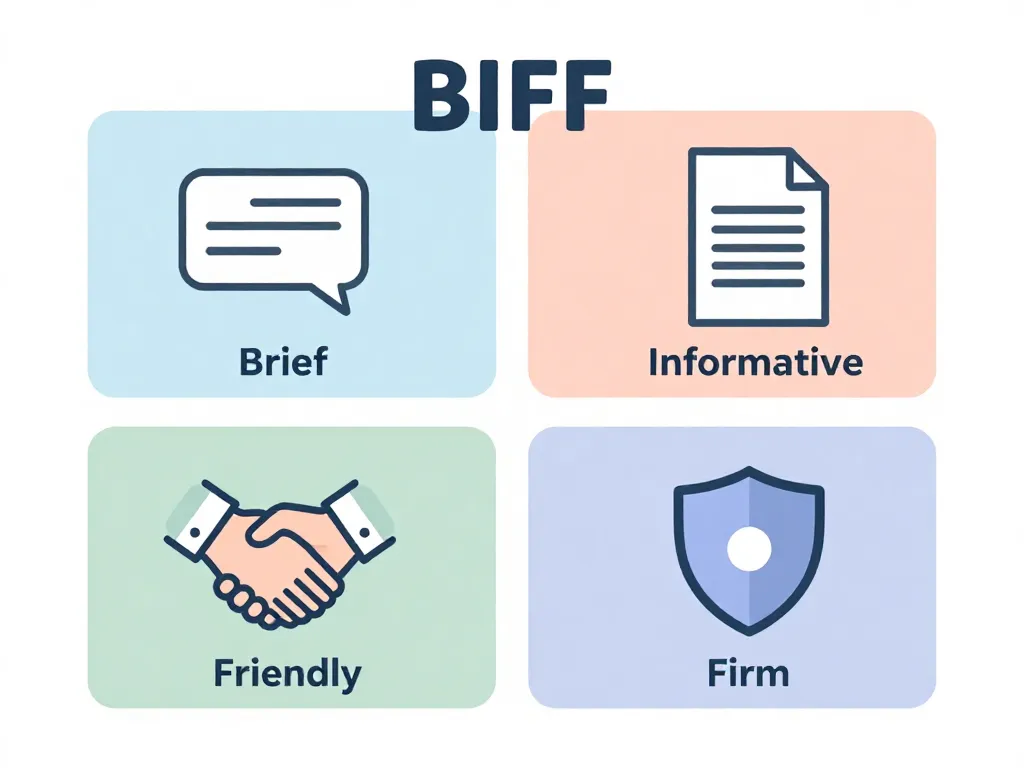
Developed by high-conflict divorce expert Bill Eddy, the BIFF response method (Brief, Informative, Friendly, Firm) is a communication framework purpose-built for tense co-parenting exchanges. It's not about being passive. It's about being strategic.
How BIFF Works in Practice
Let's revisit the scenario from the introduction. Your co-parent texts: "I'm keeping the kids next weekend. My mom is visiting."
Reactive response (what you want to say):
"You can't just change the schedule whenever you feel like it. This is exactly the kind of thing that makes co-parenting with you impossible."
BIFF response (what actually works):
"Thanks for letting me know your mom is visiting—that sounds nice for the kids. Next weekend is my scheduled time per our agreement. I'm open to discussing a swap if you'd like to propose specific alternative dates. Let me know by Wednesday so we can finalize."
Let's break down why this works:
- Brief: Two short sentences addressing the issue. No essays. No history lessons.
- Informative: References the existing agreement. States facts, not feelings.
- Friendly: Acknowledges the grandmother's visit. Shows goodwill.
- Firm: Sets a clear boundary (it's your scheduled time) and a deadline (Wednesday).
More BIFF Templates You Can Use Today
When your co-parent makes a unilateral decision about the kids' activities:
"I appreciate you wanting [child] to try [activity]. Since this affects both our schedules, can you send me the details—days, times, cost—so we can discuss it before committing? I'd like to figure this out together by [date]."
When your co-parent criticizes your parenting in a message:
"I hear your concern about [specific issue]. I've thought about it and I'm comfortable with how I'm handling it. If you'd like to discuss it further, I'm open to a focused 15-minute call on [day]. Otherwise, let's move forward."
When your co-parent is late—again—to pickup:
"Just confirming pickup was scheduled for 5:00 PM. The kids are ready. Please let me know your ETA so I can plan accordingly."
Notice the pattern: facts, boundaries, and a next step. No blame. No sarcasm. No rehashing the past.
Step 3: Replace Verbal Arguments with Written Proposals
If you and your co-parent are going back and forth about a real issue—say, splitting the cost of braces, or adjusting the holiday schedule—stop debating it in text threads and write a formal proposal.
This is the strategy that separates co-parents who resolve disputes from co-parents who litigate them.
Anatomy of a Written Co-Parenting Proposal
A strong proposal has five parts:
| Section | What to Include |
|---|---|
| 1. The Issue | One sentence describing the specific problem. "We need to decide how to split the cost of Maya's orthodontic treatment." |
| 2. Relevant Facts | Costs, dates, quotes, insurance details—anything objective. |
| 3. Your Proposed Solution | A specific, actionable plan. "I propose we split the $2,400 out-of-pocket cost 60/40, consistent with our income ratio, paid in monthly installments of $200/$133 over six months." |
| 4. Alternative Option | A second acceptable solution. This shows flexibility and good faith. |
| 5. Response Deadline | A reasonable date by which you'd like a reply. "Please let me know your thoughts by March 15." |
Why This Works
- It forces clarity. You can't write a proposal without knowing what you actually want.
- It de-personalizes the conflict. You're negotiating a document, not fighting with a person.
- It creates a paper trail. If the dispute ever does reach a mediator or court, you have documentation showing you tried to resolve it reasonably.
- It shifts the dynamic. The person who presents a thoughtful proposal is the person who looks (and feels) like the adult in the room.
Send proposals via email—not text. Email is more searchable, more formal, and less likely to trigger an impulsive reply.
Step 4: Build a Conflict Resolution Ladder
Not every disagreement deserves the same level of effort. A conflict resolution ladder gives you a clear, pre-agreed sequence of steps so you're never wondering "What do I do now?"
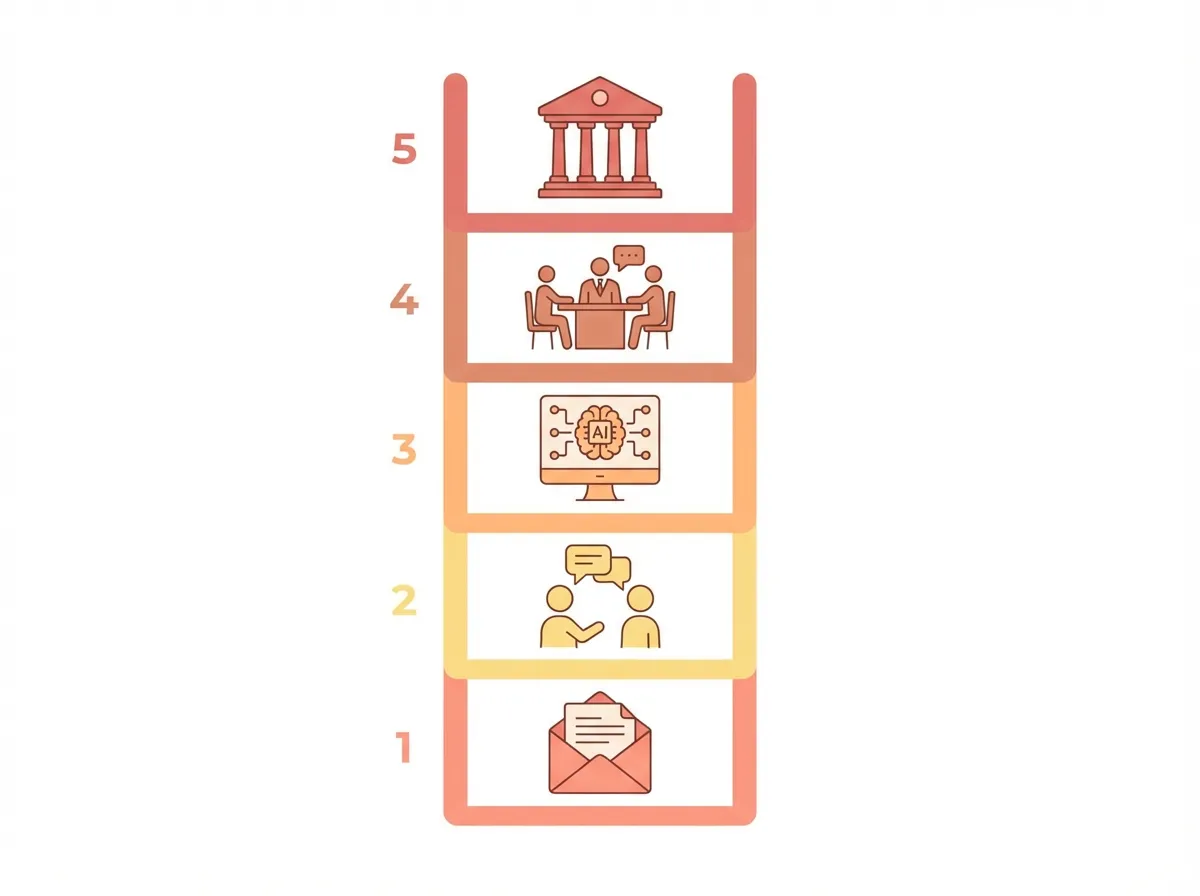
The Co-Parenting Conflict Resolution Ladder
Rung 1 — Direct Written Communication Try to resolve it between yourselves using BIFF messages and written proposals. Timeline: 1-2 weeks.
Rung 2 — Structured Conversation If writing isn't resolving it, schedule a focused 30-minute conversation (phone or video) with ground rules: one topic, no interrupting, no relitigating the past. Use a timer if needed.
Rung 3 — AI-Assisted or App-Based Mediation Before spending thousands on a professional mediator, consider technology-assisted options. AI-powered mediation platforms like Servanda can provide structure when emotions run high, helping you draft agreements and organize disputes without the cost or scheduling complexity of traditional mediation.
Rung 4 — Professional Mediation A trained mediator (typically $100-$300/hour) guides you through a structured process to reach agreement. Still far cheaper and faster than litigation.
Rung 5 — Legal Action Reserved for situations involving safety, repeated violation of court orders, or genuine impasse on major issues after exhausting the above steps.
The power of the ladder is that you agree on it in advance, during a calm moment. Then when a conflict arises, you don't have to decide what to do—you just follow the steps.
Step 5: Create a "Co-Parenting Operating Agreement"
The most successful co-parents we've seen aren't the ones who never disagree. They're the ones who have written agreements covering the things they're most likely to disagree about.
Think of it as a co-parenting operating agreement—a living document that covers:
What to Include
- Schedule changes: How much notice is required? What constitutes a valid reason for a swap? How are makeup days handled?
- Expenses: Which costs are shared? What's the splitting formula? What requires mutual approval before spending?
- Communication rules: Preferred channel (email for non-urgent, text for logistics only). Response time expectations. What topics are off-limits in front of the kids.
- Decision-making: How are medical, educational, and extracurricular decisions made? Who has final say in a tie?
- Holidays and vacations: A specific rotation—not vague guidelines. Include dates, pickup/dropoff times, and travel notification requirements.
- Introducing new partners: When, how, and what notification is expected.
A Real-World Example
Jamie and Alex (names changed) were spending roughly $500/month on legal consultations over scheduling disputes. When they finally sat down and created a detailed operating agreement—including a clause that any schedule change required 72 hours' written notice and an alternative date in the same message—their legal costs dropped to zero over the next eight months. The disputes didn't disappear, but the process for handling them did.
When You Actually Do Need a Lawyer
This article is about resolving fights without a lawyer—but let's be clear about when you should absolutely call one:
- Physical safety concerns for you or your children
- Substance abuse that's affecting parenting capacity
- Repeated, documented violations of existing court orders
- Parental alienation or deliberate interference with your relationship with your children
- Relocation disputes involving a move to another state or country
- Major financial disputes (e.g., hidden assets, refusal to pay court-ordered support)
None of the strategies in this article are substitutes for legal protection in serious situations. But for the 80% of co-parenting disputes that involve logistics, communication, and hurt feelings? You now have better tools.
Frequently Asked Questions
What do I do if my co-parent refuses to cooperate with any structure?
You can't control their behavior, but you can control yours. Continue using BIFF responses and written proposals even if they don't reciprocate. Over time, your consistency often shifts the dynamic. And if the conflict ever reaches a mediator or court, your documented, reasonable approach becomes powerful evidence of good faith.
Can co-parenting agreements made without a lawyer be legally enforced?
Informal agreements between co-parents are generally not enforceable in court on their own. However, you can take a written agreement you've created together and submit it to the court for approval, which makes it a formal court order. Many parents draft their own terms first and then have an attorney review and file them—significantly cheaper than having a lawyer negotiate from scratch.
How do I stop co-parenting arguments from affecting my kids?
Keep all conflict in adult-only channels—never in front of or through the children. Use written communication so you can manage your tone. Avoid asking kids to relay messages or report on what happens at the other parent's house. When your child brings up a concern, validate their feelings without criticizing the other parent.
Is online or AI-powered mediation as effective as in-person mediation?
For many disputes—especially scheduling, expense-splitting, and communication issues—technology-assisted mediation can be equally effective and significantly more accessible. The key advantage is that it removes the pressure of face-to-face confrontation and gives both parents time to think before responding. For high-conflict situations or complex financial issues, a professional mediator may still be the better choice.
How long should I try to resolve things on my own before getting legal help?
There's no universal timeline, but a reasonable approach is to work through the first three rungs of the conflict resolution ladder over 4-6 weeks. If you've sent written proposals, attempted a structured conversation, and tried mediation—and the issue remains unresolved—it may be time to consult an attorney. Document every step you've taken so your lawyer can see the full picture.
Moving Forward
Resolving co-parenting fights without a lawyer isn't about avoiding conflict altogether—that's unrealistic when two separate households are raising the same children. It's about having a system for handling conflict before it becomes a legal crisis.
Start small. Implement the 24-hour rule this week. Draft one BIFF response the next time a tense message lands in your inbox. Write a proposal for the one issue that's been simmering between you for months. Build the ladder. Create the operating agreement.
Each of these tools costs you nothing but a little discipline—and they compound. The co-parents who spend the least on lawyers aren't the ones who agree on everything. They're the ones who've built a structure that holds even when they don't.
Your kids don't need perfect co-parents. They need co-parents who know how to disagree without burning the house down.