
5 Conflict Resolution Scripts for Co-Parents
Key Takeaways
- You don't need to improvise during tense co-parenting conversations. Having word-for-word scripts ready helps you stay calm and child-focused when emotions spike.
- The five most common co-parenting conflicts — schedule changes, discipline disagreements, new partner introductions, financial disputes, and communication breakdowns — each have predictable patterns you can prepare for.
- Scripts work because they buy your brain time. When you have a practiced response, your nervous system stays regulated instead of flipping into fight-or-flight.
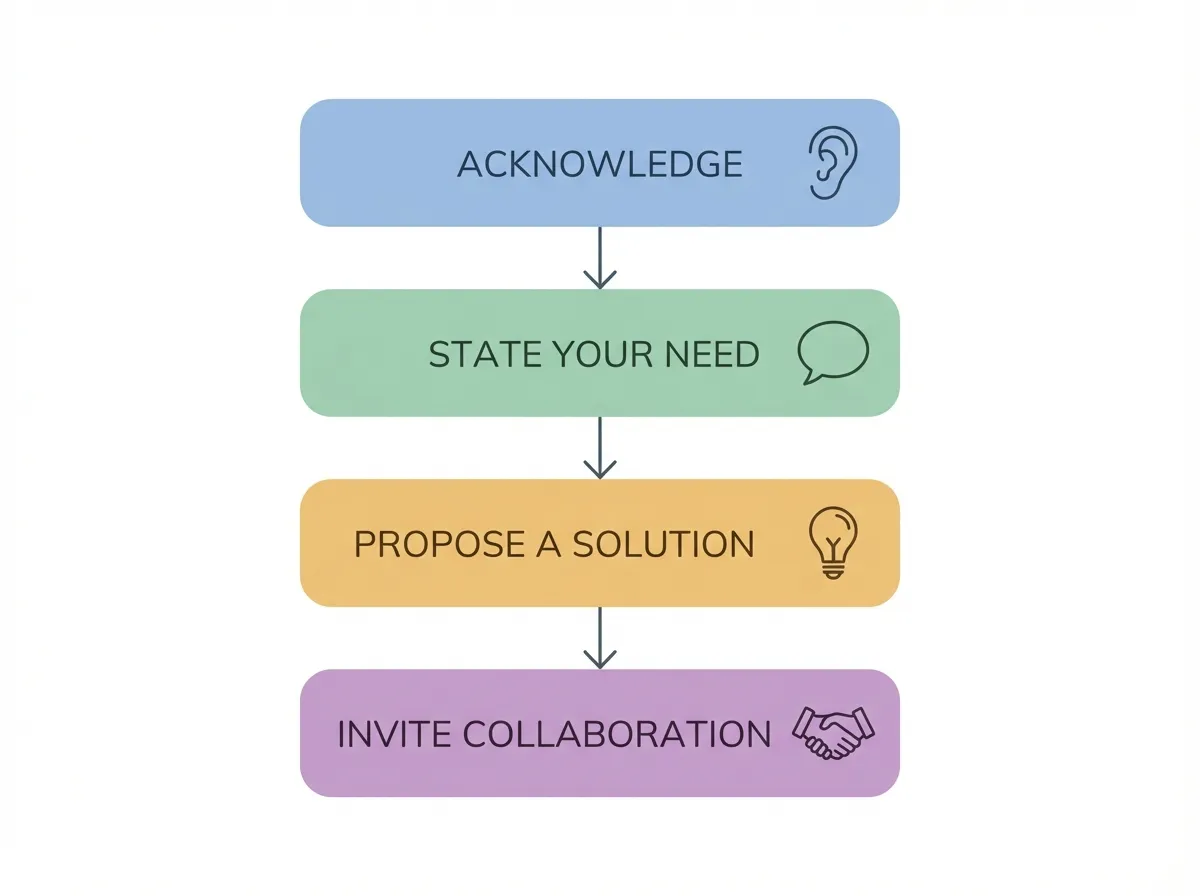
- Adjust the language to fit your voice, but keep the structure: acknowledge, state your need, propose a solution, invite collaboration.
- Written communication (text or email) is often safer for high-conflict situations because it gives you time to use these scripts intentionally.
It's 6:47 PM on a Friday. Your kids are packed and ready. Then your phone buzzes: "Something came up. I need to swap weekends."
Your stomach drops. Your thumbs hover over the keyboard. A dozen responses flash through your mind — none of them productive. You know that whatever you type in the next thirty seconds could set the tone for the entire week. Maybe the entire month.
This moment is where most co-parenting conflicts ignite. Not because either parent is a bad person, but because neither one has the right words ready when tension hits. You freeze, you fire back, or you fold — and none of those options serve your kids.
These five conflict resolution scripts for co-parents are designed for exactly this moment. They're not therapy exercises or vague principles. They're actual sentences you can copy into your phone's notes app and pull up the next time your co-parent catches you off guard.
Why Scripts Work Better Than "Just Stay Calm"
Telling a co-parent to "just stay calm" during a tense exchange is like telling someone to "just relax" during a job interview. The advice is technically correct and practically useless.
Here's what actually happens in your brain during a co-parenting conflict: your amygdala — the part of your brain that detects threats — activates faster than your prefrontal cortex, which handles rational thought. By the time you've decided to stay calm, you've already sent a message you regret.
Scripts interrupt that cycle. When you have a practiced response stored in memory, you don't have to generate language under stress. You retrieve it. That tiny difference — generating versus retrieving — is the difference between an escalation and a resolution.
The Structure Behind Every Script
Each script in this article follows a four-part framework:
- Acknowledge — Show you heard them (not that you agree)
- State your need — Be specific and child-centered
- Propose a solution — Offer one concrete option
- Invite collaboration — Leave the door open
This structure works whether you're texting, emailing, talking on the phone, or standing in a driveway during pickup.
Script 1: When Your Co-Parent Requests a Last-Minute Schedule Change
Schedule changes are the single most frequent source of co-parenting conflict. They feel personal even when they're logistical, because they touch on reliability, respect, and control.
The Scenario
Your co-parent texts on short notice asking to swap days, pick up early, or skip a weekend entirely.
The Script
"I see you need to change the schedule. I need some time to check what we already have planned. Let me look at the calendar and get back to you by [specific time]. If we do make a change, I'd like us to agree on how we make up the time so it's fair for everyone, especially [child's name]."
Why This Works
- "I see you need to change the schedule" acknowledges without agreeing or arguing.
- "I need some time" removes the pressure to respond immediately, which is where most mistakes happen.
- "Get back to you by [specific time]" shows good faith — you're not stonewalling.
- "Make up the time" sets a boundary without being punitive.
- "Especially [child's name]" recenters the conversation on your child.
What to Avoid
- "You always do this" — Generalizations escalate instantly.
- "Fine, whatever" — Passive compliance breeds resentment.
- Saying yes immediately to avoid conflict — This trains the other parent that last-minute requests always work.
Script 2: When You Disagree About Discipline or Rules
Discipline disagreements are loaded because they feel like judgments on your parenting. When your co-parent lets the kids stay up until midnight or takes away a privilege you wouldn't, it's easy to interpret it as a personal attack.

The Scenario
Your child comes home and mentions a rule at the other house that concerns you — excessive screen time, a punishment you consider too harsh, or no homework routine.
The Script
"[Child's name] mentioned [specific situation]. I'm not bringing this up to criticize how you handle things at your house. I want to talk about it because I think we'd both benefit from being on the same page about [specific topic — bedtime, screen time, homework]. Could we each share what's working for us and see where we can align? I'm open to hearing your perspective first."
Why This Works
- Leading with the child's name and a specific fact keeps it objective.
- "I'm not bringing this up to criticize" disarms the most likely defensive reaction.
- "We'd both benefit" frames it as a shared problem, not a blame exercise.
- "I'm open to hearing your perspective first" signals that this is a conversation, not a lecture.
What to Avoid
- "You're confusing the kids" — Even if it's true, leading with blame guarantees a defensive response.
- Interrogating your child for details to build a case — This puts the child in the middle.
- Sending this script over text if the topic is emotionally charged — Some discipline conversations need a phone call or a structured platform.
A Note on Parallel Parenting
If your co-parenting dynamic is high-conflict, you may not be able to align on every rule. That's okay. Research on parallel parenting shows that children adapt well to different household rules as long as each home is consistent within itself. Focus your alignment efforts on safety issues and major developmental concerns.
Script 3: When a New Partner Is Introduced
Few co-parenting situations spike anxiety like hearing that a new adult is spending time with your children. Your concerns are valid. But how you raise them determines whether you get reassurance or a brick wall.
The Scenario
Your child mentions a new person at your co-parent's house, or your co-parent tells you they're introducing someone new.
The Script
"Thanks for letting me know about [partner's name] — I appreciate the heads-up. I have some questions, not to interfere with your personal life, but because I want to make sure [child's name] feels safe and comfortable with the transition. Could we talk about how introductions will happen and what role [partner's name] will play around the kids for now? I'm asking because I'd want you to do the same if the situation were reversed."
Why This Works
- "Thanks for letting me know" rewards the transparency you want to see more of.
- "Not to interfere with your personal life" addresses the unspoken fear that you're trying to control them.
- "Safe and comfortable with the transition" is hard to argue against.
- "If the situation were reversed" appeals to reciprocity, which is one of the strongest persuasion tools available.
What to Avoid
- Running a background check and presenting it during pickup (yes, this happens).
- Telling your child your opinions about the new partner.
- Making demands: "I don't want that person around my kids" — unless there's a genuine safety concern, this usually backfires legally and relationally.
Script 4: When You Disagree About Money or Expenses
Money conflicts between co-parents almost never stay about money. They become proxy battles about fairness, sacrifice, and who's doing "more" for the kids. These scripts help you keep the conversation financial.
The Scenario
Your co-parent enrolls your child in an expensive activity without discussing it, or disputes their share of a medical bill, school cost, or extracurricular fee.
The Script (When You're Requesting Reimbursement)
"[Child's name] had [expense — doctor visit, registration fee, etc.] on [date]. The total was [amount]. Based on our agreement, I believe your share is [amount]. I've attached the receipt. Could you let me know if that works, or if you'd like to discuss it? I'd like to get it settled by [reasonable deadline] so it doesn't pile up."
The Script (When Your Co-Parent Made a Unilateral Decision)
"I see [child's name] is signed up for [activity/expense]. I want to support things that are good for them, and I also want us to discuss costs over [agreed threshold] before committing. Going forward, could we agree to a quick conversation before either of us signs them up for something that involves shared costs? I think that would prevent surprises for both of us."
Why This Works
- Specific numbers, dates, and receipts remove ambiguity.
- "Based on our agreement" references the existing framework, not your personal opinion.
- "Going forward" focuses on the future instead of relitigating the past.
- "Prevent surprises for both of us" frames the boundary as mutual.
What to Avoid
- Withholding parenting time over unpaid expenses — courts view this very unfavorably.
- Vague requests: "You owe me for the stuff" — specificity is your friend.
- Having financial conversations in front of the children.
Tip: Consider formalizing your expense-sharing agreements with a tool like Servanda before conflicts escalate. Having a written, structured record of what you've both agreed to removes the "I never said that" problem from financial disputes.
Script 5: When Communication Has Broken Down Entirely
Sometimes the conflict isn't about one specific issue — it's about the fact that every conversation turns toxic. Maybe your co-parent shuts down. Maybe every text becomes a fight. This script is designed to reset the entire dynamic.
The Scenario
You realize that you and your co-parent can't discuss anything without it escalating. You want to propose a new communication structure.
The Script
"I've been thinking about how we've been communicating, and I don't think it's working for either of us — or for [child's name]. I'm not blaming you, and I'm not saying I've handled everything perfectly either. I'd like to propose something: for the next 30 days, could we try keeping our communication to email or a co-parenting app, and limit it to logistics — pickups, drop-offs, medical, school? If something bigger comes up, we can schedule a specific time to talk about it. I think having structure might help us both stay focused on what [child's name] needs. Would you be open to trying it?"
Why This Works
- "I don't think it's working for either of us" shares ownership of the problem.
- "I'm not blaming you... I'm not saying I've handled everything perfectly" lowers defenses before you make a request.
- "For the next 30 days" makes it a trial, not a permanent sentence. People resist forever. They'll try thirty days.
- "Limit it to logistics" gives a clear, enforceable boundary.
- "Schedule a specific time" for bigger issues shows you're not avoiding hard conversations — you're containing them.
What to Avoid
- Delivering this speech mid-argument — timing matters. Send it during a neutral moment.
- Framing it as a punishment: "Since you can't communicate like an adult..." destroys any chance of buy-in.
- Expecting immediate agreement. Your co-parent may need time to sit with this.
How to Practice These Scripts So They Actually Work
Reading a script is step one. Making it available to you under pressure is step two. Here's how:
-
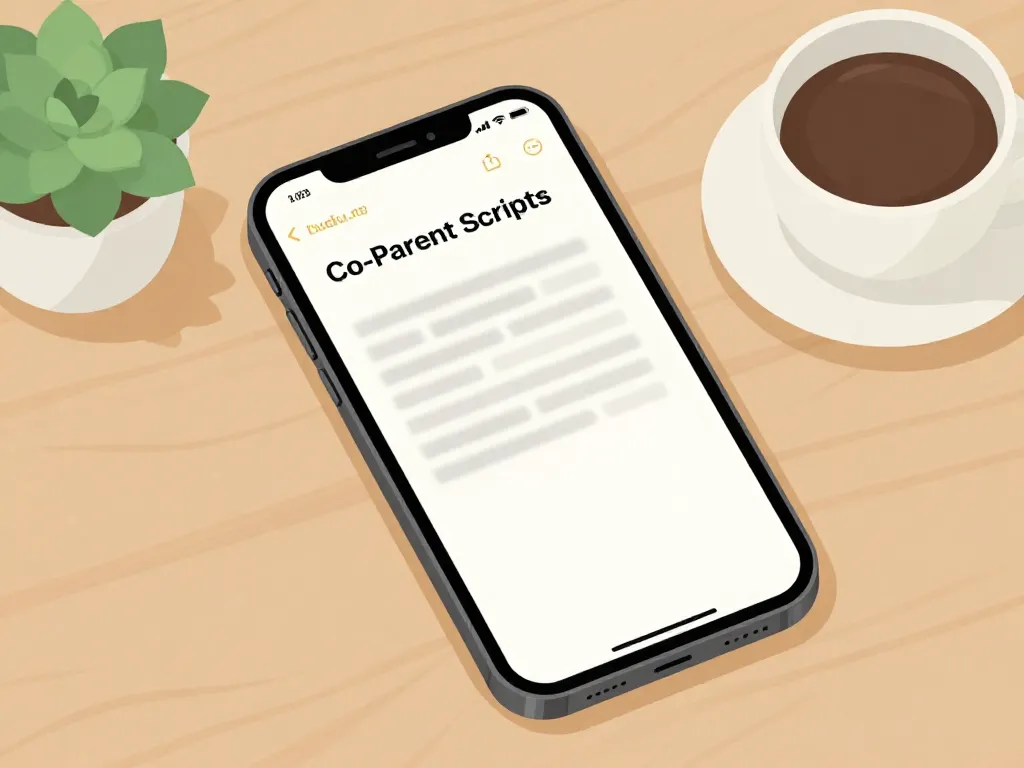
Save them in your phone. Create a note called "Co-Parent Scripts" and paste in the ones most relevant to your situation. Edit the language to sound like you — the structure matters more than the exact words.
-
Read them out loud. This sounds unnecessary until you try it. Reading a response out loud transfers it from visual memory to verbal memory, making it far more accessible when you're stressed.
-
Identify your trigger scripts. You probably don't need all five equally. Which scenario makes your heart rate spike? That's the script to rehearse most.
-
Build in a pause habit. Before responding to any tense message, take one full breath and re-read your co-parent's message once. Then open your scripts note. This three-step pause — breathe, re-read, check scripts — can become automatic within two weeks.
-
Debrief after you use them. After a conversation where you used a script, write down what worked and what you'd change. Over time, you'll develop your own customized language that fits your specific co-parenting dynamic.
Frequently Asked Questions
What if my co-parent doesn't respond well to scripted language?
Scripts are for you, not for controlling your co-parent's reaction. Even if your co-parent responds poorly, you've created a written record of calm, reasonable communication. Over time, many co-parents find that consistently measured responses de-escalate the other person — not every time, but more often than reactive ones do.
Can I use these conflict resolution scripts in court?
Text and email messages are frequently submitted as evidence in custody proceedings. Using structured, child-focused language demonstrates to a court that you're acting in good faith. These scripts aren't designed as legal strategy, but the respectful tone they promote almost always helps your position if communication records are ever reviewed.
What if my co-parent is verbally abusive — do scripts still work?
If your co-parent is abusive, scripted language can help you disengage without escalating, but it is not a substitute for legal protection. In high-conflict or abusive situations, shift to written-only communication, keep records of everything, and consult a family law attorney. Scripts help you maintain your own boundaries; they cannot fix someone else's behavior.
How do I get my co-parent to agree to better communication rules?
You can't force agreement, but you can model the behavior you want. Start using structured, calm language unilaterally. Many co-parents unconsciously mirror the tone they receive. If you want to propose formal communication guidelines, Script 5 in this article is specifically designed for that conversation.
Are co-parenting apps better than texting for conflict resolution?
Co-parenting apps offer several advantages: message logs that can't be deleted, built-in tone monitors, shared calendars, and expense tracking. They're especially helpful when trust is low. That said, the medium matters less than the language. A well-crafted text beats a hostile message on any platform.
Moving Forward One Conversation at a Time
Conflict resolution scripts for co-parents aren't about being robotic or fake. They're about being prepared. Every co-parent has moments where emotion outruns language — where you know you should respond thoughtfully but your fingers type something else entirely.
These five scripts give you a starting point for the conversations that matter most: schedule changes, discipline disagreements, new partners, money, and communication breakdowns. They won't eliminate conflict. Nothing will. But they'll give you something concrete to reach for in the moments when your instincts want to reach for something sharper.
Save the ones that apply to you. Edit them until they sound like your voice. Practice them once or twice out loud. And the next time your phone buzzes with a message that makes your chest tighten, you'll have something better than adrenaline to guide your response.
You'll have a plan.