When Coparents Disagree on Church: A Research Guide
Sunday morning. Your ex picks up the kids and takes them to a church service you never agreed to. Or maybe it's the opposite—you want your children raised in the faith that shaped your childhood, and your coparent refuses to participate. Either way, your stomach drops.
When coparents disagree on church and religious upbringing, the conflict touches something deeper than scheduling or logistics. It reaches into identity, values, family legacy, and genuine concern for a child's wellbeing. Unlike debates about screen time or bedtime routines, religion often feels non-negotiable to one or both parents—which is exactly what makes it so hard to resolve.
This guide draws on family law research, child psychology findings, and real-world coparenting strategies to help you navigate this disagreement with less conflict and more clarity. Whether you're in the early stages of tension or already locked in a standoff, there are concrete moves you can make—starting today.

Why Religious Disagreements Hit Harder Than Other Coparenting Conflicts
Most coparenting disputes live in the realm of practical compromise. Bedtime at 8:00 or 8:30? Soccer or swimming? These feel solvable because neither option threatens a parent's core sense of self.
Religion is different. Here's why these conflicts tend to escalate:
- Identity is on the line. A parent who was raised Catholic, Muslim, Jewish, or in any faith tradition may experience their child's non-participation as a rejection of their family, their heritage, or themselves.
- The stakes feel eternal. For parents with sincere religious beliefs, this isn't about preference—it's about their child's spiritual wellbeing. That perception makes compromise feel like moral failure.
- Extended family amplifies pressure. Grandparents, aunts, uncles, and faith communities often have opinions and aren't shy about sharing them, adding layers of guilt and obligation.
- There's no obvious middle ground. You can split a holiday schedule. Splitting a baptism is harder.
Understanding why this conflict is uniquely intense isn't about excusing bad behavior. It's about recognizing that your coparent's resistance comes from a place of deep sincerity—even when it frustrates you.
What the Research Actually Says About Children and Religion After Separation
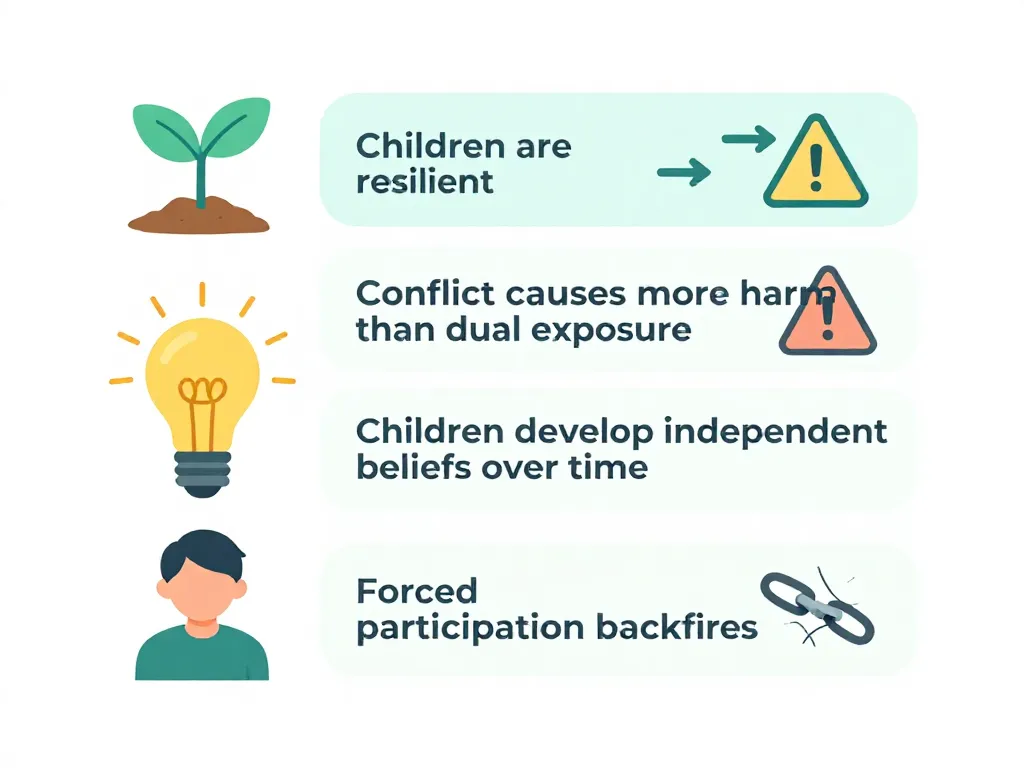
Children Are More Resilient Than We Assume
A 2015 study published in the Journal of Family Psychology found that children exposed to two different religious traditions in a coparenting arrangement did not show higher rates of confusion or anxiety compared to single-religion households—provided the parents managed the situation without open conflict. The key variable wasn't which religion the child experienced. It was whether the parents fought about it in front of the child.
Conflict Is the Actual Harm
Dr. Robert Emery, a leading researcher on divorce and children at the University of Virginia, has consistently found that interparental conflict is the single strongest predictor of negative child outcomes after separation—more than custody arrangement, more than economic disruption. When religion becomes the vehicle for ongoing hostility, the harm comes from the hostility, not the religion.
Children Develop Their Own Beliefs Over Time
Developmental psychologists note that children begin forming independent religious and spiritual opinions as early as age 7-8, with significant autonomous thinking emerging in adolescence. This means that a decision you make today about church attendance is not a permanent installation in your child's mind. It's an influence, not a verdict.
Forced Participation Can Backfire
Research from the Review of Religious Research (2013) found that adolescents who felt coerced into religious participation were more likely to reject religion entirely as young adults compared to those who were gently exposed. If your goal is a child who genuinely engages with faith, pressure is counterproductive.
What Family Courts Generally Consider
If you're wondering whether this could end up in front of a judge, here's what you should know—though this is informational, not legal advice.
The "Best Interests of the Child" Standard
Family courts in most U.S. jurisdictions evaluate religious disputes under the best interests of the child standard. Courts are generally reluctant to intervene in religious matters unless one parent can demonstrate that a specific religious practice causes the child actual, tangible harm—not hypothetical discomfort, not theological disagreement.
Common Court Approaches
| Approach |
What it means |
| Status quo preference |
If a child has been attending a particular church or practicing a particular religion throughout the marriage, courts often favor continuity. |
| Custodial parent deference |
In some jurisdictions, the parent with primary custody has broader authority over day-to-day decisions, including religious participation during their parenting time. |
| Non-interference during parenting time |
Each parent can expose the child to their own religious practices during their own parenting time, as long as it doesn't cause demonstrable harm. |
| Existing agreement enforcement |
If your parenting plan or custody order includes specific religious provisions, courts will enforce them. |
The Threshold for Court Intervention Is High
Judges don't want to be religious arbiters. A court is unlikely to order a child to attend or not attend a specific church unless there's evidence of emotional abuse, medical neglect tied to religious beliefs, or extreme practices that endanger the child. "I disagree with the theology" is almost never sufficient.
If you can resolve this outside the courtroom, you'll have more control over the outcome—and less collateral damage to your coparenting relationship.
A Practical Framework for Working Through Religious Disagreements
Here's a structured approach you can begin using immediately, whether you're dealing with a mild difference of opinion or a full-blown standoff.
Step 1: Separate the Real Concerns From the Power Struggle
Before your next conversation about church, sit down alone and answer these questions honestly:
- What specifically do I want for my child? (Not against my coparent—for my child.)
- Is this about my child's wellbeing, or about feeling respected and heard?
- Am I reacting to what my coparent is doing, or to what it represents?
Sometimes the church conflict is actually about control, boundary violations, or unresolved pain from the relationship. Identifying that doesn't mean your religious concerns aren't valid—it means you'll argue more effectively when you're clear about what's actually driving you.
Step 2: Gather Your Coparent's Actual Position
Many coparents argue against what they assume the other parent wants rather than what they've actually said. Before escalating, have a single focused conversation—or exchange written messages—to clarify:
- What religious activities does your coparent want the child to participate in?
- How frequently?
- Is this a new development or a continuation of something from the marriage?
- Are there specific practices or events that are most important to them?
Ask these questions with genuine curiosity, not cross-examination energy. You may discover the disagreement is narrower than you thought.
Step 3: Identify Your Shared Ground
Even deeply divided coparents usually agree on more than they realize. Common areas of overlap include:
- We both want our child to feel loved and secure.
- We both want our child to develop a moral foundation.
- We don't want our child caught in the middle of adult disagreements.
- We want our child to eventually form their own beliefs.
Write these shared values down. They become the foundation for any agreement you build.

Step 4: Explore Workable Arrangements
Here are several models that other coparents have successfully used. None is universally correct—the right fit depends on your specific situation.
Model A: Parallel Religious Exposure
Each parent practices their own tradition during their own parenting time. The child learns about both. Parents agree not to disparage the other's beliefs.
Works best when: Both parents are actively religious in different traditions and the child is old enough to process multiple inputs.
Model B: One Primary Tradition, Respectful Exposure to the Other
The child is raised primarily in one religious tradition (often the one practiced during the marriage), while the other parent can share their own beliefs without undermining the primary tradition.
Works best when: One parent is significantly more devout, or the child already has an established religious identity.
Model C: Secular Baseline With Optional Participation
Neither parent enrolls the child in formal religious education. Both parents may share their own beliefs and occasionally bring the child to services, but nothing is mandated.
Works best when: One parent is non-religious and the other is moderately religious without strong feelings about formal commitment.
Model D: Deferred to the Child's Choice
Parents agree that once the child reaches a specified age (commonly 12-14), the child will have the deciding voice in their own religious participation.
Works best as: A complement to any of the above models, not a standalone approach for young children.
Step 5: Put It in Writing
Verbal agreements about religion have a way of being remembered differently by each parent six months later. Whatever you agree on, document it in specific terms:
- Which religious services or classes the child will attend, and on whose parenting time
- How religious holidays will be handled
- What each parent agrees not to do (e.g., "Neither parent will tell the child the other parent's beliefs are wrong")
- How and when the agreement will be revisited
Tools like Servanda can help coparents create written agreements with clear terms, reducing the chance of future misunderstandings.
Step 6: Build in a Review Date
Children change. A five-year-old who loves Sunday school may feel differently at twelve. Build a review mechanism into your agreement—perhaps annually or at developmental milestones—so neither parent feels locked into an arrangement that no longer fits.
What Not to Do: Research-Backed Warnings
Certain moves consistently make religious coparenting conflicts worse. Avoid these:
- Don't use religion as a loyalty test. Telling your child that attending the other parent's church means they're betraying you or God puts impossible emotional weight on a child.
- Don't secretly baptize, convert, or enroll. Unilateral religious decisions made without the other parent's knowledge almost always escalate conflict and can have legal consequences.
- Don't interrogate your child after the other parent's parenting time. "What did they make you do at church?" teaches your child that they need to manage your emotions.
- Don't use your child as a theological messenger. "Tell your mom/dad that our pastor says..." is never appropriate.
- Don't assume your way is the default. Even if you were the more religious parent during the marriage, separation changes the dynamic. Both parents have standing.
When You're Stuck: Options Beyond Arguing
If direct negotiation hasn't worked, you still have options before litigation:
- Family mediation with a mediator experienced in religious disputes. Ask specifically about their experience with interfaith or religion-related custody issues.
- Consultation with a family therapist. A child psychologist can assess whether the child is experiencing distress and provide recommendations that carry weight in court if needed.
- Parenting coordinator. In some jurisdictions, courts can appoint a parenting coordinator with authority to make minor decisions when parents are at impasse.
- Collaborative law process. Both parents retain attorneys trained in collaborative practice who commit to resolving the dispute without litigation.
Frequently Asked Questions
Can my ex take my child to church without my permission?
In most U.S. jurisdictions, each parent is generally allowed to expose the child to their own religious practices during their own parenting time, unless a court order or parenting plan specifically says otherwise. Courts typically won't intervene unless the religious activity causes the child demonstrable, tangible harm. If your custody agreement includes specific religious provisions, those terms are enforceable.
Is it bad for kids to be raised in two different religions?
Research published in the Journal of Family Psychology found that children exposed to two religious traditions in a coparenting arrangement did not show higher rates of confusion or anxiety—as long as the parents managed the situation without open conflict. The harm comes from parental hostility, not from the religious exposure itself.
What do courts look at when parents disagree about religion?
Family courts evaluate religious disputes under the "best interests of the child" standard and are generally reluctant to intervene unless one parent can show a specific practice causes actual harm. Courts often favor the religious status quo from the marriage, may defer to the custodial parent for day-to-day decisions, and will enforce any religious provisions already written into the parenting plan.
How do I talk to my coparent about religion without it turning into a fight?
Start by privately clarifying your own motivations—whether the issue is truly about your child's wellbeing or about feeling disrespected—then approach your coparent with specific, curious questions about what they actually want rather than arguing against assumptions. Focus the conversation on shared values like wanting the child to feel secure and eventually form their own beliefs, and consider using written communication or a mediator if direct conversations tend to escalate.
At what age can a child decide about religion for themselves?
Developmental psychologists note that children begin forming independent religious opinions around age 7–8, with significant autonomous thinking emerging in adolescence. Many coparents agree to give the child a deciding voice in their own religious participation around age 12–14, though this works best as a complement to an existing arrangement rather than a standalone plan for younger children.