
5 De-Escalation Scripts for Co-Parent Arguments
Key Takeaways
- You don't need to think on your feet. Memorizing even one de-escalation script gives you a reliable exit from heated co-parent exchanges.
- Acknowledge before you redirect. Every script in this guide starts with a brief acknowledgment of the other parent's concern — because people can't hear solutions until they feel heard.
- Name the shared goal out loud. Saying "we both want what's best for [child's name]" isn't a cliché when it's deployed strategically to interrupt an escalation cycle.
- Pausing is not losing. Requesting a 24-hour cooldown is one of the most powerful de-escalation moves available, and Script #4 gives you the exact words to do it.
- Written follow-ups protect everyone. After any tense exchange, a brief written summary prevents the "that's not what I said" spiral that reignites conflict days later.
Introduction
It's 6:14 p.m. on a Friday. You're standing in the driveway during pickup, and your co-parent says something about the schedule change you supposedly agreed to — except you didn't. Your pulse spikes. Your jaw tightens. You have about four seconds before this becomes the kind of argument your seven-year-old will remember.
Here's the problem: in that four-second window, most co-parents don't have words ready. They have adrenaline. They have a backlog of frustration. And they have a child watching from the back seat.
These five de-escalation scripts for co-parent arguments are designed for exactly that moment. They're not therapy exercises or abstract principles. They're word-for-word phrases you can memorize, rehearse in your car, and deploy when your nervous system is screaming at you to fight back. Each one targets a specific type of co-parent conflict — from schedule disputes to parenting criticism — so you can match the script to the situation in real time.

Why Scripts Work Better Than "Staying Calm"
You've probably heard the advice: "Just stay calm." It's well-intentioned and almost completely useless in practice.
When you're triggered, your prefrontal cortex — the part of your brain responsible for measured responses — goes partially offline. Your amygdala takes over. This is the fight-or-flight response, and it doesn't care about your co-parenting plan.
Pre-rehearsed scripts work because they bypass the need to think of the right thing to say. They function like muscle memory. A firefighter doesn't decide how to hold a hose during a blaze — they've drilled it hundreds of times. De-escalation scripts work the same way.
What Makes a Good De-Escalation Script
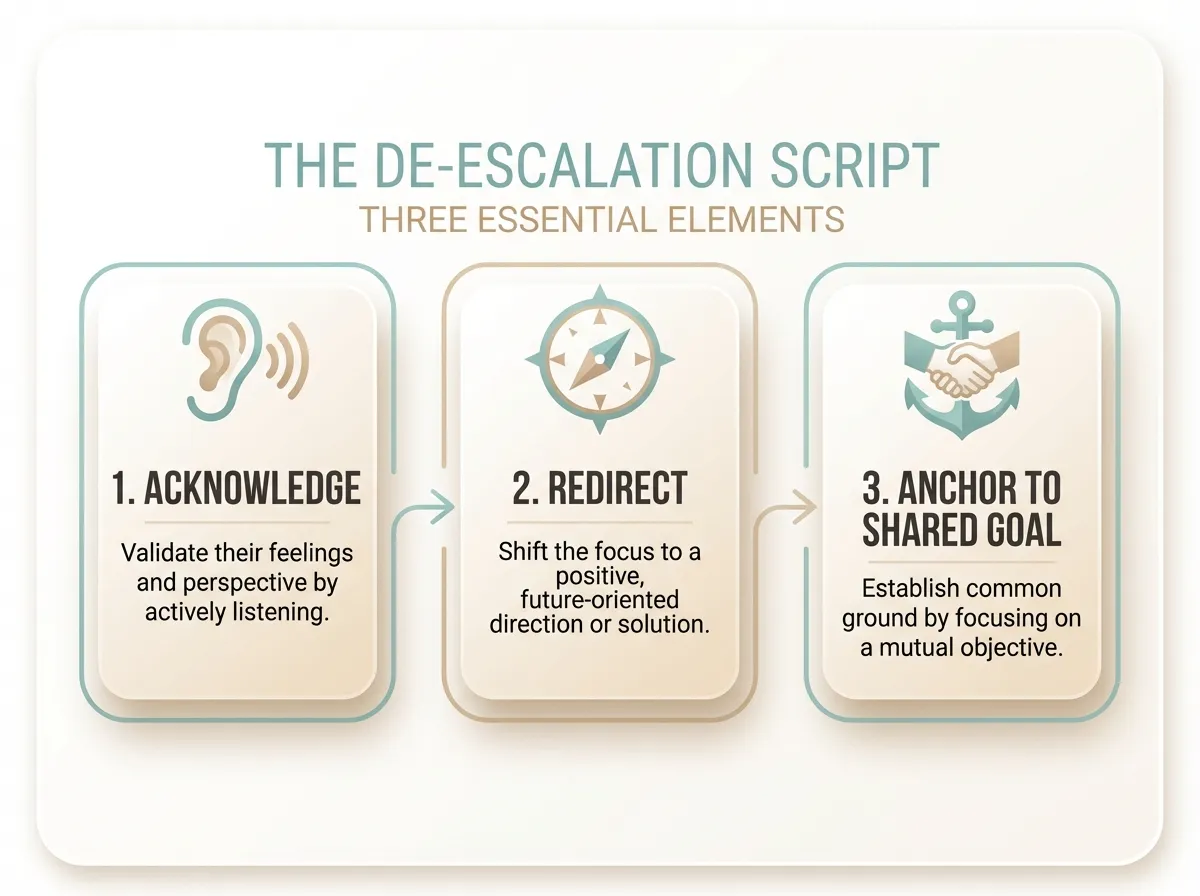
Effective co-parent de-escalation scripts share three structural elements:
- Acknowledgment — A brief, non-sarcastic recognition of what the other parent is expressing
- Boundary or redirect — A clear statement that moves the conversation toward problem-solving or pauses it entirely
- Shared-goal anchor — A reminder that both parents are oriented toward the same outcome: the child's wellbeing
None of these require you to agree with your co-parent. None require you to apologize. They simply require you to say specific words in a specific order — even if your internal experience is pure frustration.
Script #1: The Schedule Dispute De-Escalator
Use when: Your co-parent brings up a schedule change, accuses you of not following the plan, or tries to renegotiate custody time during pickup or dropoff.
The Script
"I hear that you're frustrated about the schedule. I want to get this right too. I don't think we're going to solve it standing here — can we handle this in writing tonight so we both have time to look at the actual agreement?"
Why It Works
- "I hear that you're frustrated" — Acknowledgment. You're not agreeing, you're reflecting.
- "I want to get this right too" — Shared-goal anchor. You're on the same team regarding accuracy.
- "I don't think we're going to solve it standing here" — Reality check without blame. The driveway during pickup is objectively a bad negotiation venue.
- "Can we handle this in writing tonight" — Redirect to a calmer, documented medium.
Example in Action
Marcus and Talia have been co-parenting for two years. Talia arrives for Friday pickup and tells Marcus she needs to swap weekends because of a work trip. Marcus feels ambushed. Instead of saying "You always do this," he uses the script. Talia is still annoyed, but she agrees to text about it later. Their son doesn't witness an argument. When they resolve it over text that evening, both parents have time to check the custody calendar and respond without adrenaline.
Script #2: The Parenting Criticism Deflector
Use when: Your co-parent criticizes your parenting decisions — bedtime, screen time, diet, discipline, who you're dating.
The Script
"I can see this is important to you, and I take [child's name]'s wellbeing seriously. I'm not going to discuss my household decisions during an exchange, but if you have a specific concern about [child's name]'s safety, I'm willing to talk about that in writing."
Why It Works
- "I can see this is important to you" — Acknowledgment without concession.
- "I take [child's name]'s wellbeing seriously" — You're not dismissing the concern; you're establishing that you're a thoughtful parent.
- "I'm not going to discuss my household decisions during an exchange" — Clear boundary. No justification needed.
- "If you have a specific concern about safety" — This separates legitimate safety issues from control-based criticism. It signals that you're reasonable while holding the line.
A Note on Tone
This script can sound robotic if delivered with a flat affect or condescending if delivered with exaggerated calm. Practice saying it the way you'd explain a policy to a coworker — neutral, matter-of-fact, slightly warm. Not cold. Not heated. Room temperature.
Script #3: The "You Never / You Always" Interrupt
Use when: Your co-parent uses absolute language — "You never check her homework," "You always bring her back late," "You never think about anyone but yourself."
The Script
"I don't think 'never' (or 'always') is accurate, but I understand you're upset. Let's focus on the specific situation. What happened on [specific date or event]?"
Why It Works
- "I don't think 'never' is accurate" — Corrects the distortion without counter-attacking.
- "But I understand you're upset" — Emotional acknowledgment.
- "Let's focus on the specific situation" — Redirects from sweeping accusations to a single, solvable event.
- "What happened on [specific date]?" — Forces the conversation into concrete territory where resolution is actually possible.
Why Specificity Matters
"You never" and "you always" are escalation accelerators. They make the other person feel globally attacked, which triggers defensiveness, which triggers counter-accusations. Dragging the conversation back to a single incident breaks this cycle. You're not agreeing that you messed up — you're agreeing to examine one situation.

Script #4: The 24-Hour Cooldown Request
Use when: The conversation is already heated, voices are rising, and you feel yourself losing control of your responses. This is the emergency brake.
The Script
"I can feel this getting bigger than it needs to be, and I don't want either of us to say something we'll regret. I'm going to take 24 hours and then respond in writing. This matters to me — I just need to think it through."
Why It Works
- "I can feel this getting bigger than it needs to be" — Metacommentary on the conversation itself. You're naming the escalation without blaming either party.
- "I don't want either of us to say something we'll regret" — This protects both parties. It's not "I need to get away from you." It's "I'm protecting us."
- "I'm going to take 24 hours" — Specific timeframe. This is crucial. An open-ended "I need some space" can feel like stonewalling. Twenty-four hours is concrete and manageable.
- "This matters to me" — Prevents the other parent from interpreting the pause as dismissal.
What If They Won't Let You Walk Away?
Some co-parents will escalate when you try to disengage. They might follow you to your car, send a barrage of texts, or accuse you of avoiding the issue. If this happens, repeat the last line once: "This matters to me. I'll respond in writing by [specific time tomorrow]." Then disengage. You are not required to stand in a conflict until the other person feels finished.
If your co-parent regularly prevents you from taking breaks during arguments, that's a pattern worth documenting. AI-powered mediation platforms like Servanda can help create structured communication agreements that include built-in cooldown protocols — so the rules are established before the next conflict, not during one.
Script #5: The Post-Conflict Reset
Use when: An argument happened — maybe yesterday, maybe last week — and you need to re-engage without reigniting the fire. This is the follow-up script you send in writing after things have cooled down.
The Script (Text or Email)
"I've been thinking about our conversation on [date]. I don't want that kind of exchange to become our pattern. Here's where I think we actually agree: [state one shared goal, e.g., 'we both want consistency for Mia's school nights']. Can we start from that point and figure out the logistics? I'm open to [one specific, concrete proposal]."
Why It Works
- "I've been thinking about our conversation" — Shows reflection, not reaction.
- "I don't want that kind of exchange to become our pattern" — Forward-looking. You're not relitigating who started it.
- "Here's where I think we actually agree" — Reframes the conflict from adversarial to collaborative.
- "I'm open to [specific proposal]" — Gives the other parent something concrete to respond to, rather than an open-ended "so what should we do?" which often restarts the argument.
Example in Action
Dani and Jordan argued at their daughter's soccer game about whether she'd spend Thanksgiving at Jordan's parents' house. It got loud enough that another parent noticed. Two days later, Dani sends this text:
"I've been thinking about Saturday. I don't want that kind of exchange to become our pattern — especially at Chloe's games. I think we both want her to see both families on Thanksgiving. What if she does dinner with your parents on Thursday and comes to my family's gathering Friday afternoon? I'm open to adjusting times."
Jordan, who had been dreading the next interaction, reads the message and feels disarmed. There's nothing to fight against. He responds with a counter-proposal. They reach agreement within four texts.
How to Practice These Scripts
Reading scripts is not the same as using them. Here's how to get them into your muscle memory:
1. Pick One Script and Rehearse It for a Week
Don't try to memorize all five. Choose the one that matches your most frequent conflict type. Say it out loud — in the shower, in your car, while cooking dinner. Repetition is what makes it available under stress.
2. Practice With a Trusted Friend
Ask someone you trust to role-play your co-parent. Have them escalate. Practice delivering the script while your heart rate rises. This simulates real conditions.
3. Keep a Cheat Sheet on Your Phone
Store the scripts in your phone's notes app. Before pickups, dropoffs, or phone calls, pull them up and scan the one you're most likely to need.
4. Debrief After Every Exchange
After a co-parenting interaction — good or bad — take two minutes to reflect: - Did I use a script? - What worked? - What would I change? - What script do I need to rehearse more?
This turns every real exchange into practice for the next one.
When Scripts Aren't Enough
De-escalation scripts are tools, not magic. They won't work in every situation, and there are circumstances where they're not the right approach:
- If your co-parent is verbally abusive or threatening, scripts are insufficient. Prioritize physical safety, document everything, and consult a family law attorney.
- If your co-parent is under the influence of substances during exchanges, do not engage. Document. Contact your attorney or the appropriate authority.
- If you're dealing with a high-conflict personality, scripts may need to be paired with a parallel parenting approach, where direct communication is minimized and exchanges are handled through apps, attorneys, or mediators.
Scripts are designed for co-parents who are both operating in good faith but struggling with emotional regulation in the moment. For most co-parenting relationships, that's the majority of conflicts.
FAQ
Do de-escalation scripts work if only one co-parent uses them?
Yes. De-escalation doesn't require both parties to participate — it only requires one person to change the pattern. When you refuse to match your co-parent's escalation, you remove the fuel. Over time, many co-parents begin to mirror the calmer tone, though this isn't guaranteed.
What if my co-parent accuses me of being fake or rehearsed?
This is common, especially at first. You can say: "I'm trying to handle things differently. It might sound different, but it's genuine." You don't need to defend your communication style. The results — fewer arguments, better outcomes for your child — will speak for themselves.
Should I use these scripts in front of my kids?
The scripts are designed to be appropriate for children to overhear. In fact, modeling calm conflict resolution in front of your kids is one of the most protective things you can do. That said, Script #4 (the cooldown request) is best used to end the conversation before your child absorbs too much tension.
Can I text these scripts instead of saying them out loud?
Absolutely. Scripts #1, #2, and #5 translate well to text and email. Written communication gives you the added benefit of being able to re-read before you send. If most of your co-parenting communication happens in writing, adapt the scripts to fit your natural texting style while keeping the structure.
How long does it take for de-escalation to change a co-parenting dynamic?
There's no universal timeline, but many co-parents report noticeable shifts within four to six weeks of consistent practice. The key is consistency — using the scripts even when you don't feel like it, even when your co-parent doesn't reciprocate. You're building a new default response, and that takes repetition.
Conclusion
You don't need to become a therapist to stop co-parent arguments from spiraling. You need specific words, practiced in advance, ready to deploy in the four-second window between the trigger and the reaction.
These five de-escalation scripts — the Schedule Dispute De-Escalator, the Parenting Criticism Deflector, the "You Never/You Always" Interrupt, the 24-Hour Cooldown Request, and the Post-Conflict Reset — cover the most common co-parenting flashpoints. Pick the one you need most. Practice it until it feels natural. Use it next time your pulse spikes during a co-parenting exchange.
Your kids won't remember the details of the scheduling dispute. But they'll remember whether their parents could stand in the same driveway without the air turning sharp. These scripts help you give them that.