
5 Ways to Defuse a Fight With Your Co-Parent Fast
It starts over something small. A pickup time that shifted by fifteen minutes. A text about a forgotten jacket. Then suddenly you're both typing in all caps about something that happened three Thanksgivings ago, and your chest is tight, and you can feel yourself saying things you know you'll regret by tomorrow morning.
If that sounds familiar, you're not broken — you're human. Co-parenting with someone you're in conflict with is one of the hardest relational challenges adults face. And most advice out there focuses on long-term strategies: set boundaries, build a parenting plan, go to mediation. All valuable. But none of it helps when you're standing in a driveway at 6 p.m. on a Friday with your blood pressure climbing.
This article is about what to do right now — in the moment when a disagreement is turning into a fight. These are five concrete, in-the-moment ways to defuse a fight with your co-parent before it causes real damage.
Key Takeaways
- You don't need to resolve the issue to defuse the fight. De-escalation and problem-solving are two separate steps — and de-escalation always comes first.
- A strategic pause (even 60 seconds) can interrupt the neurological hijack that turns a disagreement into a blowup.
- Shifting from "you" language to "the problem" language lowers defensiveness instantly and keeps the conversation productive.
- Having a pre-agreed "cool down" phrase removes the power struggle from stepping away — because you both decided on it in advance.
- Texting conflicts need their own set of rules — most co-parent fights escalate faster in writing than they ever would face to face.

Why Co-Parent Fights Escalate So Quickly
Before we get to the five tactics, it helps to understand why conflicts between co-parents go from zero to sixty so fast.
There's a neurological reason. When you interact with someone tied to past hurt — and your co-parent almost certainly fits that description — your brain's threat-detection system (the amygdala) activates more quickly than it would with a stranger or a colleague. Psychologists call this amygdala hijacking: the emotional brain takes over before the rational brain can weigh in.
That means your body is reacting to old pain even when the current issue is logistical. A question about who's buying school shoes can feel like an attack on your parenting — not because you're being irrational, but because your nervous system is pattern-matching to past experiences.
The good news: de-escalation techniques work precisely because they interrupt this hijack. They give your prefrontal cortex (the rational, decision-making part of your brain) time to come back online.
Here are five ways to make that happen.
1. Use the 60-Second Strategic Pause
What It Looks Like
When you feel the heat rising — your jaw tightening, your voice getting louder, the urge to fire back — stop talking. Not forever. Just for 60 seconds.
This isn't the silent treatment. It's a deliberate, brief interruption in the escalation cycle. You can say:
- "Give me one minute. I want to respond, not react."
- "I'm going to take a breath before I answer that."
- "Hold on — I need a moment to think about what you just said."
Why It Works
Research on emotional regulation shows that it takes roughly 60–90 seconds for the initial surge of stress hormones (cortisol, adrenaline) to peak and begin to recede. By pausing, you're not avoiding the conversation — you're waiting for your brain's executive function to catch up with your emotions.
A Real-World Example
Sarah and Marcus had a pattern: every handoff turned into a replay of their divorce grievances. Sarah started using the 60-second pause during pickups. The first time, Marcus interpreted it as dismissal. But when she said, "I'm not ignoring you — I just want to make sure I say something useful instead of something hurtful," the dynamic shifted. Within a few weeks, Marcus started pausing too.
2. Switch From "You" Statements to "The Problem" Statements
What It Looks Like
This is not the familiar "use I-statements" advice (though that has its place). This is more specific: take both of you out of the sentence entirely and name the problem as a separate thing.
Instead of: - "You never stick to the schedule." - "I feel disrespected when you change plans."
Try: - "The schedule keeps shifting, and that's creating confusion for the kids." - "The plan changed, and now there's a logistics issue to figure out."
Why It Works
When you remove "you" from the sentence, you remove the accusation. When you remove "I," you remove the vulnerability that can feel like weakness in a heated moment. What's left is the problem — sitting between you like an object on a table that you're both looking at, rather than a weapon one of you is throwing.
Family therapists sometimes call this externalizing the problem, and it's one of the fastest ways to lower defensiveness in any conflict.
Quick-Reference Reframes
| Instead of... | Try... |
|---|---|
| "You always cancel at the last minute." | "The cancellations are making it hard to plan." |
| "You don't care about their homework." | "The homework isn't getting done on transition nights — how do we fix that?" |
| "You're being unreasonable." | "We're stuck on this. What would a compromise look like?" |
3. Establish a Pre-Agreed "Cool Down" Phrase
What It Looks Like
This is something you set up before the next fight — and it takes less than two minutes. You and your co-parent agree on a single phrase that either of you can say to pause the conversation without it being interpreted as avoidance, punishment, or control.
Examples that real co-parents have used:
- "Let's come back to this in an hour."
- "Pausing, not quitting."
- "I need to step away so I can be fair."
The key: both people agree in advance that when this phrase is used, the conversation stops — no follow-up texts, no parting shots, no "one more thing." You also agree on when you'll revisit the issue (an hour later, the next day, in writing).
Why It Works
One of the biggest reasons co-parent fights escalate is that stepping away feels like losing. If you walk away, the other person might see it as avoidance. If they walk away, you might see it as dismissal. A pre-agreed phrase neutralizes this power dynamic because both people have already consented to the exit ramp.
How to Set This Up
Send a text (when things are calm) along these lines:
"I've been thinking about how our conversations sometimes get heated. I'd like to have a word or phrase we can both use that means 'I need a break but I'm not shutting this down.' Would you be open to that? We can pick something together."
If your co-parent won't engage with this, you can still use your own version unilaterally. It won't be as effective, but saying "I want to give you a real answer, so I'm going to take some time and get back to you by tomorrow" is still a significant de-escalation move.
4. Drop the Rope on the Side Argument
What It Looks Like
Most co-parent fights have a main issue and a side argument that spins off from it. The side argument usually involves relitigating the past, assigning blame, or debating who's the better parent. The side argument is always more emotionally charged — and it's almost never productive.
Dropping the rope means consciously refusing to engage with the side argument.
Example:
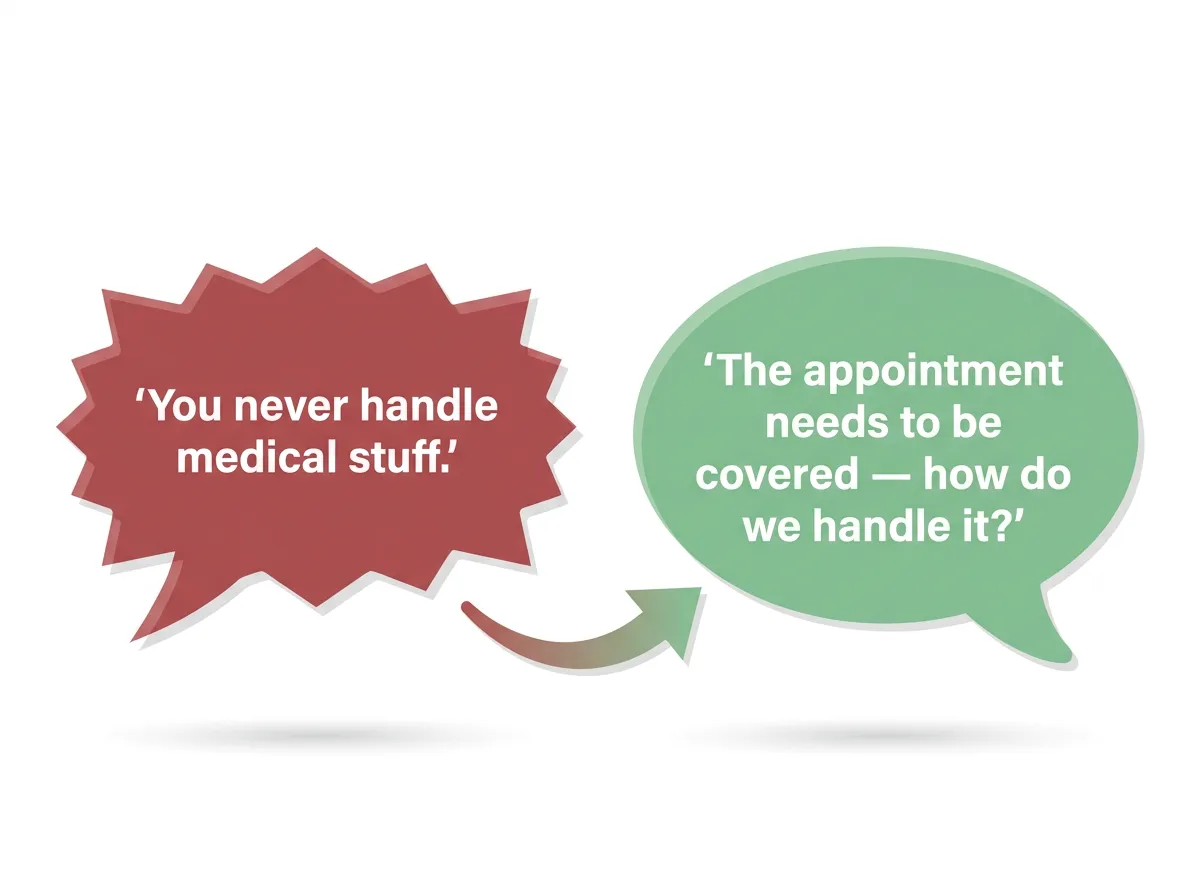
Main issue: Who's taking the kids to the dentist appointment on Tuesday?
Side argument: "You never handle medical stuff. You didn't even know their pediatrician's name when we were together."
The instinct is to defend yourself against the side argument. Don't. Instead, redirect to the main issue:
- "I hear you. Right now I want to figure out Tuesday. Can one of us confirm the appointment time?"
- "That's a separate conversation. For today, I need to know if you're able to take them or if I should arrange it."
Why It Works
Side arguments are emotional bait. Not necessarily intentional — your co-parent may not even realize they're doing it. But every side argument you engage with adds fuel and complexity to a fire that's already burning. Redirecting to the logistics keeps the conversation in the rational brain, not the emotional brain.
Think of it like this: you're not agreeing with the side argument and you're not fighting it. You're simply not picking it up.
5. Move Heated Conversations to Writing (With a Structure)
What It Looks Like
If you're in a verbal argument — on the phone or in person — and the first four tactics aren't gaining traction, move the conversation to a written format. But not a free-form text thread. Those escalate just as fast, sometimes faster, because tone is invisible and responses are instantaneous.
Instead, use a structured written format:
- State the specific issue (one sentence).
- State what you're proposing (one sentence).
- Ask for their input (one question).
That's it. Three lines. You can send this via text, email, or through a co-parenting communication platform.
Example:
"Issue: The kids need new winter coats. Proposal: I'll buy them this weekend and send you the receipt to split. Question: Does that work, or would you prefer to handle it?"
Why It Works
Structured writing does three things simultaneously:
- It forces clarity. You can't be vague when you're filling in three specific prompts.
- It creates a record. Both people can see exactly what was proposed and agreed to, which reduces future "you never said that" conflicts.
- It slows the pace. Writing takes longer than speaking, which builds in a natural pause.
AI-powered platforms like Servanda can add an additional layer here, helping co-parents draft clear agreements and formalize decisions so they don't become the source of the next argument.
A Note About Text Fights
If a conversation is already happening via text and it's escalating, resist the urge to send the longer message. Every additional sentence is an additional target for the other person to react to. Shorten your messages. Strip them down to logistics. If you're typing more than three sentences, you've likely drifted from problem-solving into arguing.
Putting It All Together: A De-Escalation Sequence
These five tactics aren't isolated moves — they work best in sequence. Here's how they might play out in a single interaction:
- Pause. You feel the heat rising. You say, "Give me a minute."
- Externalize. When you speak again, you name the problem, not the person: "The soccer schedule conflict is the issue."
- Use your phrase. If it's still escalating: "Pausing, not quitting. I'll text you by tonight."
- Drop the rope. If they follow up with a jab, don't engage with it.
- Move to structured writing. Send a three-line message that evening: issue, proposal, question.
You won't always get through all five steps. Sometimes the pause alone is enough. Sometimes you'll need to jump straight to writing. The point isn't to follow a script — it's to have options when your only instinct is to fire back.
Frequently Asked Questions
What if my co-parent won't cooperate with de-escalation?
You can't control your co-parent's behavior, but you can still use these tactics unilaterally. Pausing, externalizing the problem, dropping the rope on side arguments, and moving to structured writing all work even if only one person is doing them. Over time, many co-parents report that their calm responses gradually influence the other person's behavior — not always, but often enough to be worth the effort.
How do I stop myself from reacting in anger during a co-parenting fight?
The 60-second pause is your most reliable tool. When you feel anger surging, stop talking or stop typing. Breathe. Remind yourself that the goal isn't to win the argument — it's to solve a logistics problem for your kids. If you can delay your response by even one minute, you're significantly more likely to say something productive instead of something damaging.
Is it okay to walk away from a conversation with my co-parent?
Absolutely — as long as you communicate that you're pausing, not abandoning the issue. Walking away without explanation can feel like stonewalling to the other person. But saying "I need to step away so I can think clearly, and I'll follow up by tomorrow" is a mature, responsible move. Setting up a pre-agreed cool-down phrase makes this even smoother.
Should co-parent disagreements happen over text or in person?
It depends on the topic and the dynamic. Logistical issues (schedules, expenses, activity signups) often go more smoothly in writing because there's a record and a natural pace. Emotionally charged topics can go either way — some people regulate better in writing, while others find that text threads escalate faster because tone is missing. If your text conversations frequently turn into fights, try the three-line structured format described above.
When should co-parents consider professional mediation?
If you've tried de-escalation consistently and fights still dominate your co-parenting relationship, professional mediation is a smart next step. Signs it's time include: fights happening at every interaction, your children witnessing or being affected by the conflict, or an inability to make any decisions together. A mediator provides a neutral structure that removes the emotional charge from decision-making.
Moving Forward
Defusing a fight with your co-parent isn't about being passive, and it's not about letting the other person "win." It's about recognizing that the argument itself is the problem — not just the issue you're arguing about. Every fight that escalates makes the next conversation harder. Every fight you de-escalate makes the next one a little easier.
You don't need to overhaul your entire co-parenting dynamic today. You just need one tactic for the next heated moment. Pick the one from this list that feels most natural to you — the pause, the reframe, the phrase, dropping the rope, or moving to writing — and try it once. That's all. One time, one conversation, one moment where you choose to respond differently.
Your kids don't need perfect co-parents. They need co-parents who are willing to keep trying.