
5 Emotional Regulation Tips for Co-Parent Fights
Key Takeaways
- Your nervous system, not your ex, is often the real obstacle. Learning to recognize your body's stress response is the first step to stopping escalation before it starts.
- The 90-second rule changes everything. Neurochemically, an emotion only lasts about 90 seconds — anything beyond that is your own thinking re-triggering the cycle.
- Preparation beats willpower. Creating pre-planned emotional regulation rituals before, during, and after co-parent interactions dramatically reduces blowups.
- Repair matters more than perfection. You will lose your cool sometimes. Having a protocol for what happens next protects the co-parenting relationship long-term.
- Regulation is a skill, not a personality trait. Anyone can build this capacity with practice, regardless of how reactive they feel right now.
Introduction
It's 9:47 PM on a Tuesday. You open a text from your co-parent about this weekend's schedule, and within three seconds your jaw tightens, your chest constricts, and you're typing a response you'll regret by Wednesday morning. The words aren't even fully formed in your mind yet, but your thumbs are already moving.
Sound familiar?
Most co-parenting advice focuses on what to say — scripts, templates, sentence starters. And that advice isn't wrong. But here's the problem: no communication script survives contact with a flooded nervous system. When your body shifts into fight-or-flight, the rational, word-choosing part of your brain literally goes offline.
This article isn't about what to say. It's about what happens in your body and mind before you say anything — and how mastering that internal moment is the single most underrated skill in co-parenting. These five emotional regulation tips for co-parent fights are drawn from therapeutic approaches including dialectical behavior therapy (DBT), polyvagal theory, and somatic experiencing.
1. Learn Your Body's Early Warning System
Why This Matters
Emotional hijacking doesn't start with words. It starts with physiology. Dr. John Gottman's research on conflict found that once a person's heart rate exceeds roughly 100 beats per minute — what he calls "diffuse physiological arousal" (DPA) — their ability to listen, empathize, and problem-solve drops dramatically. At that point, you're not co-parenting. You're surviving.
The problem? Most people don't notice they've crossed that threshold until they're already mid-argument.
What to Do
Start building what therapists call interoceptive awareness — the ability to notice your body's internal signals in real time. This isn't meditation (though meditation helps). It's more specific than that.
Create a personal "escalation inventory" by reflecting on your last three co-parent conflicts and identifying:
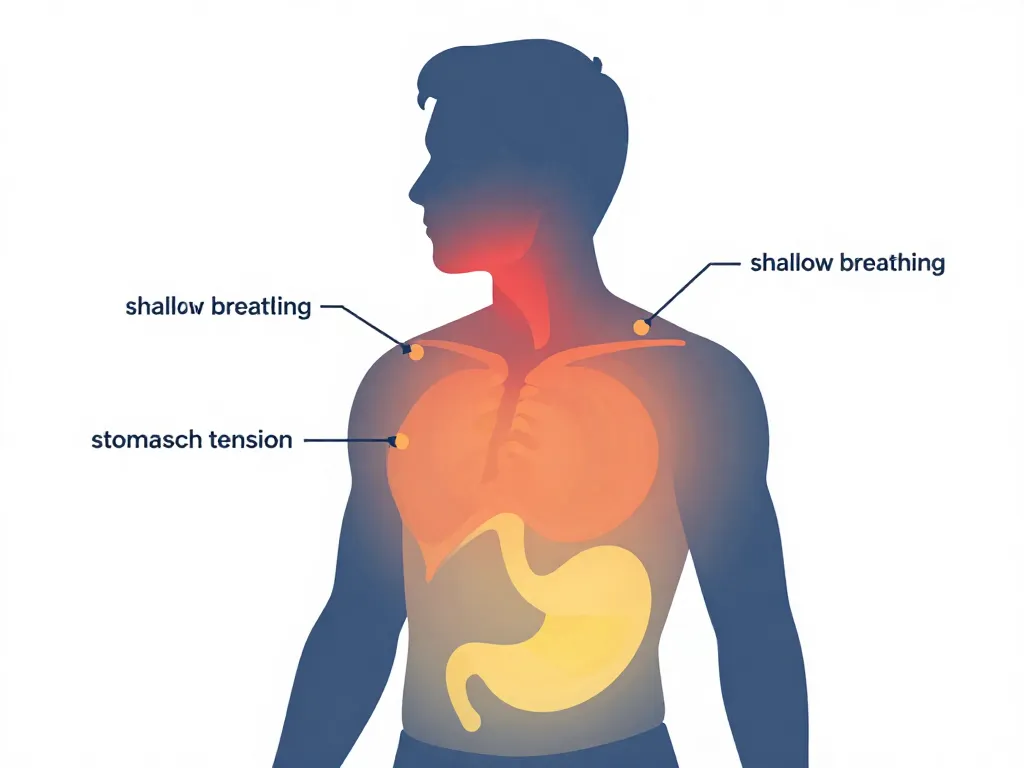
- Physical signals: Jaw clenching, shallow breathing, heat in your chest, tight shoulders, a churning stomach
- Cognitive signals: Black-and-white thinking ("They always do this"), mind-reading ("They're doing this on purpose"), rehearsing counterarguments before the other person finishes
- Behavioral signals: Typing faster, raising your voice, pacing, reaching for your phone compulsively
Write these down. Literally. Put them in a note on your phone. The goal is to catch yourself at a 2 or 3 on a 1–10 scale rather than at a 7, because by 7, your prefrontal cortex has largely checked out.
A Real Example
Marco (name changed) noticed through this exercise that his earliest warning sign wasn't anger at all — it was a specific sinking sensation in his stomach that he'd always ignored. Once he learned to treat that sensation as a signal rather than background noise, he could intervene 30 to 60 seconds earlier in his escalation cycle. That window changed everything.
2. Use the 90-Second Rule to Break the Emotional Loop
The Neuroscience Behind It
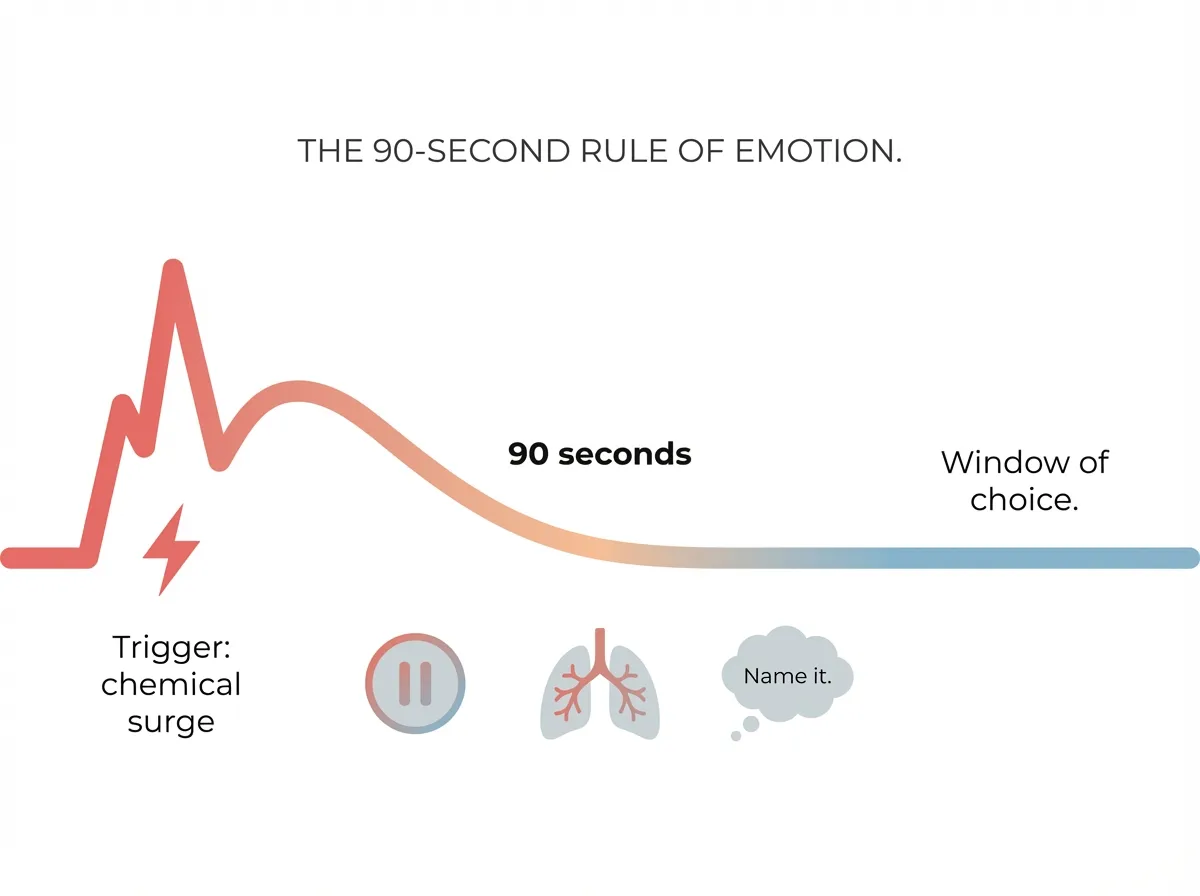
Neuroanatomist Dr. Jill Bolte Taylor describes what she calls the "90-second rule": when you experience an emotional trigger, a chemical process fires in your body that lasts approximately 90 seconds. After that, any remaining emotional response is being fueled by your own thoughts about the situation — the stories, interpretations, and mental replays you're generating.
This doesn't mean the emotion isn't real. It means there's a biochemical window where the wave will naturally crest and recede — if you let it.
What to Do
When you feel that first surge of anger, hurt, or defensiveness during a co-parent interaction:
- Name it silently. "This is the anger chemical. It will peak and pass." Naming an emotion activates your prefrontal cortex, which helps regulate your amygdala — a process neuroscientists call "affect labeling."
- Do not act for 90 seconds. Put the phone face-down. If you're in person, say, "Give me a moment" (not "I need space from you" — the framing matters).
- Breathe with extended exhales. Inhale for 4 counts, exhale for 6–8 counts. Extended exhales activate your parasympathetic nervous system, which is the only reliable manual override for fight-or-flight.
- After 90 seconds, check in. Is the intensity the same, or has it dropped? If it's dropped, you're now operating from a neurologically different state. If it hasn't, extend the pause.
Why This Is Different From "Just Calm Down"
Telling someone to calm down is both useless and insulting. The 90-second rule isn't about suppressing emotion — it's about understanding the biology of your own emotional process and working with it instead of against it. You're not pretending you aren't angry. You're giving the initial chemical surge a chance to complete its cycle so that you get to decide what happens next, rather than your amygdala deciding for you.
3. Create a Pre-Interaction Regulation Ritual
The Problem With Relying on In-the-Moment Willpower
Here's what most people do: they walk into a co-parenting conversation or open a co-parent's message cold, with no preparation, and then try to regulate their emotions while also processing new information, making decisions, and managing their ex's tone. That's like trying to learn to swim while drowning.
Emotional regulation for co-parent fights works best when it starts before the interaction.
What to Do
Build a 5-minute pre-interaction ritual. This isn't about psyching yourself up or rehearsing arguments. It's about entering the conversation with your nervous system already regulated.
A sample ritual:
- Minute 1–2: Physiological reset. Splash cold water on your face (this triggers the dive reflex, which lowers heart rate), do 10 slow breaths with extended exhales, or do 30 seconds of intense physical activity like wall push-ups to burn off adrenaline.
- Minute 3: Intention setting. Complete this sentence: "The outcome I want for my child from this conversation is _____." Not what you want to prove. Not what you want your ex to admit. What your child needs.
- Minute 4: Compassionate reframe. This is the hardest one. Try to generate one — just one — charitable interpretation of your co-parent's position. You don't have to believe it fully. The neurological purpose is to activate your brain's perspective-taking circuits, which are the same circuits that get shut down by anger.
- Minute 5: Exit plan. Decide in advance what you'll say if you need to pause the conversation. Having the words pre-loaded ("I want to give this the thought it deserves — can we revisit this at 8 PM?") means you won't have to formulate them under stress.
This Works for Text-Based Conversations Too
Many co-parent conflicts happen over text, which creates a false sense of urgency. The notification comes in, and you feel compelled to respond now. Your ritual might be as simple as: read the message, put the phone in another room for 5 minutes, complete your ritual, then return to respond. AI-powered co-parenting platforms like Servanda can add another layer of structure here, helping you draft and formalize agreements when emotions have cooled so that the text thread doesn't become the negotiation table.

4. Practice the "Gray Rock" Internal State (Not Just the Behavior)
Beyond the Surface Technique
You may have heard of the "gray rock" method — making yourself as uninteresting and unreactive as possible during difficult interactions. It's widely recommended for co-parents dealing with high-conflict exes. But most advice focuses only on the external behavior: short answers, neutral tone, no emotional engagement.
The problem is that performing calm while feeling enraged internally is exhausting and unsustainable. It also leaks. Your tone sharpens. Your word choices carry a passive edge. Your children — who are far more perceptive than we give them credit for — sense the dissonance.
True emotional regulation for co-parent fights means cultivating an internal gray rock state, not just an external one.
What to Do
This draws from acceptance and commitment therapy (ACT) and its concept of cognitive defusion — the practice of creating distance between yourself and your thoughts.
Try these techniques:
- The "sportscaster" technique. Narrate your internal experience with detachment: "I'm noticing that my brain is telling me this is unfair. I'm noticing heat in my face. I'm noticing an urge to bring up what happened last March." The word "noticing" creates psychological distance between you and the experience.
- Assign a character to the reactive voice. Some therapists suggest naming your inner critic or reactive voice. It sounds silly, but it works. When "Defensive Dana" shows up, you can acknowledge her without being controlled by her.
- Reduce the "story" to the "stimulus." Instead of "They sent this message to control me and undermine my parenting," try: "A text arrived with a schedule change request." Strip the narrative. Respond to the stimulus, not the story.
What This Looks Like in Practice
Sarah (name changed) used to spiral for hours after exchanges with her co-parent. She'd replay conversations, build a case for why she was right, and draft long messages she'd send at midnight. When she started practicing defusion — particularly the sportscaster technique — she noticed something unexpected: the intensity of her anger wasn't actually sustained. It came in 15-to-20-minute waves with calm periods between them. Once she could observe that pattern, the waves felt survivable rather than endless.
5. Build a Post-Conflict Repair Protocol
Why This Tip Exists
Here's the truth that perfectionist advice won't tell you: you are going to lose it sometimes. You're going to send the sarcastic text. You're going to raise your voice at the pickup. You're going to say the thing you promised yourself you wouldn't say.
Emotional regulation is a practice, not a final state. What separates co-parents who maintain a functional relationship from those who don't isn't the absence of blowups — it's what happens in the 24 hours after the blowup.
What to Do
Create a repair protocol that you follow every time, no exceptions:
-
Self-regulation first (not self-punishment). After a conflict where you escalated, your instinct will be either to double down ("Well, they started it") or to collapse into shame ("I'm a terrible parent"). Neither helps. Instead, treat yourself the way you'd treat your child after a tantrum — with firm compassion. "That didn't go well. I'm human. Now what do I do next?"
-
Triage the damage honestly. Ask yourself: - Did I say something factually untrue that I need to correct? - Did I make a threat (legal, custodial, financial) that I need to walk back? - Did my child witness this? - Did I agree to or reject something I need to reconsider with a clear head?
-
Issue a targeted repair. This is not a groveling apology or a performance. It's specific and brief: - "I was harsher than I needed to be in that exchange. That wasn't productive and I want to handle it differently." - "I raised my voice and that wasn't okay. Going forward, I'll step away when I feel that happening." - Note: you are not apologizing for your position. You're taking accountability for your delivery.
-
Extract the lesson. Add to your escalation inventory. What did you miss? What was the trigger you didn't see coming? What will you do differently at the same escalation point next time? This isn't rumination — it's structured debriefing, the same process used by emergency responders and therapists after critical incidents.
A Note on Asymmetry
You might be thinking, "Why should I do all this work when they never regulate their emotions?" It's a fair question. The honest answer: you're not doing this for them. You're doing this because dysregulated conflict damages your nervous system, your mental health, and your children's sense of safety — regardless of who started it. Regulation is self-protection, not concession.
Frequently Asked Questions
How do I stay calm when my co-parent is deliberately pushing my buttons?
First, recognize that "deliberately pushing buttons" is often a story your brain constructs, which may or may not be accurate. Whether it's intentional or not, the strategy is the same: focus on your own nervous system rather than their behavior. Use the 90-second rule, then respond to the content of what they said, not the tone. If a pattern of genuine provocation persists, document it factually and consult a family mediator or attorney.
Can emotional regulation actually help if my co-parent is high-conflict?
Yes, though it helps in a different way than you might expect. You probably won't change a high-conflict co-parent's behavior through your own regulation. What you will do is stop providing the reactive fuel that escalation depends on, protect your own mental health, and model stability for your children. Over time, many co-parents report that their consistent non-reactivity gradually shifts the dynamic, even with difficult exes.
What's the difference between emotional regulation and just suppressing my feelings?
Suppression means pretending the emotion doesn't exist, which actually increases physiological stress and often leads to bigger blowups later. Regulation means fully acknowledging the emotion — feeling it in your body, naming it, allowing the biochemical wave — while choosing not to let it dictate your behavior. Think of it as the difference between damming a river (suppression) and building channels for it to flow through safely (regulation).
How long does it take to get better at emotional regulation during co-parent fights?
Most people notice a meaningful shift within 3–6 weeks of consistent practice. The first thing that changes isn't the intensity of your emotions — it's the gap between the trigger and your response. That gap might go from zero seconds to five seconds to thirty seconds. That's progress, even if it doesn't feel dramatic. Like any skill, it builds with repetition, and setbacks are a normal part of the process.
Should I tell my co-parent I'm working on emotional regulation?
It depends on your relationship. If you have a cooperative co-parenting dynamic, sharing this can build trust: "I'm working on being less reactive in our conversations." If your relationship is high-conflict, showing your hand may not be strategic — and that's okay. You don't need their buy-in or permission to regulate your own nervous system. The results will speak for themselves.
Conclusion
Emotional regulation during co-parent fights isn't about becoming a robot or pretending nothing bothers you. It's about building a set of internal skills that give you choice — the choice to respond rather than react, to pause rather than escalate, and to repair rather than entrench.
The five strategies here — learning your body's early warning signals, using the 90-second rule, building pre-interaction rituals, cultivating an internal gray rock state, and creating a post-conflict repair protocol — aren't quick fixes. They're practices. Some days you'll nail them. Some days you won't.
But here's what changes over time: the fights get shorter. The recovery gets faster. And your children grow up watching a parent who takes responsibility for their own emotional experience — which may be the most powerful thing you ever model for them.