
Equity Disputes: 5 Signs Your Startup Is at Risk
You and your cofounder launched the company over beers and a shared Google Doc. You shook hands on a 50/50 split because it felt fair at the time — you were equals, after all. Twelve months later, one of you is working 70-hour weeks while the other has quietly taken on consulting gigs. Neither of you wants to bring it up. The resentment is building, but the product roadmap feels more urgent.
This is exactly how most startup equity disputes begin: not with a dramatic blowout, but with a slow, silent accumulation of unspoken expectations.
Research suggests that 65% of high-potential startups fail due to conflict among cofounders, and equity disagreements sit at the center of many of those breakdowns. The good news? These conflicts almost always send warning signals before they become existential. If you know what to look for, you can intervene while there's still something to save.
This article walks through five concrete signs that your startup is heading toward an equity dispute — and what to do about each one.
Key Takeaways
- A handshake is not an agreement. If your equity split isn't documented in a signed legal document with vesting schedules, you're exposed.
- Uneven effort without a mechanism for adjustment is the #1 trigger for cofounder equity disputes.
- Watch for avoidance behavior. If cofounders are dodging conversations about roles, compensation, or equity, conflict is already brewing.
- New stakeholders (investors, hires, advisors) pressure-test your equity structure. If it cracks under scrutiny, the underlying disagreements will surface fast.
- Early formalization is not a sign of distrust — it's a sign of maturity. The best time to create a cofounder agreement was day one. The second-best time is today.

Sign #1: Your Equity Split Was Based on a Conversation, Not a Contract
This is the most common and most dangerous setup. Two or three cofounders agree verbally — or over text, or in a casual email — to split equity evenly. No lawyer, no vesting schedule, no cliff, no written operating agreement.
It feels collaborative in the moment. It feels like a sign of trust. But what it actually creates is ambiguity, and ambiguity is the fertile soil where equity disputes grow.
Why This Matters
Without a formalized cofounder agreement, you have no shared document to point to when memories diverge. And they will diverge. Six months from now, one cofounder might remember the split as conditional on both parties working full-time. The other might remember it as unconditional.
What to Do
- Draft a cofounder agreement that covers equity allocation, vesting schedules (typically four-year vesting with a one-year cliff), roles, and what happens if someone leaves.
- If the idea of hiring a lawyer feels premature or expensive, tools like Servanda can help cofounders create structured written agreements that clarify expectations before misunderstandings take root.
- Don't wait for a "good time." There will never be a perfect moment, and every day without documentation is a day you're accumulating risk.
Real-world example: Two technical cofounders split equity 50/50 over Slack. Eight months later, one pivoted to part-time to finish a PhD. The full-time cofounder wanted to adjust the split. The part-time cofounder pointed to the original Slack messages as proof of an unconditional agreement. Without a vesting clause, neither had a clear legal leg to stand on. The dispute lasted longer than the startup did.
Sign #2: One Cofounder Is Doing Significantly More Work — and Everyone Knows It
This one is almost painfully common. In the early days, contributions may genuinely be equal. But startups evolve fast, and roles shift. One cofounder ends up carrying the product, the fundraising, and the customer calls. The other cofounder's contributions quietly shrink — sometimes due to life circumstances, sometimes due to fading commitment.

The problem isn't the imbalance itself. Startups aren't scorecards. The problem is when the imbalance exists and no one has a mechanism — or the willingness — to address it.
Warning Signals
- You catch yourself mentally tracking who's doing what (and resenting the tally)
- Team members or early employees start making comments about one cofounder's absence or reduced involvement
- One cofounder consistently misses deadlines or meetings without explanation
What to Do
- Implement milestone-based vesting or dynamic equity models rather than relying on a static, day-one split. Frameworks like Slicing Pie allow equity to adjust based on actual contribution over time.
- Have a structured conversation — not a confrontation. Frame it as: "Our roles have evolved. Let's make sure our agreement reflects reality so neither of us feels stuck."
- Document revised roles and expectations in writing. Even a shared document that both cofounders sign off on adds clarity.
Sign #3: You Avoid Talking About Money, Equity, or Compensation
If the topic of equity makes your stomach tighten, that's not a personality quirk — it's a signal. Healthy cofounder relationships can withstand direct conversations about money. When those conversations are being avoided, it usually means at least one person suspects the current arrangement isn't working but is afraid that raising the issue will rupture the relationship.
This avoidance pattern is especially common among cofounders who are also close friends. The friendship becomes a reason to keep things "easy," which translates to keeping things unexamined.
How Avoidance Escalates
- Stage one: Mild discomfort. Someone thinks, "I should bring this up, but it's not the right time."
- Stage two: Passive resentment. Internal narratives form: "They don't value my work." or "They're taking advantage of me."
- Stage three: Active conflict. The issue erupts during a high-stress moment — a funding round, a product failure, a hiring decision — when emotions are already running hot and the conversation is least likely to go well.
What to Do
- Schedule regular "cofounder check-ins" — quarterly at minimum — where equity, roles, compensation, and satisfaction are explicit agenda items. Make it routine, not reactive.
- Use a written agenda. It sounds formal, but formality creates safety. When the structure is predictable, the conversation is less threatening.
- If you genuinely can't raise the topic without it feeling adversarial, bring in a neutral third party. This could be an advisor, a coach, or even an AI-powered mediation tool.
Sign #4: A New Stakeholder Is Forcing the Equity Conversation
Sometimes the warning sign isn't internal — it's external. An investor asks to see your cap table. An advisor wants equity and you realize there's no option pool. A new hire asks about stock options and you realize you haven't even formalized your own split.
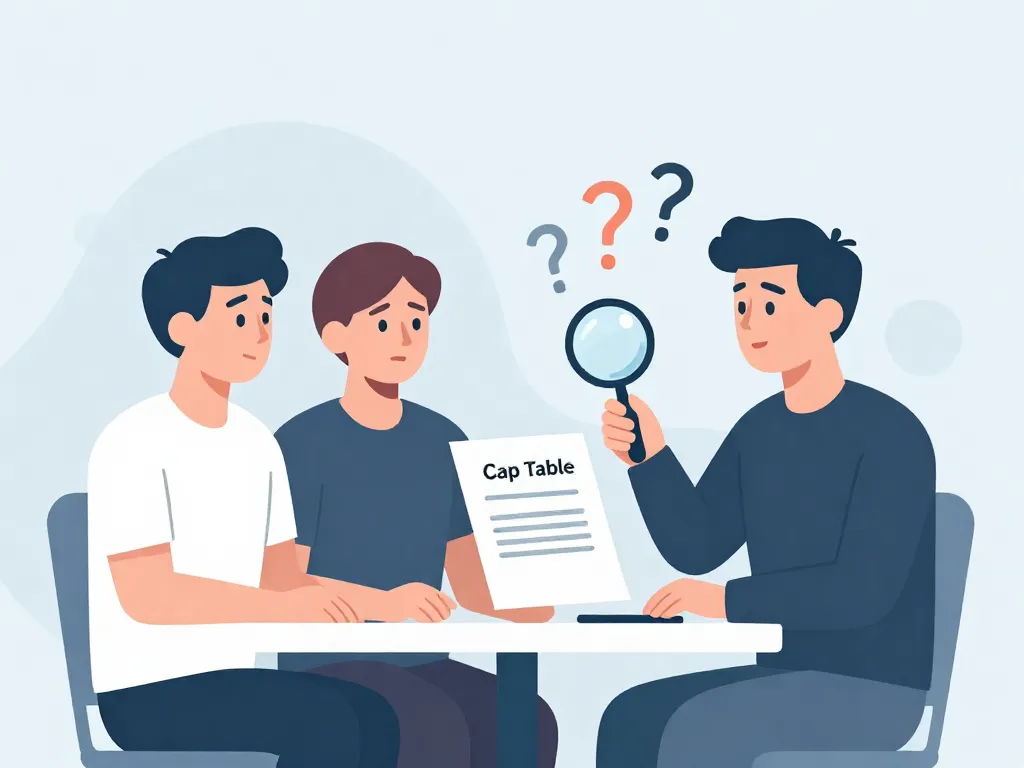
These moments can be useful — they force clarity. But they can also be destabilizing, especially if cofounders discover they have different assumptions about ownership.
Common Trigger Scenarios
- Seed round due diligence: Investors will scrutinize your cofounder agreement (or lack thereof). If they find vague terms or unsigned documents, it's a red flag that can delay or kill a deal.
- First key hire: Offering equity to an employee means deciding how much to dilute — and who gets diluted more. If cofounders haven't agreed on dilution mechanics, this becomes a proxy battle for deeper equity disputes.
- Advisor or accelerator agreements: These often require clean cap tables and clear ownership documentation.
What to Do
- Treat external pressure as a gift, not a threat. Use the investor's due diligence checklist or the advisor's questions as a framework for the internal conversation you've been avoiding.
- Clean up your cap table proactively. Tools like Carta or Pulley handle the mechanics, but the underlying agreements between cofounders need to be settled first.
- If an outside event reveals a fundamental disagreement about equity, address it head-on rather than papering over it with a quick compromise to satisfy the investor timeline.
Sign #5: You're Talking About "Fairness" More Than "Strategy"
Listen to the language in your cofounder conversations. Are you discussing market strategy, product decisions, and customer problems? Or has the conversation shifted to who deserves what, who's contributing more, and what's "fair"?
When equity disputes start to take shape, the vocabulary changes. Cofounders stop talking about building the company and start talking about dividing it. This is a critical inflection point.
What This Sounds Like
- "I was the one who came up with the original idea."
- "I've been putting in more hours than anyone."
- "If it weren't for my network, we never would have gotten that intro."
- "We need to talk about what's fair."
None of these statements are unreasonable in isolation. But when they become recurring themes, they indicate that the cofounder relationship has shifted from collaborative to transactional. And transactional cofounder dynamics rarely produce great companies.
What to Do
- Acknowledge the shift directly. Say: "I've noticed we've been spending a lot of energy on who deserves what. That worries me. Can we figure out a structure that lets us both get back to building?"
- Revisit your cofounder agreement with specific, measurable terms. Replace vague notions of "fairness" with concrete criteria: Who makes final decisions in which domain? What triggers equity reallocation? What happens if one person leaves?
- Consider whether the relationship is recoverable. Not every cofounder partnership should be saved. Sometimes an honest, well-structured separation is better for both parties — and for the company — than a slow deterioration.
How to Protect Your Startup from Equity Disputes
If you've recognized one or more of these signs, here's a practical roadmap:
- Acknowledge the issue internally. You don't need to have a solution before starting the conversation.
- Formalize your cofounder agreement. Include equity splits, vesting schedules, roles, decision-making authority, IP assignment, and exit/departure terms.
- Add a dispute resolution clause. Specify how disagreements will be handled — mediation before litigation, for example.
- Schedule recurring check-ins. Quarterly reviews of roles, equity, and satisfaction prevent slow-burn resentment.
- Get outside help before you need it. Advisors, lawyers, mediators, or structured resolution tools are exponentially more useful before positions have hardened.
Frequently Asked Questions
How do cofounders typically split equity in a startup?
There's no universal formula. Common approaches include equal splits, contribution-based splits, and dynamic models like Slicing Pie that adjust over time. The split itself matters less than whether it's documented, vested, and agreed upon by all parties in writing. A "fair" split with no documentation is more dangerous than an imperfect split with a signed agreement.
Can you change a startup equity split after the company is formed?
Yes, equity can be restructured at any point if all parties agree — though it gets more complex once investors or employees hold shares. The key is to address adjustments early, before resentment builds. A restructuring conversation at month six is far easier than one at year three when valuations and emotions are both higher.
What should be included in a cofounder agreement?
At minimum: equity allocation, vesting schedule (including cliff), roles and responsibilities, decision-making authority, IP assignment, what happens if a cofounder leaves or is removed, and a dispute resolution mechanism. Think of it as a prenup for your business — not a sign of mistrust, but a plan for handling hard situations with clarity.
When should cofounders get a lawyer involved in equity disputes?
Ideally, a startup lawyer reviews your cofounder agreement before any dispute arises. If a conflict has already surfaced, legal counsel becomes important when the disagreement involves potential breach of contract, fiduciary duties, or company-threatening decisions. Earlier is almost always cheaper and less destructive than later.
What happens to equity if a cofounder leaves the startup?
This depends entirely on your agreement. With a standard four-year vesting schedule and one-year cliff, a cofounder who leaves before the cliff forfeits all equity. After the cliff, they keep whatever has vested. Without a vesting schedule, a departing cofounder could walk away with their full original allocation — even if they contributed for only a few months.
Moving Forward
Equity disputes don't start with lawsuits. They start with a missed conversation, an undocumented handshake, and the slow realization that two people have different versions of the same agreement.
The five signs in this article aren't predictions of failure — they're opportunities for correction. Every one of them becomes manageable when cofounders are willing to formalize what they've agreed to, revisit those agreements as circumstances change, and address discomfort before it calcifies into conflict.
Your startup is likely doing a hundred things right. Make sure your cofounder relationship — the foundation everything else rests on — is one of them. The conversation you're avoiding today is almost certainly easier than the one you'll be forced to have six months from now.