Feeling Ignored by Your Partner? Here's What to Do
You're sitting on the couch, mid-sentence about something that happened at work — something that actually mattered to you — and you glance over. Your partner is scrolling their phone. They haven't looked up in two minutes. You stop talking. They don't notice.
It's not dramatic. Nobody slammed a door. Nobody yelled. But something inside you quietly deflates.
Feeling ignored by your partner is one of the most common — and most corrosive — experiences in a relationship. Research consistently places attention and emotional availability among the top three issues couples fight about, right alongside money and household responsibilities. Yet it rarely gets addressed directly, because the partner who feels neglected often worries they'll sound "needy," and the partner who's distracted often has no idea anything is wrong.

Why Feeling Ignored Hurts So Much (It's Not "Neediness")
Wanting your partner's attention is not being needy. It's being human.
Attachment theory — one of the most well-researched frameworks in relationship science — tells us that adults, like children, have a hardwired need for a reliable emotional connection with the people closest to them. When that connection feels threatened — when bids for attention go unanswered, when conversations feel one-sided, when physical closeness evaporates — our nervous system registers it as a form of danger.
That's why being ignored doesn't feel like a minor annoyance. It feels like rejection. Sometimes it feels like abandonment. When it happens repeatedly, it can trigger a cascade of responses:
- Protest behaviors: You get louder, more critical, or pick fights about unrelated things — anything to force engagement.
- Withdrawal: You go quiet, pull away emotionally, and start building walls you'll later have trouble tearing down.
- Hyper-vigilance: You start monitoring your partner's behavior — Are they on their phone again? Did they just walk past me without saying anything? — turning normal moments into evidence of neglect.
These responses are predictable reactions to an unmet attachment need. The problem is that, without awareness, they tend to make the disconnection worse.
What's Usually Happening on the Other Side
The partner doing the ignoring usually isn't doing it on purpose.
Consider a couple we'll call Marco and Priya. Priya started feeling invisible about six months into Marco's new role at work. He came home distracted. He responded to her questions with one-word answers. On weekends, he was physically present but mentally elsewhere.
Priya's interpretation: He doesn't care about me anymore.
Marco's reality: I'm drowning at work, and when I finally get home, I'm so depleted that I don't have anything left. I love Priya — I just don't have the bandwidth right now.
Both things are true. Priya's pain is valid. Marco's exhaustion is real. And yet, without a shared understanding of what's happening, these two truths collide and produce resentment on both sides.
Common reasons a partner may seem emotionally unavailable:
- Work stress or burnout that consumes their mental energy
- Different attachment styles (one partner needs more verbal reassurance; the other shows love through acts of service and doesn't realize words are missing)
- Unaddressed mental health struggles like depression or anxiety
- Digital distraction — not malicious, just habitual
- A misunderstanding of what their partner actually needs (they assume everything is fine because nobody said otherwise)
None of these reasons include "they don't love you." That possibility exists, but it's far less common than the scenarios above.

How to Talk About Feeling Ignored — Without Starting a Fight
Most couples go wrong here. The neglected partner finally reaches a breaking point and says:
"You never pay attention to me. You're always on your phone. You clearly don't care."
That sentence contains three relationship landmines: "never," "always," and a mind-read ("you clearly don't care"). The other partner's defenses go up instantly, and you're in a fight about fighting instead of a conversation about connection.
Here's a better framework.
Step 1: Name the Feeling, Not the Accusation
Start with what's happening inside you, not what your partner is doing wrong.
- Instead of: "You ignore me every evening."
- Try: "I've been feeling disconnected from you lately, and it's starting to weigh on me."
The first version puts your partner on trial. The second invites them into your experience.
Step 2: Give a Specific, Recent Example
Vague complaints are easy to dismiss. Concrete examples are harder to argue with — and easier to act on.
- "Last Tuesday, I was telling you about the issue with my sister, and I noticed you were scrolling your phone. I stopped talking and you didn't look up. That really stung."
You're describing a moment, not making a character judgment. That's something they can work with.
Step 3: Say What You Need (Don't Make Them Guess)
Many people assume their partner should "just know" what they need. Be explicit:
- "I need 15 minutes when you get home where we actually talk — phones down, eye contact. That would make a huge difference for me."
- "It would mean a lot if you asked me about my day and actually listened to the answer."
- "I don't need hours. I need moments where I feel like I'm the thing you're paying attention to."
Step 4: Ask About Their Experience
After you've shared your side, open the floor:
- "I'm not trying to pile on. I want to understand what's going on for you, too. Are you feeling overwhelmed? Is there something I'm missing?"
This transforms a complaint into a collaboration.
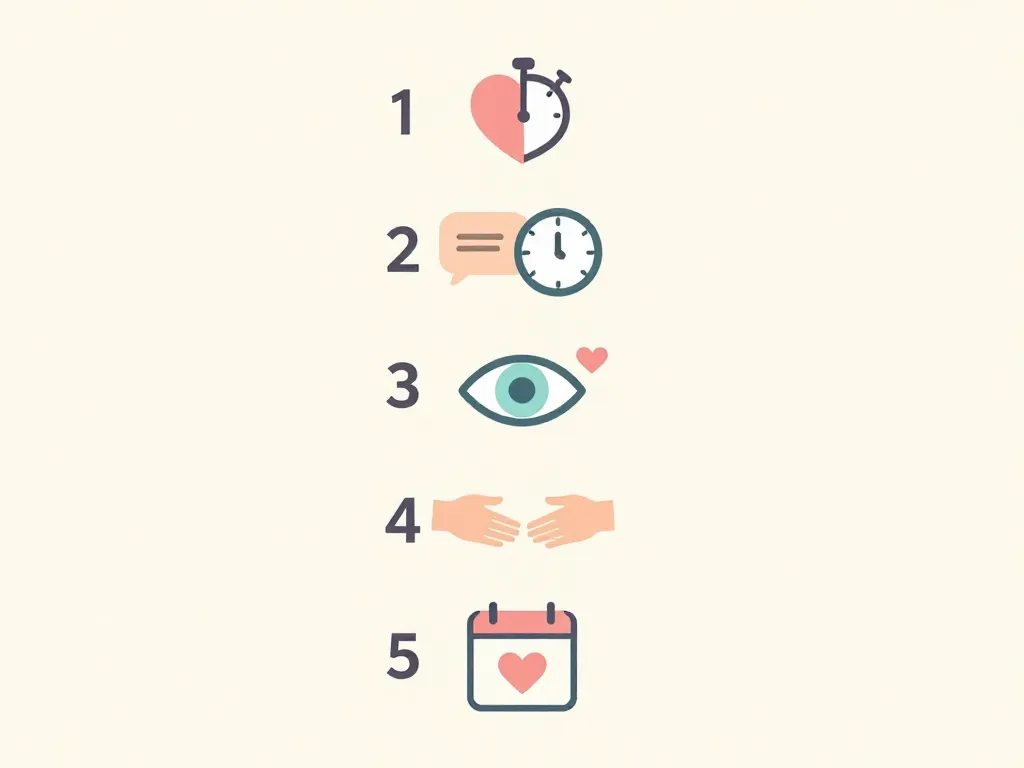
5 Daily Rituals That Rebuild Attention and Connection
Talking about the problem is necessary. What actually rewires the dynamic is consistent, small, daily behavior.
1. The 6-Second Kiss
Relationship researcher John Gottman calls this "a kiss with potential." It's long enough to be deliberate — long enough that you can't do it on autopilot. Make it a non-negotiable part of your morning, your evening, or both.
2. The 10-Minute Check-In
Set a recurring time — after dinner, before bed, during a shared coffee — and spend 10 uninterrupted minutes asking each other one question: "What's on your mind today?" No phones. No multitasking. No problem-solving unless asked. Just listening.
3. The "I Noticed" Practice
Once a day, tell your partner something you noticed about them:
- "I noticed you were really patient with the kids today."
- "I noticed you seemed stressed after that call — are you okay?"
- "I noticed you wore the shirt I like."
Noticing is the antidote to ignoring. It communicates: I see you. You register with me.
4. Bid Tracking
Gottman's research on "bids for connection" is one of the most practical findings in relationship science. A bid is any attempt to get your partner's attention — a comment, a sigh, a touch, a joke, a question. Happy couples turn toward those bids about 86% of the time. Struggling couples do so around 33%.
When your partner says, "Oh wow, look at this" while reading an article — turn toward them. Look. Respond. It takes three seconds and deposits something real into your emotional bank account.
5. A Weekly "State of Us" Conversation
This is a 20–30 minute weekly check-in focused on the relationship itself. Questions to rotate through:
- What went well between us this week?
- Was there a moment you felt disconnected?
- Is there anything you've been wanting to say but haven't?
- What's one thing I could do next week that would make you feel more loved?
Consider formalizing agreements that come out of these conversations with a tool like Servanda, which helps couples turn spoken commitments into written, trackable agreements — so the insights don't evaporate by Monday.
When the Problem Is Bigger Than Daily Rituals
Sometimes the disconnection runs deeper than distraction. Be honest with yourself about whether any of these apply:
- You've brought this up multiple times and nothing changes. A partner who hears your pain and consistently does nothing about it is communicating something — even if they're not saying it out loud.
- The ignoring feels deliberate. Stonewalling — the intentional refusal to engage — is different from distraction. It's one of Gottman's "Four Horsemen" that predict relationship breakdown.
- You've stopped caring whether they notice. If you've moved from pain to numbness, that's not healing. That's detachment. It's often a sign you've been unheard for too long.
- There's contempt in the room. Eye-rolling, sarcasm, dismissiveness — these signal that the relationship has moved past neglect into something more damaging.
In these cases, couples therapy with a trained attachment-focused therapist is a smart, early intervention. The sooner you go, the more there is to work with.
What If You're the One Who's Been Ignoring?
If you're reading this and realizing that you might be the distracted partner, that awareness is significant. A few things to sit with:
- Your partner's need for attention is not an attack on your freedom. It's an expression of trust — they're telling you that your presence matters to them.
- Being overwhelmed is real, but it's not a permanent excuse. If work or stress is eating your capacity, that's something to address — not something to let quietly erode your relationship.
- Small gestures carry disproportionate weight. You don't have to overhaul your entire personality. You have to look up from your phone. You have to ask one real question. You have to touch their shoulder when you walk past. These are small acts that say: I'm here. I choose you. You're not invisible.
Conclusion
Feeling ignored by your partner is not a trivial complaint, and wanting attention is not a weakness. It's a core human need — one that, when met, makes everything else in a relationship easier, and when unmet, makes everything harder.
The path forward is about small, consistent shifts: naming what you feel without blame, asking for what you need without apology, and building rituals that keep you turning toward each other instead of away.
You don't need a perfect relationship. You need one where both people are willing to notice — and to keep noticing — even when life gets loud. That willingness, practiced daily, is what turns a relationship from two people sharing a space into two people sharing a life.
Frequently Asked Questions
Is it normal to feel ignored by your partner?
Yes, it's one of the most common experiences in relationships, ranking alongside conflicts about money and household responsibilities. Feeling ignored activates your attachment system, which is hardwired to seek reliable emotional connection, so the pain you feel is a natural neurological response — not a sign of neediness.
How do I tell my partner I feel ignored without starting a fight?
Start by naming your own feeling ("I've been feeling disconnected") rather than making an accusation, then give one specific, recent example instead of using words like "always" or "never." Follow up by stating exactly what you need — such as 10 minutes of undistracted conversation — and then ask about their experience so the conversation becomes collaborative rather than adversarial.
Why does my partner ignore me even though they say they love me?
In most cases, a partner who seems emotionally unavailable isn't doing it on purpose — common causes include work stress, burnout, different attachment styles, habitual phone use, or simply not realizing anything is wrong. Their love can be genuine while their capacity for attentiveness is temporarily depleted, which is why explicitly communicating your needs is so important.
What are bids for connection and why do they matter?
Bids for connection are any small attempt to get your partner's attention — a comment, a question, a joke, a touch, even a sigh. Research by John Gottman found that happy couples respond positively to these bids about 86% of the time, while struggling couples do so only about 33%, making bid responsiveness one of the strongest predictors of relationship health.
When should we see a couples therapist about feeling disconnected?
Consider professional help if you've raised the issue multiple times with no meaningful change, if the ignoring feels intentional (stonewalling), or if you've shifted from feeling hurt to feeling numb or detached. Early intervention with an attachment-focused therapist gives you the most to work with and can prevent the disconnection from becoming entrenched.