Fighting Over Chores? Fix the Housework Divide
It starts with a sink full of dishes. You've asked three times. Your partner walks past them—again—grabs a snack, and settles onto the couch. Something hot rises in your chest, but it isn't really about the dishes. It's the feeling that you're invisible. That your effort doesn't count. That you're the only one holding this household together.
Meanwhile, your partner genuinely didn't notice the sink. Or they did, but they were planning to get to it after the show. Now they're blindsided by your frustration and feel like nothing they do is ever enough.
Sound familiar? You're not alone. Research consistently ranks the housework divide as one of the top sources of recurring conflict in relationships. A 2023 Pew Research study found that sharing household chores is considered essential to a successful marriage by 63% of adults. Yet most couples report that the split is anything but equal—and the resentment it breeds can quietly erode even the strongest partnerships.
This article isn't about making a better chore chart. It's about understanding what's actually fueling the fight—and fixing it at the root.
Key Takeaways
- Chore fights are rarely about tasks—they're about feeling valued, respected, and seen by your partner.
- The "mental load" (planning, tracking, remembering) is invisible labor that often falls on one partner and causes deep resentment.
- Fairness doesn't mean a 50/50 split of every task—it means both partners feel the arrangement is equitable and intentional.
- Regular, low-stakes "household check-ins" prevent resentment from building into explosive arguments.
- Written agreements about responsibilities reduce ambiguity and the exhausting cycle of asking and nagging.

Why the Housework Divide Isn't Really About Housework
If chore conflicts were truly about dishes or laundry, they'd be easy to solve. Buy paper plates. Hire a cleaner. Problem gone.
But couples who can afford help still fight about chores. That's because the real conflict runs deeper. At its core, fighting over chores is about three emotional needs:
1. The Need to Feel Valued
When one partner consistently handles more domestic labor, they start to feel like their contribution is invisible—or worse, expected without acknowledgment. Over time, "I do everything around here" isn't a statement about mopping floors. It's a cry that says, "Do you see how much I give to this relationship?"
2. The Need to Feel Respected
The partner who does less (or does it differently) often feels like they can't win. They empty the dishwasher and get told they put the mugs in the wrong cabinet. They mow the lawn but it "doesn't count" because it's not a daily task. Underneath their defensiveness is a need to hear: "Your effort matters too."
3. The Need to Feel Like a Team
Nothing destroys the sense of partnership faster than feeling like you're the project manager of your own home. When one person is always delegating and the other is always being told what to do, you stop feeling like partners and start feeling like a boss and a reluctant employee.
Until you address these emotional layers, no chore chart in the world will fix the problem.
The Mental Load: The Invisible Half of Housework
You've probably heard the term "mental load" by now—but it bears repeating because it's at the heart of most housework conflicts.
The mental load is the cognitive labor of running a household: remembering that the dog needs a vet appointment, noticing the toilet paper is low before it runs out, keeping track of whose turn it is to pick up the kids, planning meals for the week, knowing that the in-laws' anniversary is Thursday.
This work is invisible. It doesn't leave a clean countertop or a folded pile of shirts as evidence. And in heterosexual relationships, studies consistently show it falls disproportionately on women—even when both partners work full-time.
Here's what makes the mental load so corrosive: the person carrying it feels like a manager, not a partner. And the person who isn't carrying it often doesn't realize it exists.
Consider this example:
Priya and James both work demanding jobs. James does the grocery shopping every week—a task he's proud of handling. But Priya is the one who plans the meals, checks what's in the fridge, writes the grocery list, and reminds James to go before the store closes. By the time James picks up the bags, Priya has already done 80% of the cognitive work. When James says, "I do the groceries!" Priya feels unheard. When Priya says, "You only do what I tell you to do," James feels unappreciated.
Both are right. Both are hurt. And neither will feel better until they can name what's actually happening.

How to Actually Fix the Housework Divide
Here's where we move from understanding the problem to doing something about it. These aren't abstract principles—they're concrete steps you can start today.
Step 1: Make the Invisible Visible
Before you can divide labor fairly, you need to see all of it. Sit down together and create a complete inventory of everything it takes to run your household. This includes:
- Daily tasks: Cooking, dishes, tidying, pet care, childcare routines
- Weekly tasks: Laundry, grocery shopping, vacuuming, bathroom cleaning
- Monthly/seasonal tasks: Bill paying, yard work, car maintenance, deep cleaning
- Mental load tasks: Meal planning, scheduling appointments, remembering birthdays, researching schools, tracking subscriptions, restocking supplies
Write every single thing down. The list will be longer than either of you expects—and that revelation alone can shift the conversation.
Pro tip: Don't do this during a fight. Pick a calm Saturday morning with coffee. Frame it as a team project, not an interrogation.
Step 2: Acknowledge the Current Reality Without Blame
Once you see the full list, note who currently handles each task. Don't keep score to "win"—do it to understand.
This is where defensiveness tends to creep in. The partner who does less may feel attacked. The partner who does more may feel vindicated and want to say, "See?!"
Resist both impulses. Instead, try language like:
- "I didn't realize how much of the planning falls on you. That sounds exhausting."
- "I can see that I've been doing more of the physical tasks and you've been carrying more of the mental ones. Both are draining."
- "I don't want either of us to feel like we're doing this alone."
Step 3: Negotiate Based on Preference, Capacity, and Fairness—Not Equality
Fairness and equality are not the same thing. A 50/50 split of every task sounds ideal, but it ignores reality. One partner might work longer hours. One might genuinely enjoy cooking but loathe yard work. One might be going through a stressful season at work.
Instead of splitting tasks down the middle, negotiate based on:
- Preference: "I actually don't mind folding laundry. I'll take that."
- Skill: "You're faster at cooking, I'm better at managing the budget."
- Capacity: "This month is brutal at work—can you take on more, and I'll rebalance next month?"
- Autonomy: "If I own the grocery shopping, I own it completely—list, trip, and putting things away. No reminders needed."
That last point is critical. True ownership means your partner shouldn't have to manage you through the task. If they still have to remind, check, and follow up, you haven't actually taken it off their plate.
Step 4: Build in a Regular Household Check-In
Resentment doesn't explode overnight. It builds in tiny increments—one forgotten chore, one unacknowledged effort, one "I'll do it later" that never happens. By the time you blow up over a dirty pan, you're actually angry about six weeks of accumulated slights.
The antidote is a short, regular check-in. Here's a format that works:
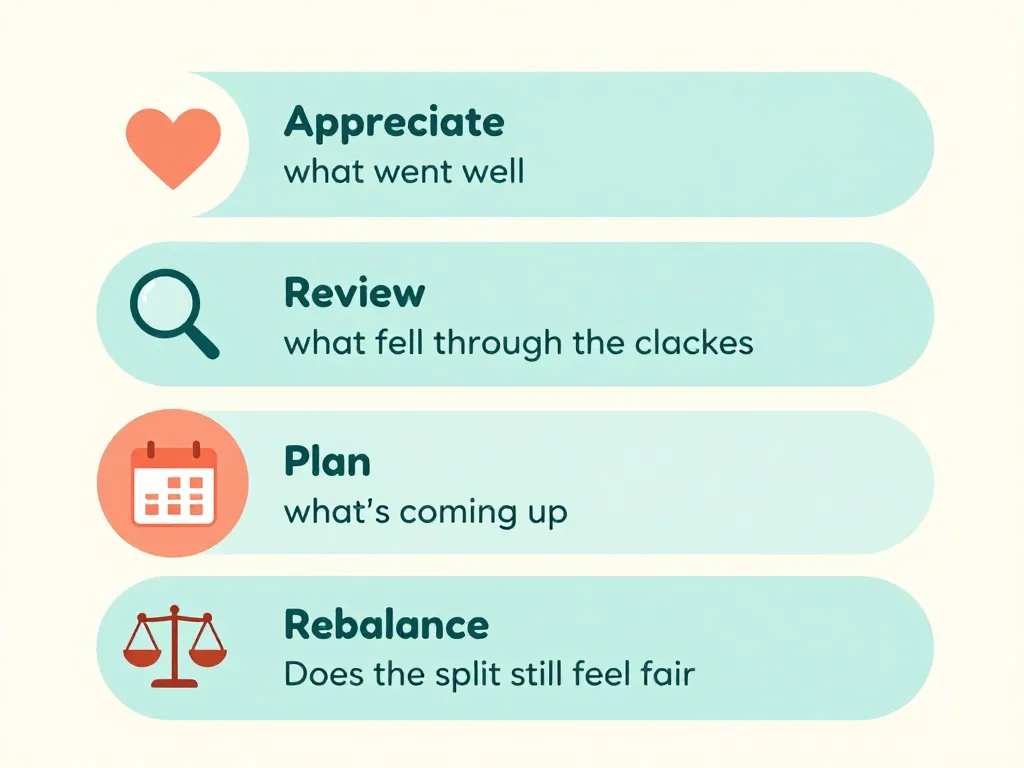
Weekly Household Sync (15 minutes, same day each week)
- What went well this week? Start with genuine appreciation. "Thanks for handling dinner three nights this week. I noticed, and it helped."
- What fell through the cracks? Name tasks that didn't get done—without blaming. "The recycling piled up. How do we want to handle that this week?"
- What's coming up? Look ahead. "Your mom's visiting Friday—should we split the prep?"
- Does the current split still feel fair? Check in on the emotional side. Not just "are tasks getting done" but "are we both okay with this?"
This check-in replaces the draining cycle of one partner nagging and the other withdrawing. It creates a predictable, low-pressure space to course-correct before resentment takes root.
This might sound overly formal for a romantic relationship, but hear me out: ambiguity is the enemy of follow-through.
When agreements live only as vague verbal understandings ("I thought you said you'd do the bathrooms"), it's easy to misremember, reinterpret, or conveniently forget. Writing things down—even in a shared note on your phones—creates clarity and accountability without the need for one partner to play enforcer.
Tools like Servanda can help couples create written agreements about household responsibilities, giving both partners a clear reference point and reducing the exhausting "I thought you were going to..." cycle.
Your agreement doesn't have to be a legal document. It can be as simple as:
- Monday–Friday dinners: Partner A cooks, Partner B cleans up
- Groceries: Partner B owns the full cycle (planning, shopping, putting away)
- Laundry: Each person handles their own; shared linens alternate weekly
- Mental load items: Shared calendar for appointments; whoever schedules it adds it immediately
The point isn't rigidity. It's that both people can look at the same page and know what "fair" looks like in your household.
Common Traps That Keep Couples Stuck
Even with the best intentions, couples fall into patterns that sabotage progress. Watch out for these:
The "Just Ask" Trap
"If you want help, just ask me!" sounds reasonable—but it keeps the mental load squarely on one partner's shoulders. Asking is managing. The goal is for both partners to notice, remember, and initiate without being prompted.
The Scorekeeper Trap
Keeping a running tally of who did what quickly turns a partnership into a competition. If you catch yourself thinking, "I cleaned the kitchen FOUR times this week and you only did it once," pause. The feeling underneath that scorekeeping—exhaustion, being taken for granted—is valid. The scorekeeping itself will only escalate the conflict.
The "Different Standards" Trap
"I would have cleaned it, but it wasn't dirty yet." Different cleanliness thresholds are real, and they're not a character flaw on either side. The solution isn't to force one partner's standards on the other—it's to agree on a shared baseline you can both live with.
The Weaponized Incompetence Trap
Doing a task badly so you won't be asked again is not a strategy—it's a betrayal of trust. If your partner does this, name it directly and calmly: "When the dishes are put away dirty, it feels like you're trying to get out of doing them. Is that what's happening, or do we need to talk about a different approach?"
What If You've Tried Everything and It's Still Not Working?
Sometimes the housework divide is a symptom of a deeper dynamic: a fundamental imbalance in how much each partner invests in the relationship. If you've had honest conversations, created fair systems, and your partner still consistently refuses to participate, the issue isn't about chores anymore. It's about respect.
In these cases, consider:
- Couples counseling: A therapist can help uncover the dynamics that a chore chart can't fix.
- Individual reflection: Ask yourself what this pattern tells you about how your partner values your time, energy, and wellbeing.
- Setting boundaries: "I'm not willing to be the sole manager of this household. I need us to find a way to share this, or we need to talk about what that means for us."
This isn't about ultimatums. It's about honoring the fact that you deserve a partner, not a dependent.
Frequently Asked Questions
How do you split chores fairly when one partner works more hours?
Fair doesn't mean equal. If one partner works significantly longer hours, it makes sense for the other to take on more household tasks—but the working partner should still contribute, especially on days off. The key is that both people feel the arrangement was chosen together, not assumed by default.
Why does my partner not notice messes the way I do?
Different people genuinely have different thresholds for noticing clutter or dirt. This isn't laziness or passive aggression—it's a real perceptual difference. Rather than waiting for your partner to "just see it," agree on specific standards together (e.g., "the kitchen gets wiped down every night after dinner") so both people know what "done" looks like.
Is it normal to fight about housework this much?
Yes—it's one of the most common recurring arguments couples have. But "normal" doesn't mean it should be ignored. Frequent fights about chores usually signal that one or both partners feel undervalued. Addressing the emotional root, not just the task list, is what breaks the cycle.
How do I bring up the housework divide without starting a fight?
Timing and framing matter. Don't bring it up in the moment you're frustrated (e.g., while scrubbing the stove). Choose a calm time and lead with your feeling, not an accusation: "I've been feeling overwhelmed by how much I'm tracking at home, and I'd love for us to figure out a better system together" lands very differently than "You never help around here."
Should couples use a chore chart or app?
Chore charts and apps can be helpful as tools—but they're not solutions on their own. If the underlying emotional dynamics aren't addressed, a chore chart just becomes another thing one partner manages and the other ignores. Use them to support agreements you've already made together, not as a substitute for the actual conversation.
Moving Forward Together
The housework divide is one of those conflicts that seems small on the surface but touches something deep: your sense of being valued, respected, and truly partnered with the person you love.
The good news is that this is fixable—not with a perfect chore chart, but with honest conversation, genuine curiosity about each other's experience, and a willingness to build systems that reflect your shared life instead of one person's silent sacrifice.
Start with one step this week. Make the invisible visible. Acknowledge what your partner does. Ask what fairness looks like for both of you. And build a rhythm of checking in before resentment gets the last word.
You chose each other. Now choose to be a team in every room of the house—not just the easy ones.