
High-Conflict Co-Parenting Communication Tips
Key Takeaways
- Use the BIFF method (Brief, Informative, Friendly, Firm) to respond to hostile messages without escalating conflict.
- Shift to parallel parenting when cooperative co-parenting isn't possible — reduce direct contact and let each parent manage their own household independently.
- Treat co-parenting communication like a business relationship: stick to logistics, use written channels, and remove emotional language from every exchange.
- Set and enforce hard boundaries around communication timing, channels, and acceptable topics to protect both yourself and your children.
- Document everything — written communication isn't just practical, it's protective.
Introduction
It's 9:47 p.m. on a Tuesday. You open a text from your co-parent about this weekend's pickup time, and somehow, within three messages, you're relitigating a fight from 2019. Your chest tightens. You start typing a response you'll regret. Your kid is asleep in the next room, and you know — on some level you absolutely know — that none of this is about Saturday's schedule.
If this sounds familiar, you're not alone. Millions of co-parents navigate relationships where even routine logistics spiral into full-blown conflict. The standard advice — "just communicate better" — feels almost insulting when you're dealing with a co-parent who baits, blames, or bulldozes every conversation.
This article isn't about that generic advice. These are high-conflict co-parenting communication tips built for volatile dynamics: specific frameworks, scripted responses, and structural changes that help you stop the cycle without requiring your co-parent to change at all.

Why Standard Co-Parenting Advice Fails in High-Conflict Situations
Most co-parenting guidance assumes two reasonable adults who simply need better tools to collaborate. It assumes good faith on both sides. In high-conflict dynamics, that assumption falls apart.
High-conflict co-parenting often involves one or more of these patterns:
- Chronic boundary violations — ignoring agreed-upon schedules, overstepping parenting decisions, or contacting your children to undermine your authority.
- Emotional provocation — using guilt, blame, insults, or past grievances to pull you into arguments.
- Weaponizing communication — sending excessive messages, making demands disguised as questions, or creating crises that require immediate responses.
- Refusal to follow agreements — changing plans unilaterally, then painting you as the difficult one for objecting.
If you're dealing with any of these, cooperative co-parenting frameworks will leave you frustrated and depleted. What you need instead is a containment strategy — a system that limits opportunities for conflict while still meeting your children's needs.
The BIFF Response Method: Your First Line of Defense
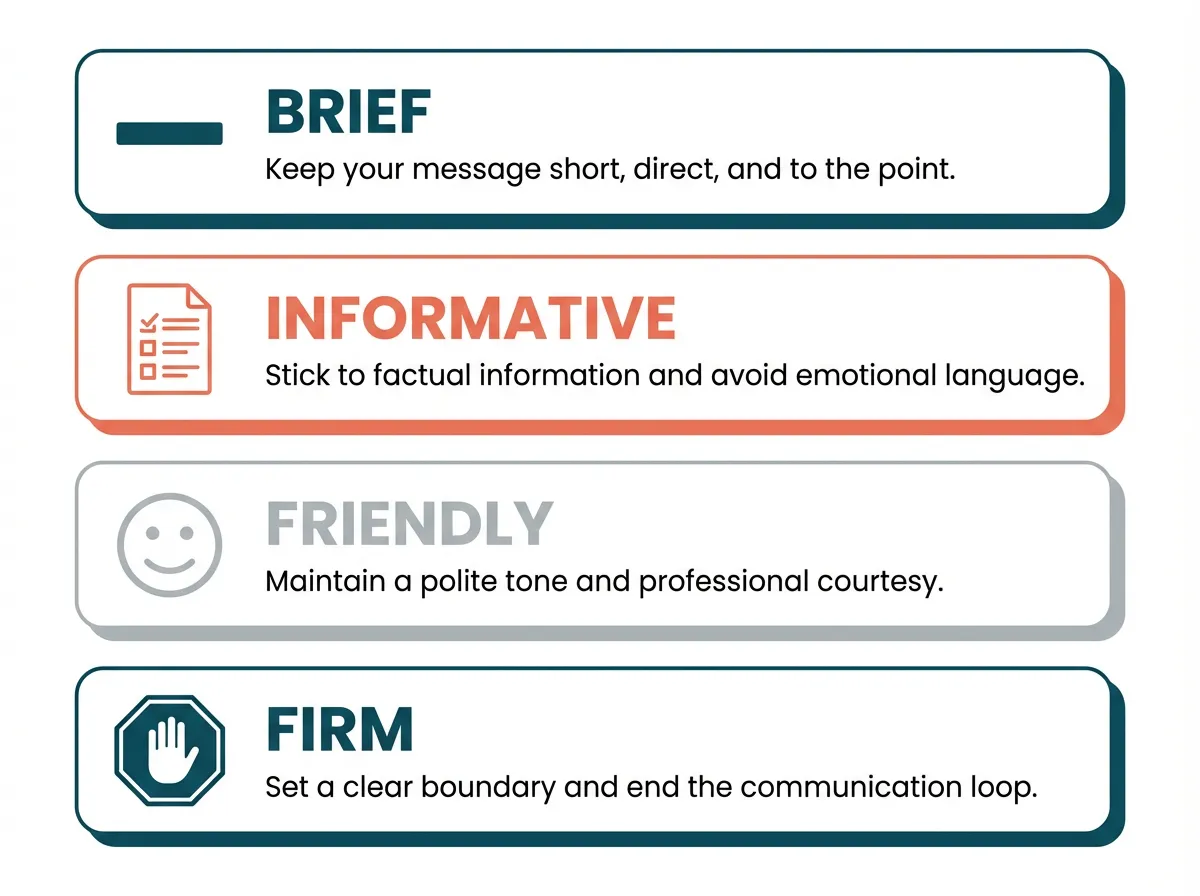
Developed by attorney and mediator Bill Eddy, the BIFF response method is one of the most effective tools for high-conflict co-parenting communication. BIFF stands for:
Brief
Keep your response short. High-conflict personalities thrive on lengthy exchanges because more words mean more material to distort, argue with, or weaponize. A two-sentence response gives them almost nothing to work with.
Informative
Stick to factual, objective information. No opinions, no interpretations of their behavior, no emotional language. Share only what they need to know.
Friendly
This doesn't mean warm or affectionate. It means neutral and non-hostile. A simple "Thanks for letting me know" at the beginning of a message qualifies. The goal is to deny them a reason to claim you're being aggressive or uncooperative.
Firm
End the conversation. Don't ask open-ended questions. Don't leave the door open for debate. State what needs to be stated and stop.
BIFF in Practice
The incoming message:
"You ALWAYS do this. You didn't pack Mia's jacket AGAIN and now she's sick. You clearly don't care about her health. I'm keeping her home this weekend since you can't be bothered to take care of her properly."
A non-BIFF response (what most of us want to type):
"Are you serious right now? She had a runny nose when she LEFT your house. Maybe if you didn't keep the heat at 60 degrees she wouldn't be cold. And you don't get to just cancel my weekend. I'll see you at 5 on Friday like the schedule says."
A BIFF response:
"I'm sorry to hear Mia isn't feeling well. I'll make sure to pack an extra jacket on Friday. Per our custody agreement, pickup is at 5 p.m. Please let me know if she needs any specific medication brought along."
Notice what happens here. The BIFF response acknowledges the concern (friendly), provides practical information (informative), stays short (brief), and doesn't invite further debate (firm). The accusation about not caring? Ignored entirely. The threat to withhold the child? Addressed by calmly restating the agreement without engaging in the power struggle.
Parallel Parenting: When Co-Parenting Isn't Safe or Possible
There's an important distinction that high-conflict co-parents need to hear: you do not have to co-parent cooperatively with someone who makes cooperation impossible.
Parallel parenting is a structured approach designed specifically for high-conflict situations. Unlike cooperative co-parenting — which involves shared decision-making, flexibility, and frequent communication — parallel parenting minimizes direct contact between parents while keeping both engaged with their children.
Core Principles of Parallel Parenting
-
Each parent governs their own household. Bedtime at Dad's house is Dad's decision. Diet at Mom's house is Mom's decision. Unless there's a safety concern, you disengage from what happens during the other parent's time.
-
Communication is limited to essential logistics. Drop-off times, medical appointments, school events. That's it. No daily check-ins, no "how was your day with the kids" conversations.
-
Exchanges happen in neutral locations. School drop-off and pickup, a public parking lot, a police station lobby. Anywhere that removes the opportunity for face-to-face confrontation.
-
A detailed parenting plan replaces ongoing negotiation. The more specific your written agreement, the less you need to communicate. Spell out holidays, vacation weeks, transportation responsibilities, and decision-making authority in advance.
What Parallel Parenting Looks Like Day-to-Day
Consider the experience of two parents — let's call them James and Tanya. After their divorce, every phone call about their son's schedule turned into a screaming match. James would make last-minute changes; Tanya would respond with anger. Their eight-year-old started having anxiety before every transition.
With a parallel parenting framework:
- James and Tanya switched to communicating exclusively through a co-parenting app with a built-in message log.
- Their parenting plan specified every exchange time, location, and contingency (e.g., "If the receiving parent is more than 15 minutes late without notice, the exchange is forfeited").
- Neither parent commented on the other's household rules.
- Their son stopped being a messenger between two angry adults.
The conflict didn't disappear — James and Tanya still disagreed on plenty. But the structure removed the stage on which the conflict played out.
The Business-Model Communication Framework
One of the most powerful mental shifts in high-conflict co-parenting communication is to treat your co-parent like a business colleague you don't particularly like but must work with on one project: raising your children.
What This Means in Practice
- Use written communication only. Email or a co-parenting app. Not phone calls, not in-person conversations at the door, and definitely not text messages at 11 p.m.
- Maintain a professional tone. Write every message as if a judge will read it — because someday, a judge might.
- Stick to an agenda. Each message should have a clear purpose. If it doesn't require a logistical decision, it probably doesn't need to be sent.
- Set response windows. You are not obligated to respond immediately to non-emergency messages. Give yourself 24 hours. This isn't avoidance; it's strategic de-escalation.
Templates That Work
Here are message structures you can adapt:
Schedule change request:
"I'd like to request a schedule adjustment for [date]. Instead of [current plan], I'm proposing [new plan]. Please let me know by [reasonable deadline] whether this works for you. If I don't hear back, I'll proceed with the original schedule."
Medical update:
"[Child's name] was seen by Dr. [Name] on [date] for [reason]. The diagnosis is [X]. The treatment plan is [Y]. No action is needed on your end / I need you to [specific action] during your parenting time."
Responding to a provocation:
"I've received your message. Regarding the schedule, I'll have [child] ready at [time] on [date] as planned."
Notice the pattern: acknowledge, inform, close. No emotional content. No defensiveness. No counter-accusations.

Setting Boundaries That Actually Hold
Boundaries in high-conflict co-parenting aren't suggestions — they're infrastructure. Without them, every interaction is an open field where conflict can go anywhere.
Boundaries Worth Setting Immediately
- Communication channel: "All non-emergency communication will go through [app/email]. I will not respond to text messages about scheduling."
- Response time: "I will respond to non-urgent messages within 24 hours during business days."
- Topic limits: "I'm willing to discuss [child]'s schedule, health, and education. I will not engage in conversations about our past relationship or each other's personal lives."
- Disengagement protocol: "If a message contains insults or accusations, I will respond only to the logistical content and ignore the rest."
The Hardest Part: Enforcing Without Explaining
Here's where most co-parents struggle. When you set a boundary and your co-parent violates it, the instinct is to explain why you have the boundary, to justify it, to argue for its legitimacy. Don't.
Boundary enforcement is action, not conversation. If you said you won't respond to texts about scheduling, then don't respond to texts about scheduling. If your co-parent sends fifteen angry texts, you don't owe them a seventeenth text explaining your boundary. You simply respond to the logistical content via your designated channel, or you don't respond at all.
This will feel rude. It will feel uncomfortable. Your co-parent may escalate temporarily. But over time, boundaries that are consistently enforced teach the other person where the walls are — even if they never stop testing them.
Protecting Your Children in the Middle of It All
Every strategy in this article exists for one reason: to shield your children from the fallout of adult conflict. But frameworks and templates only go so far if your kids are still absorbing tension during exchanges or hearing frustration in your voice after a difficult message.
Practical Steps to Protect Your Kids
- Never use your child as a messenger. "Tell your dad he needs to pay for the field trip" puts your child in an impossible position. Send an email instead.
- Don't react to co-parent messages in front of your children. Read messages during time alone. If you need to vent, call a friend, a therapist, or a support group — not your kid.
- Keep transitions boring. The ideal custody exchange is so uneventful that your child barely notices it. No lingering conversations, no tense silences, no arguments in the driveway.
- Validate without badmouthing. If your child says, "Dad's house has different rules and it's confusing," you can say, "That sounds hard. Different houses sometimes have different rules, and that's okay." You don't need to criticize the other parent to acknowledge your child's feelings.
When to Bring In Outside Support
Sometimes, even the best communication frameworks aren't enough. If your co-parent consistently violates court orders, if you suspect abuse or neglect during their parenting time, or if the conflict level is so severe that your mental health is deteriorating, it's time to involve professionals.
- Family mediators can help negotiate parenting plan modifications in a structured environment.
- Parenting coordinators (appointed by the court in some jurisdictions) serve as a tie-breaker for disputes so parents don't have to resolve every disagreement themselves.
- AI-powered mediation platforms like Servanda can help you formalize agreements and build structured communication frameworks when sitting in the same room as your co-parent isn't realistic.
- Family law attorneys should be consulted whenever there's a pattern of agreement violations or escalating behavior.
Asking for help isn't a failure. It's a recognition that some situations require more structure than two people can build alone.
Frequently Asked Questions
How do you communicate with a co-parent who is constantly hostile?
Switch to written-only communication through email or a co-parenting app, and use the BIFF method for every response. Respond only to logistical content and ignore personal attacks entirely. Over time, this removes the reward of provocation and reduces the frequency of hostile messages.
What is parallel parenting and when should you use it?
Parallel parenting is a co-parenting arrangement where each parent operates independently during their parenting time, with minimal direct communication. It's appropriate when cooperative co-parenting leads to consistent conflict that harms the children. You can transition to more collaborative co-parenting later if the conflict level decreases.
Is it okay to not respond to my co-parent's messages?
You should respond to messages about your children's safety, health, and scheduling within a reasonable timeframe. However, you are not obligated to respond to personal attacks, rehashing of old arguments, or messages that don't contain actionable logistical content. Document everything in case it becomes relevant in court.
How do I stop my co-parent from badmouthing me to our kids?
You can't control what your co-parent says. What you can control is how you respond to your children. Avoid counter-badmouthing, validate your children's feelings without agreeing or disagreeing with what was said, and maintain a stable, loving environment during your time. In severe cases, a family therapist or parenting coordinator can address the issue formally.
Can a co-parenting app really reduce conflict?
Yes. Co-parenting apps create a documented record of all communication, which encourages more thoughtful messaging. Many apps also include tone-detection features, shared calendars, and expense tracking — all of which reduce ambiguity and the opportunities for disagreement. The structure alone makes a measurable difference.
Conclusion
High-conflict co-parenting communication doesn't improve because you find the magic words that finally make the other person reasonable. It improves because you change the system — the channels, the structures, the boundaries — so that conflict has fewer places to take root.
The BIFF method gives you a script when emotions are high. Parallel parenting gives you permission to disengage without guilt. The business-model framework redefines what communication even needs to look like. And firm boundaries protect you and your children from the chaos that unstructured contact invites.
None of this is easy. Some days you'll slip. You'll fire off a reactive text, or you'll engage with a provocation you should have ignored. That's human. What matters is the pattern over time — and the fact that you're building one that puts your kids first, even when your co-parent won't meet you halfway.