
High-Conflict Co-Parenting: 7 Strategies That Work
It's 9:47 PM on a Sunday. Your phone buzzes — again. Another text from your ex about next weekend's schedule, but this one has that familiar edge. The accusation buried inside a question. The rewriting of something you both agreed on last Tuesday. Your chest tightens. You start typing a response, delete it, type another one. You know that whatever you send will be screenshot, dissected, and thrown back at you. Meanwhile, your eight-year-old is sleeping down the hall, blissfully unaware that two people who love her more than anything can't get through a single week without an argument.
If this sounds familiar, you're navigating high-conflict co-parenting — and you're not alone. Research suggests that roughly 25–30% of divorced or separated parents experience ongoing, high-intensity conflict that persists well beyond the initial separation. The good news? You don't need your co-parent to change for things to get better. These seven strategies put you back in control.
Key Takeaways
- You can reduce conflict unilaterally. Most of these strategies work even if your co-parent refuses to cooperate.
- Parallel parenting — not co-parenting — is the gold standard for high-conflict situations. It minimizes direct contact while keeping both parents involved.
- Written, business-like communication eliminates most escalation triggers. Tools like co-parenting apps create accountability and reduce emotional reactivity.
- Your children's adjustment depends more on their exposure to conflict than on family structure. Shielding them from parental disputes is the single most protective thing you can do.
- Structure is your best friend. The more detailed your parenting plan, the fewer opportunities for disagreements.

1. Shift From Co-Parenting to Parallel Parenting
Traditional co-parenting advice assumes two reasonable adults who can collaborate, compromise, and communicate openly. In high-conflict situations, that assumption is the problem — not the solution.
Parallel parenting is a structured approach where each parent operates independently within their own household. You don't coordinate on day-to-day decisions. You don't debrief each other on the kids' moods. You follow the parenting plan, handle your own time your way, and keep direct interaction to an absolute minimum.
What parallel parenting looks like in practice:
- Each parent makes routine decisions (meals, bedtimes, homework routines) independently during their parenting time
- Communication is limited to logistics: schedule changes, medical updates, school events
- Exchanges happen in neutral public locations — or through school/daycare drop-off and pick-up to eliminate face-to-face contact entirely
- Major decisions (education, healthcare, religion) follow whatever your custody order specifies
This isn't about shutting your co-parent out. It's about accepting that collaboration requires a baseline level of mutual respect — and that forcing it when that baseline doesn't exist creates more harm than good, especially for your children.
Real-world example: After two years of arguments at every custody exchange, Marcus and Dana switched to "school bridge" transfers. Marcus drops the kids off at school Monday morning; Dana picks them up Monday afternoon. They haven't stood in the same parking lot in six months — and their daughter's teacher reports that her anxiety at school has noticeably improved.
2. Adopt the B.I.F.F. Communication Method
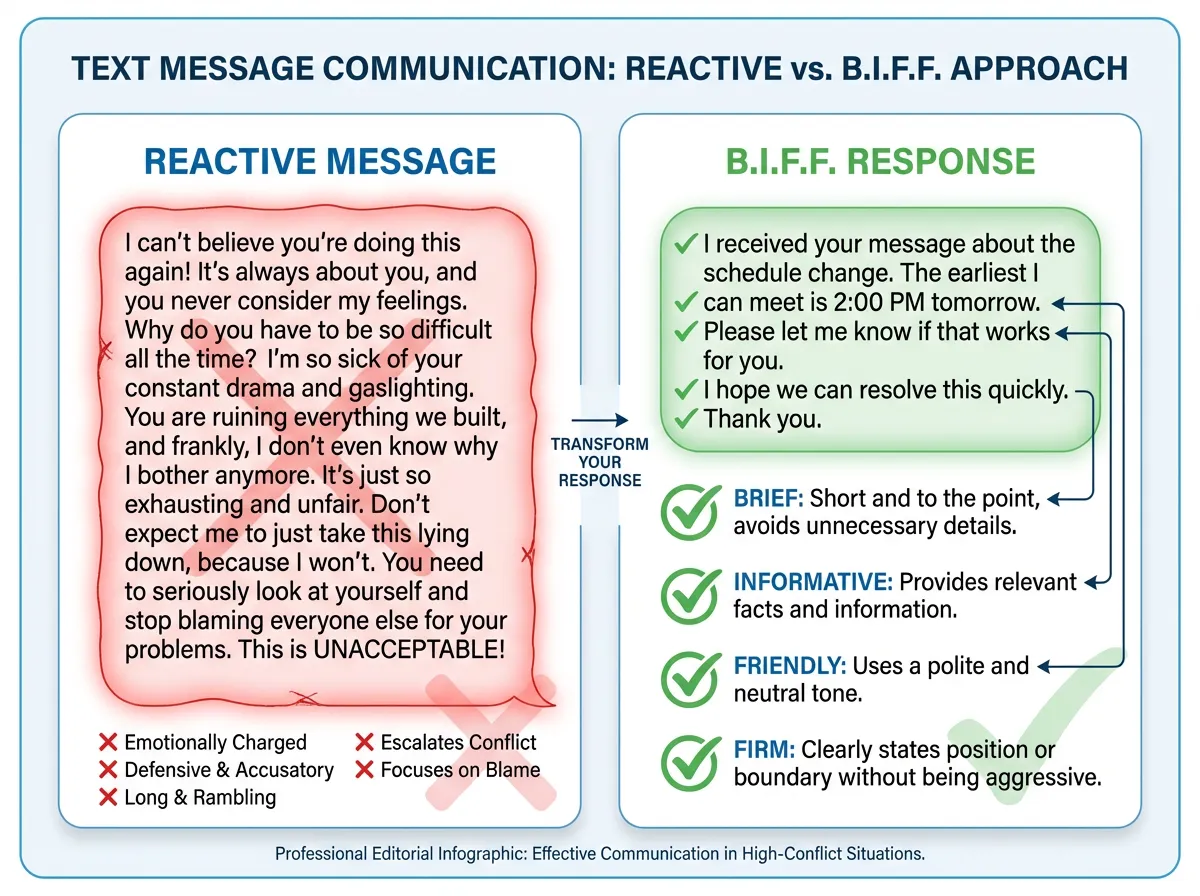
Bill Eddy, a therapist and attorney who specializes in high-conflict personalities, developed the B.I.F.F. framework for written communication. It's become a cornerstone strategy in high-conflict co-parenting, and for good reason: it works.
Every message you send should be:
- Brief — Two to five sentences. That's it. The longer the message, the more material for misinterpretation.
- Informative — Stick to facts and logistics. No opinions, no editorializing, no "I just think it's interesting that..."
- Friendly — Not warm. Not affectionate. Just civil. A neutral greeting and sign-off.
- Firm — End the conversation. Don't leave openings for debate. State your point and stop.
Before and after B.I.F.F.:
Before: "You always do this. I told you last week that Saturday doesn't work and you just ignored me like you always do. The kids are going to be so disappointed AGAIN because you can't be bothered to check the calendar I sent you three times. This is exactly why we're in this situation."
After: "Hi. Saturday the 14th doesn't work for the exchange as I have a prior commitment with the kids. Per our agreement, I'm giving you two weeks' notice. I'm available for the exchange on Sunday the 15th at 10 AM at the usual location. Let me know by Wednesday if that works. Thanks."
The first message invites a fight. The second invites a decision.
3. Use a Dedicated Co-Parenting Communication Platform
If most of your conflicts start in a text thread or email chain, the medium itself may be part of the problem. Text messages feel casual and immediate — which is exactly the wrong environment for high-conflict communication.
Co-parenting apps (like OurFamilyWizard, TalkingParents, or AppClose) create a structured, documented communication channel that changes behavior in subtle but powerful ways:
- Everything is on the record. When both parties know messages could be reviewed by a mediator, attorney, or judge, the tone shifts dramatically.
- Built-in cooling periods. Some platforms let you set a delay before messages send, giving you time to edit reactive responses.
- Shared calendars and expense logs. These eliminate the "he said / she said" disputes about schedules and financial contributions.
- Boundaries around access. No more 11 PM texts. No more 47-message threads about a single topic.
If your co-parent refuses to use an app, you can still switch your own communication to email-only and apply the B.I.F.F. method. You control your channel even if you can't control theirs.
4. Build a Parenting Plan So Detailed It's Boring
Vague agreements are conflict factories. Every undefined term — "reasonable notice," "flexible scheduling," "shared holidays" — is a future argument waiting to happen.
The most effective parenting plans in high-conflict situations are almost tediously specific:
- Holidays: Not just "alternating Thanksgiving" but specifying exact pickup and drop-off times, who provides transportation, and what happens when Thanksgiving falls during the other parent's regular week
- Schedule changes: How many days' notice is required? What counts as an emergency exception? How are makeup days handled?
- Communication windows: When can the non-custodial parent call or video chat? How long? What if the child doesn't want to talk?
- Medical decisions: Who schedules routine appointments? How are emergency medical decisions communicated?
- Extracurriculars: Who approves new activities? How are costs split? What happens if an activity conflicts with the other parent's time?
AI-powered platforms like Servanda can help co-parents formalize these kinds of detailed written agreements — turning vague understandings into clear, structured terms before small ambiguities become big conflicts.
The goal isn't to be controlling. It's to make the parenting plan so comprehensive that you rarely need to negotiate in real time — because real-time negotiation is where high-conflict dynamics thrive.
5. Disengage From the Emotional Cycle
High-conflict co-parenting often follows a predictable cycle: provocation → reaction → escalation → temporary resolution → repeat. Breaking the cycle requires you to stop reacting, even when you're right.
This isn't about being passive. It's about being strategic.
Practical disengagement techniques:
- The 24-hour rule: Unless it's a genuine emergency involving your child's immediate safety, wait 24 hours before responding to any message that triggers an emotional reaction.
- The "gray rock" approach: Make yourself as uninteresting as possible to engage with. Flat, neutral, factual responses. No emotional hooks. No defensiveness. No counter-accusations.
- Pre-written responses: Keep a notes file on your phone with template responses for common scenarios. When a provocative message arrives, copy, customize minimally, paste, send.
- The audience test: Before sending any message, ask: "If a judge read this, would I look reasonable?" If yes, send. If not, revise.
Real-world example: When Priya's ex sent a hostile message accusing her of "poisoning the kids against him," her instinct was to defend herself with a detailed rebuttal. Instead, she waited overnight and replied: "I want the kids to have a great relationship with both of us. If there's a specific scheduling issue to address, I'm happy to discuss it." He didn't respond — because there was nothing to fight about.

6. Shield Your Children With Intentional Boundaries
Children in high-conflict co-parenting situations are at risk — not because their parents separated, but because of their exposure to ongoing parental conflict. Decades of research, including landmark studies by psychologists E. Mavis Hetherington and Robert Emery, consistently show that inter-parental conflict is the single strongest predictor of poor child adjustment after divorce.
Shielding your children isn't just a nice ideal. It's the most consequential thing you can do.
Non-negotiable boundaries:
- Never use your child as a messenger. "Tell your dad he needs to send the check" puts your child in the middle of an adult conflict. Use written communication between parents directly.
- Never discuss legal or financial matters within earshot. Children absorb far more than adults realize, and partial information creates anxiety.
- Never interrogate your child after visits. "What did Mom's new boyfriend say?" feels like casual curiosity to you. To your child, it feels like a loyalty test.
- Never react negatively to your child's positive experiences with the other parent. If your daughter had a great time at Dad's house, the only appropriate response is "I'm so glad you had fun."
- Keep transition moments calm and brief. The emotional temperature during exchanges sets the tone for your child's next several hours.
This is genuinely hard — especially when you suspect your co-parent isn't following the same rules. But your children need at least one home where the conflict doesn't reach them. Make sure that home is yours.
7. Build a Support System That Isn't Your Child
High-conflict co-parenting is emotionally exhausting. The chronic stress of managing a difficult co-parent — while simultaneously trying to be a present, stable parent — takes a real toll. Without appropriate outlets, that stress leaks into your parenting.
Invest in your own support infrastructure:
- A therapist who understands high-conflict dynamics. Not every therapist does. Look for someone experienced with personality disorders, family systems, or high-conflict divorce specifically. They can help you distinguish between situations that require action and situations that require acceptance.
- A trusted friend or family member who can be your "first reader." Before sending a heated response, forward it to someone who can offer perspective. Often, just the act of sharing it with someone else releases enough pressure that you can revise.
- A family law attorney (even on retainer). Knowing your legal rights reduces anxiety. You don't need to litigate everything — but knowing you could gives you confidence to disengage from provocations.
- A parenting coordinator or mediator. In many jurisdictions, courts can appoint a parenting coordinator to resolve day-to-day disputes without requiring a full court hearing. This is underused and incredibly effective.
- Peer support groups. Online communities (many on Reddit, Facebook, and dedicated forums) provide validation and practical tips from people who understand exactly what you're going through.
Notice what's absent from this list: your child. Even older teenagers should never serve as your emotional confidant about the co-parenting conflict. That role reversal — called "parentification" — creates lasting damage.
Frequently Asked Questions
How do you co-parent with someone who refuses to communicate?
You shift to parallel parenting and rely exclusively on written communication — ideally through a documented platform. You don't need your co-parent's cooperation to follow a detailed parenting plan; you just need the plan to exist. If they violate it, you document the violation and address it through your attorney or the court, not through a text argument.
Is parallel parenting the same as no contact?
No. Parallel parenting still involves communication — it's just limited to essential logistics about your children. You're not cutting your co-parent out; you're removing the unstructured, emotionally charged interactions that fuel conflict. Think of it as moving from an open floor plan to separate offices with a shared conference room for necessary meetings only.
What do you do when your co-parent badmouths you to the kids?
Resist the urge to defend yourself by badmouthing back. Instead, give your child a safe space to talk about what they heard without confirming or denying it. Something like "That sounds confusing. I'm sorry you're dealing with that. You don't have to worry about grown-up stuff" is far more effective than a rebuttal. If the badmouthing is severe or persistent, document it and discuss it with your attorney — it may constitute parental alienation, which courts take seriously.
Can high-conflict co-parenting ever become low-conflict?
Sometimes, yes — but usually only after significant time has passed and both parents have moved forward emotionally. In the meantime, your goal isn't to fix the relationship. It's to build systems and structures that make the conflict level irrelevant to your children's daily experience. Some co-parents report that after a year or two of strict parallel parenting, the tension naturally decreases because there's simply less to fight about.
How do I know if our situation is "high-conflict" or just difficult?
Difficult co-parenting involves occasional disagreements that can usually be resolved through direct conversation. High-conflict co-parenting involves a persistent pattern: frequent escalation, inability to resolve disputes without third-party intervention, hostility that persists regardless of the topic, and a dynamic where one or both parents seem to seek conflict rather than resolution. If you dread every interaction and most exchanges feel adversarial, you're likely in high-conflict territory.
Moving Forward
High-conflict co-parenting isn't a problem you solve once. It's a situation you manage — sometimes for years — with deliberate, structured strategies that protect both your children and your own well-being.
The seven strategies in this article share a common thread: they don't require your co-parent to change. Parallel parenting, B.I.F.F. communication, detailed parenting plans, emotional disengagement, co-parenting platforms, child-centered boundaries, and a strong support system — these are all things you can implement starting today, unilaterally, regardless of what the other parent does.
Your children don't need perfect co-parents. They need at least one parent who creates a zone of stability, predictability, and peace. That's within your power, even in the most difficult circumstances. Start with one strategy. Build from there. You're already doing harder things than this every single day.