
High-Conflict Co-Parenting: When to Stop Engaging
It's 10:47 p.m. and your phone buzzes again. Another wall of text from your co-parent—accusations about last weekend's pickup time, a veiled threat about modifying custody, a demand that you respond "immediately." Your stomach tightens. Your thumbs hover over the keyboard, already composing a defense. You've been here before. You already know how this ends: two hours of escalating messages, no resolution, and a knot in your chest that lingers for days.
Here's the question no one asks you: What if the healthiest thing you can do—for yourself and your child—is stop responding?
High-conflict co-parenting doesn't always require more communication. Sometimes it requires less. The idea that two parents must cooperate closely after separation is well-intentioned but dangerously wrong for situations involving manipulation, control, or chronic hostility. This article is for the parent who has tried everything and is ready to hear a different strategy: structured disengagement.
Key Takeaways
- Not all co-parenting requires collaboration. Parallel parenting—where each parent operates independently within agreed-upon boundaries—is a legitimate, therapist-endorsed model for high-conflict situations.
- Disengaging is not abandoning your child. It's removing yourself from a dynamic that harms both you and them.
- You can identify patterns. If conversations consistently escalate regardless of your tone or approach, the conflict is not about the topic—it's about control.
- Boundaries need infrastructure, not just willpower. Written agreements, communication apps, and response protocols make boundaries enforceable.
- Know when professional intervention replaces direct communication. Courts, mediators, and documented agreements can speak where conversation cannot.
Why "Just Communicate Better" Doesn't Work in High-Conflict Co-Parenting
Most co-parenting advice assumes two people who are both willing to negotiate in good faith. Articles tell you to use "I" statements, stay calm, and focus on the child. That's reasonable advice—for reasonable situations.
But high-conflict co-parenting isn't a communication problem. It's a pattern problem.
In truly high-conflict dynamics, one or both parents may exhibit behaviors like:
- Chronic blame-shifting — Every issue, no matter how small, becomes your fault.
- Moving goalposts — Agreements made on Monday are rewritten by Wednesday.
- Weaponizing responsiveness — Demanding immediate replies, then using your words against you.
- Manufacturing urgency — Creating "emergencies" that require you to break your own boundaries.
- Triangulating through the child — Using your son or daughter as a messenger, spy, or emotional ally.
If you recognize three or more of these, you're not dealing with a difficult co-parent. You're dealing with a high-conflict personality. And the rules are different.
The fundamental shift: You stop trying to change the dynamic between you and your co-parent. You start managing your exposure to it.
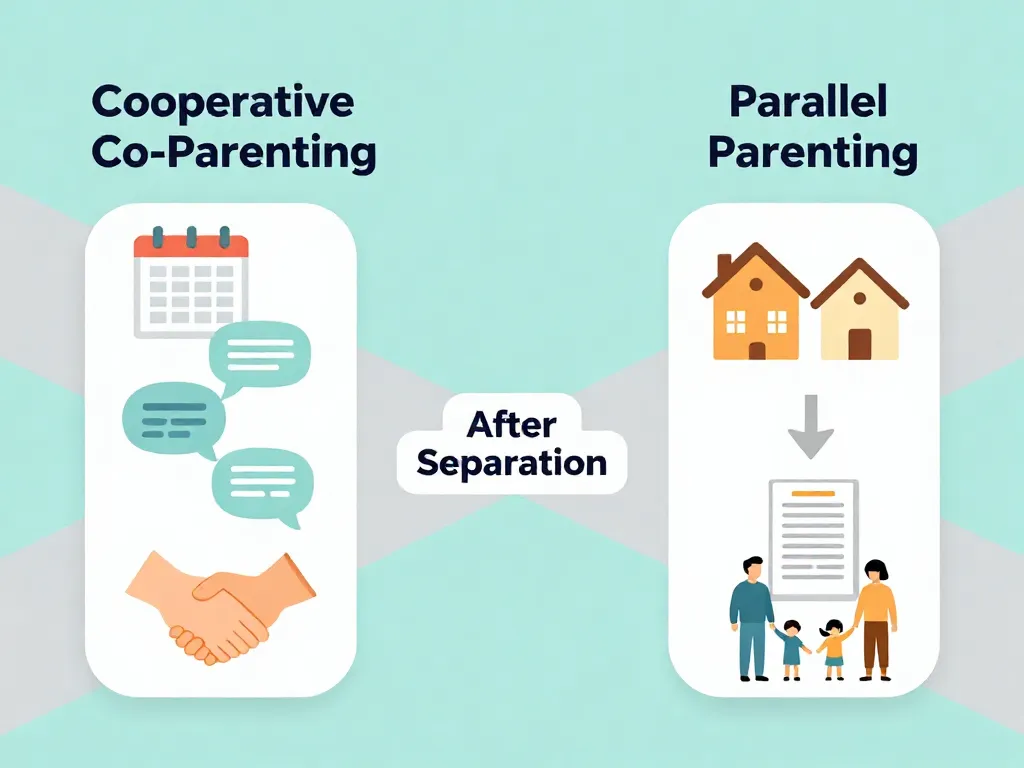
The Difference Between Cooperative Co-Parenting and Parallel Parenting
Cooperative co-parenting is what most books describe: shared calendars, flexible scheduling, joint decisions about school and health, friendly exchanges at pickup. It works beautifully when both parents prioritize the child's needs above their own grievances.
Parallel parenting is what happens when cooperation becomes a vehicle for conflict. It's not a failure—it's an adaptation.
How Parallel Parenting Works
| Cooperative Co-Parenting | Parallel Parenting |
|---|---|
| Frequent, open communication | Limited, business-only communication |
| Flexible schedules based on mutual agreement | Rigid schedules with minimal deviation |
| Joint decision-making on most issues | Independent decision-making within each home |
| Shared events (birthdays, school plays) | Separate attendance or structured boundaries |
| Verbal and informal agreements | Written, documented agreements |
Parallel parenting doesn't mean you never communicate. It means every communication has a structure, a purpose, and a boundary.
What Parallel Parenting Looks Like Day to Day
Consider "David" and "Michelle" (names changed). After their divorce, they attempted cooperative co-parenting for two years. Every text thread devolved into an argument. School conferences became battlegrounds. Their 8-year-old daughter started having stomachaches every Sunday night before transitions.
Their therapist recommended parallel parenting. Here's what changed:
- Communication moved to email only, with a 24-hour response window (unless a genuine medical emergency arose).
- Each parent made daily decisions—bedtimes, meals, screen time—independently in their own home.
- Major decisions (medical, educational) were outlined in a written parenting plan with specific decision-making authority assigned.
- Birthday parties were held separately. School events were attended separately, sitting apart.
- Neither parent discussed the other parent's household with their daughter.
Within three months, the Sunday stomachaches stopped. David's anxiety decreased. Michelle had fewer targets for provocation. And their daughter stopped feeling like she was standing in the middle of a war zone.

How to Know It's Time to Stop Engaging
Disengagement isn't your first move. It's what you do after good-faith efforts have failed repeatedly. Here are the signals that it's time:
1. Your Responses Don't Change the Outcome
Look at your last twenty exchanges with your co-parent. Did any of your thoughtful, measured replies actually resolve the issue? Or did each response simply fuel the next round?
If the outcome is the same whether you write a three-paragraph explanation or a single sentence, the conversation is not functional. You're performing for an audience that isn't listening.
2. Your Child Is Absorbing the Conflict
Children don't need to overhear arguments to feel them. They read it in your face when you check your phone. They sense it in the tightness of your voice during pickup. They know.
Research from the American Psychological Association consistently shows that interparental conflict—not divorce itself—is the primary predictor of negative child outcomes. Reducing conflict is more important than maintaining the appearance of cooperation.
3. You've Become Reactive Instead of Intentional
When you catch yourself drafting angry replies in the shower, rehearsing arguments during your commute, or losing sleep over a co-parent's email, you've crossed from engaged to enmeshed.
This isn't weakness. It's a predictable neurological response to chronic stress. Your nervous system is treating every notification as a threat. Disengagement is how you restore your capacity to be the parent your child needs.
4. The Conflict Has Become the Relationship
Ask yourself: When was the last time you and your co-parent had an exchange that was simply about logistics? If every interaction—even "What time is soccer practice?"—becomes a referendum on your character, the communication channel itself has become toxic.
A Practical Framework for Structured Disengagement
Disengaging doesn't mean going dark. It means being deliberate. Here's a framework you can start using today.
Step 1: Establish Your Communication Protocol
Choose one channel. Email is often best because it's asynchronous, documentable, and naturally slower than texting. Inform your co-parent in writing:
"Going forward, I'll be communicating about parenting matters via email. I'll respond to non-urgent messages within 24 hours. For medical emergencies, call 911 first, then call me."
You don't need their agreement. You're setting a boundary for yourself.
Step 2: Apply the BIFF Method to Every Response
Developed by high-conflict specialist Bill Eddy, the BIFF method keeps responses:
- Brief — Two to four sentences maximum.
- Informative — Facts only. No emotions, no history, no defensiveness.
- Friendly — Neutral tone. Not warm, not cold. Professional.
- Firm — End the conversation. Don't leave openings for debate.
Example:
Incoming message: "You NEVER follow the schedule. Last week you were 15 minutes late and you clearly don't care about your son's stability. I'm documenting everything."
BIFF response: "I arrived at 3:15 last Tuesday due to traffic. The parenting plan states a 15-minute grace period. I'll continue to communicate any delays in advance. Thank you."
Notice what's missing: No defense. No counter-accusation. No emotional engagement. The message is a closed door, not an invitation.
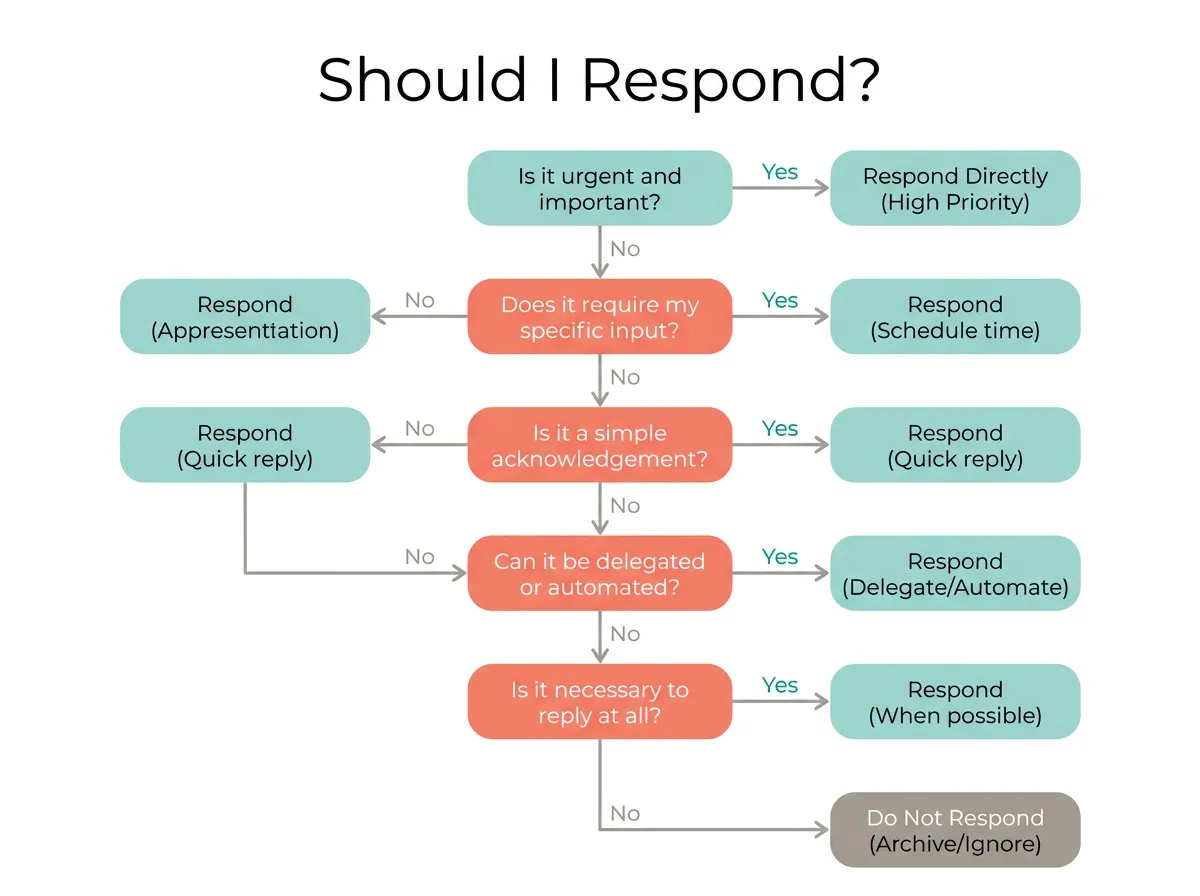
Step 3: Create a "Respond / Don't Respond" Filter
Not every message requires a reply. Before responding, run it through this filter:
- Does this message contain a logistical question about our child? → Respond with facts.
- Does this message require my action or agreement on a specific, time-bound issue? → Respond with a decision.
- Is this message an accusation, insult, vent, or provocation? → Do not respond.
- Is this message relitigating a past event? → Do not respond.
- Is this message attempting to control what happens in my home? → Do not respond.
Silence is not rudeness. It's the absence of fuel.
Step 4: Formalize What Matters
The fewer things left open to interpretation, the fewer things there are to fight about. Work with a mediator, attorney, or AI-powered mediation platform like Servanda to put specifics in writing: pickup times down to the minute, holiday rotation schedules, decision-making authority for medical and educational choices, and expense-splitting formulas.
Vague agreements are high-conflict playgrounds. Specific agreements are fences.
Step 5: Build Your Support Infrastructure
Structured disengagement is harder than it sounds because high-conflict dynamics are addictive. The cycle of provocation and response creates a neurochemical loop that feels impossible to break.
You need support:
- A therapist who understands high-conflict dynamics — Not couples counseling. Individual therapy focused on boundaries and trauma response.
- A family law attorney — Even if you're not in active litigation. You need someone who can tell you what you're legally required to respond to and what you can ignore.
- A trusted friend or family member — Someone who can read a message before you respond and say, "Don't take the bait."
- A documentation system — Save every communication. Not to obsess over, but to have a factual record if legal intervention becomes necessary.
What Disengagement Is Not
Let's be clear about what this article is not suggesting:
- Disengagement is not punishing your co-parent with silence. The goal is peace, not power.
- It is not withholding information about your child. Medical updates, school reports, and safety concerns still get communicated—briefly and in writing.
- It is not badmouthing your co-parent to your child. Your child's relationship with their other parent is not yours to manage.
- It is not refusing to follow court orders. Legal obligations remain. You're changing the emotional texture of compliance, not compliance itself.
Disengagement is the decision to stop participating in a dynamic that harms everyone, including the person driving it.
When You Need More Than Disengagement
Some situations go beyond high-conflict co-parenting into territory that requires legal or safety intervention:
- Threats of violence or self-harm — Contact law enforcement and your attorney immediately.
- Parental alienation — Documented, sustained efforts to turn your child against you may require court intervention.
- Substance abuse affecting the child's safety — This is not a boundary issue. It's a safety issue.
- Violation of court orders — Document and involve your attorney.
Disengagement is a strategy for chronic, low-to-moderate conflict. It is not a substitute for protective action when your child is at risk.
Frequently Asked Questions
Is parallel parenting the same as giving up on co-parenting?
No. Parallel parenting is a form of co-parenting specifically designed for situations where direct collaboration causes more harm than good. It prioritizes the child's need for stability and low conflict over the ideal of parental teamwork. Many families use parallel parenting temporarily during the most contentious period and gradually shift toward more cooperation as tensions decrease over time.
What if my co-parent accuses me of being uncooperative for not responding to every message?
This is common and expected. A high-conflict co-parent may frame your boundaries as hostility. Protect yourself by maintaining a clear written communication record, responding to all legitimate logistical questions within your stated timeframe, and following your parenting plan precisely. If the issue escalates to court, judges generally view measured, documented communication favorably—not constant engagement in arguments.
How do I explain parallel parenting to my child?
You don't need to use the term. Keep it simple and age-appropriate: "Mom and Dad do things a little differently in each house, and that's okay. The rules at Dad's house are Dad's rules, and the rules at Mom's house are Mom's rules." Children adapt quickly to consistency within each home. What they struggle with is being caught between two homes at war.
Can I use parallel parenting without a court order?
Yes. Parallel parenting is a behavioral strategy, not a legal designation. You can begin implementing structured communication and independent decision-making on your own. However, having a detailed parenting plan—ideally one that's been formalized through mediation or a court order—makes parallel parenting significantly more effective because it reduces the number of issues that require any discussion at all.
How long does parallel parenting usually last?
There's no fixed timeline. Some families operate in a parallel parenting model for years, particularly when one parent has a personality disorder or persistent pattern of conflict. Others find that after 12–24 months of reduced contact and firm boundaries, the intensity decreases enough to allow limited cooperation. The key is to let the dynamic—not a calendar—determine when and whether to shift.
Moving Forward Without Looking Back
High-conflict co-parenting is exhausting because it asks you to solve a problem that isn't yours to solve. You cannot make another person communicate fairly, respect boundaries, or prioritize your child's emotional safety. What you can do is remove yourself from the cycle.
Structured disengagement isn't cold. It isn't petty. It's the recognition that your child needs at least one parent who isn't consumed by conflict—and that parent can be you.
Start small. Choose one boundary from this article and implement it this week. Set your communication channel. Apply the respond/don't respond filter to tonight's message. Let the silence do what your words never could.
Your child doesn't need parents who get along perfectly. They need a parent who is present, regulated, and at peace. That's enough. That's everything.