Holiday Custody Split: Templates That Prevent Fights
It's October 28th, and your phone buzzes. Your co-parent wants the kids for all of Thanksgiving week—not just the day itself. You assumed you'd have them because it's "your year." But nothing was written down, and now you're both scrolling through old texts trying to prove who agreed to what. The tension climbs. The kids sense it. What should be a season of warmth becomes a battlefield over logistics.
Holidays carry enormous emotional weight, and when a holiday custody split isn't clearly documented in advance, even well-meaning co-parents end up locked in arguments that spill over into their children's experience. The fix is a written template—agreed upon before emotions peak—that answers every predictable question so you don't have to negotiate in the heat of the moment.
Below, you'll find ready-to-use frameworks, specific language, and real-world scheduling patterns that co-parents around the country rely on to keep the holidays peaceful.
Why Most Holiday Custody Agreements Fail
The Ambiguity Problem
Most parenting plans include a line like: "Parents shall alternate major holidays." That sounds reasonable until you realize it answers almost nothing:
- Does "Christmas" mean Christmas Eve, Christmas Day, or both?
- What time does the holiday start and end?
- Who handles transportation?
- What happens when Christmas falls on a Wednesday in the middle of the other parent's regular custody week?
Ambiguity creates space for conflict when stress is high, extended family is applying pressure, and both parents have competing visions of what the holiday should look like.
The Emotion Multiplier
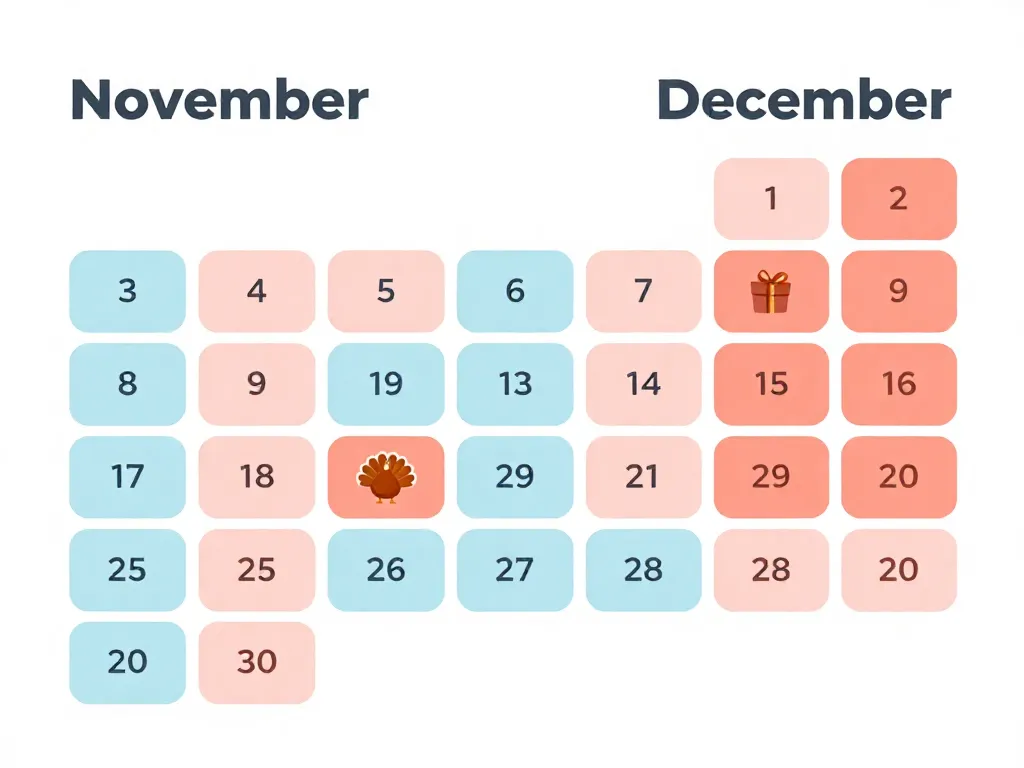
Holidays aren't just dates on a calendar. They're tied to identity, tradition, and memories of your own childhood. When you feel your holiday time is being threatened, the response isn't purely logical—it's protective. That's why a custody disagreement about pickup time on Thanksgiving morning can escalate faster than a disagreement about a random Tuesday.
Templates work precisely because they remove the need for real-time negotiation during these emotionally loaded periods.
The Core Template: Alternating Year Holiday Schedule
This is the most widely used holiday custody split format. Here's the structure:
How It Works
- Even years: Parent A has the children for Holiday Group 1; Parent B has Holiday Group 2.
- Odd years: They swap.
Holiday Group 1:
- Thanksgiving (Wednesday 6:00 PM through Sunday 6:00 PM)
- Easter / Spring Break (first half)
- Fourth of July (July 3rd 6:00 PM through July 5th 6:00 PM)
- Halloween (3:00 PM through 8:30 PM)
Holiday Group 2:
- Christmas Eve and Christmas morning (December 23rd 6:00 PM through December 25th 1:00 PM)
- Christmas afternoon through New Year's Day (December 25th 1:00 PM through January 1st 6:00 PM)
- Easter / Spring Break (second half)
- Children's birthdays
Template Language You Can Copy
Here's sample wording precise enough to prevent most disputes:
"In even-numbered years, Parent A shall have the children for Thanksgiving, beginning at 6:00 PM on the Wednesday immediately preceding Thanksgiving Day and ending at 6:00 PM on the following Sunday. Parent B shall have the children for Christmas Eve and Christmas morning, beginning at 6:00 PM on December 23rd and ending at 1:00 PM on December 25th. In odd-numbered years, these assignments reverse. Holiday schedules supersede the regular custody schedule. The receiving parent is responsible for transportation at the start of their holiday period."
The Split-Day Template: For Parents Who Live Close Together
If you and your co-parent live within reasonable driving distance (generally under 30 minutes), splitting individual holidays can work well—and it means neither parent fully misses a major holiday.
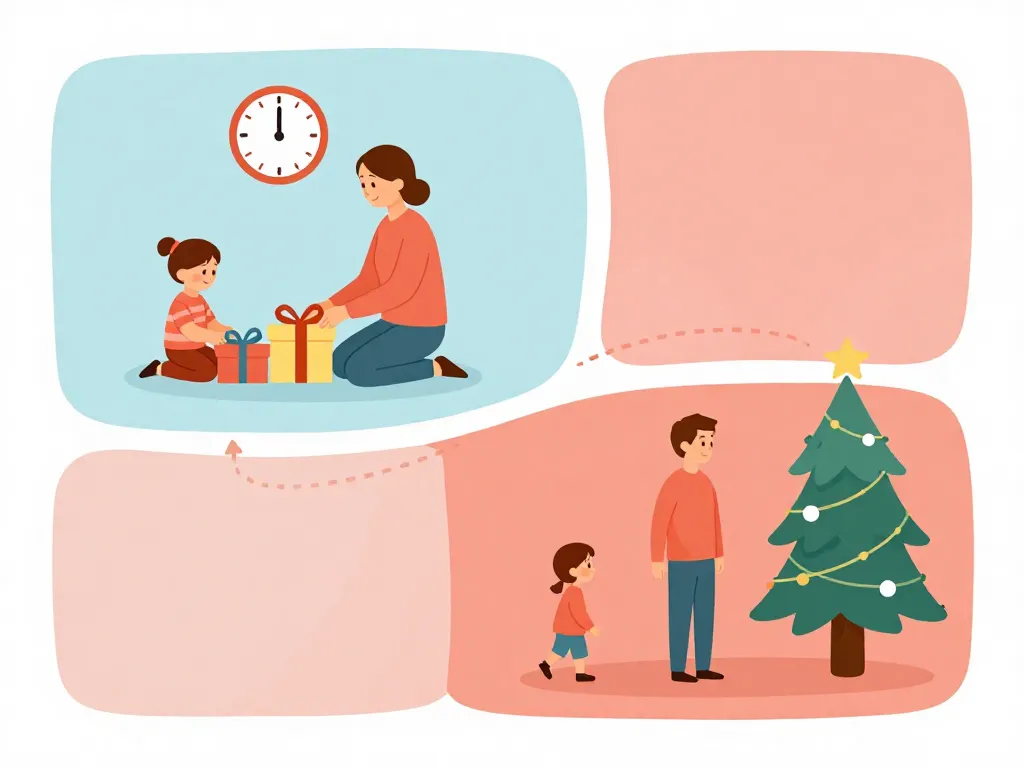
Christmas Split-Day Example
| Time Block |
Parent |
| Christmas Eve 5:00 PM – Christmas Day 10:00 AM |
Parent A |
| Christmas Day 10:00 AM – December 26th 10:00 AM |
Parent B |
This rotates annually. In alternate years, Parent B gets Christmas Eve through Christmas morning.
Thanksgiving Split-Day Example
| Time Block |
Parent |
| Thanksgiving Day 8:00 AM – 2:00 PM |
Parent A (morning + early meal) |
| Thanksgiving Day 2:00 PM – Friday 6:00 PM |
Parent B (evening meal + day after) |
When Split-Day Works—and When It Doesn't
Works well when:
- Both parents live nearby
- Children are school-aged and can handle transitions
- Extended family gatherings happen at different times of day
Doesn't work well when:
- Drive time exceeds 30–40 minutes
- Children are very young (under 3) and need routine stability
- One or both parents tend to push boundaries on transition times
The Fixed Holiday Template: When Certain Days Matter More to One Parent
Sometimes the fairest arrangement isn't a perfect 50/50 rotation. Maybe your co-parent's family always celebrates on Christmas Eve while your tradition centers on Christmas Day. Maybe Eid, Diwali, Hanukkah, Lunar New Year, or another cultural holiday matters deeply to one parent but not the other.
The fixed template assigns specific holidays to each parent permanently, rather than alternating.
Example
Parent A (every year):
- Christmas Eve (4:00 PM through Christmas Day 9:00 AM)
- Mother's Day / Father's Day (whichever applies)
- Parent A's cultural or religious holidays
Parent B (every year):
- Christmas Day (9:00 AM through December 26th 9:00 AM)
- Thanksgiving
- Parent B's cultural or religious holidays
Still alternating:
- Spring Break
- Summer vacation blocks
- Children's birthdays
This model reduces negotiation to near-zero for the fixed holidays. The trade-off is that it requires honest conversation upfront about which holidays each parent values most.
Summer and Extended Break Templates
Summer custody splits deserve their own section because they're uniquely complex. You're not dealing with a single day—you're dividing weeks or months.
The Two-Week Block Model
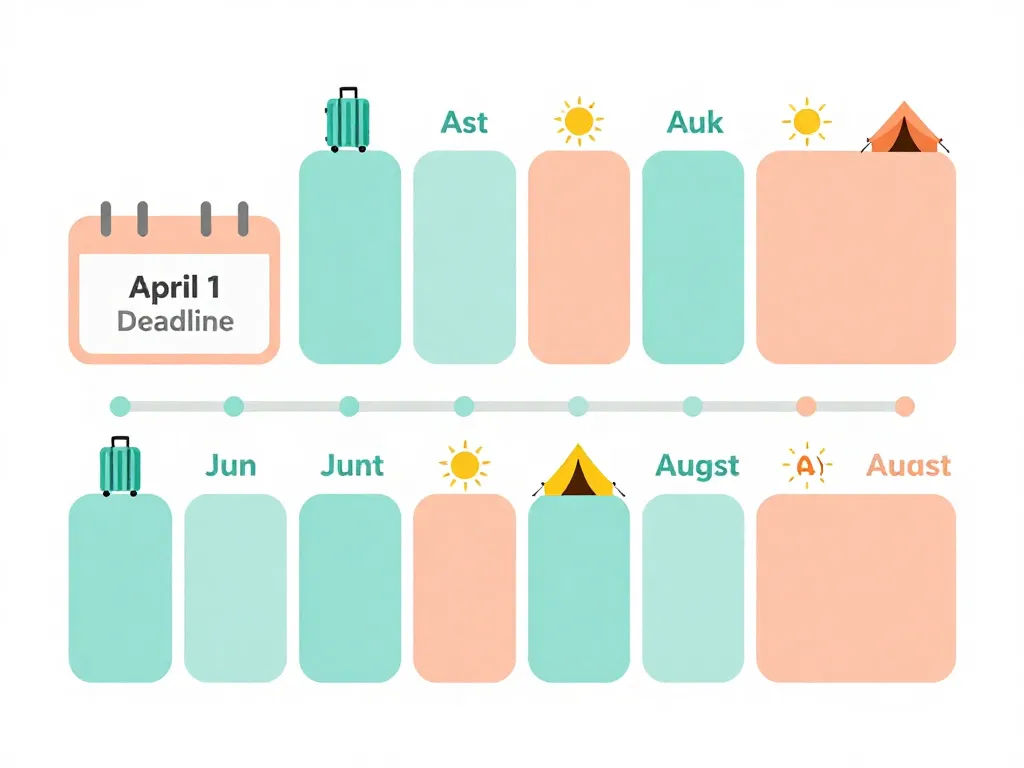
Each parent selects two-week blocks of uninterrupted summer time. This works well for vacations and camps.
Rules that prevent fights:
- Each parent submits their preferred summer weeks in writing by April 1st.
- Parent A has first pick in even years; Parent B has first pick in odd years.
- Neither parent may select more than two consecutive weeks without the other's written consent.
- Remaining summer time follows the regular custody schedule.
- Travel plans (including destination and contact information) must be shared at least 14 days before departure.
Template Language
"Each parent is entitled to up to four non-consecutive weeks of summer parenting time. Requests must be submitted in writing no later than April 1st. If both parents request the same week, the parent with first-pick priority for that year prevails. The non-traveling parent shall have phone or video access to the children every other day between 7:00 PM and 7:30 PM during the other parent's summer block."
Five Rules That Make Any Template Actually Work
A template is only as strong as the habits around it. These five rules are what separate families who fight every December from families who don't.
1. Put Everything in Writing
Verbal agreements are not agreements. Every holiday plan should exist in a document both parents can reference. Tools like Servanda help co-parents create written agreements that prevent future conflicts, especially when you need a neutral record of what was decided.
2. Define "Holiday" Down to the Hour
Don't write "Thanksgiving." Write "Wednesday, November 26th at 6:00 PM through Sunday, November 30th at 6:00 PM." Don't write "Christmas." Write the exact start and end times. Precision prevents disputes.
3. Include a Tiebreaker Clause
What happens when both parents want the same unassigned day? Decide now. Common tiebreakers:
- Alternate years for first-pick priority
- Coin flip documented by a third party
- Deference to the parent whose regular custody day it falls on
4. Build in a 15-Minute Grace Period
Transition times are flashpoints. A parent running 10 minutes late on Christmas morning should not become a crisis. Include language like:
"A grace period of 15 minutes applies to all holiday transitions. Delays beyond 15 minutes must be communicated by text. Consistent lateness (three or more instances in a 12-month period) may be addressed in mediation."
5. Review the Template Every September
Family circumstances change. Kids get older. One parent moves. Set a recurring calendar reminder for early September to review and update your holiday template before the season begins.
A Real-World Example: How One Family Stopped Fighting About Christmas
Jamal and Priya divorced when their son was four. The first two holiday seasons were miserable—last-minute texts, guilt trips, their son crying at transitions. Before their son's third post-divorce Christmas, they sat down and built a fixed/alternating hybrid:
- Christmas Eve went to Priya every year (her family's main celebration).
- Christmas Day went to Jamal every year (his family's tradition).
- Thanksgiving alternated.
- Spring Break was split in half, with the first parent to submit plans getting first choice of which half.
- Summer followed the two-week block model with April 1st deadlines.
They wrote it down, both signed it, and shared it with their respective families. That third Christmas, their son opened presents at his mom's on Christmas Eve night and woke up at his dad's on Christmas morning. No texts. No arguments. He later told Priya it was "the best Christmas" because "nobody was mad."
Conclusion
Holiday custody splits don't have to be a source of annual dread. The families who navigate them well aren't necessarily better communicators or less emotional—they simply have better documentation. A clear template with exact dates, specific times, defined transportation responsibilities, and a tiebreaker clause removes the need to negotiate when emotions are at their peak.
Start with the model that fits your family—alternating, split-day, or fixed—and customize it using the sample language above. Write it down before October ends. Share it with your co-parent and give them a deadline to respond. Then put it somewhere both of you can access it without having to ask.
Your kids don't need a perfect holiday. They need a calm one. That starts with a plan.
Frequently Asked Questions
How do you split Christmas custody fairly between two parents?
The two most common approaches are alternating the full Christmas period each year or splitting Christmas Eve and Christmas Day between parents. If you live close together, a split-day model lets one parent have Christmas Eve through Christmas morning and the other have Christmas afternoon through December 26th, rotating annually. The key is specifying exact transition times in writing so there's no room for misunderstanding.
What should a holiday custody agreement include?
A strong holiday custody agreement should list every holiday by name, define the exact start and end dates and times for each custody period, specify which parent is responsible for transportation, and include a tiebreaker clause for disputed days. It should also state that holiday schedules override the regular weekly custody rotation.
How do you handle holidays that aren't in the custody agreement?
For cultural, religious, or family-specific holidays not covered by a standard parenting plan, use a fixed holiday template that permanently assigns those days to the parent for whom they hold the most significance. This avoids yearly negotiations and ensures traditions are respected. Any remaining unassigned days can follow the regular custody schedule or be handled through a written first-pick priority system.
When should co-parents finalize their holiday custody schedule?
Co-parents should review and finalize their holiday schedule every September, well before the holiday season begins. Setting an annual calendar reminder gives both parents time to discuss changes—such as a new address, a child's school schedule, or travel plans—without the pressure of an approaching holiday.
What happens if one parent is consistently late for holiday custody exchanges?
Building a 15-minute grace period into your written agreement prevents minor delays from becoming major conflicts. If a parent is going to be more than 15 minutes late, they should communicate via text immediately. Including a clause that addresses consistent lateness—such as three or more late transitions in 12 months triggering mediation—gives both parents accountability without turning every small delay into a dispute.