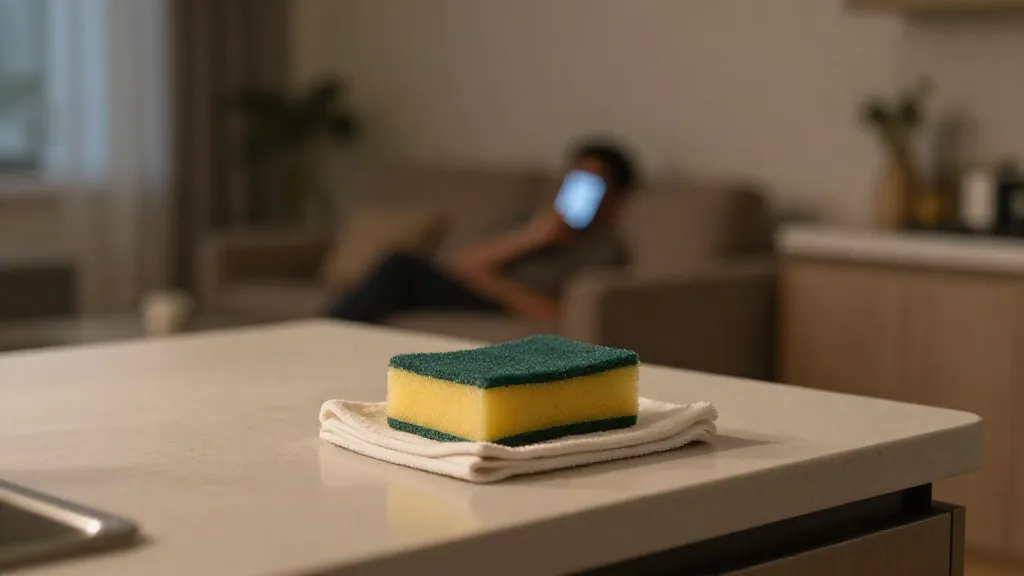
The Housework Fight: Why It's Never About the Dishes
It starts with a sink full of dishes. Or maybe it's the laundry sitting in the dryer for the third day in a row. One partner sighs — a little too loudly. The other snaps back: "I was going to do it." And suddenly you're not talking about plates and soap anymore. You're arguing about who does more, who notices what, and whether your partner actually respects your time.
If this scene feels painfully familiar, you're not alone. Research consistently places housework among the top five sources of conflict for couples, right alongside money and sex. But here's the thing most couples never pause long enough to realize: the housework fight is almost never actually about the housework.
It's about feeling unseen. It's about carrying a weight your partner doesn't seem to know exists. It's about what "fair" means when two people have completely different definitions.
This article unpacks what's really happening beneath the surface of your chore wars — and gives you concrete ways to stop the cycle.
Key Takeaways
- Housework fights are proxies for deeper issues — they're really about respect, equity, and feeling valued by your partner.
- The "mental load" (planning, tracking, remembering) is invisible labor that frequently falls on one partner and fuels resentment when it goes unacknowledged.
- Unspoken expectations are the real enemy. If you haven't explicitly discussed standards and responsibilities, you're setting each other up to fail.
- Scorekeeping destroys partnerships. Shifting from "who does more" to "how do we function as a team" changes everything.
- A single honest conversation using the right framework can do more than months of passive-aggressive dishwasher loading.

What the Housework Fight Is Really About
Let's get this out of the way: nobody has ever filed for divorce because of a dirty pan. But plenty of relationships have eroded because of what that dirty pan represents.
When couples argue about chores, at least one of three deeper conflicts is usually driving the tension:
1. Respect and Recognition
When you clean the kitchen, fold the laundry, and meal-prep for the week — and your partner doesn't seem to notice — the sting isn't about the tasks. It's the feeling that your effort is invisible. That your time matters less.
Consider Maya and Jordan. Maya works from home and handles most of the weekday cooking and tidying. Jordan commutes and often comes home tired. When Maya finally brought up how overwhelmed she felt, Jordan's response was: "But the house looks fine to me."
Jordan wasn't being cruel. He genuinely didn't see the work — because by the time he walked through the door, it was already done. But to Maya, his response translated to: "What you do all day doesn't count."
This is the respect gap. It's not about gratitude as a performance — it's about one partner's labor becoming so normalized that it disappears.
2. The Mental Load
The mental load — sometimes called "cognitive labor" — is the invisible work of managing a household: remembering that the dog needs a vet appointment, knowing when the kids' school forms are due, tracking when you're low on groceries, planning meals for the week.
This labor doesn't show up on any chore chart, but it's exhausting. And studies from the Pew Research Center and the American Sociological Review consistently show it falls disproportionately on women in heterosexual relationships, even when both partners work full-time.
Here's what the mental load sounds like in a fight:
- "I shouldn't have to ask you to do it."
- "You only do things when I remind you — that makes me your manager, not your partner."
- "I'm not upset that you didn't take out the trash. I'm upset that it never occurs to you on your own."
The partner carrying the mental load isn't angry about a single forgotten task. They're exhausted from being the default project manager of the household — a job they never applied for and can't clock out of.
3. Unspoken Expectations and Different Standards
You grew up in a house where the kitchen was wiped down every night. Your partner grew up in a house where a "clean enough" kitchen meant no food on the stove. Neither of you is wrong — but you've never actually talked about it.
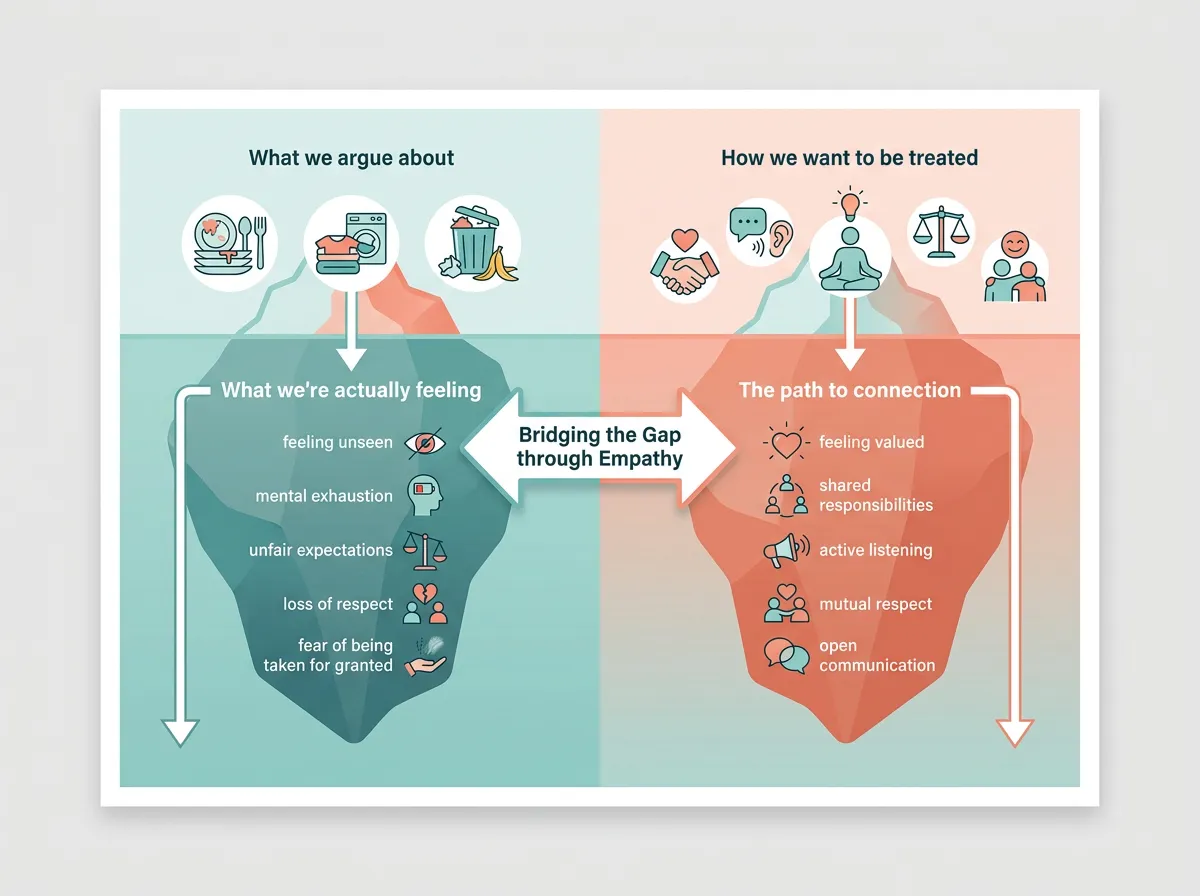
Unspoken expectations are the landmines of domestic life. When you assume your partner shares your definition of clean, your timeline for completing tasks, or your sense of what's urgent, you're building resentment on a foundation of mind-reading.
This is why the common advice to "just split chores 50/50" often backfires. A rigid split doesn't account for different standards, preferences, energy levels, or work schedules. And it definitely doesn't address the mental load.
Why Scorekeeping Makes Everything Worse
When the housework fight escalates, most couples default to scorekeeping: "I did the laundry AND the bathrooms last week. What did you do?"
This feels logical in the moment. If the problem is unfairness, then tracking who does what should fix it, right?
Not quite. Scorekeeping shifts the relationship from a partnership to a transaction. It turns your home into a ledger. And it creates a dynamic where both partners feel undervalued — because each person naturally overestimates their own contributions and underestimates their partner's.
Psychologists call this egocentric bias: in studies, when both partners in a couple are asked to estimate their share of household work, the combined percentages almost always add up to well over 100%. We remember what we do. We're less aware of what happens when we're not looking.
Scorekeeping doesn't solve the underlying problem. It just gives both people ammunition.
How to Actually Resolve the Housework Fight
If the real issues are respect, invisible labor, and unexpressed expectations, then the real solutions have to target those — not just redistribute tasks.
Here's a framework that works:
Step 1: Name What's Underneath
Before your next conversation about chores, take ten minutes alone and ask yourself: What am I actually feeling when I get angry about the dishes?
Common answers include:
- "I feel like my time isn't valued."
- "I feel like the default parent/housekeeper and I didn't choose that role."
- "I feel like I can't relax because I'm always tracking what needs to be done."
- "I feel like asking for help makes me a nag, so I just do it and resent it."
Naming the feeling — not the task — changes the entire conversation. "I feel unseen" opens a door. "You never clean the bathroom" slams one shut.
Step 2: Make the Invisible Visible
Sit down together and create a complete list of everything it takes to run your household. Not just the physical tasks, but the mental ones:
Physical tasks: - Cooking, cleaning, laundry, yard work, taking out the trash, grocery shopping
Mental/administrative tasks: - Meal planning, scheduling appointments, managing the family calendar, researching schools or daycares, remembering birthdays, tracking household supplies, coordinating with repair people, planning social events
Most couples are stunned by how long this list actually is. And the partner who hasn't been carrying the mental load often has a genuine "I had no idea" moment — not because they don't care, but because this labor was designed to be invisible.

Step 3: Discuss Standards Before Dividing Tasks
Before you assign anything, talk about your standards. This is the step almost every couple skips.
Useful questions:
- How clean does the kitchen need to be before bed? Every night, or just most nights?
- How often should bathrooms be cleaned?
- Does laundry need to be folded immediately, or is a "clean clothes basket" acceptable?
- What's your threshold for clutter?
You don't have to agree on everything. But you do have to know where your expectations differ — because that awareness alone prevents a huge number of fights.
Step 4: Divide Based on Ownership, Not Just Tasks
Instead of splitting a list down the middle, assign areas of ownership. When one partner fully owns a domain — say, all meal-related tasks from planning to cleanup — they also own the mental load for that domain. No reminders needed. No management from the other person.
This is critical. The goal isn't just getting help with execution. It's transferring the cognitive burden so it's genuinely shared.
Some couples find it helpful to formalize these agreements in writing — especially if you've been stuck in the same argument cycle for months or years. Tools like Servanda can help couples create clear, written agreements about household responsibilities, making the invisible visible and giving both partners something concrete to revisit when things drift.
Step 5: Build in Check-Ins, Not Critiques
No system is perfect on the first try. Life changes — work schedules shift, kids enter new stages, someone gets sick. What worked in October might not work in February.
Schedule a brief monthly check-in (15 minutes, max) to ask:
- Is this division still working for both of us?
- Is there anything that's quietly building resentment?
- Do we need to adjust?
Frame these as team maintenance, not performance reviews. The tone matters as much as the content.
The Emotional Shift That Changes Everything
The couples who successfully move past the housework fight don't do it by finding the perfect chore chart. They do it by making a fundamental shift in how they see the problem.
They stop asking: "Who does more?" And start asking: "Does my partner feel supported?"
That question changes behavior in ways that a spreadsheet never will. When both people are genuinely oriented toward the other's well-being — not tracking transactions, but paying attention to each other's stress — the specific distribution of tasks tends to sort itself out.
This doesn't mean ignoring real imbalances. It means approaching those imbalances as a shared problem to solve, not a case to prosecute.
When It's More Than Just Chores
Sometimes the housework fight is a symptom of a larger power imbalance in the relationship. If one partner consistently dismisses the other's concerns, refuses to engage in conversations about fairness, or weaponizes incompetence (doing tasks badly on purpose so they won't be asked again), the issue goes beyond household management.
Signs the problem may be deeper:
- One partner shuts down or walks away every time the topic comes up
- There's a persistent "I'll do it my way or not at all" attitude
- One partner feels they can't raise concerns without being labeled "controlling" or "nagging"
- The imbalance extends to emotional labor, childcare, and relationship maintenance
In these cases, couples therapy with a licensed professional can provide a safe space to address dynamics that a chore chart alone won't fix.
FAQ
Why do couples fight about housework so much?
Housework fights rank among the most common relationship conflicts because they happen daily and carry deep emotional weight. They're rarely about the chores themselves — they're about feeling respected, valued, and treated as an equal partner. The repetitive nature of household tasks means these feelings get triggered over and over without resolution.
How do I talk to my partner about unequal housework without starting a fight?
Start by expressing how you feel rather than cataloging what your partner hasn't done. Instead of "You never help with anything," try "I've been feeling overwhelmed and I'd like us to figure this out together." Choose a calm moment — not right after a trigger — and frame the conversation as problem-solving, not blame.
What is the mental load in a relationship?
The mental load refers to the invisible cognitive work of running a household: remembering, planning, organizing, anticipating, and tracking everything from grocery lists to doctor's appointments. It's the difference between doing a task when asked and being the person who always has to know it needs doing in the first place.
Is splitting chores 50/50 the best approach?
Not necessarily. A rigid 50/50 split ignores differences in work schedules, energy levels, preferences, and standards. A more effective approach is assigning full ownership of specific domains, so both partners carry not just the tasks but the thinking behind them. Fairness matters more than exact equality — and fairness looks different for every couple.
How often should couples revisit their housework arrangement?
A brief monthly check-in works well for most couples. It doesn't need to be formal — just a quick conversation about whether the current system still feels fair and functional. Major life changes (a new job, a baby, a move) should also trigger a fresh conversation, since what worked before may no longer fit.
Moving Forward: From Battleground to Partnership
The housework fight persists in so many relationships because it touches something deeper than dirty dishes — it touches our need to feel respected, seen, and valued by the person we've chosen to build a life with.
Resolving it doesn't require a perfect system. It requires both partners to acknowledge the full scope of what it takes to run a home, to speak honestly about their needs and standards, and to approach imbalances as a shared problem rather than a personal failing.
Start small. Have one honest conversation this week — not about who forgot to wipe the counter, but about how you both want to feel when you walk through the door at the end of the day. That conversation is worth more than any chore chart ever written.
Because it was never about the dishes. It was always about each other.