
Money Fights Are Ruining Your Relationship: A Fix
It's 9:47 p.m. on a Tuesday. You're scrolling through your bank's app when you see it—a $280 charge at a store you don't recognize. Your stomach tightens. By the time your partner walks in the door, you're not just asking about the charge. You're relitigating every purchase, every "we agreed to cut back," every broken promise from the last six months. Twenty minutes later, you're both in separate rooms, and neither of you is actually talking about the $280 anymore.
If this sounds familiar, you're not alone. Research consistently shows that money fights in relationships are the single most common concrete issue couples argue about—and one of the strongest predictors of divorce. But here's the part most advice misses: the fight was never really about the $280. It was about what that $280 means—about security, trust, control, and whether you're actually building the same future.
This article breaks down what's really happening beneath your money arguments and gives you a concrete framework to stop the cycle.
Key Takeaways
- Money fights are rarely about money. They're about deeper emotional needs—security, autonomy, values, and trust—and you can't resolve the surface issue without addressing the undercurrent.
- Identify your "money story." Each partner brings a financial worldview shaped by childhood, culture, and past experiences. Naming these stories out loud defuses conflict before it starts.
- Replace vague expectations with a written financial agreement. A simple, specific document covering spending thresholds, savings goals, and personal discretionary funds eliminates most recurring arguments.
- Schedule regular "money check-ins" that aren't triggered by a crisis. Proactive conversations are calmer, shorter, and more productive than reactive ones.
- Use the 48-hour rule for non-emergency financial disagreements. Pausing before engaging prevents escalation and gives both partners time to separate emotion from logistics.

Why Money Fights in Relationships Are So Destructive
A 2012 study published in Family Relations by researcher Sonya Britt found that arguments about money are the top predictor of divorce—more than disagreements about children, sex, or household responsibilities. A more recent survey by Ramsey Solutions found that money is the second leading cause of divorce, and couples who say they have a "great" marriage are almost twice as likely to talk about money daily or weekly compared to those who say their marriage is "okay" or "in crisis."
Why does money carry this much destructive weight? Because unlike dishes or screen time, money is a proxy for almost everything else in a relationship:
- Security: "Will we be okay if something goes wrong?"
- Control: "Do I have a say in how our life is shaped?"
- Values: "Are we building the same kind of life?"
- Trust: "Can I count on you to follow through?"
- Identity: "Am I respected as an equal partner here?"
When you argue about a credit card bill, you're rarely arguing about the bill. You're arguing about one or more of these deeper needs. And until you name that, the $280 fight will keep coming back—wearing a different dollar amount each time.
The Real Problem: You're Speaking Different Financial Languages
Every person walks into a relationship carrying what therapists call a "money story"—a set of unconscious beliefs and emotional associations with money that were formed long before you ever shared a bank account.
Where Your Money Story Comes From
- Childhood household: Did your family talk openly about money or treat it as taboo? Was there scarcity, abundance, or instability?
- Cultural background: Some cultures emphasize communal financial responsibility; others prioritize individual financial independence.
- Past experiences: Have you experienced debt, job loss, financial abuse, or sudden windfalls? These leave deep imprints.
- Personality wiring: Some people are natural savers who get anxious when the cushion shrinks. Others are natural spenders who feel controlled when they can't purchase freely.
A Real Example
Consider a couple—let's call them Marcus and Priya. Marcus grew up in a household where money was tight and unpredictable. His father lost his job twice during Marcus's childhood. For Marcus, a healthy savings account isn't a preference—it's an emotional survival mechanism. When the balance dips, his nervous system sounds an alarm.
Priya grew up in a stable, middle-class household where her parents spent freely on experiences—travel, restaurants, concerts. For Priya, spending on experiences is how you live a good life. When Marcus pushes back on a weekend trip, she doesn't hear fiscal responsibility—she hears, "Your joy doesn't matter to me."
Neither of them is wrong. But without understanding each other's money stories, they'll keep having the same argument disguised as different topics—the vacation, the new couch, the holiday gifts.

A Practical Framework to Stop Recurring Money Fights
Understanding the emotional layer is essential, but it's not enough on its own. You also need structure. Here's a step-by-step framework that addresses both the emotional and logistical dimensions of financial conflict.
Step 1: Have the "Money Story" Conversation
Set aside 45 minutes—not after a fight, not while reviewing bills. Sit down with a drink, no screens, and take turns answering these prompts:
- "What was money like in your house growing up?"
- "What's your earliest emotional memory involving money?"
- "When you think about our financial future, what makes you feel safe? What makes you feel anxious?"
- "What does financial freedom mean to you, specifically?"
The goal isn't to solve anything. It's to hear each other. You'll likely discover things you never knew—even if you've been together for years. This conversation alone can transform how you interpret each other's financial behavior.
Step 2: Define Your Shared Financial Values (Not Just Goals)
Most couples skip to goals—"save $20,000 for a down payment"—without agreeing on the values that should guide their financial life together. Goals without shared values create compliance, not partnership.
Try ranking these together and discussing where you align and diverge:
- Financial security / emergency preparedness
- Experiences and travel
- Generosity toward family and community
- Career freedom and flexibility
- Homeownership or specific lifestyle milestones
- Day-to-day comfort and quality of life
- Retirement timeline
- Children's education or future needs
You don't need identical rankings. You need to understand each other's priorities well enough that spending decisions don't feel like betrayals.
Step 3: Create a Written Financial Agreement
This is where most couples fail—not because they can't agree, but because they never formalize what they've agreed to. A verbal "let's try to spend less eating out" is not an agreement. It's a wish.
A practical financial agreement between partners should include:
- A spending threshold: Any purchase over $_____ gets a conversation first. (Common thresholds range from $50 to $200, depending on your income.)
- Personal discretionary funds: Each partner gets $_____ per month to spend on anything, no questions asked, no justification needed. This single element eliminates a shocking number of fights.
- Savings targets: Specific, time-bound goals with automatic transfers so willpower isn't the mechanism.
- Debt repayment plan: If applicable—who owes what, what's the priority order, and how much goes toward it monthly.
- Review cadence: When you'll revisit the agreement (monthly or quarterly works for most couples).
Write it down. Put it in a shared document. Tools like Servanda can help you formalize these kinds of agreements in a structured way, so that what you decided during a calm conversation doesn't evaporate the next time emotions spike.
Step 4: Schedule Proactive Money Check-Ins
The worst time to talk about money is when you're already upset about money. Yet that's when most couples have the conversation—reactively, defensively, from a place of blame or fear.
Instead, schedule a recurring money check-in. Here's a format that works:
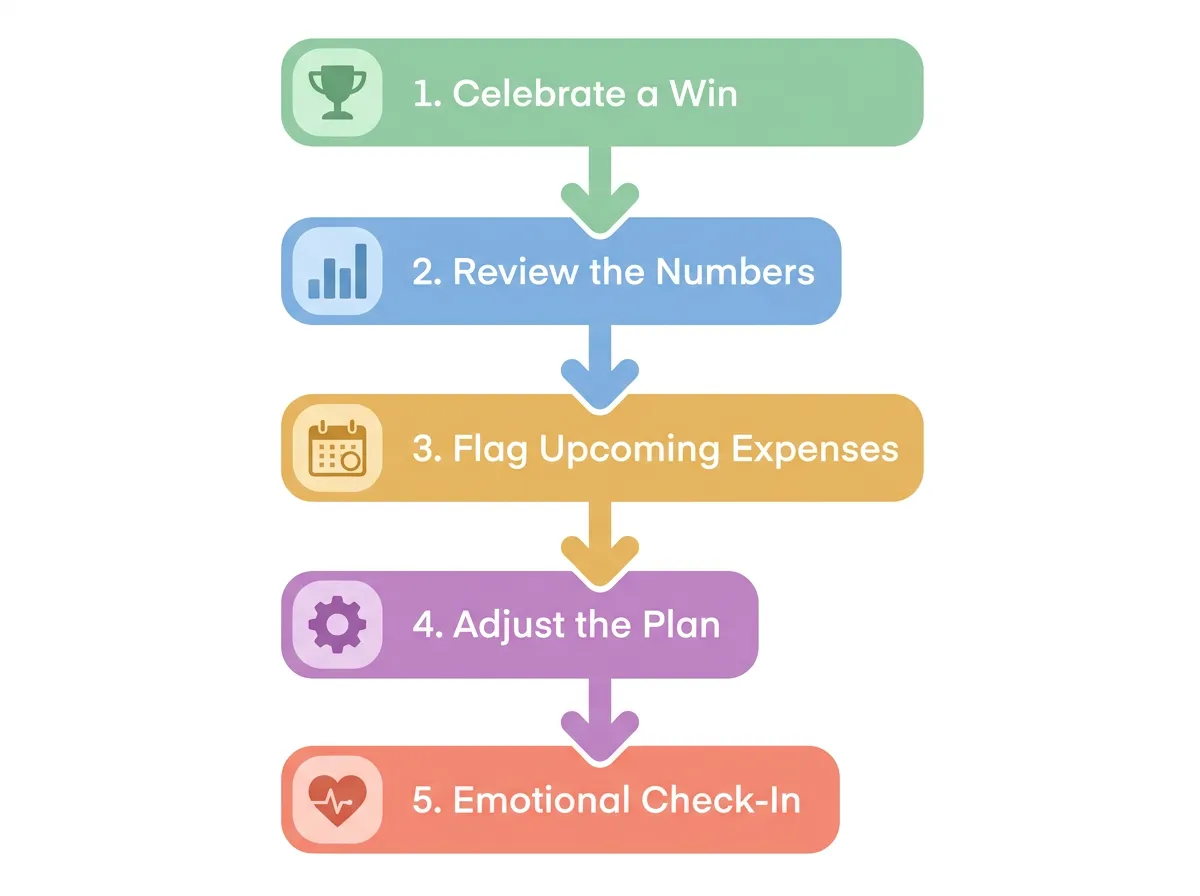
Monthly Money Meeting (30 minutes max)
- Celebrate a win (2 minutes): What went well financially this month? Did you hit a savings target? Stay under budget in a category? Even small wins build momentum.
- Review the numbers (10 minutes): Go through actual spending vs. plan. No blame—just data.
- Flag upcoming expenses (5 minutes): Birthdays, car maintenance, trips—anything coming in the next 30-60 days.
- Adjust the plan if needed (10 minutes): Life changes. The agreement should change with it.
- Check in emotionally (3 minutes): "How are you feeling about our financial life right now?" This one question prevents a month of silent resentment.
Pro tip: Pair the meeting with something pleasant—a favorite takeout meal, a walk in the park, a glass of wine. You're conditioning your brain to associate money conversations with normalcy instead of crisis.
Step 5: Use the 48-Hour Rule for Non-Emergency Disagreements
When a charge, purchase, or financial decision triggers you—and it's not an actual emergency—wait 48 hours before engaging.
During that pause:
- Ask yourself: "Am I reacting to the dollar amount, or to what it represents?"
- Write down what you're actually feeling (anxiety, disrespect, loss of control, fear).
- Consider your partner's money story. Is there a generous interpretation of their behavior?
After 48 hours, if the issue still matters, bring it up—but lead with the emotion, not the accusation.
Instead of: "You spent $280 without telling me again."
Try: "When I saw that charge, I felt anxious because I've been worried about our savings cushion. Can we talk about it?"
This isn't about suppressing your reaction. It's about giving yourself enough space to address the real issue instead of just detonating.
When Money Fights Are About Something Bigger
Sometimes, financial conflict is a symptom of a deeper relationship dynamic that a budget spreadsheet won't fix:
- Power imbalances: If one partner earns significantly more and uses that as leverage in decisions, the money fight is really a fight about equality.
- Financial infidelity: Hidden accounts, secret debt, or undisclosed spending erode trust in ways that go far beyond the numbers.
- Incompatible life visions: If one partner wants to retire early and live simply while the other wants to climb the career ladder and live lavishly, no budget will bridge that gap—it requires a deeper conversation about the life you're building together.
- Control and coercive behavior: If one partner restricts the other's access to money, monitors every purchase, or uses finances as punishment, that's financial abuse—not a disagreement. If this describes your situation, please reach out to the National Domestic Violence Hotline at 1-800-799-7233.
For the first three, couples therapy with a therapist who specializes in financial conflict can be genuinely transformative. This isn't a failure—it's an investment in the most important partnership of your life.
FAQ
How do couples stop fighting about money?
The most effective approach combines understanding (learning each other's emotional relationship with money) with structure (a written agreement covering spending thresholds, personal discretionary funds, and shared savings goals). Scheduled, proactive money conversations also prevent the reactive blowups that cause the most damage.
Should couples combine finances or keep them separate?
There's no universally right answer. Many financial therapists recommend a hybrid approach: a joint account for shared expenses and goals, plus individual accounts for personal spending. The key isn't the account structure—it's having explicit, agreed-upon rules about how money flows between them.
What do you do when your partner is a spender and you're a saver?
First, recognize that neither orientation is inherently better—they reflect different emotional needs. A practical fix is establishing personal discretionary funds (a set monthly amount each person can spend freely) alongside shared savings targets. This gives the saver the security they need and the spender the autonomy they need, without either partner feeling controlled or anxious.
Is it normal to argue about money in a relationship?
Yes—surveys consistently show that money is the most common topic of recurring arguments among couples. The issue isn't that you argue about it; it's whether you have a productive framework for resolving those arguments or whether the same fight keeps cycling without resolution.
When should couples see a financial therapist?
Consider professional help if money arguments are escalating in frequency or intensity, if there's been financial infidelity (hidden debt, secret accounts), if you can't agree on basic financial priorities after multiple attempts, or if money conflicts are bleeding into other areas of your relationship—affecting intimacy, trust, or daily mood.
Moving Forward Together
Money fights feel intractable because they're never just about money. They're about the stories you carry, the futures you're building, and the trust you're asking each other to hold. That's why a new budgeting app alone won't fix them—but a real conversation about what money means to each of you, backed by a written agreement and a regular rhythm of check-ins, can.
You don't need to have identical financial instincts to build a strong financial partnership. You need to understand each other's instincts, respect the emotions underneath them, and create enough structure that your system doesn't depend on willpower or mind-reading.
Start tonight. Ask your partner one question from Step 1. You might be surprised where it leads.