
How Co-Parent Conflict Hurts Your Finances
It starts with a text on a Tuesday afternoon. Your co-parent changed the pickup time without asking—again. You fire back. They escalate. By Thursday, you're both cc'ing your attorneys. By the end of the month, you're looking at a $1,200 invoice for emails, phone calls, and a motion that didn't need to happen.
You never planned to spend your emergency fund on legal letters about a Wednesday night. But here you are.
Most co-parents understand that ongoing conflict takes a toll on their children and their own mental health. What rarely gets talked about is the very real, very measurable financial damage that unresolved co-parenting disputes cause. The costs go far beyond attorney retainers. They show up in missed workdays, stalled career growth, duplicated household expenses, and retirement accounts that never get funded. When co-parent conflict hurts your finances, it quietly undermines the stability you're working so hard to build for your family.
This article puts real numbers to the problem—and offers concrete strategies to stop the financial bleeding.
Key Takeaways
- Repeated legal costs from minor disputes can total $10,000–$50,000+ over several years, even when both parents have moderate incomes.
- Schedule chaos from unresolved conflict directly reduces earning potential through missed shifts, lost clients, and stalled promotions.
- Financial planning—retirement, college savings, home buying—stalls when parents are stuck in reactive, short-term spending mode.
- Structured communication and written agreements are the single most effective way to reduce conflict-driven financial waste.
- Every dollar spent on unnecessary conflict is a dollar not spent on your kids' future—reframing disputes through a financial lens can motivate faster resolution.
The Hidden Price Tag of Co-Parent Conflict
When people think about the cost of co-parenting conflict, they usually think about lawyers. And yes, legal fees are a major factor. But the true financial impact is a web of interconnected costs, many of which parents don't recognize until the damage is done.
Let's break it down into the three categories where co-parent conflict hits your wallet hardest.
1. Direct Legal and Mediation Costs
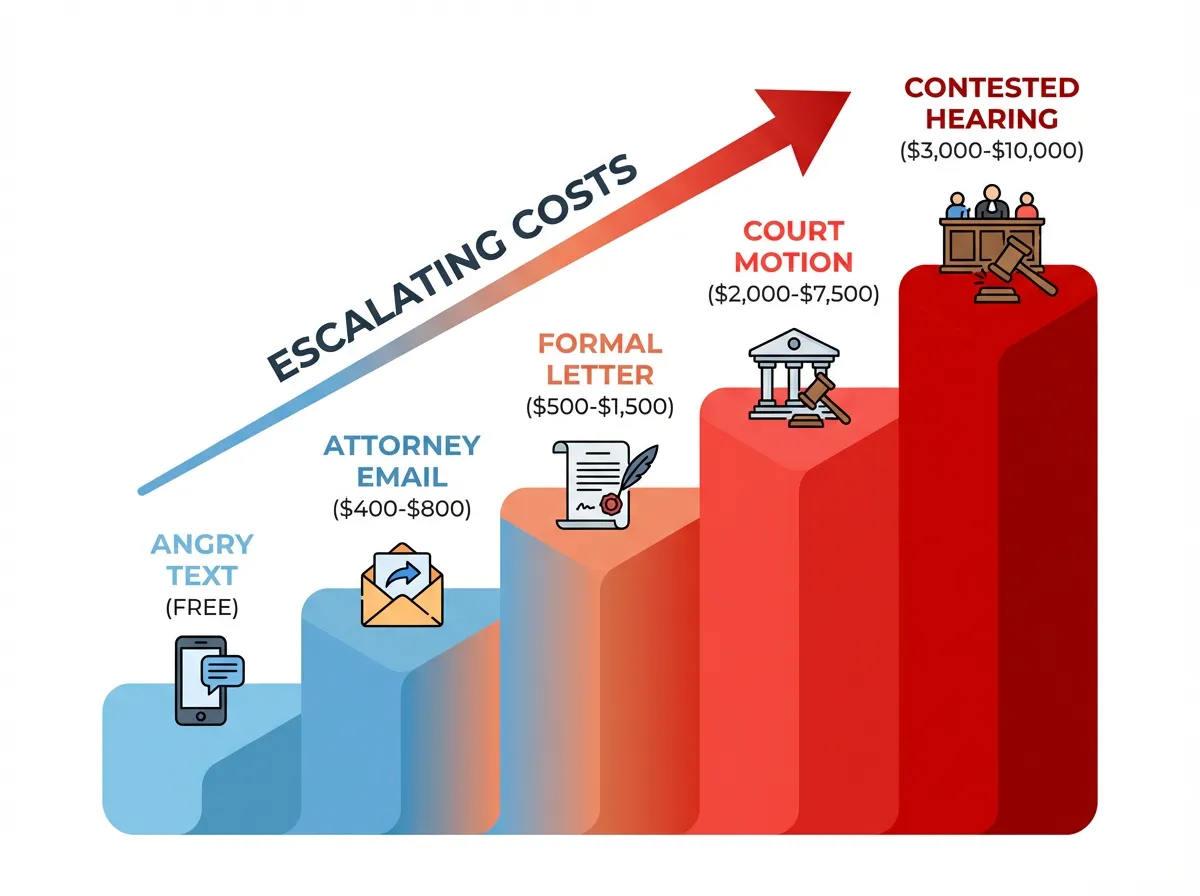
Family law attorneys in the U.S. charge between $200 and $500 per hour on average, depending on your market. Every angry email you forward to your lawyer, every phone call requesting advice on a scheduling dispute, every motion filed to enforce or modify a custody order—it all adds up.
Here's what a typical escalation path looks like financially:
| Dispute Stage | Estimated Cost Per Incident |
|---|---|
| Attorney email exchange (both sides) | $400–$800 |
| Formal letter or demand | $500–$1,500 |
| Motion to modify or enforce | $2,000–$7,500 |
| Contested hearing (half day) | $3,000–$10,000 |
| Guardian ad litem or custody evaluation | $5,000–$15,000 |
Now imagine this cycle repeating two or three times a year over a decade of co-parenting. A parent who goes back to court just twice over minor disputes could easily spend $15,000–$30,000 that would otherwise go toward a child's college fund or a down payment on a home.
Real example: "Dana" and "Marcus" disagreed about extracurricular activity costs. Neither would budge. Over 18 months, they exchanged attorney letters, filed competing motions, and attended two hearings. Total cost between them: roughly $22,000. The original dispute was about $1,400 in soccer fees.
2. Lost Income and Career Stagnation
This is the cost most parents underestimate. Co-parent conflict doesn't just drain money you have—it prevents you from earning money you could have.
Schedule disruptions affect work in concrete ways:
- A last-minute custody swap means calling out of a shift or canceling client meetings
- Ongoing conflict increases stress, which research links to reduced productivity and more sick days
- Court dates require time off work—often unpaid—plus the cognitive toll of preparation and emotional recovery
- Parents in high-conflict situations are less likely to pursue promotions, take on extra projects, or invest in professional development because their bandwidth is consumed by the dispute
For hourly workers, the math is immediate. Missing a shift to attend a hearing means $100–$300 gone, on top of the legal cost. For salaried professionals, the impact is slower but potentially larger: the raise you didn't pursue, the project you turned down, the networking event you skipped because you were on the phone with your attorney.

Real example: "James" worked as a freelance graphic designer. During an eight-month custody dispute, he turned down two long-term contracts because he couldn't guarantee his availability around court dates and unpredictable schedule changes. He estimated the lost revenue at $18,000—money that never showed up on a legal bill but was directly caused by the conflict.
3. Duplicated and Reactive Spending
High-conflict co-parents often fall into patterns of duplicated spending that stem directly from poor communication:
- Duplicate purchases: Both parents buy school supplies, winter coats, sports equipment, or birthday gifts because they're not coordinating. Over a year, this can add up to $500–$2,000 in unnecessary spending.
- Competing through spending: One parent enrolls the child in an expensive activity; the other feels pressured to match it. Neither budgeted for it.
- Emergency childcare costs: When a handoff falls apart at the last minute, someone's paying for a babysitter, aftercare, or emergency daycare. At $15–$25/hour, a few breakdowns per month become a significant line item.
- Moving costs driven by conflict: Some parents move to create distance or "start fresh" after a particularly bad stretch, incurring thousands in moving costs, new deposits, and higher rent.
How Conflict Derails Long-Term Financial Planning
Beyond the immediate costs, ongoing co-parent conflict creates a financial planning vacuum. When you're in perpetual crisis mode, long-term thinking becomes nearly impossible.
Retirement Gets Pushed to "Someday"
Parents in high-conflict co-parenting situations are significantly less likely to contribute consistently to retirement accounts. The reasons are layered:
- Legal fees consume discretionary income
- Emotional exhaustion reduces the capacity for financial planning
- The sense that everything is temporary ("I'll figure it out once this is settled") becomes permanent
Missing even $200/month in retirement contributions during your 30s and 40s can cost over $150,000 in compounding growth by retirement age. Co-parent conflict doesn't just cost you today—it costs your future self.
Children's Education Funding Stalls
College savings plans like 529s require consistent contributions to be effective. When co-parents are locked in conflict:
- Neither parent wants to fund an account the other might control
- Disposable income is redirected to legal costs
- Discussions about shared educational expenses become another battleground rather than a collaborative planning conversation
Credit and Debt Spiral
When legal bills and lost income exceed what a parent can absorb, credit cards fill the gap. High-interest debt from conflict-driven expenses is particularly damaging because it's not building anything—no asset, no investment, no experience for the child. It's purely reactive spending that creates a debt cycle, further limiting financial flexibility and increasing stress, which in turn fuels more conflict.
Breaking the Cycle: Practical Steps to Protect Your Finances
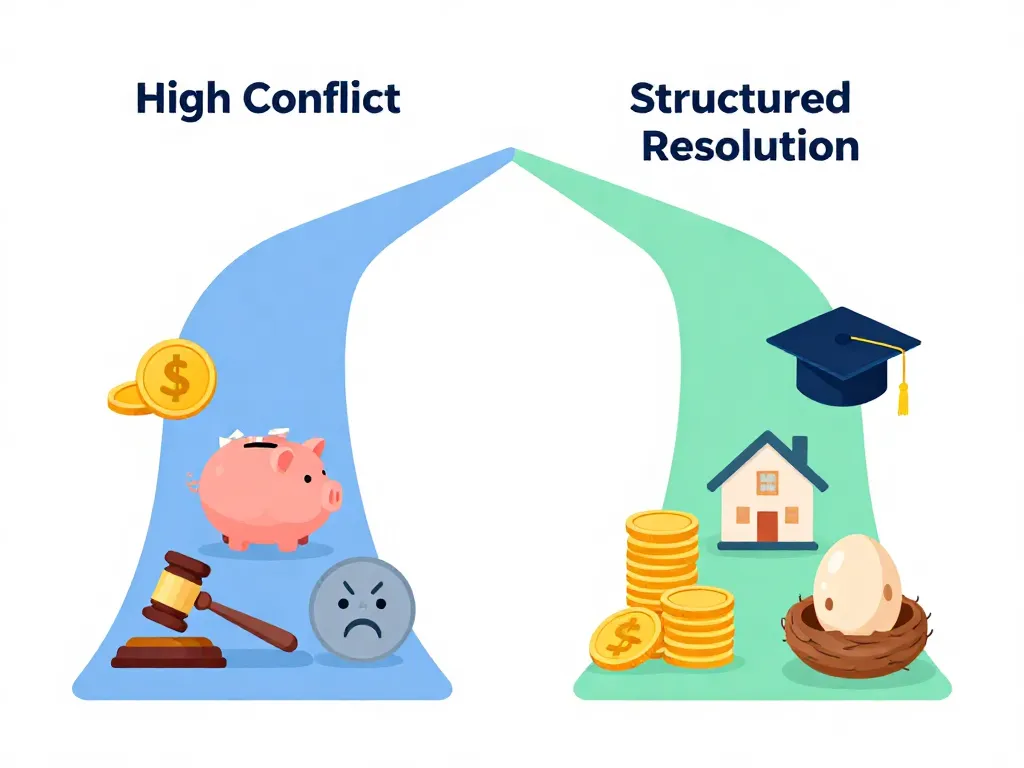
The good news: most co-parent conflict is preventable or containable before it becomes expensive. Here are specific, actionable steps to protect your finances.
Put Every Agreement in Writing
Verbal agreements are conflict incubators. Even when both parents have good intentions, memory is unreliable and interpretations diverge.
- Document custody schedules, expense-sharing arrangements, and decision-making protocols in writing
- Use a shared digital platform rather than text threads that get buried or screenshotted out of context
- AI-powered mediation tools like Servanda can help co-parents create clear, written agreements with structured communication—especially useful when direct conversation tends to derail
Adopt the "48-Hour Rule" Before Involving Attorneys
Unless there's a safety concern, wait 48 hours before escalating any dispute to legal counsel. During that window:
- Write down the specific issue and what resolution you'd accept
- Re-read your parenting plan to check if it already addresses the situation
- Send one clear, factual message to your co-parent proposing a solution
- If you still can't resolve it after 48 hours, consult your attorney—but with a specific question, not an emotional download (specific questions cost less in billable time)
Create a Shared Expense Protocol
Money disputes are the most common recurring co-parent conflict. Prevent them with a structure:
- Agree on categories: What's shared (medical, education, extracurriculars) vs. what each parent covers independently
- Set a threshold: Expenses under $100 don't require approval; expenses over $100 require written agreement within 72 hours
- Use a shared tracking tool: Apps, spreadsheets, or even a shared Google Doc for logging expenses. The method matters less than the consistency
- Reconcile monthly, not annually: Small, frequent check-ins prevent large blowups
Reframe Disputes Through a Financial Lens
Before escalating any disagreement, run a quick mental cost-benefit analysis:
- "If I send this to my lawyer, it will cost approximately $___."
- "Is this issue worth $___ to me, or can I find a resolution that costs $0?"
- "What could I do with that money instead?"
This isn't about avoiding necessary legal action. It's about distinguishing between disputes that require legal intervention and disputes that are driven by frustration, ego, or habit. Studies on conflict resolution suggest that most co-parenting disagreements fall into the latter category.
Build a "Conflict Buffer" Into Your Budget
Accept that some conflict is inevitable and plan for it financially:
- Set aside $100–$200/month into a dedicated fund for co-parenting-related expenses (legal consultations, mediation, unexpected childcare)
- Having a buffer reduces panic when costs arise and prevents credit card debt
- Track what you spend from this fund—it creates an honest record of what conflict is actually costing you, which can be a powerful motivator for change
When the Financial Damage Is Already Done
If you're reading this and recognizing that conflict has already taken a significant financial toll, you're not behind—you're becoming aware. That awareness is the turning point.
Start here:
- Calculate your total conflict costs over the past 12 months: legal fees, missed work, duplicate spending, emergency childcare. Write the number down. Seeing it in black and white shifts something.
- Meet with a financial planner—even a single session. Many offer flat-fee consultations. Explain your co-parenting situation. They can help you build a realistic recovery plan.
- Propose a "financial ceasefire" to your co-parent. Frame it around the children: "I've calculated that we've spent $X on legal fees this year. That's $X not going toward [child's name]'s future. Can we try handling the next disagreement differently?" This works more often than you'd expect.
Frequently Asked Questions
How much does co-parenting conflict cost on average per year?
The cost varies widely, but parents in moderate-to-high-conflict co-parenting situations commonly spend $3,000–$15,000 annually on legal fees alone. When you factor in lost income, duplicated expenses, and emergency childcare, the total can easily double. Even "low-conflict" co-parents who involve attorneys for minor disputes typically spend $1,000–$3,000 per year more than they need to.
Can co-parenting conflict affect my credit score?
Indirectly, yes. When legal fees and lost income lead to credit card debt or missed payments on other obligations, your credit score suffers. Some parents also encounter credit issues when a co-parent fails to pay joint debts as agreed in a divorce decree—the creditor doesn't care about your custody arrangement, only whose name is on the account.
Is mediation really cheaper than going to court?
In almost every case, yes. A full private mediation typically costs $2,000–$5,000 total (split between parents), compared to $10,000–$50,000+ for a contested court process. Community mediation centers often offer sliding-scale fees starting under $200. Even when mediation doesn't fully resolve an issue, it usually narrows the disagreement enough to significantly reduce court costs.
How do I stop my co-parent from dragging me into expensive legal fights?
You can't control your co-parent's behavior, but you can control your response. Stick to written, factual communication. Respond to legal filings strategically with your attorney rather than reactively. Document everything. In some cases, courts will award attorney fees to a parent who can demonstrate the other party is litigating in bad faith—ask your lawyer if this applies to your situation.
Should co-parents use a financial planner together?
It depends on your conflict level. If you can sit in the same room and have a goal-oriented conversation, a joint session with a certified divorce financial analyst (CDFA) can help you make smarter shared decisions about children's expenses. If direct collaboration isn't realistic right now, individual financial planning is still highly valuable—focus on what you can control.
Conclusion
Co-parent conflict is expensive in ways that go far beyond attorney invoices. It erodes earning potential, stalls long-term financial goals, creates debt, and diverts money away from the people who matter most—your children.
The financial lens isn't meant to replace the emotional or relational work of co-parenting. But it adds a layer of clarity that can cut through the fog of frustration. When you calculate the actual cost of a dispute, the calculus often shifts. The pickup time disagreement that felt worth fighting over at 8 p.m. looks different when you attach a $2,000 price tag to it the next morning.
Every co-parenting conflict that gets resolved before it escalates is money back in your pocket—and in your child's future. Start with one written agreement, one 48-hour pause, one honest look at last year's spending. The numbers will do the convincing from there.