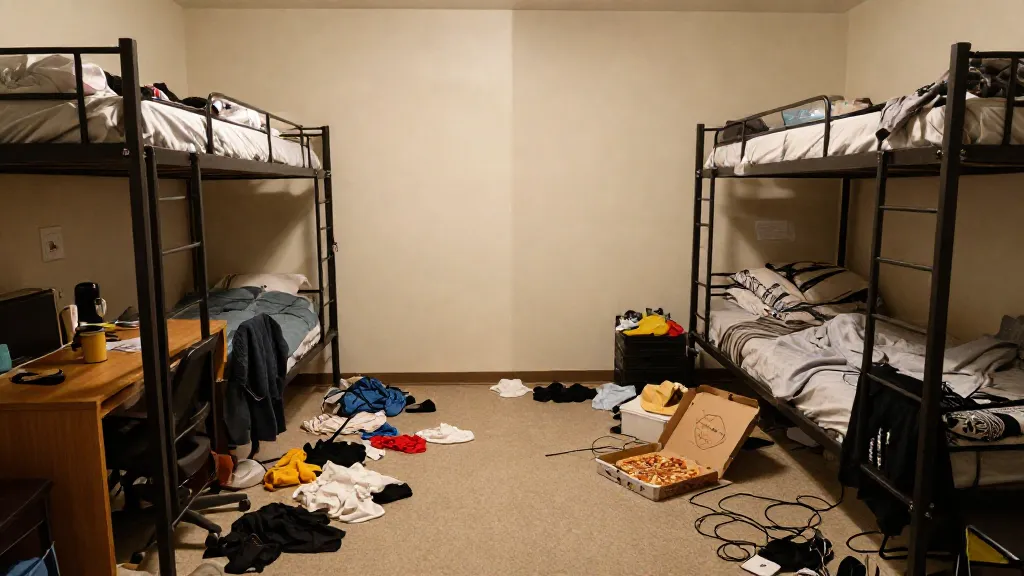
How to Handle a Roommate Who Escalates Everything
You left a single dish in the sink before heading to class. By the time you got home, your roommate had sent a paragraph-long text accusing you of "never cleaning up after yourself," tagged you in a passive-aggressive Instagram story about messy people, and was now giving you the silent treatment. All over one plate.
If this sounds familiar, you're probably living with what conflict experts call an escalator — someone who consistently turns minor friction into full-blown confrontations. A forgotten chore becomes proof that you "don't respect the space." A polite request turns into a shouting match. Every small disagreement feels like it could become a lease-breaking event. Living with a roommate who escalates everything doesn't just create conflict — it rewires your nervous system, making you walk on eggshells in your own home. But here's the good news: you don't have to match their energy, and you don't have to suffer in silence. There are specific, proven strategies for defusing escalation patterns and protecting your peace.
Key Takeaways
- Recognize the escalation pattern, not just individual incidents. Understanding why your roommate escalates helps you respond strategically instead of reactively.
- Use de-escalation scripts that lower the emotional temperature. Specific phrases can interrupt the spiral before it becomes a blowout.
- Set boundaries in writing, during calm moments — never mid-conflict. Written agreements remove ambiguity and give both parties something objective to reference.
- Protect your own emotional health with firm but respectful disengagement tactics. You are not obligated to participate in every argument you're invited to.
- Know when the situation has crossed a line and requires outside help. Escalation that includes threats, property damage, or harassment is no longer a roommate disagreement — it's a safety issue.
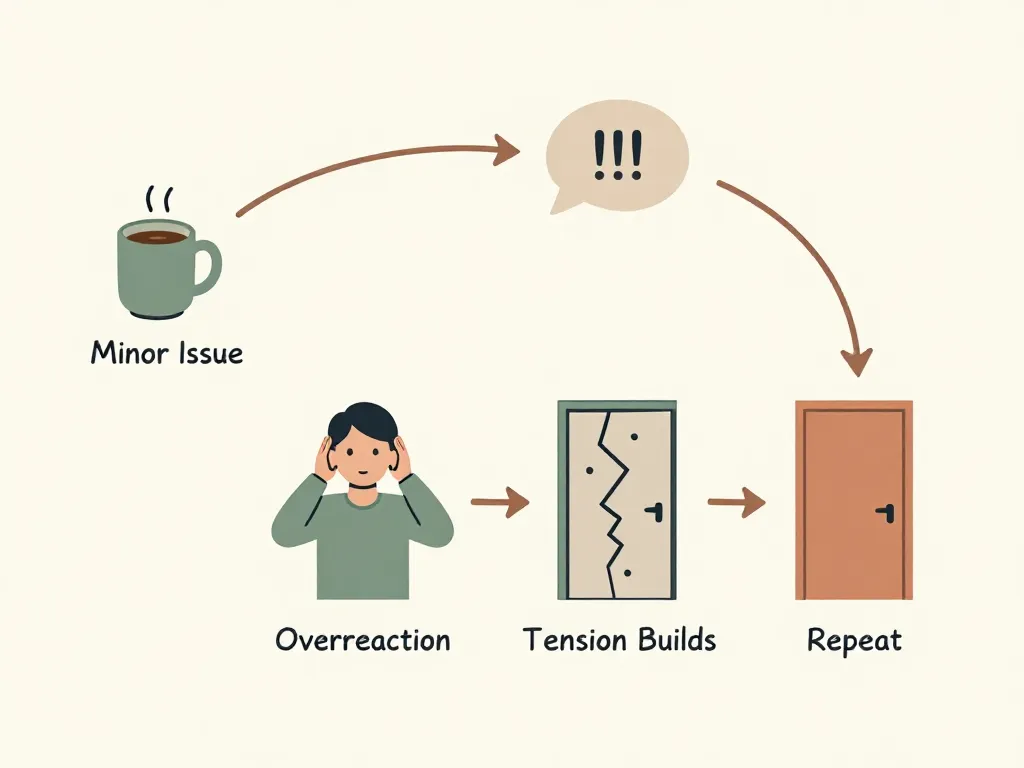
Understanding the Escalator Roommate
Before you can handle a roommate who escalates everything, it helps to understand what's actually going on beneath the surface. Escalation isn't random. It follows patterns, and those patterns usually stem from a few identifiable sources.
Why Some People Escalate Conflict
Not every difficult roommate is an escalator. The escalator has a specific behavioral signature: they respond to low-stakes situations with high-stakes emotional intensity. Here's why that happens:
- Anxiety-driven control: Some people escalate because unpredictability makes them deeply anxious. A dish in the sink isn't just a dish — it represents chaos they can't control. The escalation is an attempt to regain a sense of order.
- Accumulated resentment: Your roommate may have been silently bothered by twelve things before they finally exploded about the thirteenth. The reaction seems disproportionate because it's not really about this one incident.
- Learned conflict behavior: People who grew up in homes where yelling was the default communication style may genuinely not realize they're escalating. Intensity feels normal to them.
- Insecurity about the relationship: Some escalators test boundaries because they're unsure where they stand. The blowup is, paradoxically, a way of seeking reassurance that the relationship can survive conflict.
None of these explanations excuse the behavior. But understanding the root cause helps you choose the right de-escalation approach instead of guessing.
Signs You're Living with an Escalator
Not sure if your roommate truly fits the pattern? Here are the hallmarks:
- Disproportionate responses. The emotional intensity consistently doesn't match the situation.
- All-or-nothing language. They use words like "always," "never," "every single time."
- Rapid topic-shifting. A conversation about the thermostat suddenly becomes about something you did three months ago.
- Recruiting allies. They bring in mutual friends, other roommates, or social media audiences to validate their position.
- Punitive follow-through. After a disagreement, they engage in retaliatory behavior — silent treatment, slamming doors, "forgetting" shared responsibilities.
If three or more of these are showing up regularly, you're dealing with an escalation pattern, not isolated bad days.
De-Escalation Tactics That Actually Work
Generic advice tells you to "talk it out." But talking it out with someone who escalates everything often just gives them more fuel. Instead, try these specific tactics.

Tactic 1: The Pause-and-Redirect
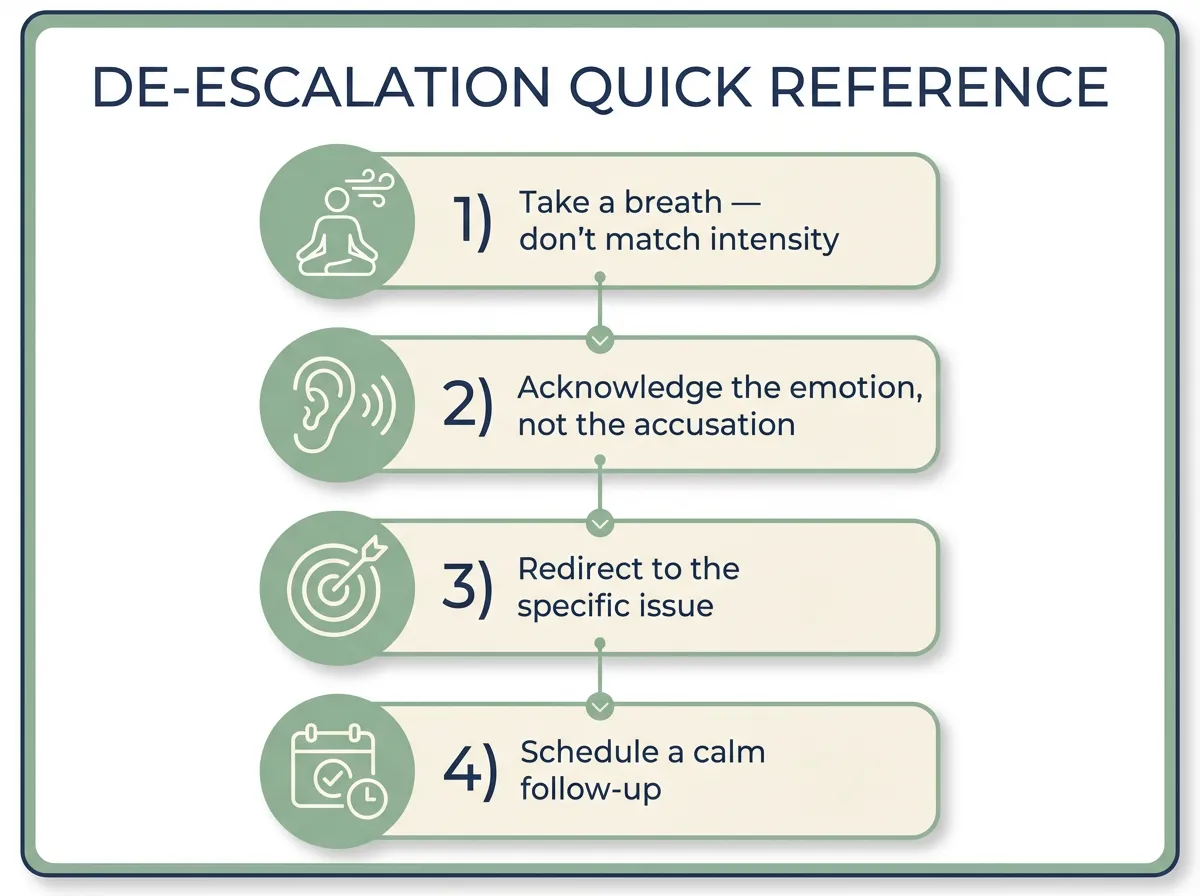
When your roommate begins ramping up — their voice gets louder, the accusations broaden, the language becomes absolute — do not match their intensity. Instead, use this three-step approach:
- Pause. Take a breath. Let their last statement hang in the air for two to three seconds. Silence is disarming.
- Acknowledge the emotion, not the accusation. Say something like: "I can see you're really frustrated about this."
- Redirect to the specific issue. Follow with: "I want to solve the actual problem. Can we focus on [the specific thing]?"
Example script:
Roommate: "You NEVER clean up after yourself. I'm basically your maid. I'm so sick of living like this." You: (pause) "I hear that you're frustrated about the kitchen. I want to figure this out. Can we talk specifically about what happened today?"
This does two things: it validates their emotion (which often defuses intensity) and it narrows the conversation from an existential crisis back to a solvable problem.
Tactic 2: The Broken Record
Escalators thrive on expanding the battlefield. They want to pull in past grievances, character judgments, and hypothetical future offenses. The broken record technique keeps you anchored:
Pick one calm, clear statement and repeat it — gently but firmly — no matter where they try to steer the conversation.
"I understand there are other things we need to discuss. Right now, I'd like to focus on the noise issue after 11 p.m."
Say it once. If they pivot, say it again. You're not being dismissive — you're refusing to let a solvable problem become an unsolvable argument about everything.
Tactic 3: Schedule the Conversation
Escalators often ambush. They catch you when you're walking in the door, getting ready for bed, or in the middle of something. This is not the time to have a productive conversation, and you're allowed to say so.
Script:
"I can tell this is important to you, and I want to give it my full attention. Can we sit down and talk about it tomorrow at [specific time]?"
This isn't avoidance — it's strategic timing. Scheduled conversations give both parties time to cool down and come prepared, which dramatically reduces the chance of escalation.
Tactic 4: Name the Pattern (Carefully)
If escalation is happening repeatedly, there's a time and place to address the pattern itself — but only during a calm moment, never during a conflict. Choose a neutral time and use "I" language.
Script:
"Hey, I want to talk about how we handle disagreements. I've noticed that when something comes up, it tends to get really intense really fast, and that makes it hard for me to problem-solve. I'd like us to find a way to bring stuff up before it reaches that point. What do you think?"
Notice what this script doesn't do: it doesn't label them as "the problem." It frames escalation as a shared dynamic you'd both benefit from changing.
Setting Boundaries with a Roommate Who Escalates
De-escalation is about handling conflicts in the moment. Boundaries are about preventing the pattern from consuming your life.
Boundary 1: You Don't Have to Engage on Demand
You are allowed to say:
- "I'm not in a place to have this conversation right now."
- "I'll talk about this when we're both calm."
- "I'm going to step away for a bit. I'm not ignoring this — I just need some space."
An escalator may interpret disengagement as rejection or avoidance. That's why it's important to name what you're doing and why. You're not leaving the conflict — you're leaving the escalation.
Boundary 2: Put Agreements in Writing
Verbal agreements are fertile ground for escalation. A week later, your roommate remembers the conversation differently, and now you're arguing about what was actually agreed upon.
Written agreements eliminate this entirely. They don't have to be formal or legalistic — even a shared Google Doc or a message thread titled "House Agreements" works. Cover the recurring friction points:
- Quiet hours
- Cleaning responsibilities and schedule
- Guest policies
- Shared expenses and due dates
- How you'll raise concerns (e.g., text first, then discuss in person)
Tools like Servanda can help roommates create structured written agreements that both parties formally acknowledge, which provides a neutral reference point when memories and emotions diverge.
Boundary 3: Define Your Non-Negotiables
Some boundaries aren't up for discussion. Be clear — with yourself first, and then with your roommate — about what you will and won't tolerate:
- Yelling or name-calling: "I won't continue a conversation where I'm being yelled at. I'll come back when things are calmer."
- Involving others without consent: "I'm not okay with our disagreements being shared with [mutual friend/social media]. This stays between us."
- Retaliation: "If we disagree about chores, the solution isn't to stop doing yours. Let's find something that actually works."
State these boundaries once, clearly, and then enforce them with action, not repeated warnings. If you said you'd walk away from yelling, walk away from yelling. Every time.
When It's More Than Just Escalation
There's an important line between a roommate who's difficult and a roommate who's unsafe. Escalation crosses into dangerous territory when it includes:
- Threats — direct or implied — to your safety, belongings, or housing
- Property destruction — punching walls, breaking your things, slamming doors hard enough to damage them
- Intimidation — blocking doorways, invading personal space, using their physical size to frighten you
- Harassment — repeated hostile behavior after you've clearly asked for it to stop
If any of these are present, this is no longer a conflict resolution situation. Contact your landlord or housing office, document everything in writing, and reach out to a local tenant rights organization or, if you feel unsafe, law enforcement. Your lease is not worth your safety.
Building a Long-Term System That Prevents Escalation
Once you've navigated the immediate crisis, the goal is to build a living situation where escalation has less oxygen. Here's a framework:
- Weekly five-minute check-ins. Pick a regular time — Sunday evenings, for example — to briefly ask each other: "Anything bugging you this week?" Small irritations addressed early never become explosions.
- A shared "raise it within 48 hours" rule. If something bothers you, bring it up within two days. No more stockpiling grievances for a future detonation.
- A cool-down protocol. Agree in advance: if either person says "I need 20 minutes," the conversation pauses. No exceptions, no guilt.
- Revisit agreements quarterly. What worked in September might not work in January. Scheduled reviews normalize renegotiation and prevent resentment.
This system works because it replaces reactive conflict with proactive maintenance. It's less dramatic, and that's exactly the point.
Frequently Asked Questions
How do I tell my roommate they're being too aggressive without starting another fight?
Timing is everything. Bring it up during a calm, neutral moment — not in the heat of an argument. Use "I" statements that focus on your experience rather than their character: "I feel anxious when disagreements get really intense, and I'd like us to find a calmer way to work through things." Framing it as a shared goal rather than a personal accusation significantly reduces defensiveness.
What if my roommate refuses to calm down or follow any boundaries I set?
If your roommate consistently ignores your stated boundaries, you may need to involve a third party — a mutual friend, an RA if you're in campus housing, or a mediator. Document the pattern by keeping a simple log of incidents with dates. If the behavior is severe enough, this documentation will also support you if you need to approach your landlord about breaking your lease.
Is it ever okay to just avoid my roommate instead of confronting them?
Strategic avoidance during heated moments is healthy — that's disengagement, not avoidance. But long-term avoidance where you're rearranging your entire life to dodge another person in your own home is unsustainable and a sign the situation needs intervention. If you find yourself timing your showers, meals, and comings and goings around your roommate's schedule, it's time to either address the dynamic directly or explore other living arrangements.
Can a roommate agreement actually prevent escalation?
A written agreement won't change someone's personality, but it removes one of escalation's biggest fuel sources: ambiguity. When expectations are documented and mutually agreed upon, there's far less room for the "you never said that" arguments that escalators thrive on. The most effective agreements include not just rules but a process for how disputes will be handled.
When should I consider moving out instead of trying to fix the relationship?
Consider it seriously if: you've consistently applied de-escalation strategies and set clear boundaries with no improvement; the escalation includes any form of intimidation or threats; your mental or physical health is suffering; or you dread coming home on a regular basis. Sometimes the healthiest resolution is recognizing that two people simply aren't compatible as roommates, and that's not a failure.
Moving Forward
Living with a roommate who escalates everything is exhausting — but it's not something you have to simply endure. By understanding the pattern behind the behavior, using targeted de-escalation scripts, and setting firm boundaries backed by written agreements, you reclaim agency in your own home.
Remember: you're not responsible for managing another adult's emotions. You are responsible for protecting your own well-being and responding in ways you can feel good about later. Start with one tactic from this article — the pause-and-redirect, the scheduled conversation, or the weekly check-in — and build from there. Small, consistent shifts in how you respond to escalation can fundamentally change the dynamic of your living situation, even if your roommate never reads a single word of this article.