
How to Have the Cofounder Prenup Talk Early
You've found someone who shares your vision. You're finishing each other's sentences about the product, the market, the future. Everything feels electric — like you've found the business equivalent of a soulmate.
And that's exactly when you need to have the awkward conversation.
Not six months from now, when a paying customer changes the power dynamics. Not after your first funding round, when a lawyer forces the issue. Right now — while the relationship is good and the stakes feel low.
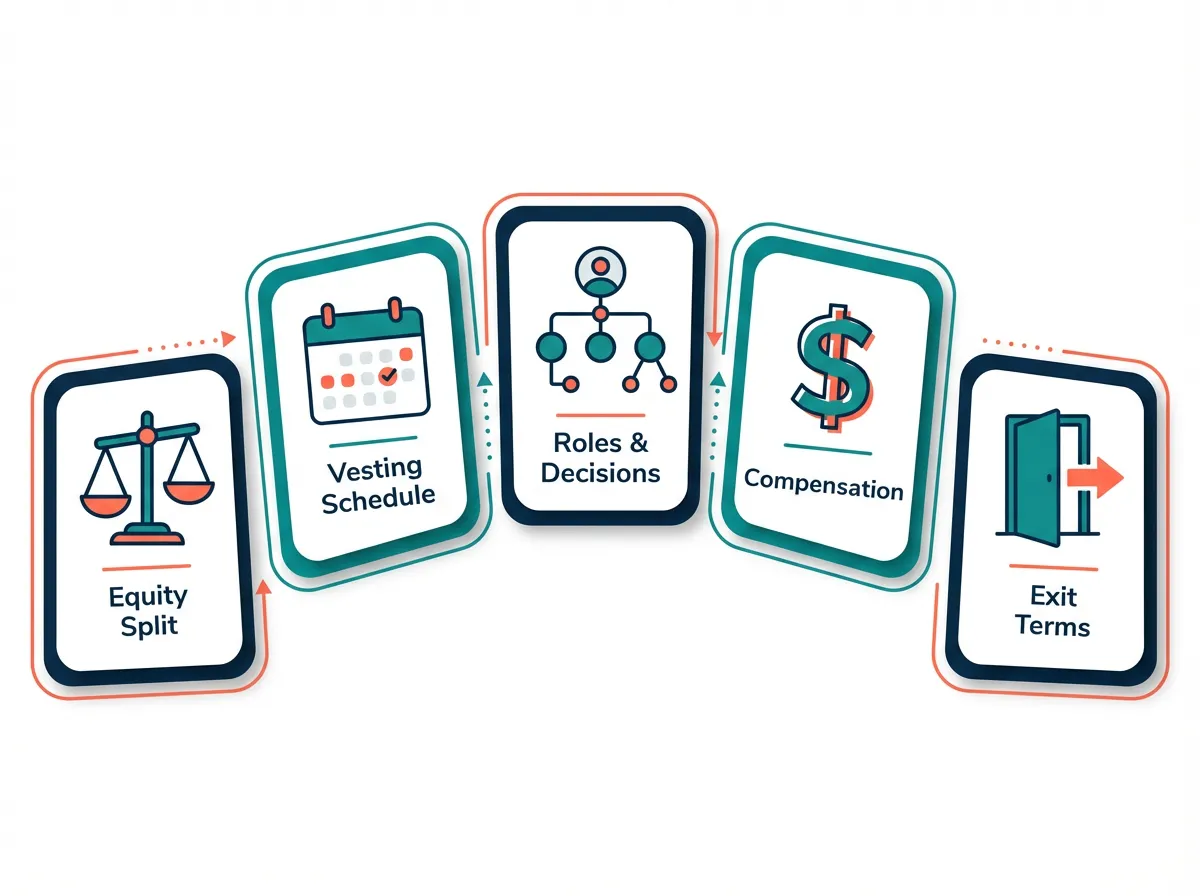
We're talking about the cofounder prenup talk: the upfront discussion about equity splits, vesting schedules, role definitions, decision-making authority, and what happens if someone wants out. It's the conversation most founders skip because it feels premature, distrustful, or just plain uncomfortable. And it's the single most important conversation you'll have for the survival of your company.
Key Takeaways
- The best time for the cofounder prenup talk is before you write a single line of code or spend a single dollar together — not after conflict arises.
- Equity, vesting, roles, decision-making, and exit terms are the five non-negotiable topics every founding team must address in writing.
- Framing the conversation as "building infrastructure" rather than "planning for failure" removes the emotional sting and makes both parties more willing to engage honestly.
- You don't need a $30,000 lawyer to start — structured templates, AI-assisted tools, and honest 90-minute conversations can get you 80% of the way there.
- Revisiting your cofounder agreement every 6–12 months is just as important as creating one in the first place.

Why Most Cofounders Avoid the Hard Talk
Let's be honest about why this conversation doesn't happen.
It's not ignorance. Most founders know they should discuss equity and roles upfront. They've read the horror stories. They've heard the advice.
They skip it anyway because of three emotional traps:
1. The Honeymoon Bias
Early-stage cofounding relationships run on optimism. Bringing up worst-case scenarios feels like introducing doubt into a moment that should be pure excitement. You worry it'll signal that you don't trust your cofounder — or worse, that you're already planning your exit.
2. The Fairness Illusion
"We'll figure it out as we go" sounds reasonable. It feels egalitarian. But "figuring it out later" almost always means figuring it out when there's money on the table, when contributions feel unequal, and when both parties have a revisionist memory of who promised what.
3. The Imposter Fear
Asking for a formal agreement can feel presumptuous when you haven't built anything yet. "Who are we to need a legal document? We're two people with a Google Doc and an idea." But that's exactly the point — you're defining the relationship before complexity makes it harder.
Here's the reframe that changes everything: a cofounder prenup isn't a plan for failure. It's proof that you take the partnership seriously enough to protect it.
The Five Non-Negotiable Topics in Every Cofounder Prenup Talk
You don't need to cover every edge case in your first conversation. But you do need to address these five areas before you formalize anything — an LLC, a handshake deal, or even a shared bank account.
Topic 1: Equity Split — and the Logic Behind It
The 50/50 split is the default because it avoids confrontation. It's also the source of more cofounder resentment than almost anything else.
Equity should reflect a combination of factors:
- Who originated the idea (and how much that matters going forward)
- Who's going full-time vs. part-time
- What each person is contributing — capital, technical skills, domain expertise, existing relationships
- Who's taking more financial risk — quitting a job, investing savings, foregoing salary
The goal isn't to assign a precise dollar value to each contribution. It's to make the reasoning explicit so that neither cofounder feels shortchanged six months later.
Example: Two cofounders — call them Maya and Jordan — started a SaaS company. Maya was full-time and built the MVP. Jordan was part-time, contributing nights and weekends, but brought deep industry expertise and early customer intros. They initially agreed on 50/50. Eight months later, Maya resented the split because she was working 60-hour weeks while Jordan still had a day job. The argument wasn't really about the percentage — it was about the fact that they never articulated why 50/50 made sense or under what conditions it should be revisited.
A better approach: agree on an initial split and document the assumptions behind it. If those assumptions change (someone goes full-time, someone stops contributing), the split conversation reopens.
Topic 2: Vesting Schedules — Your Biggest Safety Net
If equity split is the what, vesting is the when. And it's arguably more important.
A standard vesting schedule is four years with a one-year cliff. This means:
- No equity is earned in the first 12 months (the cliff)
- After 12 months, 25% vests at once
- The remaining 75% vests monthly or quarterly over the next three years
Vesting protects both cofounders. If someone leaves after three months — because of a life change, a disagreement, or simple loss of interest — they don't walk away with 50% of a company they barely helped build.
This is not a trust issue. This is structural hygiene. Even Y Combinator requires vesting for all cofounders in their standard deal terms.
Topic 3: Roles, Responsibilities, and Decision-Making Authority
Early on, everyone does everything. That's fine. But you still need clarity on:
- Who has final say on product decisions?
- Who has final say on financial decisions?
- Who's the public face — the one talking to investors, press, customers?
- What happens when you fundamentally disagree on a strategic direction?
You don't need rigid job descriptions. You need a decision-making framework. Some founding teams use a simple rule: each cofounder has a "domain" where their word is final, with a predefined tiebreaker process (a trusted advisor, a board vote, or a structured mediation) for cross-domain disagreements.
Topic 4: Compensation and Financial Expectations
Money conversations get awkward fast, but unanswered questions fester:
- Are both cofounders taking the same salary (or no salary)?
- At what point do salaries kick in?
- If one cofounder is investing personal capital, how is that tracked — as a loan, as additional equity, or as a gift to the company?
- What's the monthly burn rate you're both comfortable with?
The number one source of early cofounder conflict isn't strategic disagreement — it's the feeling that one person is sacrificing more than the other without acknowledgment.
Topic 5: The Exit Conversation — What If Someone Wants Out?
This is the part that feels most like a prenup, and it's the part people resist most. But you need to answer:
- If one cofounder leaves voluntarily, what happens to their unvested equity? Their vested equity?
- If one cofounder needs to be removed (for cause), what's the process?
- Is there a buyback provision for vested shares?
- What constitutes "cause" for removal?
- If the company gets an acquisition offer, how do you decide whether to accept it?
These questions are straightforward when no one's angry. They become legal warfare when someone is.
How to Actually Start the Conversation: A Practical Script
Knowing what to discuss is one thing. Getting the words out is another. Here's a framework that founders have used successfully.
Step 1: Frame It as Building, Not Doubting
Don't say: "We need to talk about what happens if this doesn't work out."
Do say: "I'm excited about what we're building. I want to set up the right infrastructure so we can focus on the work and not worry about ambiguity. Can we block 90 minutes this week to get our operating agreement on paper?"
The language of infrastructure and operating agreement is neutral and forward-looking. It signals professionalism, not paranoia.
Step 2: Use a Structured Template
Don't try to have this conversation free-form over beers. Use a written framework. Many excellent open-source templates exist:
- The Founders' Agreement Canvas (inspired by the Business Model Canvas)
- Y Combinator's standard cofounder agreement terms
- Stripe Atlas's formation documents
Walking through a template together removes the feeling that one person is "demanding" terms from the other. You're both filling in blanks.

Step 3: Write It Down During the Conversation
Not after. During. Open a shared doc and capture decisions in real time. This prevents the "I thought we agreed on X" problem that plagues informal discussions.
Tools like Servanda can help cofounders create structured written agreements that capture these decisions clearly, reducing the risk of misremembered handshake deals turning into full-blown disputes months later.
Step 4: Agree on a Review Cadence
Your cofounder agreement isn't a one-time document. It's a living artifact. Set a recurring calendar event — every six months or after any major milestone (funding round, first hire, pivot) — to revisit the terms and make sure they still reflect reality.
What Happens When You Skip This Talk: Two Real Stories
The 50/50 That Became 100/0
Two college friends started a consumer app. Equal equity, no vesting, no written agreement. One cofounder gradually lost interest and started freelancing on the side. By the time the other cofounder landed a $500K seed round, the disengaged cofounder owned 50% of a company he'd barely touched in six months. The investor walked away. The remaining cofounder spent eight months and $40,000 in legal fees negotiating a buyout from someone who'd been his best friend.
The Role Confusion That Killed a Series A
Two cofounders — one technical, one business — never formalized who owned the investor relationship. Both started having separate, contradictory conversations with the same VC firm. The investors perceived it as dysfunction (because it was) and passed. The company survived, but the cofounders' relationship didn't.
Neither of these outcomes was inevitable. A 90-minute conversation at the beginning could have prevented both.
A Quick-Reference Checklist for Your Cofounder Prenup Talk
Bring this list to your first formal conversation:
- [ ] Equity split with documented reasoning
- [ ] Vesting schedule (4-year/1-year cliff is standard)
- [ ] Full-time vs. part-time expectations and timeline
- [ ] Role definitions and decision-making authority
- [ ] Salary/compensation expectations and timeline
- [ ] IP assignment (all work product belongs to the company)
- [ ] What happens if a cofounder leaves voluntarily
- [ ] What happens if a cofounder is removed for cause
- [ ] How strategic disagreements are resolved
- [ ] Review cadence for the agreement itself
FAQ
Is a cofounder agreement the same as an operating agreement?
Not exactly. An operating agreement is a legal document required for LLCs that governs the company's structure. A cofounder agreement is broader — it covers the interpersonal and operational terms between founders, including equity, roles, and exit provisions. In practice, the best approach is to incorporate your cofounder terms into your operating agreement so everything lives in one enforceable document.
When is it too late to have the cofounder prenup talk?
It's never truly too late, but it gets exponentially harder once money, employees, or investors are involved. The ideal window is before you incorporate or sign any formal partnership. If you've already started operating without an agreement, have the conversation this week — don't wait for a conflict to force it.
Do we need a lawyer for a cofounder agreement?
For the conversation, no. You can and should have the discussion yourselves using structured templates. For the final document, it's wise to have a startup attorney review it — especially if significant equity, IP, or capital is involved. Many startup lawyers offer flat-rate packages for founder agreements that cost far less than you'd expect.
What if my cofounder gets offended when I bring this up?
This is a common fear, and it's worth naming directly. If your cofounder sees a request for clarity and structure as an insult, that's actually important information about how they handle difficult conversations — something you'll face hundreds of times as you build a company together. Most cofounders, when approached thoughtfully, are relieved someone brought it up.
Can we change the cofounder agreement later?
Absolutely — and you should expect to. Your agreement should include a provision for how amendments are made (typically requiring written consent from all parties). Life changes, roles evolve, and companies pivot. The document should evolve with them.
Conclusion
The cofounder prenup talk isn't a sign that something is wrong. It's a sign that you're building something you care about enough to protect.
Every difficult conversation you have now — about equity, about roles, about what happens if things change — is a future crisis you won't have to endure. The founders who thrive long-term aren't the ones who never disagree. They're the ones who built the scaffolding to handle disagreement before the building was on fire.
Block 90 minutes. Open a shared document. Walk through the checklist in this article. You'll leave that conversation feeling closer to your cofounder, not further apart — because nothing builds trust quite like the willingness to say, "Let's talk about the hard stuff while it's still easy."
Your future selves will thank you.