
How to Respond When Your Co-Parent Won't Cooperate
You've read the co-parenting books. You've tried the calm texts, the compromises, the "let's focus on the kids" conversations. You've bent over backward to make this work.
And your co-parent still ignores your messages, breaks every agreement, or responds to a simple scheduling question with a wall of hostility.
Here's the reality most co-parenting advice won't tell you: cooperation requires two people. When your co-parent won't cooperate, the standard playbook — communicate more, be flexible, find common ground — can actually make things worse. It can leave you drained, resentful, and stuck in a cycle where your goodwill gets exploited.
This article is for the parent who's already trying. You don't need a lecture on being the bigger person. You need strategies that work when only one side shows up.
Key Takeaways
- Stop trying to fix the relationship — focus on protecting the structure. When cooperation isn't possible, shift from co-parenting to parallel parenting with clear boundaries.
- Document everything in writing. Written communication isn't petty — it's your most powerful tool for accountability and legal protection.
- Use the BIFF method for hostile messages. Keep responses Brief, Informative, Friendly, and Firm to de-escalate without engaging in conflict.
- Distinguish between inconvenient and harmful behavior. Not every frustrating choice is worth a battle — save your energy for issues that directly affect your children's safety and well-being.
- Build your support system before you hit a crisis. A therapist, a family law attorney, and a structured communication tool can prevent small conflicts from becoming emergencies.

Understanding Why Your Co-Parent Won't Cooperate
Before you can respond effectively, it helps to understand what you're dealing with. Uncooperative co-parents generally fall into a few patterns, and each one calls for a different approach.
The Stonewaller
This co-parent simply doesn't respond. Texts go unanswered. Emails sit unread. Requests for schedule changes disappear into a void. The silence isn't always malicious — sometimes it's avoidance, overwhelm, or a passive way of maintaining control — but the effect on you is the same: you can't plan, you can't coordinate, and you're left carrying the full mental load of parenting logistics.
The Rule-Breaker
This co-parent agrees to things and then does the opposite. They return the kids late. They ignore dietary restrictions. They make unilateral decisions about school or medical care. Each individual violation might seem minor, but the pattern erodes trust and creates chaos for your children.
The Escalator
Every interaction becomes a fight. A question about soccer practice turns into a re-litigation of your entire relationship. This co-parent uses conflict as a communication style, and engaging with them on their terms leaves you emotionally exhausted and no closer to a resolution.
The Underminer
This co-parent cooperates on the surface but subtly sabotages things behind the scenes — badmouthing you to the kids, "forgetting" to pass along important information, or scheduling fun activities during your parenting time.
Recognizing the pattern helps you choose the right strategy. You wouldn't treat a silent treatment the same way you'd treat open hostility.
Shift from Co-Parenting to Parallel Parenting
This is the single most important mindset shift for dealing with an uncooperative co-parent: you may need to stop co-parenting and start parallel parenting.
Traditional co-parenting assumes both parents can communicate, negotiate, and make joint decisions. Parallel parenting acknowledges that this isn't always possible — and that's okay.
In a parallel parenting arrangement:
- Each parent makes day-to-day decisions independently during their own parenting time
- Communication is limited to essential logistics (schedules, medical needs, school information)
- Interactions are structured, brief, and preferably in writing
- You disengage from trying to control or influence what happens in the other household (unless safety is at stake)
This isn't giving up. It's being honest about what's possible and protecting your children from ongoing parental conflict — which research consistently shows is more damaging to kids than divorce itself.
Example: Jenna spent two years trying to coordinate bedtimes, homework routines, and screen time rules with her ex, who ignored every conversation. She was exhausted and resentful. When she shifted to parallel parenting — focusing only on her own household and communicating only about logistics — her stress dropped dramatically, and her kids actually became calmer because they stopped witnessing constant tension between their parents.

Set Boundaries That Don't Depend on Their Cooperation
The biggest trap for cooperative co-parents is setting boundaries that require the other person to change. If your boundary is "I need you to respond to my texts within 24 hours," you've handed control of your emotional state to someone who has already shown they won't comply.
Effective boundaries are about what you will do, not what they must do.
Examples of Boundaries You Can Actually Enforce
| Instead of this... | Try this... |
|---|---|
| "You need to stop yelling at me during pick-ups." | "I will end any conversation that includes yelling. I'll walk away and follow up in writing." |
| "You need to answer my texts about the schedule." | "I'll send schedule requests in writing with a 48-hour deadline. If I don't hear back, I'll proceed with the existing plan and document that I made the attempt." |
| "You can't keep changing plans last minute." | "I'll follow the parenting plan as written. If changes aren't agreed to in writing 24 hours in advance, I'll stick to the original schedule." |
| "Stop talking badly about me to the kids." | "I'll create a safe space for my kids to process their feelings without interrogating them, and I'll document concerning statements for my attorney." |
Notice the pattern: every boundary is something you control. You can't make your co-parent cooperate, but you can decide how you'll respond when they don't.
Master the BIFF Method for Hostile Communication
When your co-parent sends an inflammatory message — blaming, attacking, distorting the truth — your gut reaction is to defend yourself, correct the record, or fire back. Don't.
The BIFF method, developed by high-conflict communication expert Bill Eddy, is a framework that keeps you out of the weeds:
- Brief: Keep it short. One paragraph max. Long responses give the other person more ammunition.
- Informative: Stick to facts and logistics. No opinions, no emotions, no history lessons.
- Friendly: A neutral or mildly warm tone. Not sarcastic, not cold. Just human.
- Firm: End the conversation. Don't leave openings for debate.
Real-World Example
Their message: "You're always trying to control everything. I'm taking the kids to my mom's this weekend and there's nothing you can do about it. You're a terrible co-parent and the kids are sick of your rules."
Your BIFF response: "Thanks for letting me know about your mom's. Per our agreement, this weekend is my parenting time. I'm happy to discuss a swap for another weekend — let me know what works. Hope you and the kids are doing well."
Notice what's missing: no defense against the personal attacks. No acknowledgment of the insults. No emotional reaction. You addressed the logistics and nothing else.
This isn't about being a pushover. It's about refusing to play a game you can't win.
Document Everything — Strategically, Not Obsessively
When your co-parent won't cooperate, documentation becomes your most important tool. But there's a difference between strategic documentation and anxious record-keeping that takes over your life.
What to Document
- Missed or late pick-ups/drop-offs — Date, time, how late, any communication around it
- Broken agreements — What was agreed, how it was violated, any impact on the children
- Hostile or threatening communication — Screenshots with timestamps
- Unilateral decisions — Medical, educational, or scheduling decisions made without your input when your agreement requires it
- Your own attempts to communicate — This proves you tried
What NOT to Document
- Every minor annoyance or parenting decision you disagree with
- Things you heard secondhand from the kids (unless it involves safety)
- Perceived slights or tonal issues that won't matter in court
Keep your documentation in one centralized place. AI-powered mediation platforms like Servanda can help you formalize agreements in writing, creating a clear record that holds both parents accountable — which matters enormously when one parent has a pattern of breaking commitments.
The "Would a Judge Care?" Test
Before you document something, ask: Would a family court judge consider this significant? If the answer is no, let it go. If yes, log it calmly and factually.
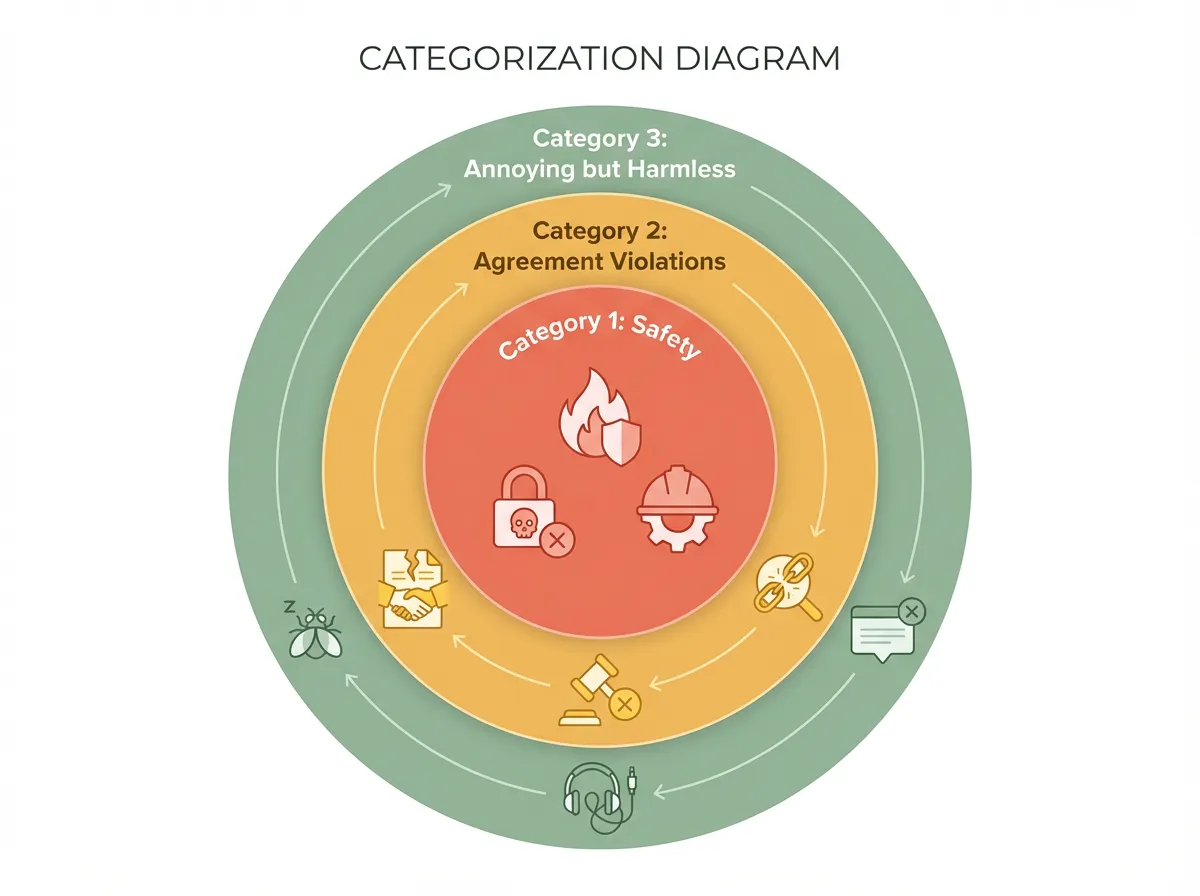
Pick Your Battles with the 3-Category Framework
When every interaction with your co-parent is difficult, it's easy to treat every issue as urgent. But fighting every battle burns you out and dilutes the impact of the fights that actually matter.
Sort issues into three categories:
Category 1: Safety and Well-Being (Act Immediately)
- Substance abuse around the children
- Physical or emotional abuse
- Neglect of basic needs (food, shelter, medical care)
- Exposure to dangerous situations or people
Response: Document, contact your attorney, and if the children are in immediate danger, contact authorities. Do not wait.
Category 2: Agreement Violations (Document and Address)
- Consistently late for exchanges
- Missing scheduled parenting time
- Making decisions that require mutual agreement without consulting you
- Withholding information about the children's school or health
Response: Document the pattern. Send a brief written communication noting the violation. If the pattern continues, escalate through your attorney or mediator.
Category 3: Annoying but Harmless (Let It Go)
- Feeding the kids junk food
- Different bedtime routines
- Letting the kids watch a show you wouldn't choose
- A parenting style that's different from yours
Response: Take a breath. Unless it's affecting the children's health or safety, this falls under their household, their rules. Parallel parenting means accepting that you can't control everything.
Example: Marcus used to fight with his ex over everything — screen time, snack choices, how the kids wore their hair. When his therapist helped him sort issues into categories, he realized that 80% of their conflicts fell into Category 3. By letting those go, he had more energy and credibility when a real Category 2 issue arose (his ex repeatedly missing the kids' medical appointments).
Build Your Support System Before You Need It
Dealing with an uncooperative co-parent is a long game, not a single event. You need a team.
Your Support Team Checklist
- A family law attorney — Even if you're not in court, having one on retainer means you can get advice quickly when something escalates. Ask about a limited-scope arrangement if cost is a concern.
- A therapist who understands high-conflict co-parenting — Not a general couples therapist. Someone who specializes in post-separation dynamics and can help you maintain boundaries without becoming rigid or reactive.
- A trusted friend or family member — Someone you can vent to so that your children never become your sounding board.
- A parenting coordinator (if available in your jurisdiction) — A neutral third party who can make binding decisions on day-to-day disputes without going to court.
What About the Kids?
If your children are showing signs of stress — behavioral changes, sleep problems, reluctance to transition between homes, or comments that suggest they feel caught in the middle — consider connecting them with a child therapist. This isn't a sign of failure. It's a sign that you're paying attention.
What to Do When Nothing Seems to Work
Sometimes you do everything right and things still don't improve. The stonewalling continues. The agreements keep getting broken. The hostility doesn't let up.
Here's what to remember:
-
You're not failing. You cannot cooperate your way out of someone else's refusal to cooperate. That's not a personal shortcoming — it's a math problem.
-
Focus on what your children experience in your home. You can't control the other household, but you can make yours a place of stability, consistency, and calm. That matters more than you think.
-
Know when to go back to court. If your co-parent is consistently violating court orders, document the pattern and talk to your attorney. Courts take repeated violations seriously, especially when they affect the children.
-
Protect your own mental health. Co-parenting with an uncooperative person is one of the most stressful ongoing situations an adult can face. Treat your own well-being as a parenting priority, because it is one.
Frequently Asked Questions
How do I co-parent with someone who refuses to communicate?
Shift to parallel parenting and communicate only about essential logistics, always in writing. Give clear deadlines for responses (e.g., "Please confirm by Friday at noon") and follow the existing parenting plan if you don't hear back. You don't need their cooperation to be a great parent — you just need a clear structure.
Can I take my co-parent to court for not following our parenting plan?
Yes, if your co-parent is consistently violating a court-ordered parenting plan, you can file a motion for contempt or a modification. Courts generally want to see a documented pattern rather than a single incident. Keep thorough records and consult with a family law attorney about the strength of your case before filing.
Is parallel parenting the same as no contact?
No. Parallel parenting still involves communication — it's just minimal, structured, and focused entirely on the children's needs. You're not cutting the other parent out; you're removing the unnecessary friction points that create conflict. Think of it as a business relationship with very limited scope.
How do I stop my co-parent from badmouthing me to our kids?
You can't directly control what your co-parent says, but you can control how you respond. Don't interrogate your children or put them in the middle by asking them to report back. Instead, create a safe space where they can share their feelings. If the alienating behavior is severe and documented, discuss parental alienation remedies with your attorney.
What's the difference between a difficult co-parent and a high-conflict co-parent?
A difficult co-parent is frustrating but can occasionally be reasoned with — they may cooperate inconsistently or require extra effort. A high-conflict co-parent has a persistent pattern of hostility, blame, and refusal to cooperate regardless of your approach. With a truly high-conflict co-parent, standard co-parenting strategies often backfire, and parallel parenting with firm boundaries is usually more effective.
Moving Forward When Only One Side Is Trying
Dealing with an uncooperative co-parent isn't something you can fix with a single conversation or a perfect text message. It's an ongoing practice of setting boundaries, protecting your energy, and staying focused on what your children need from you.
The strategies in this article — parallel parenting, the BIFF method, strategic documentation, and the 3-category framework — won't change your co-parent's behavior. But they will change how much power that behavior has over your life.
You don't need your co-parent's cooperation to give your children stability. You don't need their approval to set boundaries. And you certainly don't need their permission to stop participating in a dynamic that's hurting everyone.
Start with one thing today: the next time a hostile message lands in your inbox, try a BIFF response. See what happens when you refuse to take the bait. That small shift can change everything.