
How to Set Boundaries With Your Co-Parent
Key Takeaways
- Boundaries aren't walls — they're agreements that protect your emotional well-being and your child's stability. They reduce conflict over time, not increase it.
- Start with the boundaries that cause the most friction first — like unexpected schedule changes, unilateral parenting decisions, or emotionally charged messaging — and define clear, specific expectations around each.
- Communicate boundaries in writing using neutral, child-focused language. Verbal agreements are easily forgotten or reinterpreted under stress.
- Consistency is what makes boundaries work. Enforcing them calmly and repeatedly teaches your co-parent what to expect — and what you will and won't engage with.
- You can only control your side of the boundary. Focus on your own responses and actions rather than trying to change your co-parent's behavior.
Introduction
It's 9:47 on a Tuesday night. You're finally sitting down after getting the kids to bed when your phone lights up: your co-parent wants to swap weekends — again — and needs an answer "ASAP." Last week it was a unilateral decision about signing your daughter up for a new activity. The week before, a string of texts that started about pickup logistics and ended somewhere deeply personal.
Each incident feels small on its own. But stacked together, they leave you drained, resentful, and like the ground rules of your co-parenting relationship are being rewritten without your input.
If this sounds familiar, you're not alone — and you're not being "difficult" for wanting it to change. Learning how to set boundaries with your co-parent is one of the most constructive, child-centered things you can do after a separation. It doesn't require your co-parent's permission. It doesn't mean starting a fight. And when done well, it actually makes co-parenting easier for everyone — including your kids.
Here's how to do it, step by step.

Why Boundaries Matter in Co-Parenting
There's a common misconception that setting boundaries with a co-parent is adversarial — that you're drawing battle lines. In reality, the opposite is true. Research on post-separation parenting consistently shows that clear expectations reduce conflict, while ambiguity fuels it.
Think about it this way: when neither co-parent knows where the lines are, every interaction becomes a negotiation. Every text is an opening for misunderstanding. Every schedule change becomes a power struggle.
Boundaries replace that chaos with predictability. They answer questions before they become arguments:
- When and how will we communicate?
- Who makes which decisions?
- What happens when the schedule needs to change?
- What topics are on the table, and what's off-limits?
When both parents know the answers, there's less friction — not more. And less friction between parents means a calmer, more secure environment for your children.
What Boundaries Are (and What They're Not)
Let's clear up what we mean by "boundaries" in a co-parenting context:
Boundaries are: - Clearly stated expectations about how you will interact - Limits on what you will and won't engage with - Decisions about your own behavior and responses - Protective of your time, emotional health, and parenting role
Boundaries are not: - Punishments or ultimatums - Attempts to control your co-parent's life outside of shared parenting - Tools for winning arguments - Set in stone forever — they can evolve as your situation changes
The distinction matters. A boundary sounds like: "I'll respond to non-emergency messages within 24 hours during business days." A power play sounds like: "I'm not going to answer you anymore." Same topic. Entirely different energy.
How to Identify Which Boundaries You Need
Before you set a single boundary, it helps to get specific about where things are actually breaking down. Vague frustration ("they never respect me") is hard to act on. Specific patterns are not.
The Boundary Audit
Spend a few days paying attention to the moments that spike your stress. Write them down — not to build a case, but to find patterns. Common areas where co-parenting boundaries are needed include:
- Schedule and logistics: Last-minute changes, late pickups/drop-offs, unilateral vacation planning
- Communication: Texts at all hours, personal or emotionally charged messages, excessive contact frequency
- Parenting decisions: Making decisions without consultation (school changes, medical decisions, extracurriculars)
- New partners: Introducing new relationships to children, involving new partners in co-parenting decisions
- Financial: Unexpected expenses, unilateral spending decisions that affect both households
- Personal life: Questions or comments about your dating life, living situation, or personal choices
Once you can see the patterns, you can prioritize. You don't need to address everything at once. Start with the one or two areas that cause the most recurring conflict.
A Step-by-Step Process to Set Boundaries With Your Co-Parent
Setting a boundary isn't a single conversation — it's a process. Here's how to approach it methodically.
Step 1: Get Clear on What You Need (Before You Communicate Anything)
Before you say a word to your co-parent, define the boundary for yourself. Be as specific as possible.
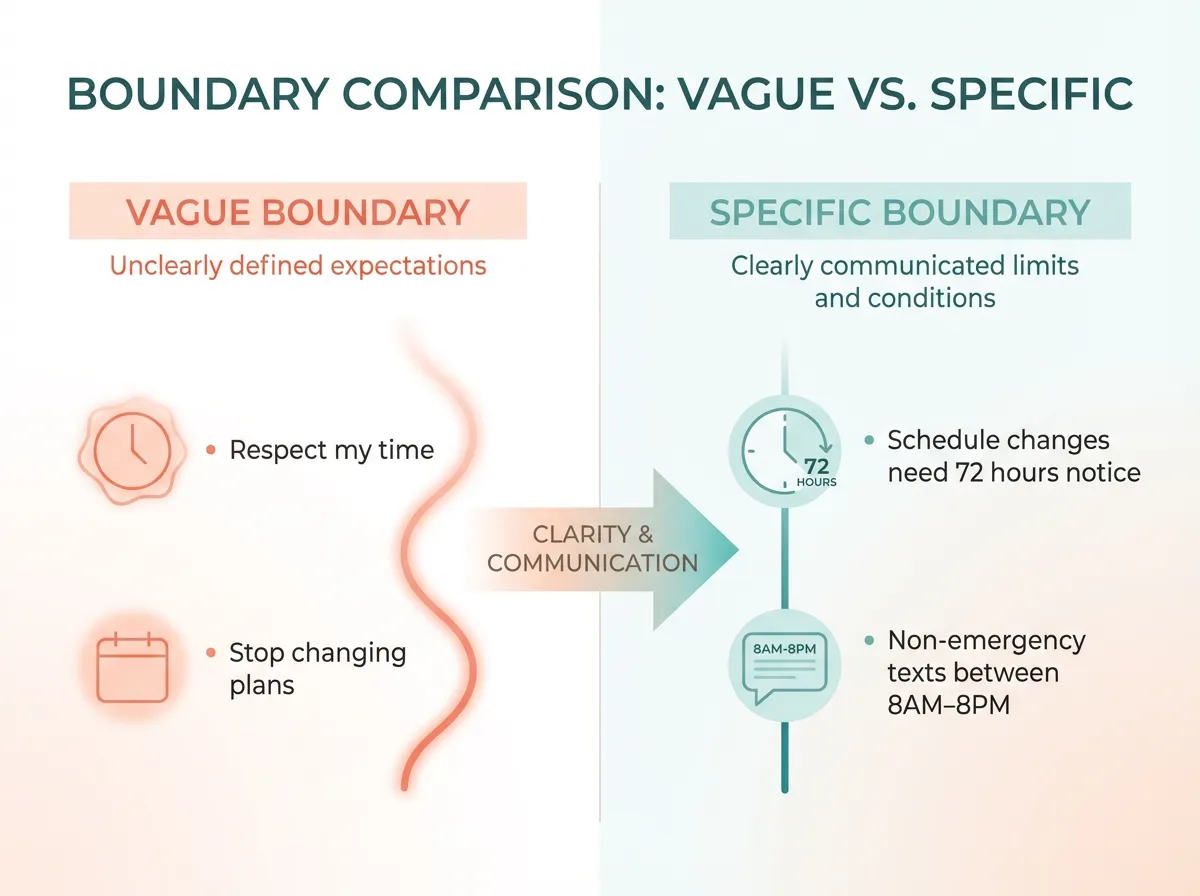
Vague: "I need you to respect my time."
Specific: "Schedule change requests need to be made at least 72 hours in advance, except in genuine emergencies. I'll respond to non-emergency texts within 24 hours, and I won't respond to messages sent after 9 PM until the following morning."
Specificity removes ambiguity. It also protects you — when the boundary is clear in your own mind, you'll know exactly when it's being crossed and exactly how to respond.
Step 2: Use Child-Centered Language
How you frame a boundary dramatically affects how it's received. Boundaries framed as personal attacks ("You always...") invite defensiveness. Boundaries framed around your child's well-being invite cooperation — or at least compliance.
Compare:
| Instead of this... | Try this... |
|---|---|
| "Stop texting me all night." | "So we're both rested for the kids, let's keep non-emergency texts to between 8 AM and 8 PM." |
| "You can't just change the schedule." | "The kids do better with consistency. Let's agree to 72 hours' notice for schedule changes." |
| "Don't make decisions without me." | "For decisions about school, health, and activities, let's agree to discuss and align before committing." |
This isn't about being fake or suppressing your real feelings. It's about choosing framing that actually gets you the result you want.
Step 3: Put It in Writing
Verbal agreements made during stressful times have a remarkably short shelf life. Writing boundaries down — whether in an email, a shared document, or a co-parenting app — creates a reference point that both parties can return to when emotions flare.
A written boundary might look like:
"Going forward, let's agree to the following: Non-emergency communication will happen via [app/email] between 8 AM and 8 PM on weekdays. Schedule change requests require 72 hours' notice. Decisions about [child's name]'s education, healthcare, and extracurricular commitments will be discussed between both of us before any commitments are made. If we can't agree, we'll use [mediation process] to resolve it."
Tools like Servanda can help co-parents formalize these kinds of written agreements, which is especially useful when you want a clear record that both parties can reference without relitigating old arguments.
Step 4: Define Your Own Response (Not Theirs)
This is the part that trips people up: you can only enforce the boundary on your side. You can't control whether your co-parent sends a 10 PM text. You can control whether you read it and respond that night.
For each boundary you set, decide in advance what your response will be when it's tested:
- Boundary: No non-emergency communication after 8 PM. Your response: Silence your notifications from your co-parent after 8 PM. Respond the next morning.
- Boundary: 72 hours' notice for schedule changes. Your response: If a non-emergency change is requested with less notice, decline with a simple, calm message: "I'm not able to accommodate that with this notice. Let's stick to the current schedule this time."
- Boundary: No discussion of personal/relationship topics. Your response: If the conversation veers personal, redirect once: "I'd like to keep our communication focused on [child's name]. Was there anything else about this weekend's plans?" If it continues, stop engaging.
Notice the pattern: no lectures, no explanations, no emotional engagement. Just the boundary, consistently applied.
Step 5: Expect Pushback — and Hold Steady
When you first set boundaries with a co-parent, things often get temporarily worse before they get better. This is normal, and it doesn't mean the boundaries are wrong.
Your co-parent may:
- Test the boundary to see if you'll enforce it
- Accuse you of being controlling or uncooperative
- Escalate emotionally to provoke a reaction
- Ignore the boundary entirely at first
Your job isn't to manage their reaction. It's to respond consistently, every single time. Consistency is what eventually teaches your co-parent that the boundary is real.
A helpful mantra: "I don't have to attend every argument I'm invited to."

Handling the Hardest Scenarios
When Your Co-Parent Refuses to Acknowledge Any Boundary
Some co-parents won't agree to your boundaries — and that's okay, because boundaries don't require the other person's agreement. If your co-parent repeatedly disregards reasonable boundaries around scheduling, decision-making, or communication, you have options:
- Document the pattern. Keep records of boundary violations — screenshots, logs, dates. This isn't about building ammunition; it's about having facts if you ever need them for mediation or legal proceedings.
- Use a structured communication platform. Moving communication to an app that logs everything (and limits the ability to delete messages) changes the dynamic significantly.
- Involve a mediator or parenting coordinator. When direct communication isn't working, a neutral third party can help establish and enforce agreements.
- Revisit your custody agreement. If boundaries are being violated in ways that affect your child's well-being or your legal rights, consult your family law attorney about modifying your order.
When Boundaries Feel Impossible Because of Guilt
Many co-parents — especially those who initiated the separation — struggle to set boundaries because they feel guilty. The internal narrative sounds like: "I already disrupted their life. I don't have the right to make demands."
Let's reframe: setting boundaries isn't making demands. It's creating the conditions for a co-parenting relationship that actually works long-term. You can't co-parent effectively if you're resentful, burned out, or constantly walking on eggshells. Your children benefit from two parents who are emotionally well — and that requires boundaries.
When Your Children Are Used to Cross Boundaries
Sometimes a co-parent will communicate schedule changes or parenting decisions through the children: "Tell your mom I'm picking you up Friday instead of Saturday" or "Ask your dad if you can stay an extra night."
This puts children in an unfair position. Address it directly:
"Let's make sure scheduling conversations happen between us directly, so [child's name] doesn't have to be the messenger. I know neither of us wants to put that on them."
If it continues, you can gently tell your child: "That's something Mom/Dad and I will figure out together. You don't need to worry about it."
Five Boundaries Every Co-Parent Should Consider
If you're not sure where to start, these five boundaries address the most common friction points:
-
Communication windows: Agree on acceptable hours and methods for non-emergency communication. Example: weekday texts/emails only between 8 AM–8 PM, with a 24-hour response expectation.
-
Schedule change protocol: Require a minimum notice period (48–72 hours) for non-emergency changes, with a clear process for requesting them.
-
Decision-making categories: Define which decisions require joint agreement (major medical, educational, religious) versus which can be made independently (daily routines, meals, age-appropriate bedtimes).
-
Conversation scope: Agree that communication stays focused on the children. Personal topics, past relationship grievances, and new partners are off the table unless both parties choose otherwise.
-
Transition protocols: Establish consistent pickup/drop-off times, locations, and expectations for when transitions happen (e.g., child is ready and packed 10 minutes before pickup, both parents stay in the car, etc.).
You don't need all five on day one. Pick the one that would make the biggest immediate difference and start there.
What to Do When You're the One Crossing Boundaries
Honesty moment: boundary-setting is a two-way process, and it's worth examining whether you might be crossing some of your co-parent's boundaries too.
Ask yourself:
- Do I send messages outside of agreed-upon hours?
- Do I make comments about their personal life or parenting style that aren't about our child's safety?
- Do I change plans without adequate notice?
- Do I involve our child in adult logistics or disagreements?
If the answer to any of these is yes, that's not a reason for shame — it's information. Modeling boundary respect is one of the most powerful things you can do to establish a healthier co-parenting dynamic. And it gives you significantly more credibility when you ask for the same in return.
Frequently Asked Questions
How do I set boundaries with a co-parent who gets angry every time I try?
Focus on written communication rather than verbal conversations, which tend to escalate faster. State the boundary once, clearly and in writing, then enforce it through your actions rather than repeated conversations about it. If anger escalates to harassment or threats, document everything and involve your attorney or a mediator.
Is it okay to set boundaries with a co-parent even if we don't have a formal custody agreement?
Absolutely. Boundaries are about how you interact — they don't require a legal document, although formalizing them can help. You can set expectations around communication, scheduling, and decision-making at any point. If your co-parent doesn't respect them, having those expectations documented can support you if you do pursue a formal agreement later.
What's the difference between setting a boundary and being controlling?
A boundary governs your own behavior and responses: what you'll engage with, when you'll respond, and how you'll handle specific situations. Control attempts to dictate someone else's behavior in areas that don't directly affect your child or your co-parenting arrangement. If your boundary focuses on protecting your peace and your child's stability — not on monitoring or restricting your co-parent's independent life — you're on the right track.
How long does it take for co-parenting boundaries to actually work?
Expect a testing period of several weeks to a few months. Most co-parents report that consistent enforcement — not repeated discussions about the boundary, but simply holding it — shifts the dynamic within one to three months. The key is not giving in during the pushback phase, which is when most people abandon their boundaries.
Can co-parenting boundaries actually improve our relationship over time?
Yes — and this is the part that surprises most people. When expectations are clear and consistently enforced, the number of conflicts drops significantly. Many co-parents find that boundaries actually create more goodwill over time because both parties know what to expect, interactions become less emotionally charged, and there are fewer opportunities for resentment to build.
Moving Forward
Setting boundaries with your co-parent isn't a one-time event — it's an ongoing practice that evolves as your children grow and your co-parenting relationship matures. Some boundaries you set today will need adjusting next year. New situations will require new agreements. That's completely normal.
What matters is the foundation you're building: a co-parenting relationship where both parents know the ground rules, your children aren't caught in the middle, and conflict doesn't dominate every interaction.
You don't need your co-parent to be on board with everything from day one. You just need to start — with one specific boundary, communicated clearly, enforced consistently. The rest will follow.
Your children don't need perfect co-parents. They need co-parents who are willing to do the steady, unglamorous work of building something functional. Boundaries are where that work begins.